-
-
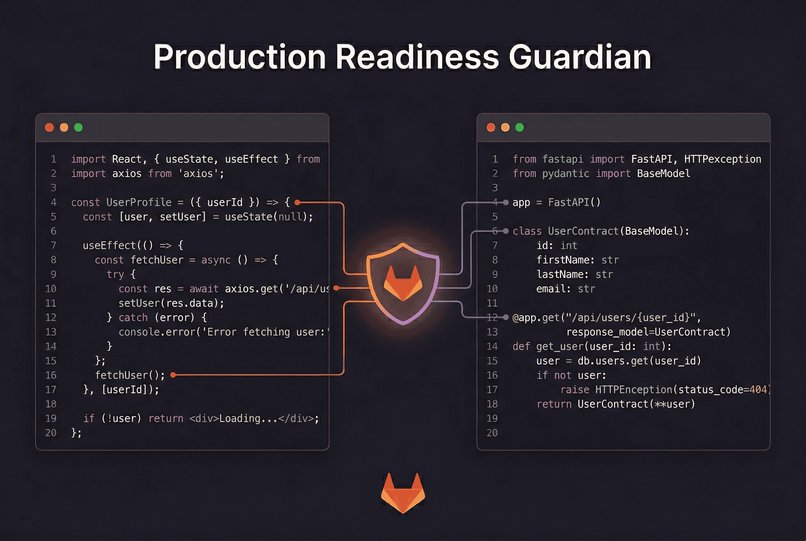
AI-powered frontend-backend contract validation for GitLab
Inspiration
We’ve all hit this fullstack pain point: a “simple” feature request touches backend routes, schemas, frontend API calls, TypeScript interfaces, and UI components across different folders and owners.
Manual tracing is slow, easy to skip, and hard to get right.
So code gets shipped, the MR looks fine, and then production fails on a silent contract mismatch:
Frontend sends:  { "username": "alice", "password": "s3cret" }
Backend expects: { "email": "...",      "password": "..." }
Result: 400 in production, zero warning during review.
Existing contract tools often require writing and maintaining contract files (high adoption friction), while many “auto-fix” tools overreach and patch high-risk issues that should stay human-reviewed (auth gaps, endpoint removals, architecture-level changes).
We built Production Readiness Guardian to solve both: contract validation inside the GitLab workflow, with safe, transparent auto-fixes that know their limits.
What It Does
Production Readiness Guardian is a Claude-powered agent system that covers the full frontend-backend contract lifecycle:
1) Pre-Code: Contract Advisor (Duo Chat Agent)
Before writing code, a developer asks:
analyze issue #15
The agent reads the issue and posts a Contract Impact Analysis directly on the issue:
- Current Contract: endpoints, fields, types, auth requirements
- Contract Impact:
CONTRACT BREAKvsCONTRACT UPDATE NEEDEDvsCHECK MANUALLY - Migration Checklist: ordered implementation steps (receiver before sender)
- Architecture Diagram: Mermaid contract chain
- Risk Assessment: LOW / MEDIUM / HIGH blast radius
2) Post-Code: Guardian Flow (5-Agent Pipeline)
When the MR is ready, five agents run in sequence:
$$ \text{Endpoint Validator} \rightarrow \text{Schema & Type Validator} \rightarrow \text{Breaking Change Detector} \rightarrow \text{Report Generator} \rightarrow \text{Auto Fixer} $$
Agent responsibilities
Endpoint Validator
Finds missing endpoints, method mismatches, missing auth, and unused routes.
Uses OpenAPI/Swagger/GraphQL as source of truth when present.Schema & Type Validator
Traces runtime origins (not just TS annotations).
Catches field mismatches, missing required fields, unguarded optional access.Breaking Change Detector
Reports only regressions introduced by the MR diff (not old debt).Report Generator
Deduplicates findings, posts structured MR report, creates issues for CRITICAL findings, and labels MR:
| Verdict | Condition | MR Label |
|---|---|---|
| BLOCKED | Any CRITICAL violation | contract-violation::critical |
| NEEDS ATTENTION | HIGH or MEDIUM only | contract-violation::warning |
| READY | LOW or none | contract-violation::ready |
- Auto Fixer
Applies fixes only for allowlisted safe categories:- Type mismatch
- HTTP method mismatch
- Field name mismatch
- Unguarded field access
- Missing required field
Auto-Fix Safety Model
Before touching files, the Auto Fixer runs guardrails:
- Repository-wide usage scan for target fields/endpoints
- Abort if referenced in scripts/CI/infra-sensitive locations
- Skip high-risk global keywords when:
$$ n > 50 $$
(where (n) = cross-directory matches)
- Refuse UI-destructive edits (e.g., conditional render block removal)
- If spec files exist, update spec + code atomically in one commit
- Deliver changes as a Draft MR, never direct blind merge
How We Built It
- Orchestration: GitLab Duo Workflow with explicit routing and context passing
- Pre-code advisor: standalone Duo Chat agent prompt
- Contract inference (no mandatory spec files):
- Backend routes/decorators
- Backend schemas/models
- Frontend API calls (
fetch,axios,ky) - Frontend types and component field usage
- Spec-aware mode: prioritize OpenAPI/Swagger/GraphQL when available
- Cross-framework design: structure-driven analysis, not framework-specific parser dependency
Demo Coverage
We built 3 demo stacks with pre-planted violations:
| Project | Stack | Violations |
|---|---|---|
| nextjs-fastapi-demo | Next.js + FastAPI | HTTP method mismatch, unguarded field access, removed response field |
| react-express-demo | React + Express | Type mismatch (URL param string vs expected number), missing authentication |
| vue-django-demo | Vue + Django REST | Field name mismatch (username → email), missing required field (user_id) |
Total issues: 7=5 (auto-fixable)+2 (manual)
Challenges We Ran Into
- Defining strict boundaries for what AI may auto-fix safely
- Preventing overconfident edits that should require human judgment
- Passing rich context across five agents while keeping reports deduplicated and actionable
- Reducing scope creep (no speculative findings, only real contract mismatches)
- Enforcing runtime type tracing over “trust the annotation” behavior
Accomplishments We’re Proud Of
- Pre-code impact prediction from issue text
- Zero-setup adoption on existing codebases
- Safe, explainable auto-fixes with explicit skips and reasons
- Spec-aware atomic updates (spec + implementation together)
- Cross-agent deduplication into one clear MR report
- Workflow-native behavior integrated into GitLab review lifecycle
What We Learned
- Chat-only AI is weak for cross-file contract reasoning without project context
- Prompt design is system design: constraints and safety rules define behavior
- The highest leverage moment is before code is written
- Structured output matters as much as reasoning: in multi-agent plain-text handoffs, downstream quality depends on upstream formatting precision. Poorly formatted findings in one agent can break later deduplication.
- Agentic systems need explicit limits; confidence without guardrails is dangerous
What’s Next
- Contract drift detection across MR history
- Multi-repo frontend/backend analysis
- Contract test generation from detected violations
- Broader backend/framework coverage (Go, Java, Rails, Laravel)
Built With
- claude
- django
- express.js
- fastapi
- gitlab-duo
- javascript
- mermaid
- node.js
- openapi
- python
- react
- swagger
- typescript
- vue.js
- yaml

Log in or sign up for Devpost to join the conversation.