🎬 Inspiration
Film and television productions operate under extreme daily financial risk. A major feature film burns $85,000 to $250,000+ USD per day in fixed overhead—paying for A-list cast, crew call times, equipment rentals, soundstages, location permits, and logistics.
When unexpected real-world disruptions strike—a lead actor falling ill, a primary 8K camera rig failing, bad weather washing out outdoor filming, or a key location permit being revoked—line producers are forced to make high-stakes decisions under immense time pressure.
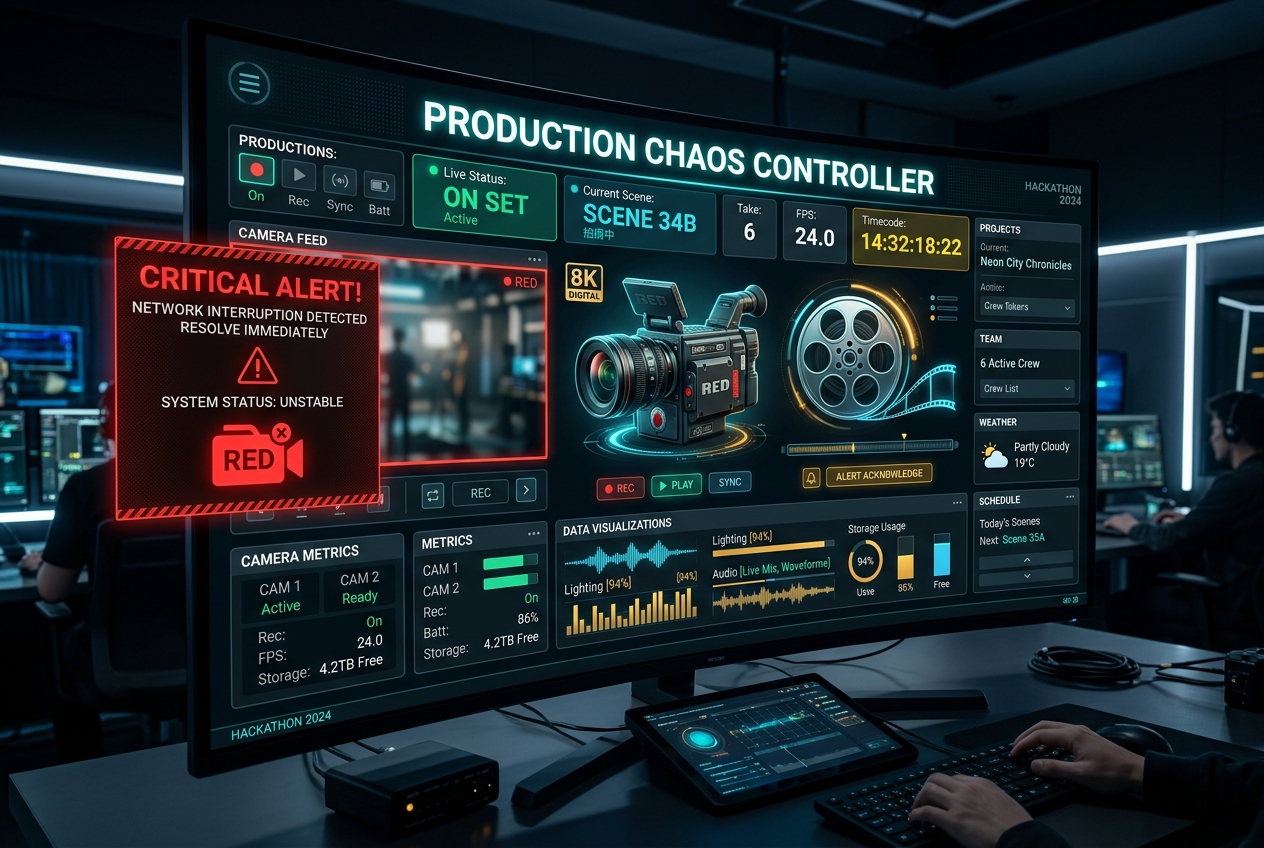
We were inspired to build Production Chaos Controller: an autonomous agentic AI system that instantly evaluates real-time disruption telemetry, builds dynamic resource dependency graphs, calculates deterministic financial & calendar impacts, and presents human-in-the-loop recovery plans for producer sign-off.
⚡ What It Does
Production Chaos Controller transforms chaotic film production emergencies into clear, optimized recovery decisions:
- 🎭 Actor Unavailability: Automatically detects actor absence and finds indoor cover set swaps ($0 day delay) or calculates calendar extension penalties.
- 🎥 Equipment Package Failure: Identifies broken camera/grip gear, checks compatibility, verifies crew authorization, and dispatches emergency hot-courier rentals.
- 🌧️ Weather Washout Protection: Monitors weather-vulnerable outdoor scenes (e.g. mountain summits) and shifts production to Stage 4 soundstages during rain or blizzards.
- ⚡ Multi-Disruption "Chaos Mode": Analyzes simultaneous compound disasters (e.g., Lead Actor Sick + Camera Failure + Heavy Rain on Day 6), resolves double-booking resource collisions, and outputs unified master recovery plans.
- 📊 ClickHouse Telemetry & MCP Integration: Queries high-throughput production data across 10
MergeTreetables and exposes an official Model Context Protocol (MCP) tool server (/api/v1/mcp/clickhouse). - 🛑 Human-in-the-Loop Sign-off: All AI recovery proposals default to
requires_human_approval: true, empowering line producers to Approve, Reject, or Modify plans.
📐 Impact Calculation Formula
The financial impact $I$ of any production disruption is computed dynamically as:
$$\text{Impact } (I) = \left( \Delta t \times \text{Daily Burn Rate} \right) + \sum_{i=1}^{n} \text{Expedite Cost}_i - \sum \text{Location Savings}$$
Where:
- $\Delta t$: Shooting calendar delay (in days)
- $\text{Daily Burn Rate}$: Fixed daily overhead (e.g. $\$85,000/\text{day}$)
- $\text{Expedite Cost}_i$: Emergency replacement rentals, couriers, or day-player hires
🛠️ How We Built It
- Backend Intelligence: Built with Python 3.12+ and FastAPI, integrated with Google Gemini 2.0 Flash SDK (
google-genai) for multi-step agent reasoning and recovery plan synthesis. - Analytics Database: Powered by ClickHouse (
clickhouse-connectSDK) with 10 optimizedMergeTreetables (scenes,schedules,actors,crew,equipment,locations,disruption_history, etc.) and zero-downtime fallback. - Protocol: Built a native Model Context Protocol (MCP) tool server (
/api/v1/mcp/clickhouse) allowing AI agents to query production metrics dynamically. - Frontend Dashboard: Built with Next.js 15 (App Router), TypeScript, and Tailwind CSS to render real-time dependency graphs, schedule comparisons, and producer approval workflows.
- Deployment: Hosted backend on FastAPI Cloud and frontend on Vercel.
🧠 What We Learned
- Agentic Resource Scheduling: Structuring complex dependencies into graph models allows LLMs to avoid resource allocation collisions (e.g., double-booking a soundstage).
- Deterministic AI Hybrid Architecture: Combining deterministic scheduling rules with Gemini 2.0 Flash reasoning yields fast, reliable, and halluncination-free financial recommendations.
- High-Throughput Production Analytics: Leveraging ClickHouse's column-oriented storage makes complex queries across historical film telemetry virtually instantaneous.
🔥 Challenges We Faced
- Simultaneous "Chaos Mode" Collisions: Resolving multiple compound disruptions required building a collision detection engine so independent recovery plans (e.g., moving to Stage 4) wouldn't conflict with existing schedules.
- Cross-Origin & Real-Time Telemetry: Integrating Gemini AI reasoning with live FastAPI endpoints required zero-latency state synchronization between frontend, backend, and database fallbacks.
🚀 What's Next
- Predictive Weather Integration: Real-time Doppler weather API feeds to automatically trigger cover-set shifts 48 hours before storms hit.
- Budget Software Connectors: Direct integration with industry-standard film budgeting tools like Movie Magic Budgeting and Gorilla Scheduling.
Built With
- ai-agents
- clickhouse
- fastapi
- fastapi-cloud
- google-gemini-2.0
- mcp
- model-context-protocol
- next.js
- production-management
- pydantic
- python
- react
- tailwind-css
- typescript
- uv
- vercel

Log in or sign up for Devpost to join the conversation.