-
-
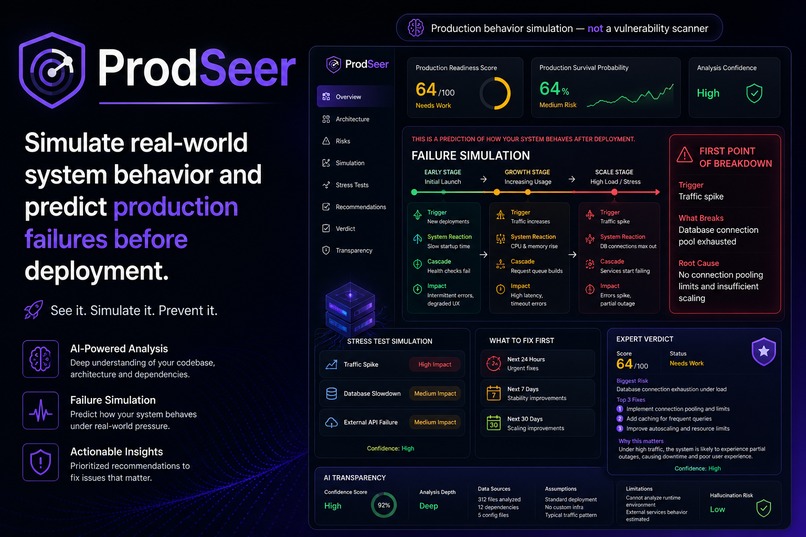
Product Description / Thumbnail
-
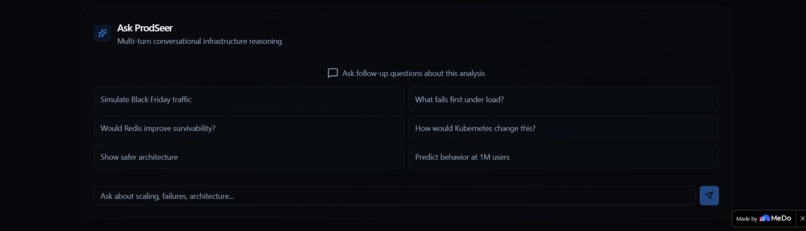
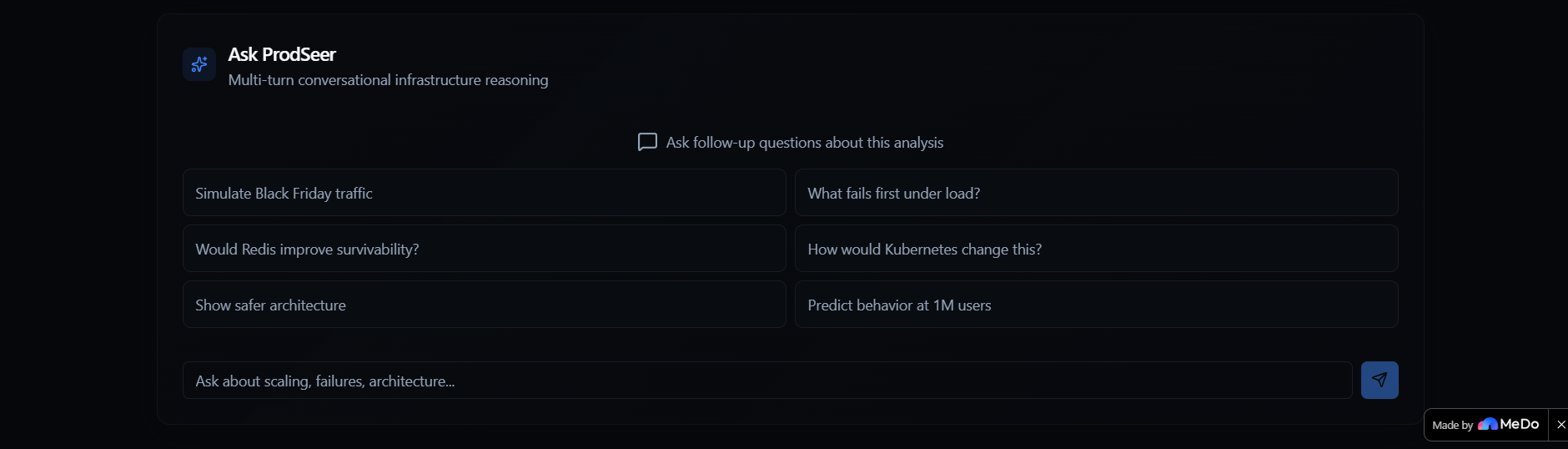
Ask_ProdSeer Multi Turn Conversational Reasoning Engine
-
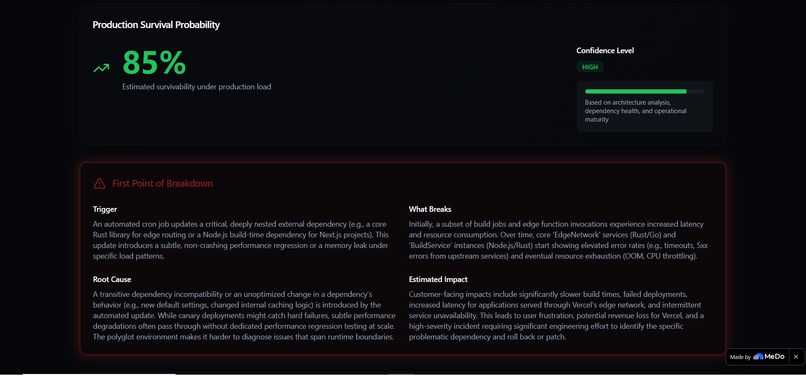
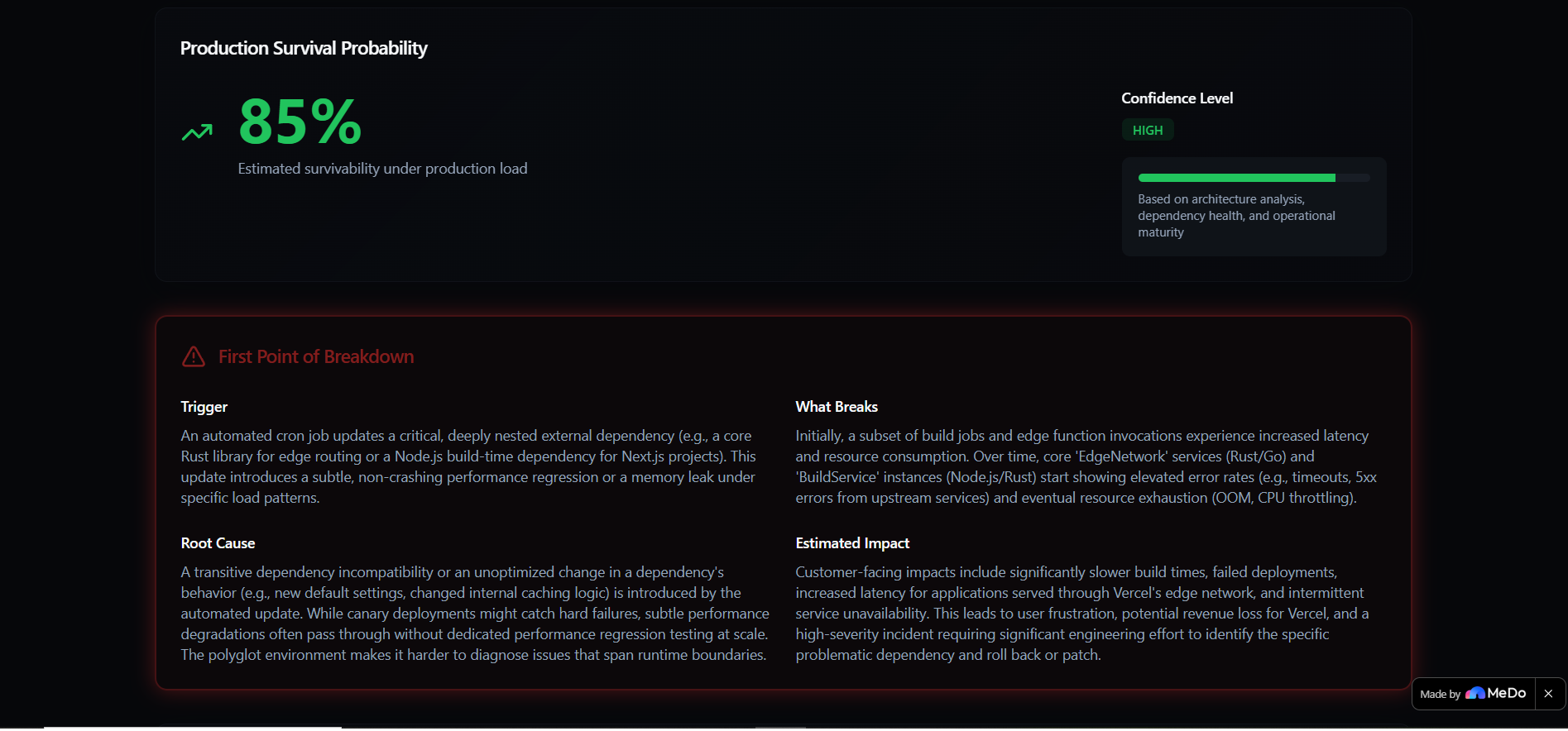
Analysis_Results_2_Prod_Survival_Probability
-
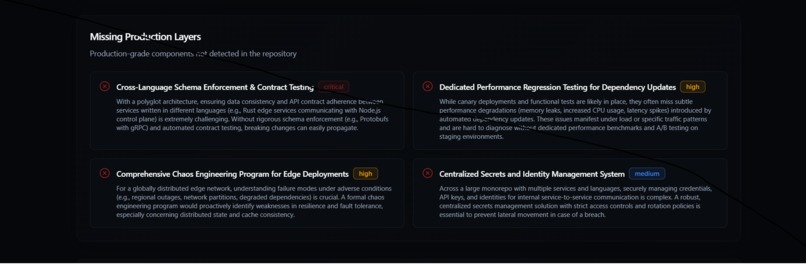
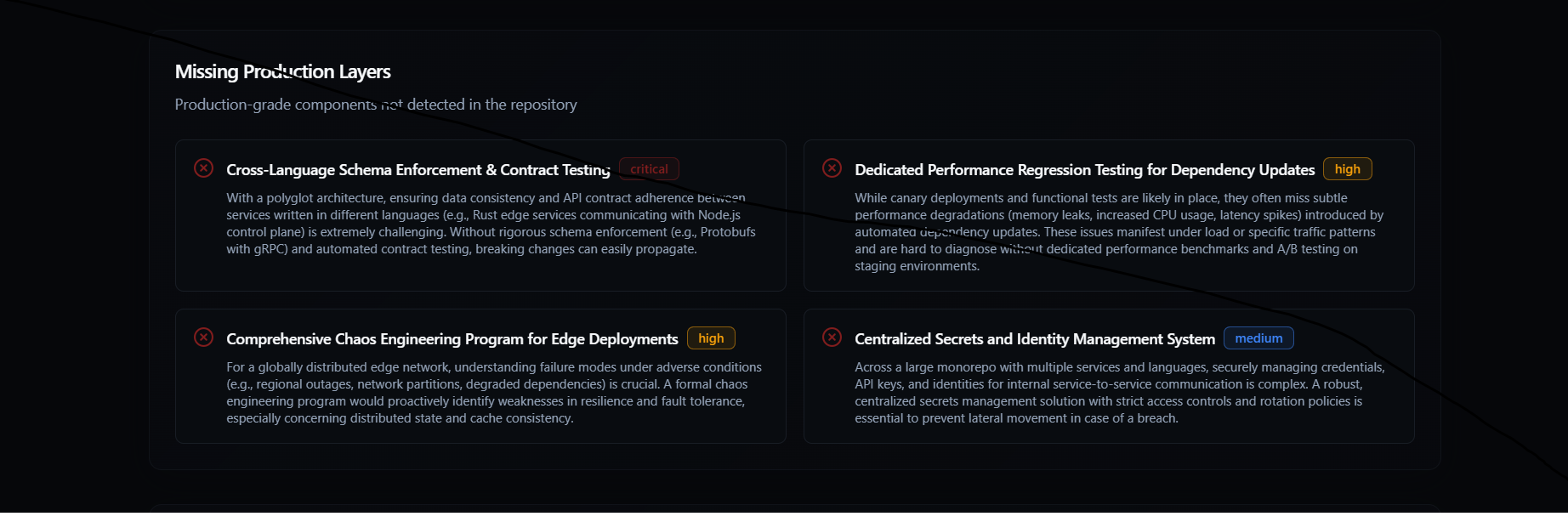
Analysis_Results_7_Missing_Prod_Layers
-
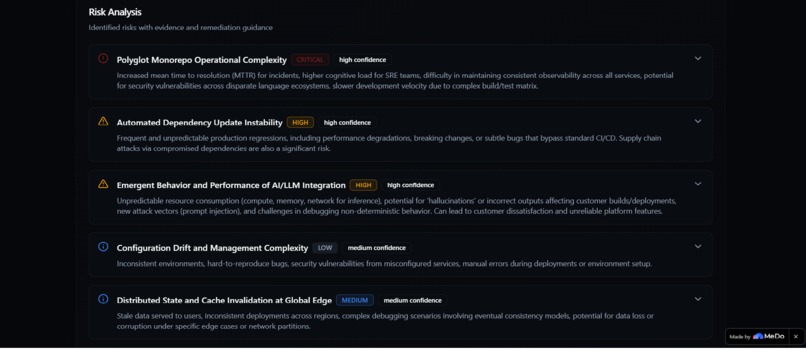
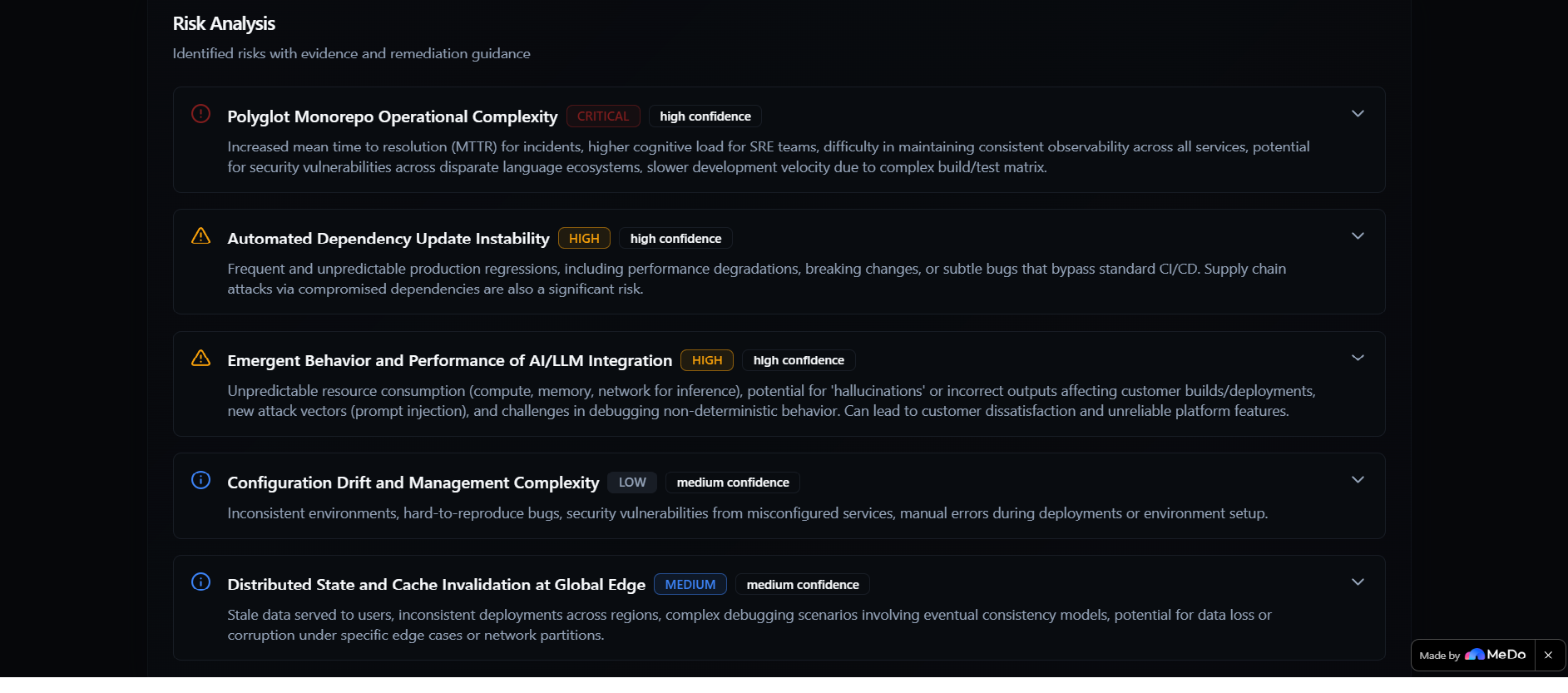
Analysis_Results_6_Risk_Analysis
-
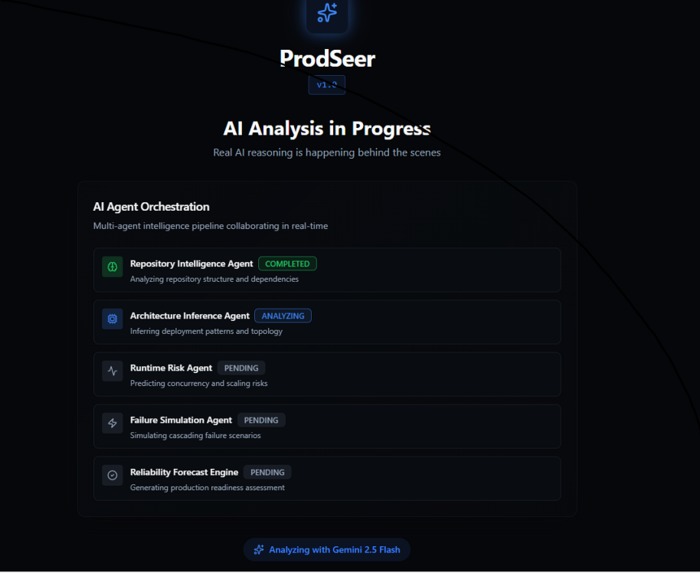
Analysis In Action
-
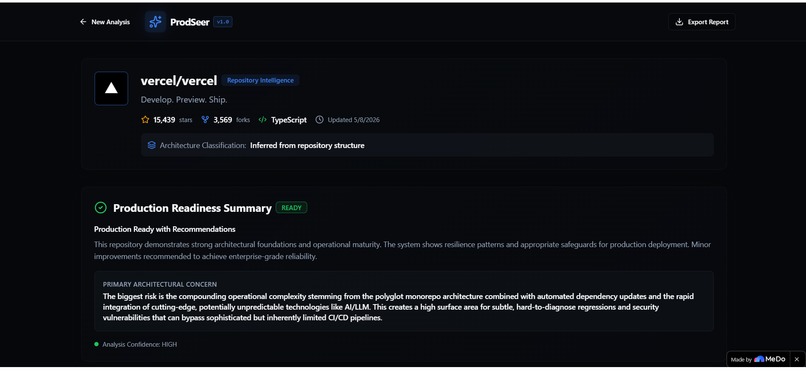
Analysis_Results_1_Git_Repo_Info_And_Summary
-
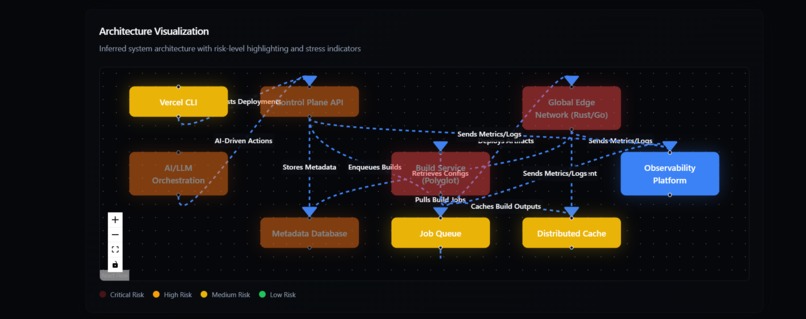
Analysis_Results_4_Inferred_Architecture_Visualization
-
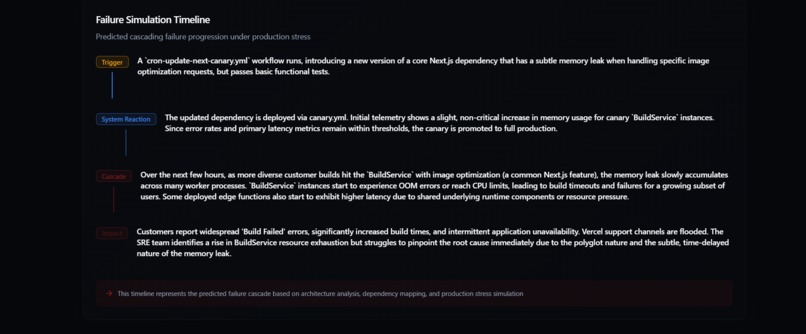
Analysis_Results_3_Prod_Failure_Simulation_Timeline
-
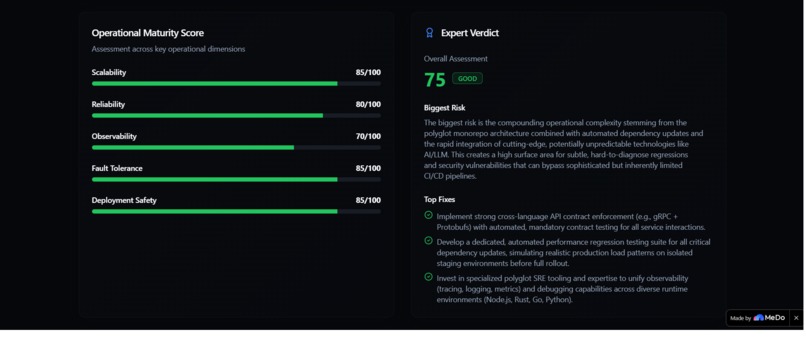
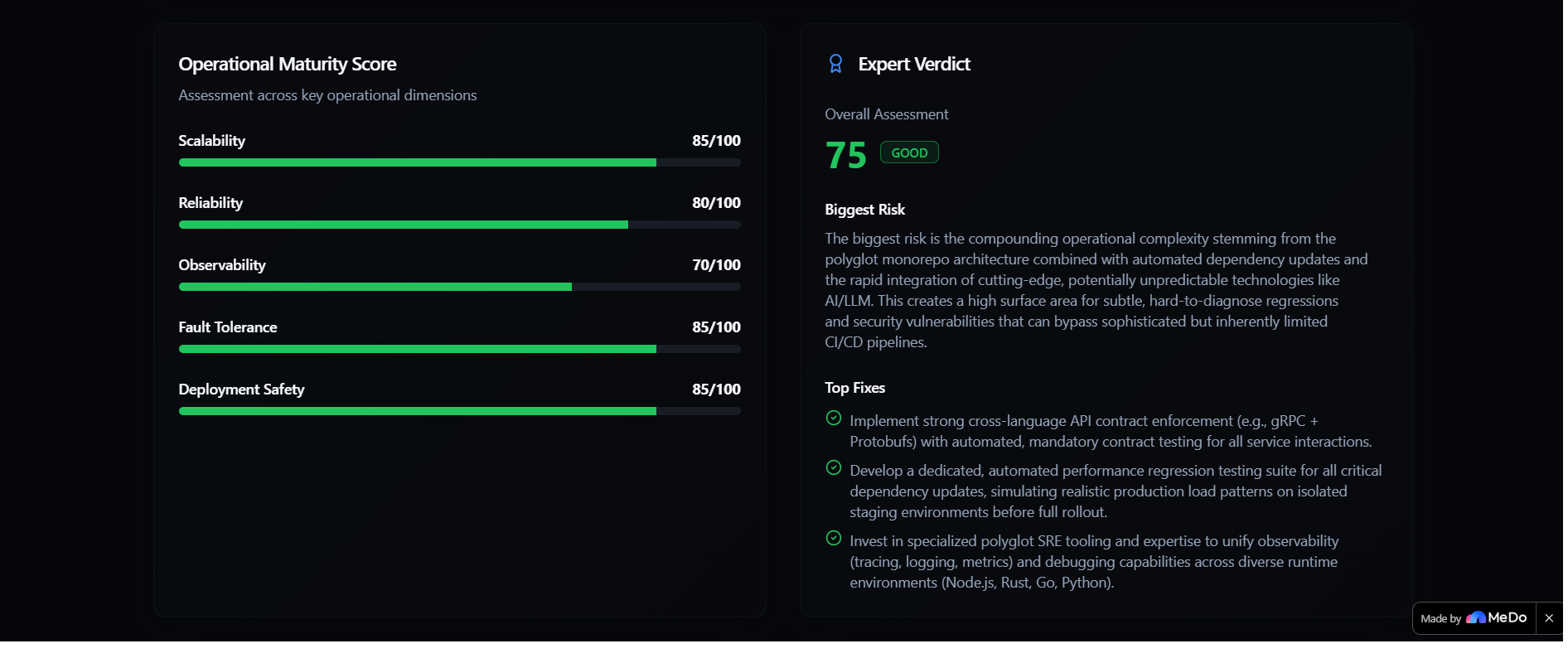
Analysis_Results_5_Score_Cards_And_Expert_Verdict
-
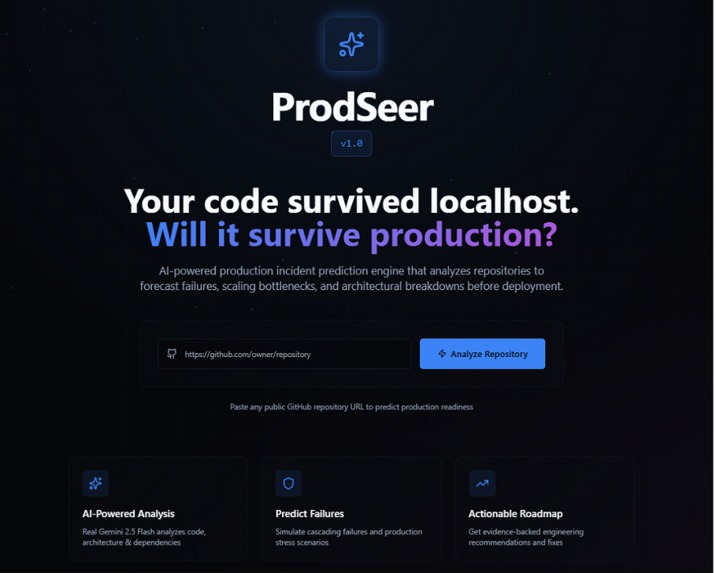
Product Home Screen
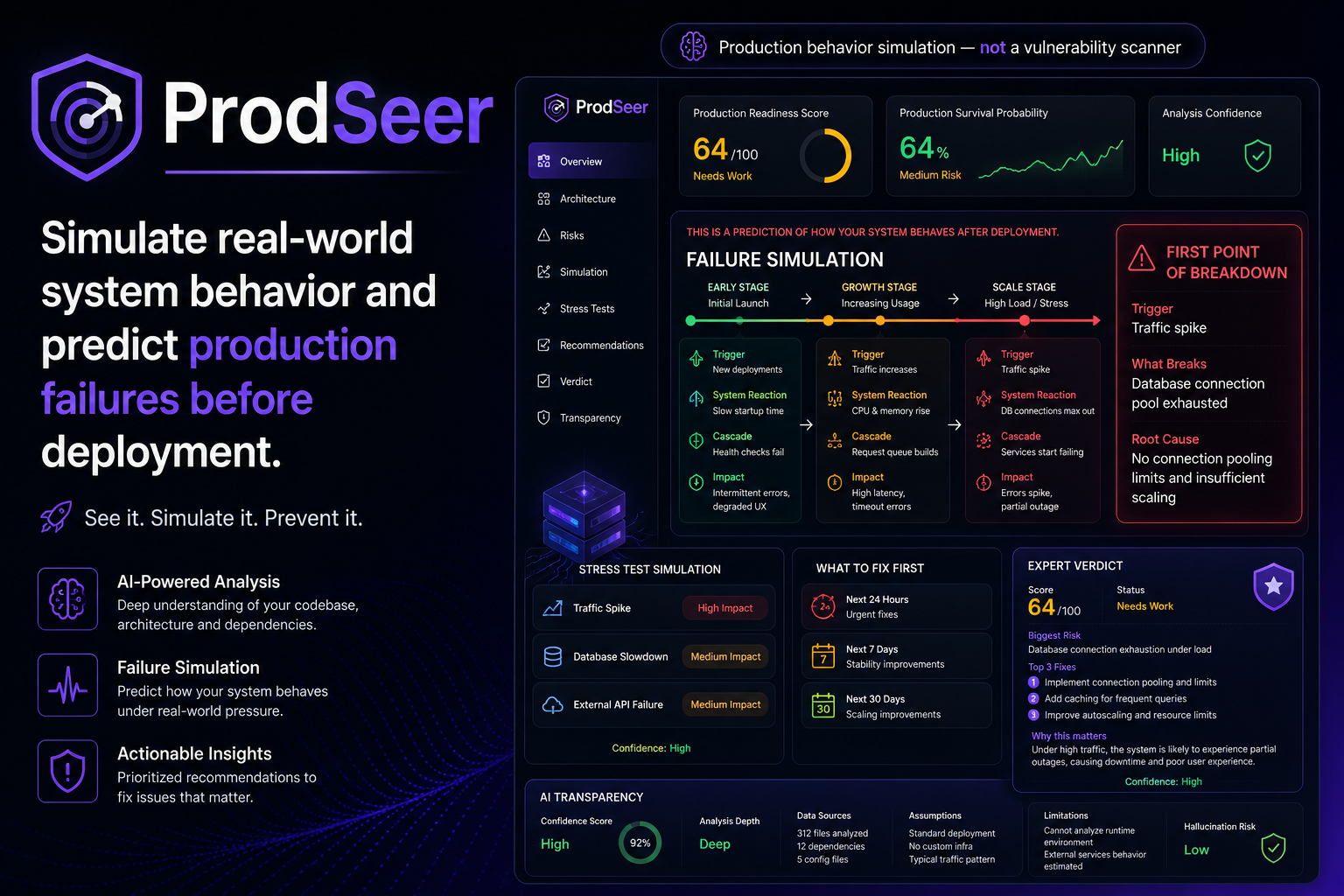
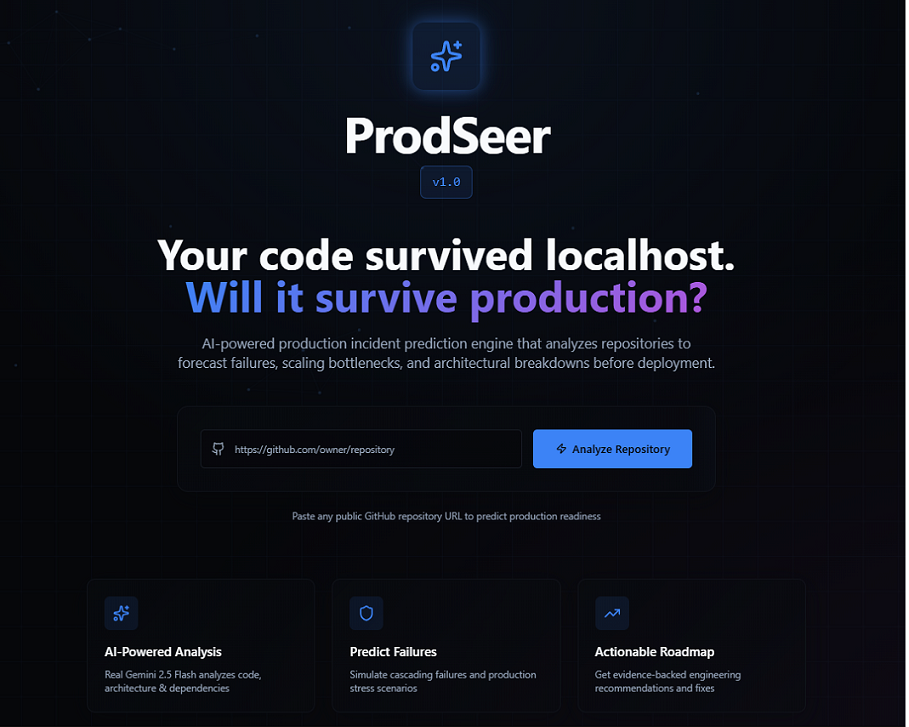
ProdSeer — AI-Powered Production Failure Prediction™
Your code survived localhost.
Will it survive production?
Inspiration
Modern software systems rarely fail because of a single bug.
They fail because of interconnected operational behavior:
- overloaded databases
- cascading service failures
- missing observability
- uncontrolled API costs
- poor scalability assumptions
- weak deployment architecture
As AI accelerates software development, teams are shipping code faster than ever — but production complexity is growing even faster.
Most existing tools focus on:
- static analysis
- vulnerabilities
- linting
- code quality
But they don’t answer the question engineers, founders, and SRE teams actually care about:
“Will this system survive production?”
Modern production reliability is fundamentally an emergent systems problem:
$$ System\ Failure \neq Single\ Bug $$
$$ Failure = f(Dependencies,\ Traffic,\ Latency,\ Infrastructure,\ Human\ Operations) $$
ProdSeer was designed to model those interactions before deployment.
We built ProdSeer to explore a new category:
AI-powered Production Failure Prediction™.
Instead of only analyzing code, ProdSeer simulates how systems behave under real-world operational pressure — before deployment.
What it does
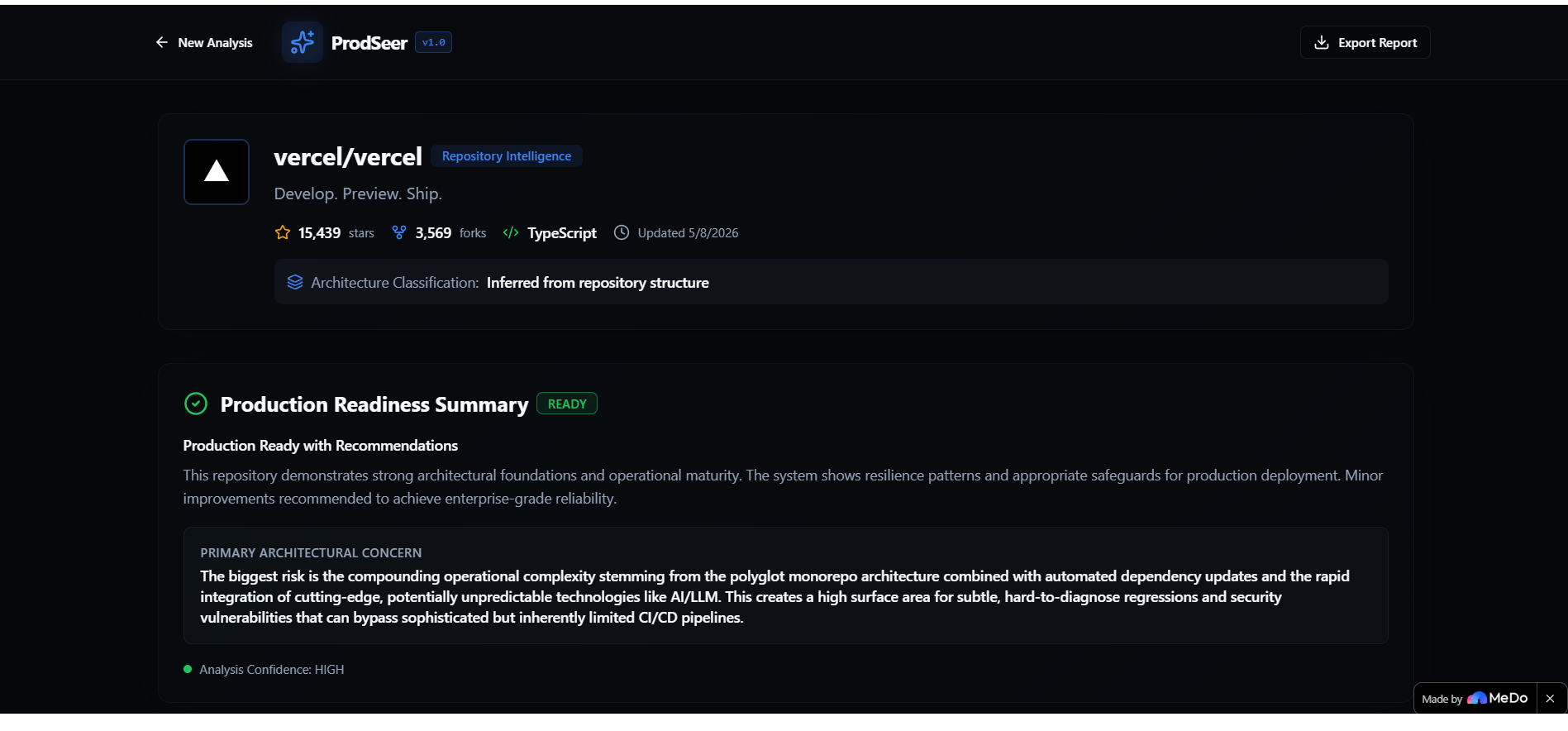
ProdSeer analyzes GitHub repositories and predicts how they may behave in production environments.
It performs:
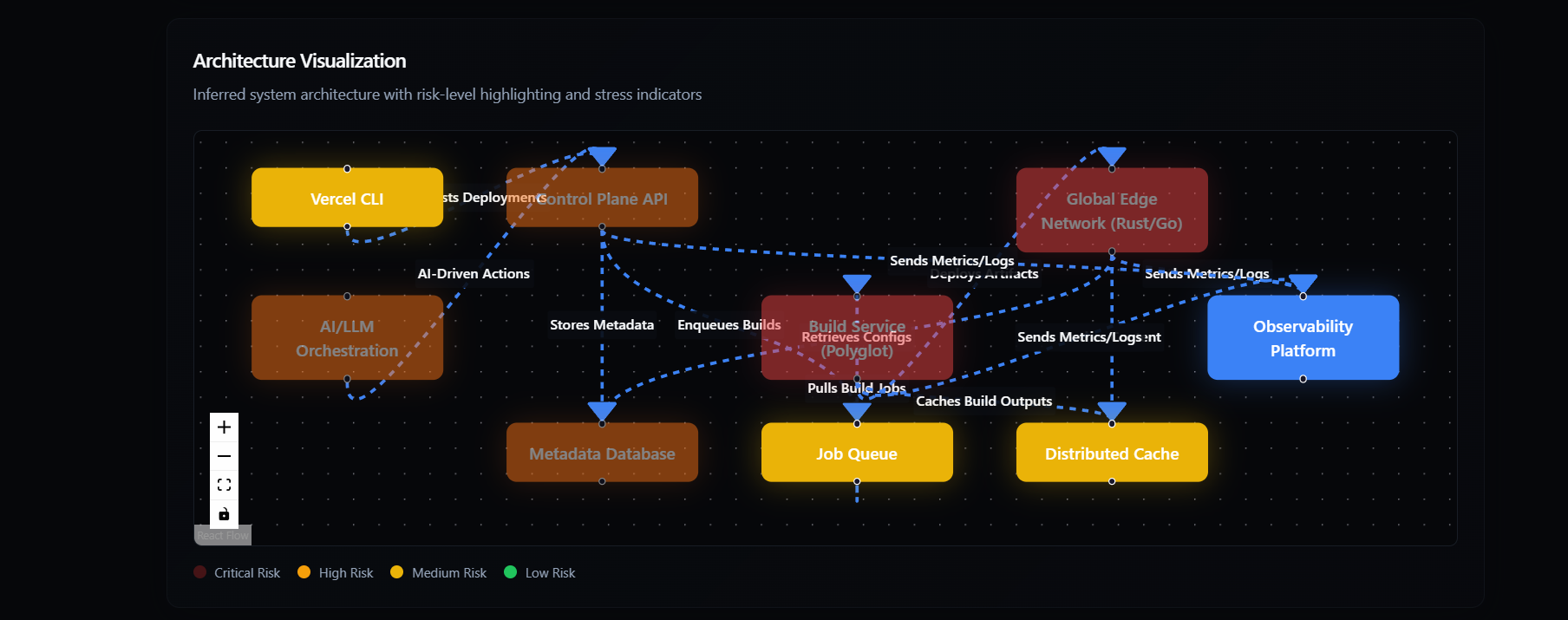
- architecture inference
- operational risk analysis
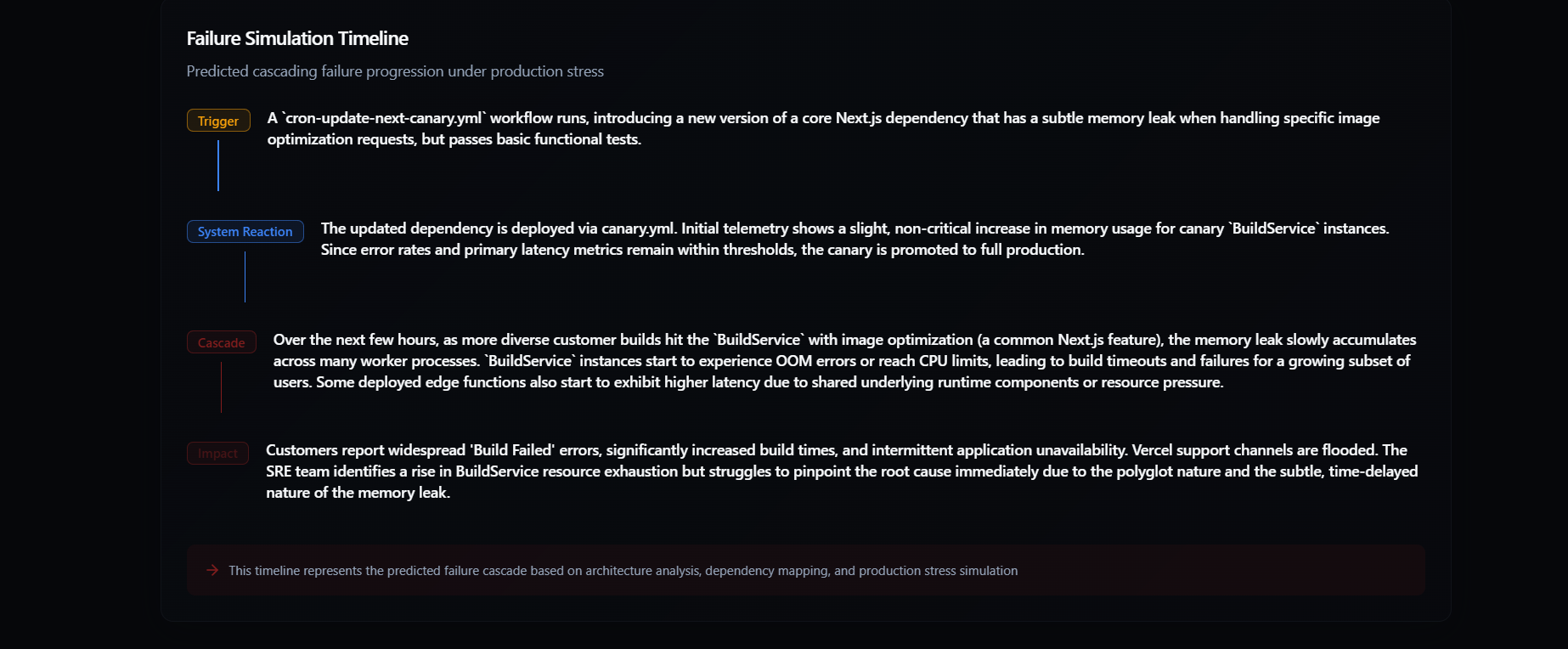
- cascading failure simulation
- infrastructure reasoning
- stress scenario forecasting
- production survivability assessment
Instead of returning generic AI summaries, ProdSeer generates:
- Production Readiness Reports
- Failure Simulation Timelines
- Operational Maturity Scores
- First Point of Breakdown analysis
- Missing Production Layer detection
- Infrastructure modernization recommendations
ProdSeer can identify:
- API cost explosion risks
- database bottlenecks
- missing observability
- scaling weaknesses
- security collapse scenarios
- resource exhaustion risks
- deployment fragility
- architectural SPOFs (Single Points of Failure)
The platform also includes:
- animated topology visualization
- AI orchestration workflows
- conversational architecture reasoning via “Ask ProdSeer”
- exportable operational intelligence reports
How we built it
ProdSeer was built using MeDo’s full-stack generation and multi-turn AI workflows.
The platform combines:
- repository analysis
- structured AI reasoning
- operational simulation
- dynamic visualization
- conversational infrastructure intelligence
Core Architecture
Repository Intelligence Layer
The backend fetches:
- repository structure
- dependency information
- configuration files
- deployment indicators
- architectural signals
using GitHub APIs and repository parsing.
AI Reasoning Engine
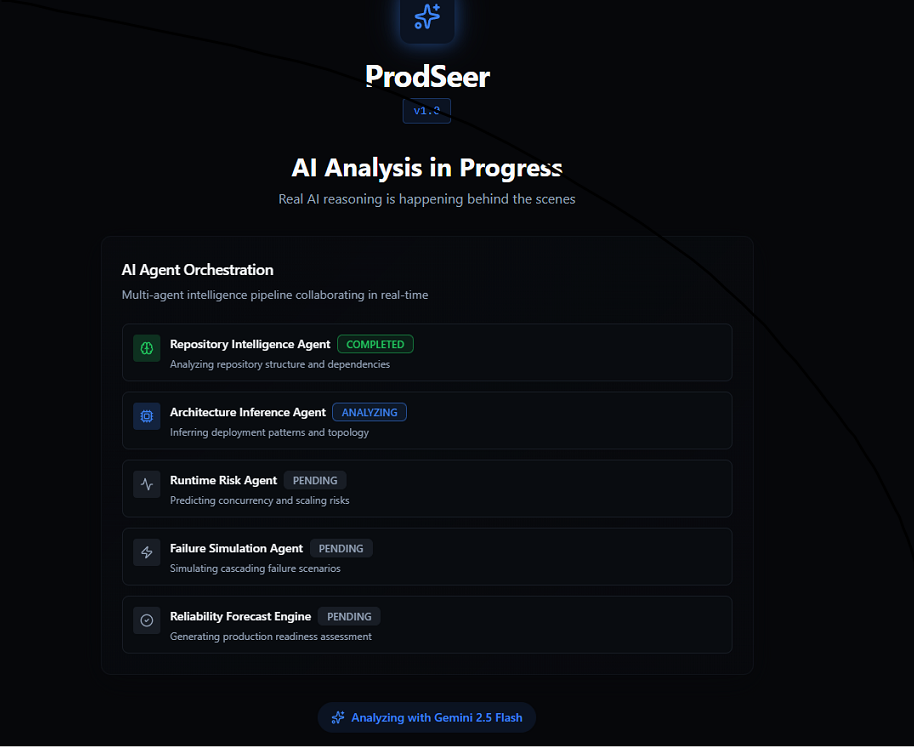
ProdSeer uses real LLM-powered analysis (Gemini) with structured multi-stage prompting.
Instead of a single prompt, the system performs staged reasoning workflows including:
- architecture analysis
- operational risk modeling
- failure forecasting
- cascading failure simulation
- remediation planning
- production survivability scoring
We designed specialized reasoning stages that simulate:
- Repository Intelligence Agents
- Runtime Risk Analysis
- Failure Simulation workflows
- Reliability Forecasting
The AI outputs structured JSON with:
- evidence
- confidence levels
- operational impact
- remediation priority
- infrastructure recommendations
This dramatically reduced generic AI output and improved consistency.
Frontend Experience
The frontend was designed as a cinematic operational intelligence platform.
Key UX features include:
- dark-mode SaaS interface
- animated dependency topology graphs
- orchestration progress visualization
- operational status indicators
- survivability scoring
- AI-generated infrastructure reports
We intentionally designed the experience to feel closer to:
- observability platforms
- reliability engineering systems
- AI infrastructure intelligence dashboards
rather than a generic chatbot UI.
Challenges we ran into
1. Avoiding generic AI analysis
Our earliest outputs sounded like typical AI summaries.
To solve this, we introduced:
- strict structured outputs
- evidence-based reasoning
- confidence scoring
- operational categorization
- staged AI prompting
This dramatically improved realism and consistency.
2. Simulating real production failures
Predicting production behavior is significantly harder than detecting code issues.
We developed:
- Trigger → Reaction → Cascade → Impact modeling
- timeline-based failure simulation
- survivability forecasting
- infrastructure dependency reasoning
This became one of the most distinctive parts of ProdSeer.
3. Making AI reasoning feel operationally believable
We wanted reports to sound like:
- SRE reviews
- architecture assessments
- operational readiness audits
—not generic AI responses.
We refined prompts extensively to produce:
- contextual reasoning
- nuanced risk prioritization
- adaptive infrastructure analysis
- scenario-based operational forecasting
4. Balancing technical depth with usability
Operational intelligence can easily overwhelm users.
We introduced:
- Production Survival Probability
- First Point of Breakdown
- Operational Maturity Scores
- Executive-style summaries
- structured remediation guidance
to keep outputs understandable and actionable.
5. Creating a coherent product identity
We didn’t want another “AI repo analyzer.”
We positioned ProdSeer as:
“AI-powered Production Failure Prediction™”
That framing influenced:
- UI design
- topology visualization
- orchestration UX
- report generation
- conversational workflows
- operational storytelling
Accomplishments that we're proud of
- Built an AI system that predicts how software systems fail in production
- Designed a dynamic Failure Simulation Timeline
- Introduced the First Point of Breakdown concept
- Created adaptive repository intelligence that changes behavior depending on repository type
- Built cinematic topology visualizations with operational stress mapping
- Implemented conversational infrastructure reasoning with “Ask ProdSeer”
- Generated exportable operational intelligence reports
- Created a polished SaaS-grade AI operations experience using MeDo
What we learned
- Production failures are emergent, systemic, and interconnected
- AI becomes significantly more useful when guided with structured reasoning workflows
- Operational storytelling creates far stronger user engagement than generic analysis
- UX and presentation dramatically influence perceived intelligence
- Developers don’t just want diagnostics — they want operational foresight and prioritization
What's next for ProdSeer
We see potential for ProdSeer to evolve into a full AI-powered operational intelligence platform.
Future directions include:
- CI/CD integration
- pull request risk forecasting
- multi-repository comparison
- Kubernetes and cloud architecture inference
- continuous operational monitoring
- runtime telemetry integration
- organization-wide production readiness scoring
- deployment gating based on survivability analysis
We also want to improve simulation accuracy using:
- runtime signals
- infrastructure metrics
- deployment telemetry
- observability platform integrations
Final Thought
Most tools analyze what your code is.
ProdSeer analyzes what your system becomes under real-world operational pressure.
Your code survived localhost.
Will it survive production?
Built With
- medo

Log in or sign up for Devpost to join the conversation.