-
-

-

-
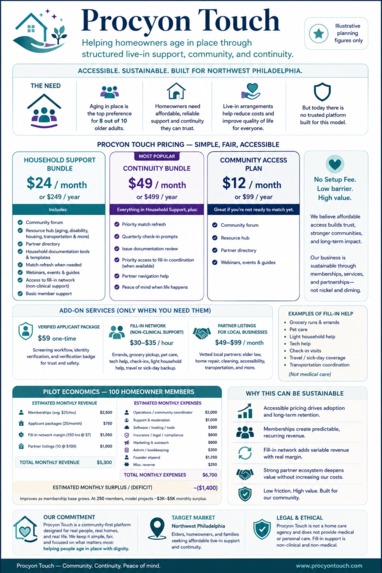
Plans
-
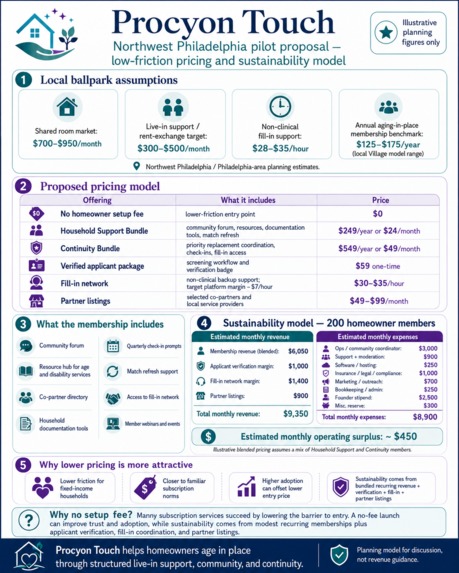
Pricing Model


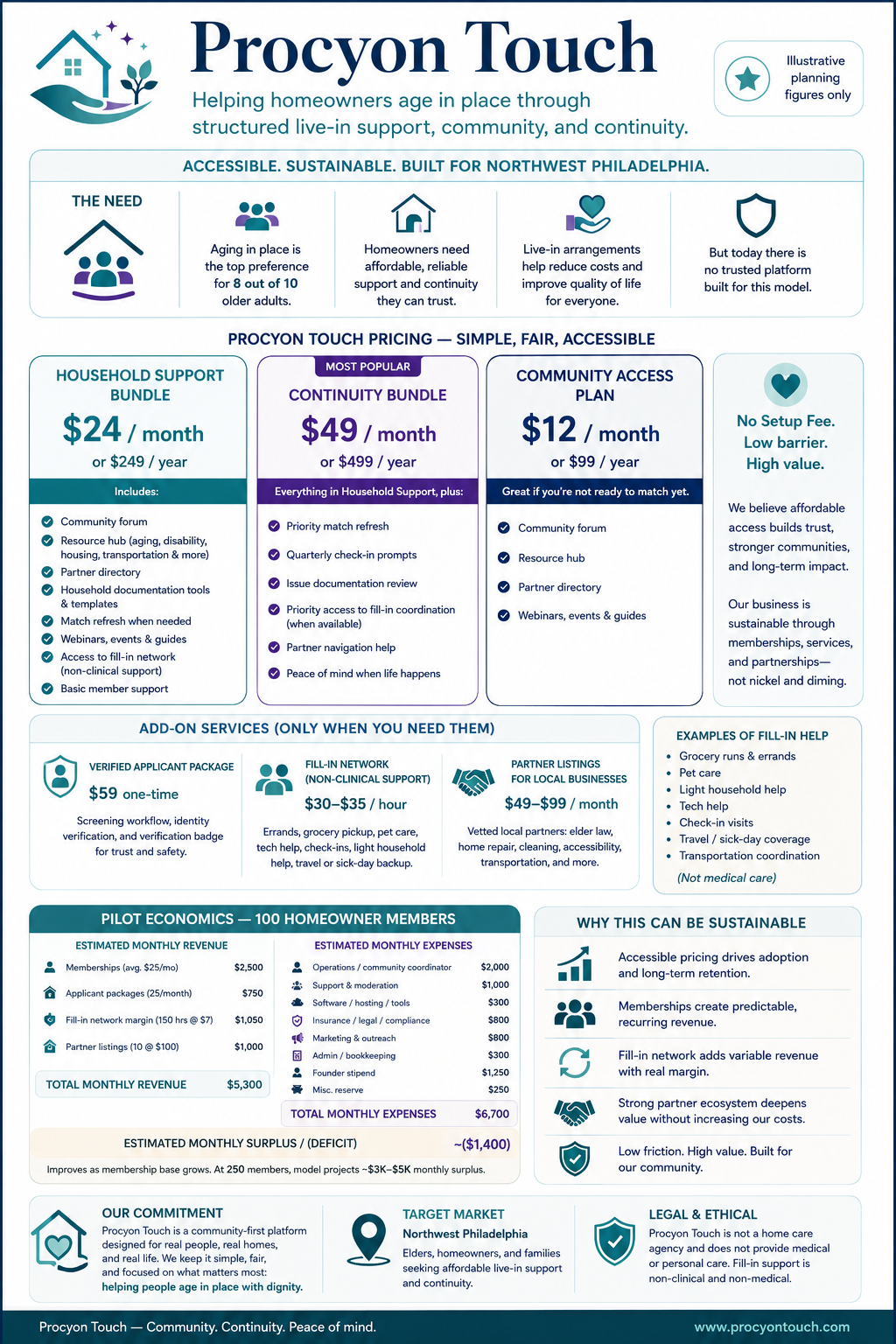
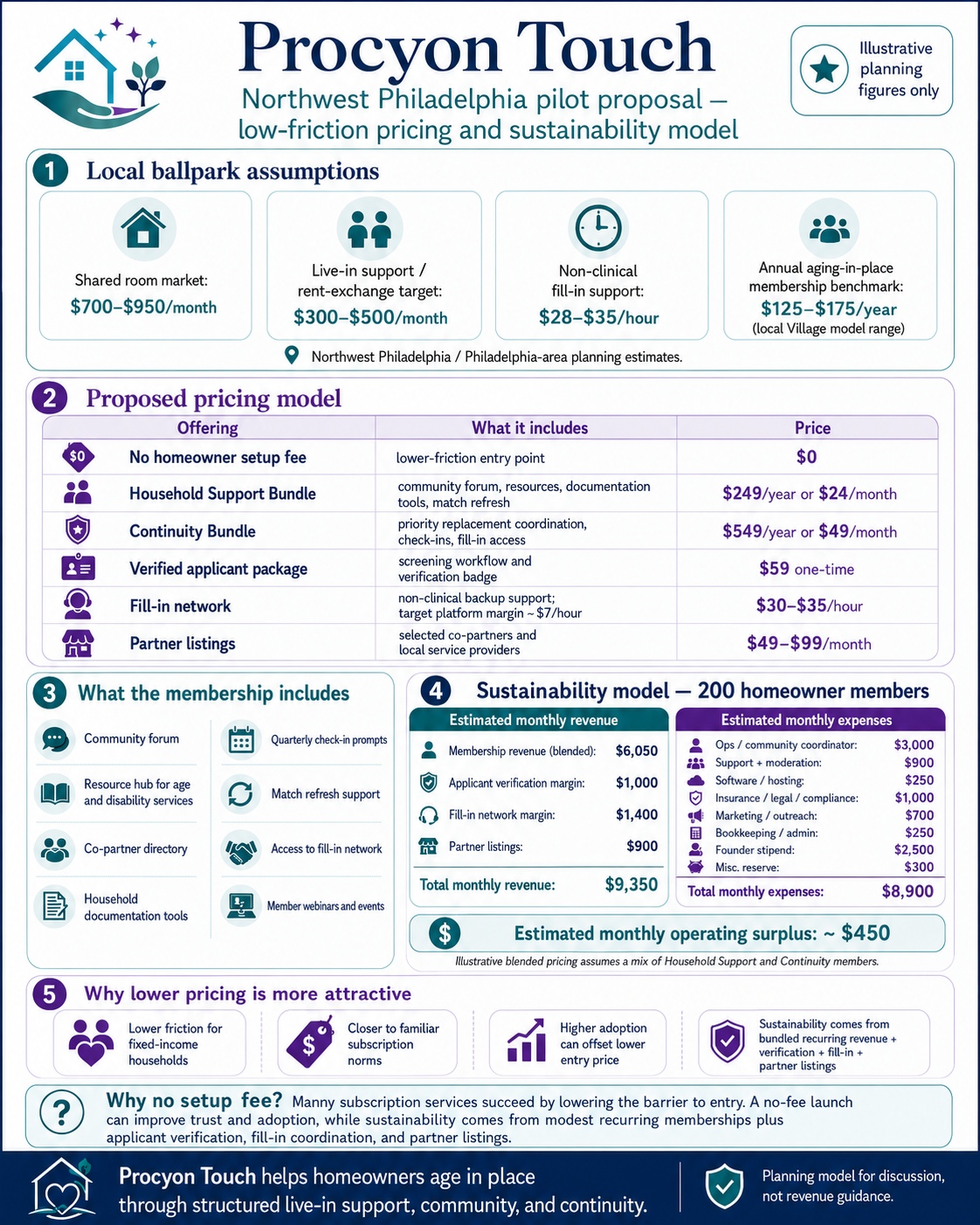
Inspiration
Procyon Touch was inspired by several connected problems that are usually treated separately.
Many older adults and people with disabilities want to remain in their own homes, but they may need help with errands, meals, transportation coordination, household routines, technology, or simply having another person nearby. At the same time, many renters face unaffordable housing costs and a shortage of suitable homes. Meanwhile, established houses frequently contain empty bedrooms and underused living space.
Procyon Touch asks whether these challenges can become part of the same solution. The project is designed to connect homeowners who have available space with compatible people seeking affordable housing. In exchange for reduced rent, a live-in companion may provide clearly agreed-upon forms of everyday support, such as preparing meals, running errands, helping with technology, performing light household tasks, or providing regular companionship. The goal is to help older adults and people with disabilities age in place while creating affordable housing opportunities and making better use of space that already exists.
What it does
Procyon Touch is an AI-assisted matching and coordination platform for shared-living arrangements that support aging in place. The platform helps homeowners and potential live-in companions describe their needs, preferences, schedules, expectations, and boundaries. Users can provide information about: Available rooms and household accessibility Rent expectations Household routines Pets, smoking, noise, and privacy preferences Meal preparation and grocery assistance Errands and transportation coordination Technology assistance Light household support Companionship preferences Scheduling and availability Accessibility requirements Personal boundaries and house rules The goal is not simply to fill an empty bedroom. It is to create a structured and transparent living arrangement that benefits both participants. A future version of the matching system could calculate a compatibility score using weighted factors: $$ S = \sum_{i=1}^{n} w_i x_i $$ In this model, $x_i$ represents a compatibility factor, such as schedule, location, accessibility, household preferences, or support needs. The value $w_i$ represents how important that factor is to the individual user.
This approach would allow users to prioritize the qualities that matter most to them instead of relying on a generic matching system.
Procyon Touch is intended to help address several problems at once:
The desire of older adults and people with disabilities to age in place
The shortage of affordable rental housing
The high cost of rent
Social isolation and lack of companionship
The need for practical, nonmedical household support
Empty bedrooms and underused space in established homes
How we built it
I built Procyon Touch as a web-based prototype using HTML, CSS, and JavaScript. I used OpenAI Codex throughout the development process to help me: Translate the original concept into a functional interface
Generate and revise HTML, CSS, and JavaScript
Organize the project structure
Improve navigation and usability
Debug layout and formatting problems
Refine the language used throughout the platform
Create clearer pathways for homeowners and companions
Develop project documentation
I used GitHub to store the code, maintain the project files, and document the concept.
The prototype includes:
An introduction to the Procyon Touch model
Separate pathways for homeowners and potential companions
Household preference and compatibility questions
Explanations of possible companion support
Safety and boundary-setting information
Resources related to housing, disability, aging, and companionship.
A clear description of the platform's current limitations.
The current project is a prototype only. It is not a production matching service, tenant-screening platform, home healthcare provider, emergency-response service, or substitute for legal, medical, or housing-compliance advice.
Challenges we ran into
One of the largest challenges as a new coder and former small business owner was scaling up the project to accommodate large-scale demand.
Also, a live-in companion might help with groceries, meals, errands, technology, transportation coordination, or household routines. However, that person should not automatically be treated as a nurse, home health aide, medical provider, or emergency responder.
The platform therefore needs to communicate clear boundaries regarding what a companion can and cannot be expected to do. Another major challenge was balancing accessibility with safety.
A successful version of Procyon Touch would need more than an attractive matching interface. It would also require systems for:
Identity verification Background checks References Secure communication Written household agreements Privacy protections Emergency contacts Dispute resolution
Clear expectations about rent and support Compliance with applicable housing laws Reporting and account-removal procedures I also faced the challenge of turning a large social-policy idea into a prototype that users could understand quickly.
Housing affordability, loneliness, caregiver shortages, disability support, unused residential space, and aging in place are all complex subjects. I needed to show how one platform could connect these issues without overstating what an early prototype can accomplish.
A further challenge was learning how to direct an AI coding tool effectively. Codex could debug code quickly, but useful results still required clear instructions, testing, review, correction, and repeated refinement.
Accomplishments that we're proud of
I am proud that I transformed a broad social concept into a working prototype with a clear user experience.
Procyon Touch connects several major needs:
Aging in place Disability support Affordable housing Companionship Household assistance Better use of existing homes
I am also proud that the prototype presents the concept responsibly. It explains both the potential benefits and the limitations of the model.
The project does not assume that every homeowner and companion will be compatible. Instead, it emphasizes matching, transparency, boundaries, safety, and mutual agreement.
Another accomplishment was using Codex to turn an idea rooted in housing, aging, disability, and community support into a functional web experience. The project demonstrates how someone with strong subject knowledge can use generative AI to create and refine a technical prototype.
What we learned
I learned that AI-assisted development can make software creation more accessible to founders who have strong domain knowledge but limited traditional programming experience. Codex was most effective when I treated it as a development partner rather than as a one-command website generator. The development process usually followed a cycle:
Describe the goal. Generate or revise the code. Review the result. Identify problems or inconsistencies. Test the interface. Refine the instructions. Repeat the process. I also learned that compatibility in a shared home depends on much more than age, location, or rent. Important matching factors may include: Privacy expectations Work and sleep schedules Communication styles Noise tolerance Pets Smoking Cooking habits Mobility needs Transportation access Household cleanliness Guests and visitors Technology comfort The exact forms of support each person is willing to provide
I learned that safety features cannot be added as an afterthought. They must be part of the platform's structure from the beginning. Most importantly, I learned to view empty residential space as a potential community resource.
Procyon Touch does not depend entirely on constructing new facilities or moving people away from familiar neighborhoods. It begins with resources that already exist:
Established homes Empty bedrooms People seeking affordable rent People who want to age in place People who can provide practical support and companionship What's next for Procyon Touch Future development could include: Verified user profiles Background-check integrations Secure messaging Video introductions References and endorsements Accessibility filters Scheduling tools Household agreement templates Rent and support calculators Emergency-contact features Check-in systems Reporting and moderation tools Community discussion resources Partnerships with aging, disability, and housing organizations
A future pilot could begin in Philadelphia, focusing on neighborhoods with established housing, older homeowners, people with disabilities, and strong demand for affordable rent.
The next stage would also involve consulting housing, disability, aging, legal, and safety experts to determine how the model could be implemented responsibly.
The long-term goal is to create a safer and more structured way to turn unused residential space into affordable housing, practical support, companionship, and stronger communities. Procyon Touch is based on a simple idea: a home can be more than property. With the right structure, it can become part of a person's support system.
Built With
- codex
- css
- html
- javascript
- openai

Log in or sign up for Devpost to join the conversation.