-
-
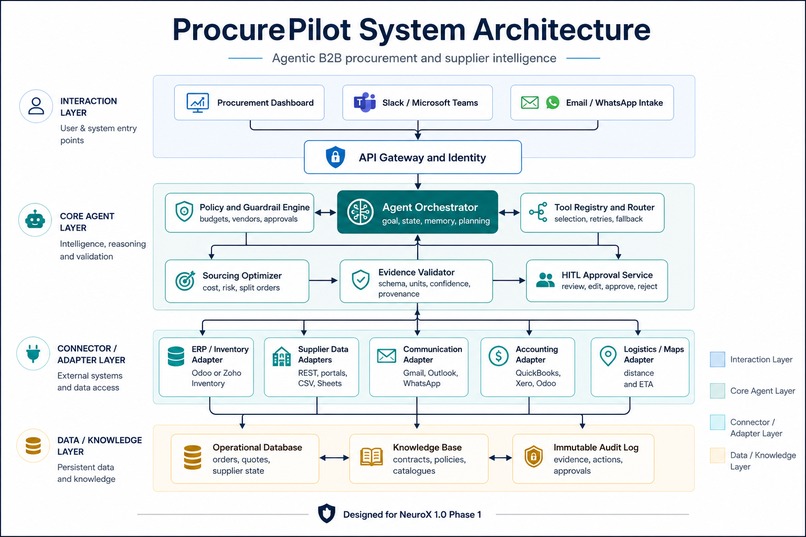
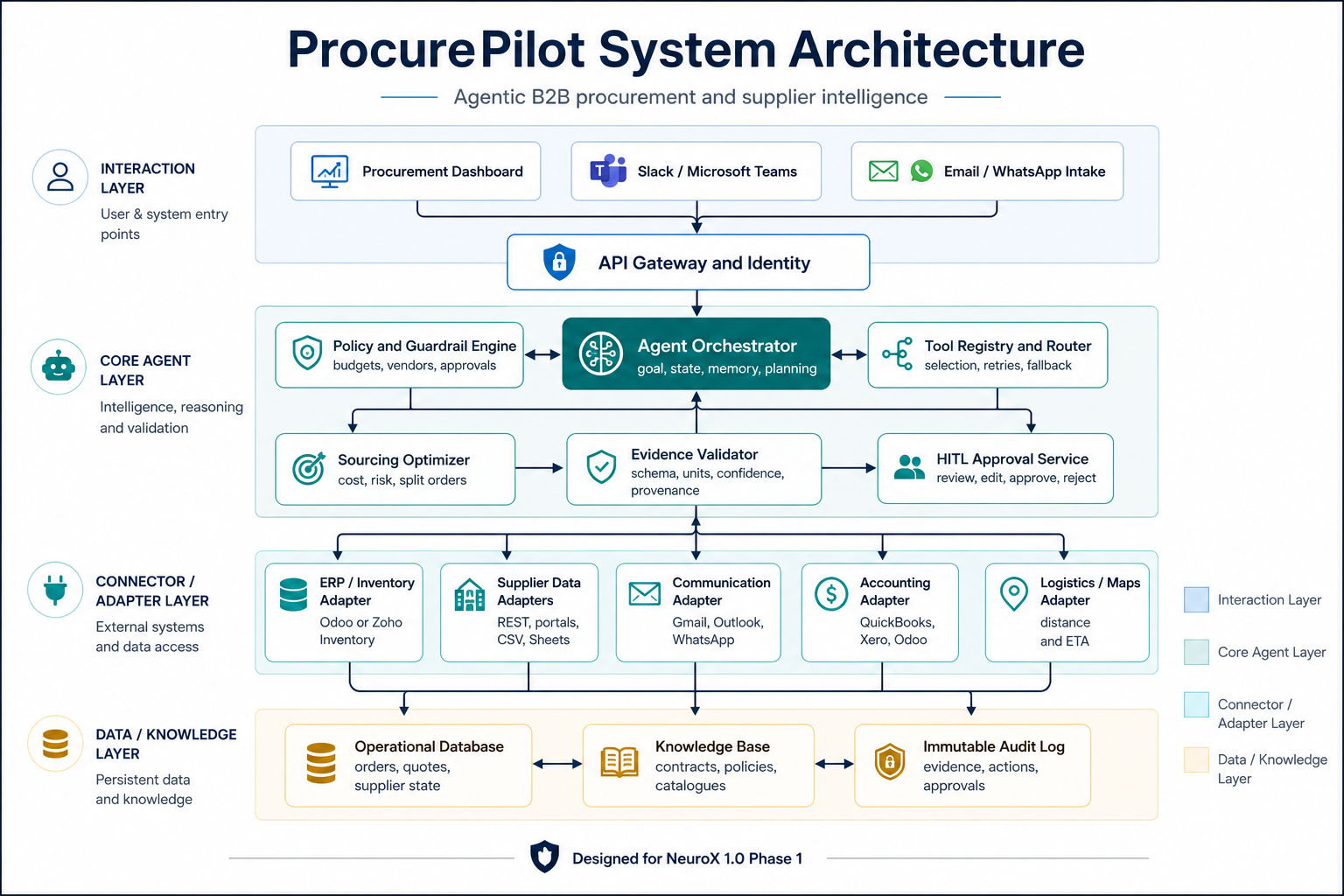
Modular architecture connecting business channels, the agent core, enterprise tools, persistent data, and the audit log.
-
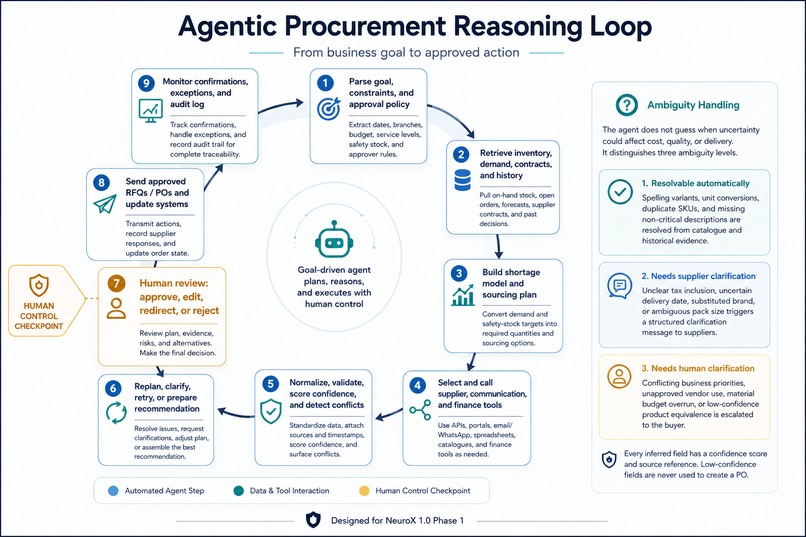
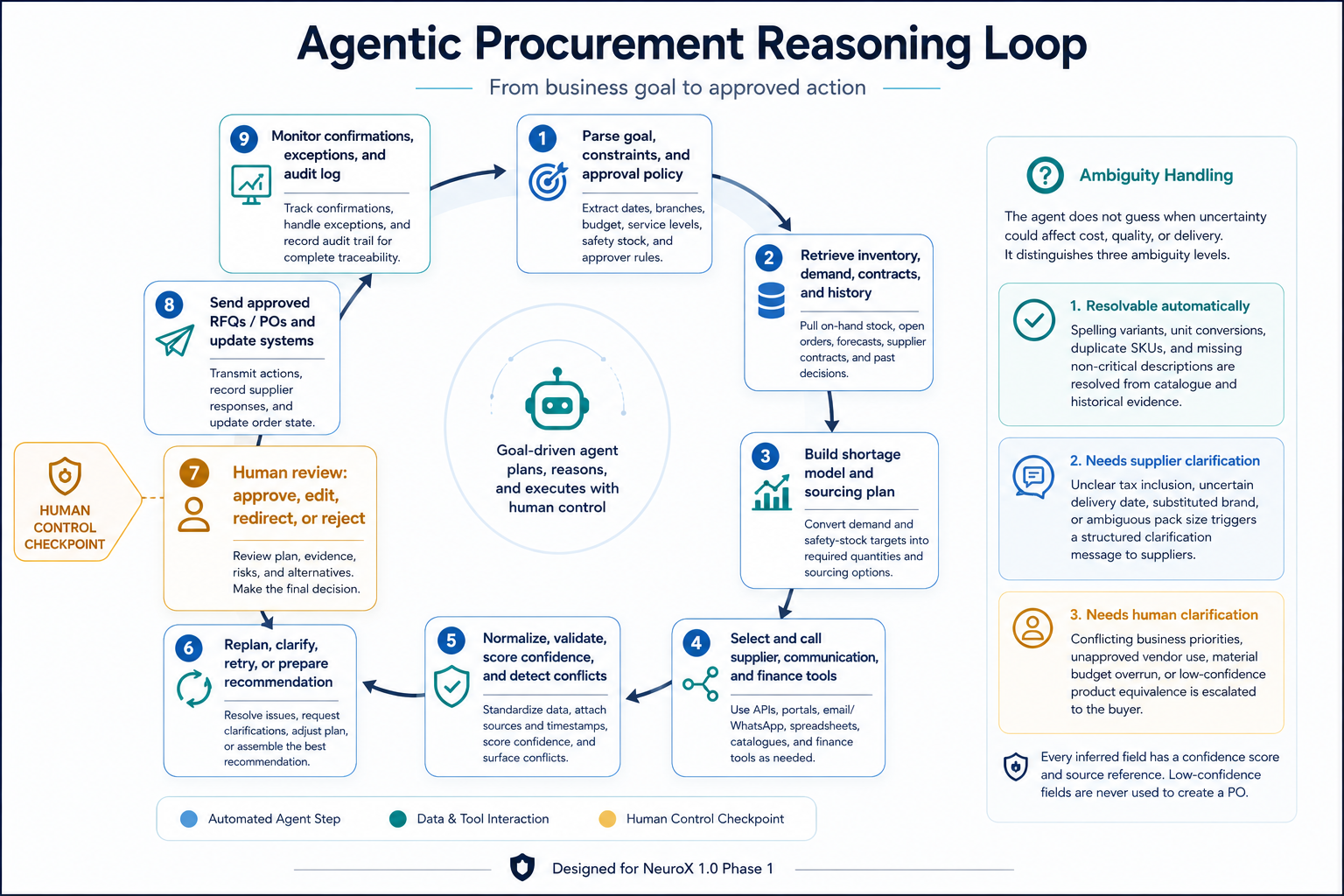
The agentic reasoning loop from business goal to evidence gathering, replanning, human review, execution, and monitoring.
-
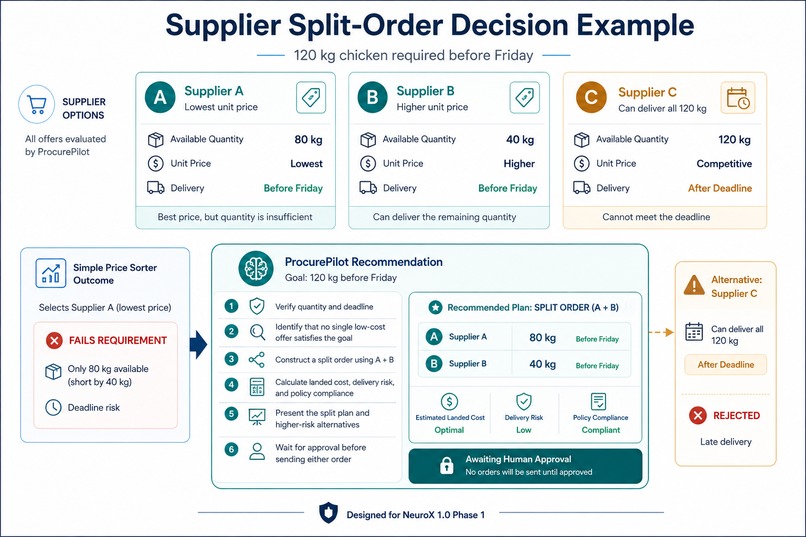
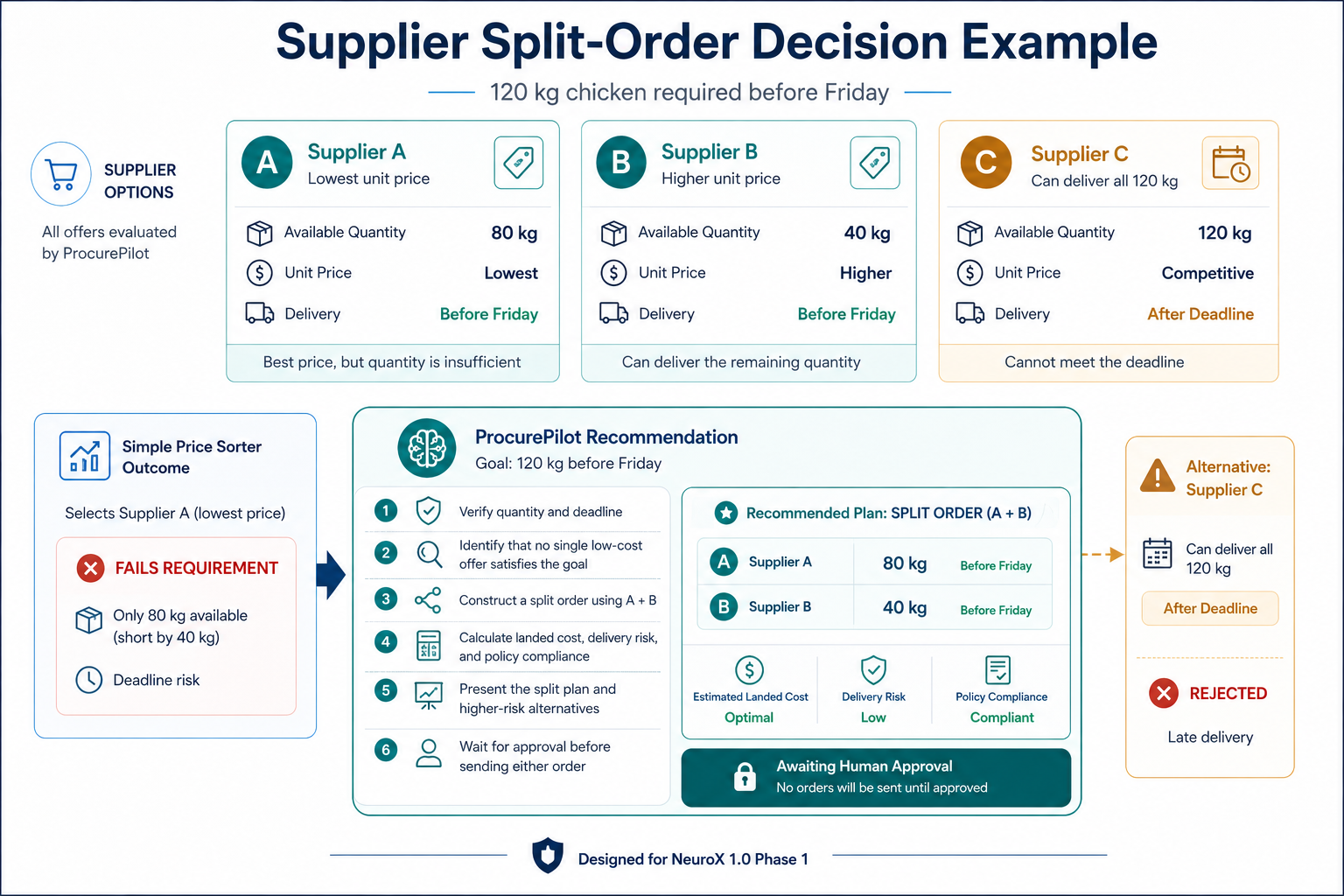
ProcurePilot combines Suppliers A and B to meet quantity and deadline constraints while rejecting the late alternative.
-
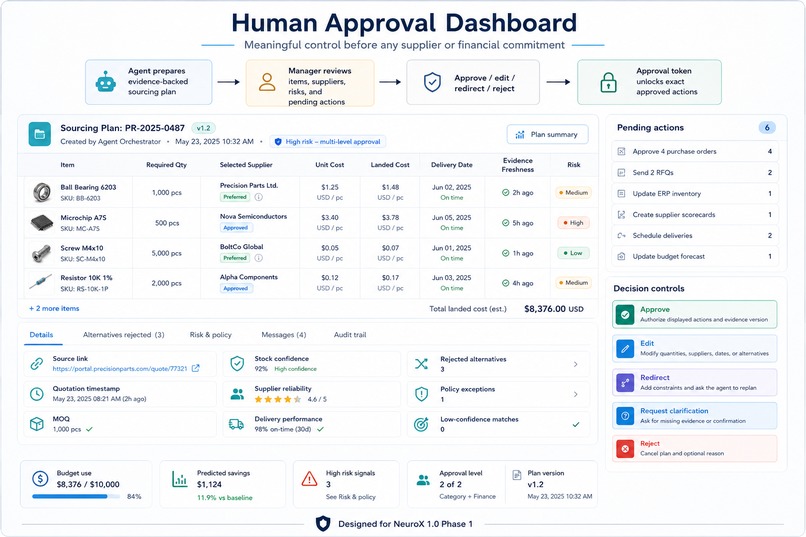
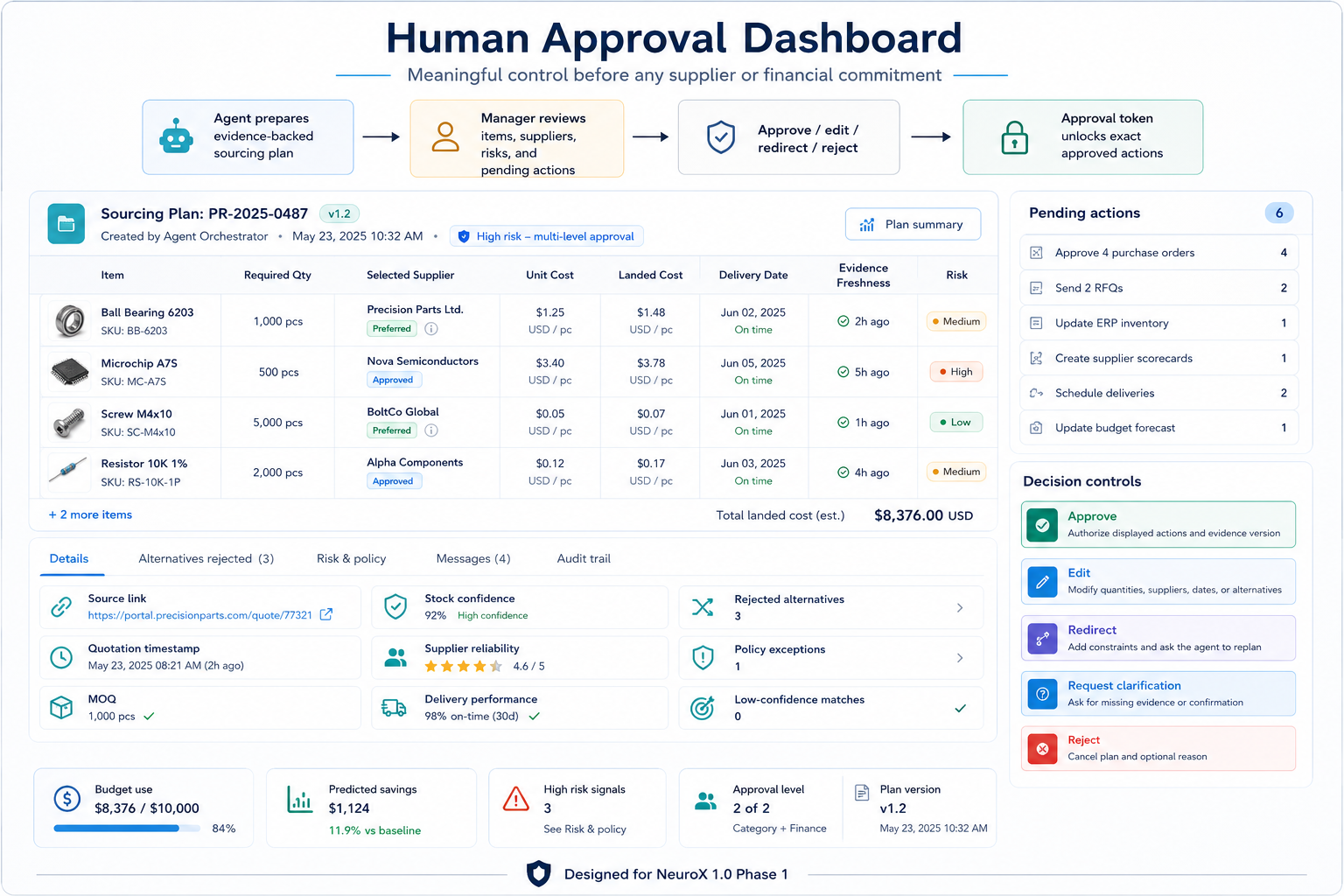
Human approval dashboard for reviewing evidence, risks, supplier choices, and pending actions before execution.
-
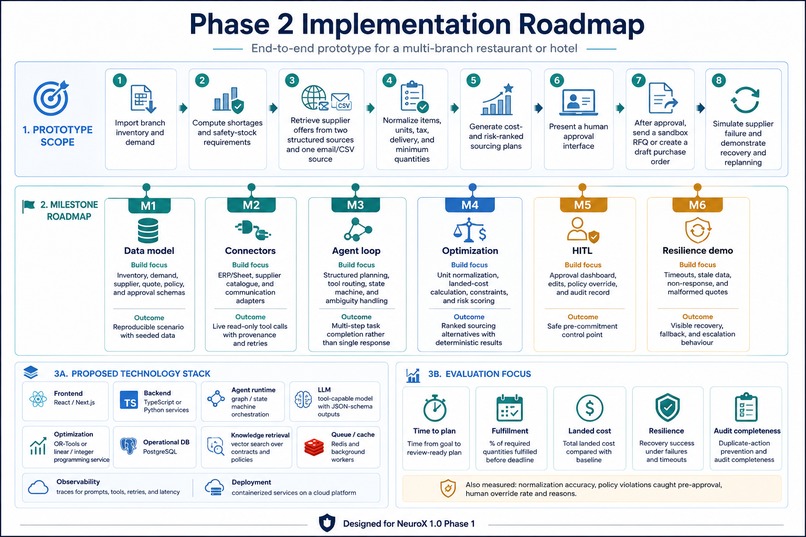
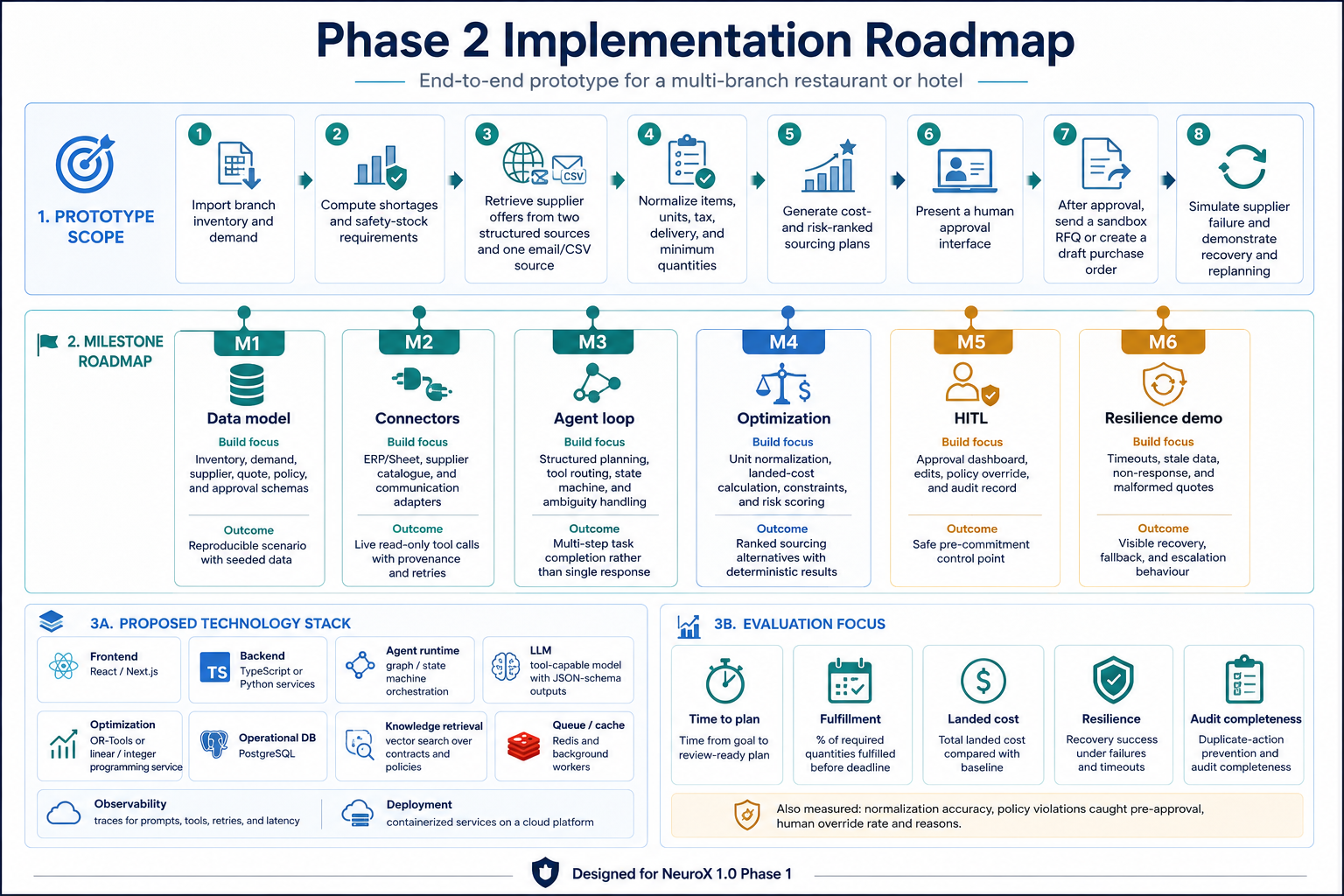
Phase 2 roadmap covering data, connectors, agent reasoning, optimization, human approval, and resilience testing.
ProcurePilot
From inventory gaps to approved supplier action.
ProcurePilot is an agentic B2B procurement and supplier-intelligence system designed for restaurants, hotels, caterers, retailers, warehouses, and other inventory-driven businesses.
It transforms fragmented inventory needs and supplier information into verified, optimized, and approval-ready purchasing plans.
Inspiration
Business procurement is often more manual than it appears.
A procurement officer may have an inventory system, accounting software, supplier portals, spreadsheets, emails, quotations, and WhatsApp messages. However, the difficult reasoning between these systems is still performed manually.
The buyer must determine:
- What needs to be purchased
- How urgently each item is required
- Which suppliers can fulfil the order
- Whether quotations use equivalent units and pack sizes
- Whether taxes and delivery costs are included
- Whether the supplier can meet the deadline
- Whether the plan follows the company’s purchasing policies
- Whether the final order remains within budget
We were inspired by this missing reasoning layer. Existing software records transactions, but it rarely investigates the problem, evaluates trade-offs, recovers from failures, and prepares a complete decision for approval.
The problem
Procurement is not simply about selecting the lowest price.
The cheapest supplier may not have the full required quantity. A preferred supplier may deliver too late. Quotations may use different brands, currencies, units, minimum order quantities, tax treatments, and delivery fees.
Supplier information is also scattered across:
- ERP and inventory systems
- Supplier APIs and portals
- Spreadsheets and CSV files
- Email threads
- Messaging applications
- Contracts and historical purchase orders
When information is missing or a supplier fails to respond, procurement teams often restart the comparison manually.
This consumes time, increases the risk of stockouts and emergency purchases, and makes it difficult to explain why a supplier was selected.
What ProcurePilot does
A manager gives ProcurePilot a business goal such as:
Prepare next week’s procurement plan for all branches. Maintain three days of safety stock, remain within LKR 450,000, use approved suppliers where possible, and complete delivery before Monday at 6:00 a.m.
ProcurePilot then:
- Understands the goal, budget, deadlines, branches, policies, and approval requirements.
- Retrieves inventory, demand, open orders, supplier contracts, and purchasing history.
- Calculates shortages and separates urgent purchases from deferrable items.
- Dynamically selects the most suitable external tools and supplier sources.
- Collects and normalizes quotations, units, taxes, currencies, delivery fees, and dates.
- Generates multiple sourcing plans based on cost, delivery risk, supplier preference, and policy compliance.
- Detects missing information, ambiguous quotations, and possible supplier failures.
- Presents an evidence-backed recommendation for human review.
- Executes only the exact actions approved by an authorized manager.
ProcurePilot is not a chatbot that merely recommends a supplier. It is a goal-driven agent that plans, gathers evidence, uses tools, handles failures, and works toward a real operational outcome.
Agentic reasoning and failure recovery
The next action changes according to the evidence the agent discovers.
For example, suppose a hotel needs 120 kg of chicken before Friday:
- Supplier A has the lowest price but can supply only 80 kg.
- Supplier B can supply the remaining 40 kg at a higher price.
- Supplier C can supply all 120 kg but only after the deadline.
A basic price-sorting system may select Supplier A and fail the actual business requirement.
ProcurePilot instead creates a split order using Suppliers A and B, calculates the complete landed cost, checks delivery and supplier risk, and explains why Supplier C was rejected.
If a supplier API times out, the agent can retry and switch to another connector. If a supplier does not respond, it can follow up, check fallback vendors, or prepare a partial plan. If a quotation is unclear, the agent requests clarification rather than silently guessing.
Human-in-the-loop control
Human control is placed immediately before an external or financial commitment.
The agent may autonomously:
- Read inventory and supplier data
- Compare quotations
- Calculate sourcing alternatives
- Draft supplier messages
- Detect policy exceptions
- Replan after failures
However, it cannot send a confirmed order, create a purchase order, approve a supplier allocation, or write to an accounting system without authorization.
The reviewer can:
- Approve the proposed plan
- Edit quantities or suppliers
- Add a new constraint and request replanning
- Request further evidence
- Reject the recommendation
- Record a controlled policy override
This allows the system to perform the repetitive investigation and reasoning while the business retains authority over money, supplier relationships, and policy exceptions.
How we designed it
For the NeuroX 1.0 Idea Validation phase, we designed a modular and failure-tolerant architecture containing:
- An Agent Orchestrator for goals, state, planning, and tool selection
- A deterministic Policy Engine for budgets, deadlines, approved vendors, and authorization limits
- An Evidence Validator for units, schemas, timestamps, confidence, and source tracking
- A Sourcing Optimizer for landed-cost and supplier-allocation calculations
- A Tool Registry and Router for retries, connector selection, and fallback handling
- A Human Approval Service for review, editing, redirection, approval, and rejection
- An Audit Log for evidence, agent actions, human decisions, and external operations
The proposed integrations include inventory or ERP platforms, supplier APIs, spreadsheets, email and business messaging, accounting systems, logistics services, and contract knowledge bases.
Financial calculations, optimization, and policy enforcement are handled by deterministic services rather than relying only on language-model output.
Challenges we faced
The main design challenge was balancing autonomy with control.
A procurement agent must be able to investigate, compare, and replan independently. At the same time, it must never make unsupported assumptions or create an unauthorized financial commitment.
Other important challenges included:
- Comparing non-equivalent supplier quotations
- Handling missing or stale information
- Recovering from unavailable tools
- Preventing duplicate actions after retries
- Explaining rejected alternatives
- Preserving evidence and decision history
- Determining when the agent should continue and when it should escalate to a human
What we learned
We learned that the lowest price is not always the best procurement decision.
Delivery time, available quantity, supplier reliability, contracts, budget limits, and approval rules must be considered together.
We also learned that an effective business agent needs more than an LLM. It requires structured tool calls, deterministic calculations, policy checks, confidence tracking, failure recovery, approval controls, and a complete audit trail.
Most importantly, meaningful human oversight should not prevent the agent from reasoning. It should be placed exactly where human authority creates the most business value.
Phase 2 plan
During Phase 2, we plan to build an end-to-end prototype for a multi-branch restaurant or hotel.
The prototype will:
- Import inventory and demand information
- Calculate shortages and safety-stock requirements
- Retrieve supplier offers from structured and unstructured sources
- Normalize quotation information
- Generate cost- and risk-ranked sourcing plans
- Present the plans through an approval dashboard
- Create a draft RFQ or purchase order only after approval
- Demonstrate recovery from timeouts, malformed data, missing quotations, and supplier rejection
Team
Team Rexosphere
University of Moratuwa
- Ifaz Ikram
- Suhas Dissanayake
- Sangeeth Kariyapperuma
- Kalana Liyanage
Built With
- agent-reasoning
- agentic
- ai
- api
- connectors
- docker
- fastapi
- gemini
- generative
- human-approval
- inventory
- next.js
- odoo
- optimization
- or-tools
- postgresql
- python
- react
- redis
- rest
- typescript
- zoho

Log in or sign up for Devpost to join the conversation.