-
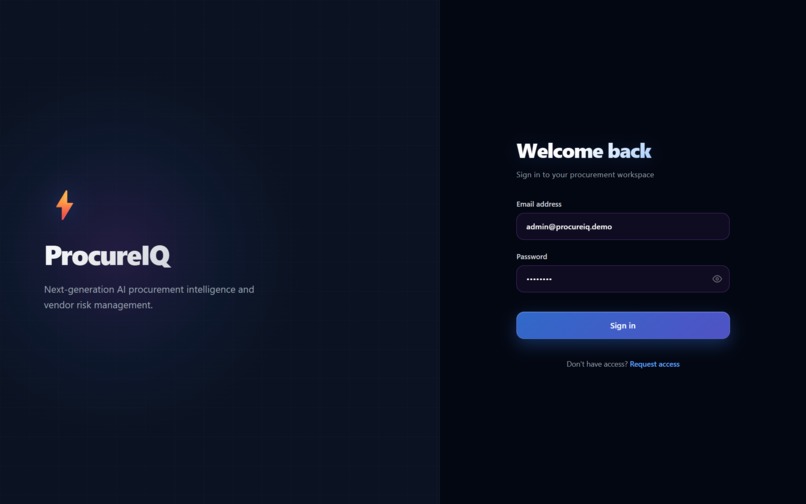
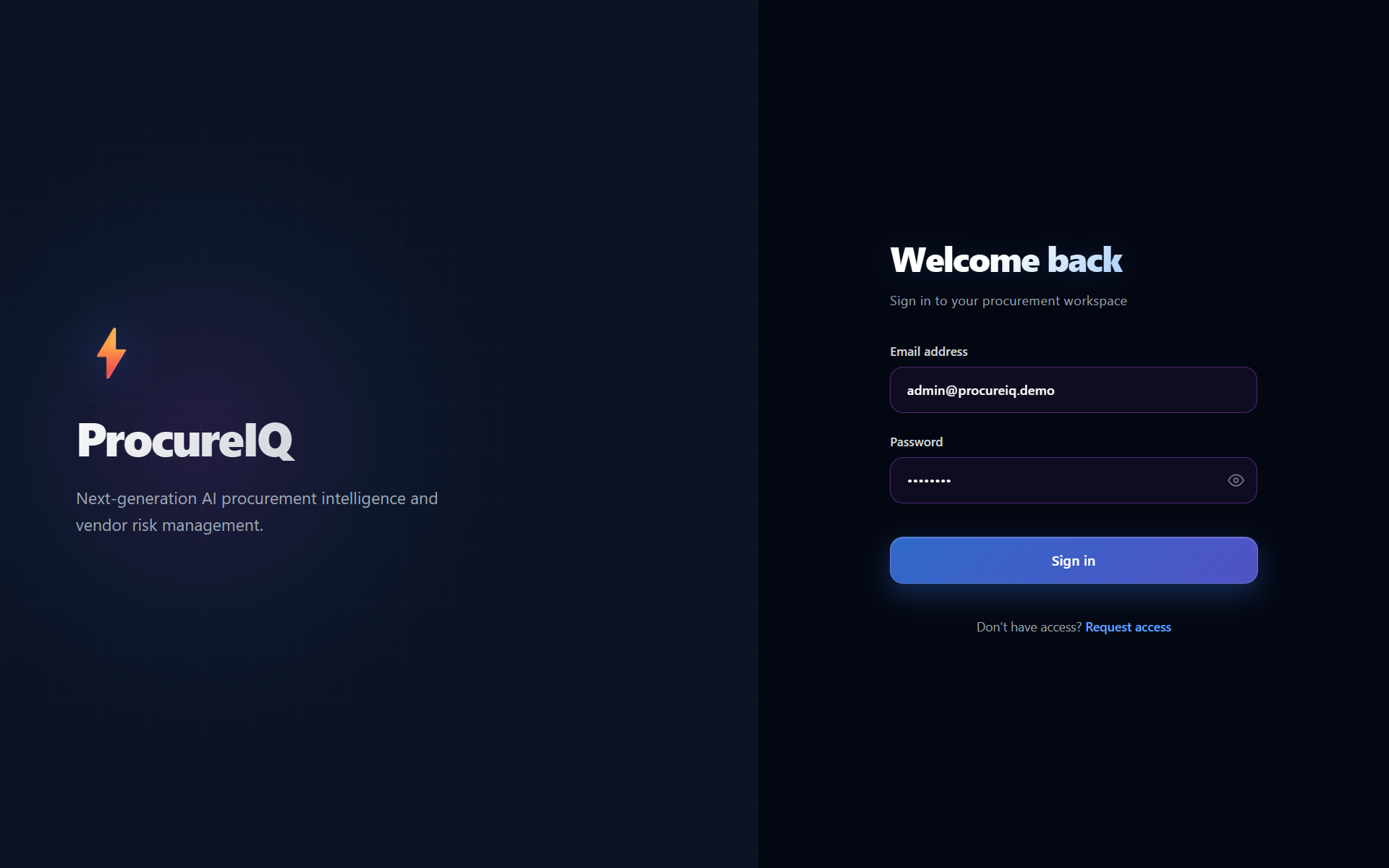
Login Page
-
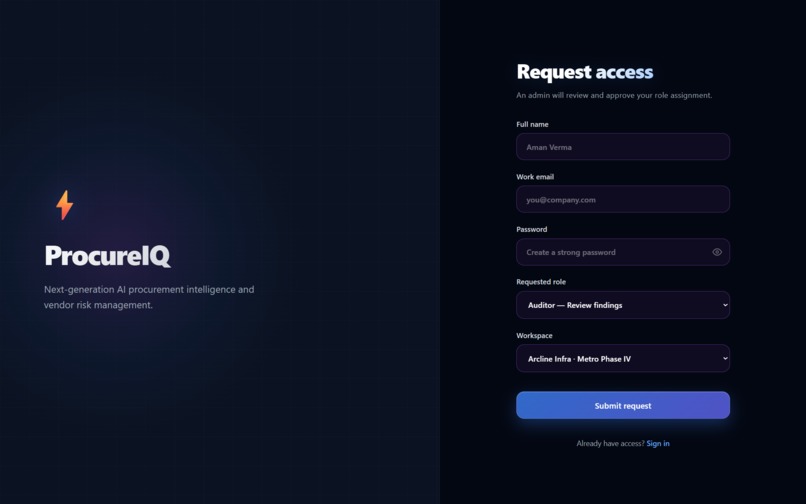
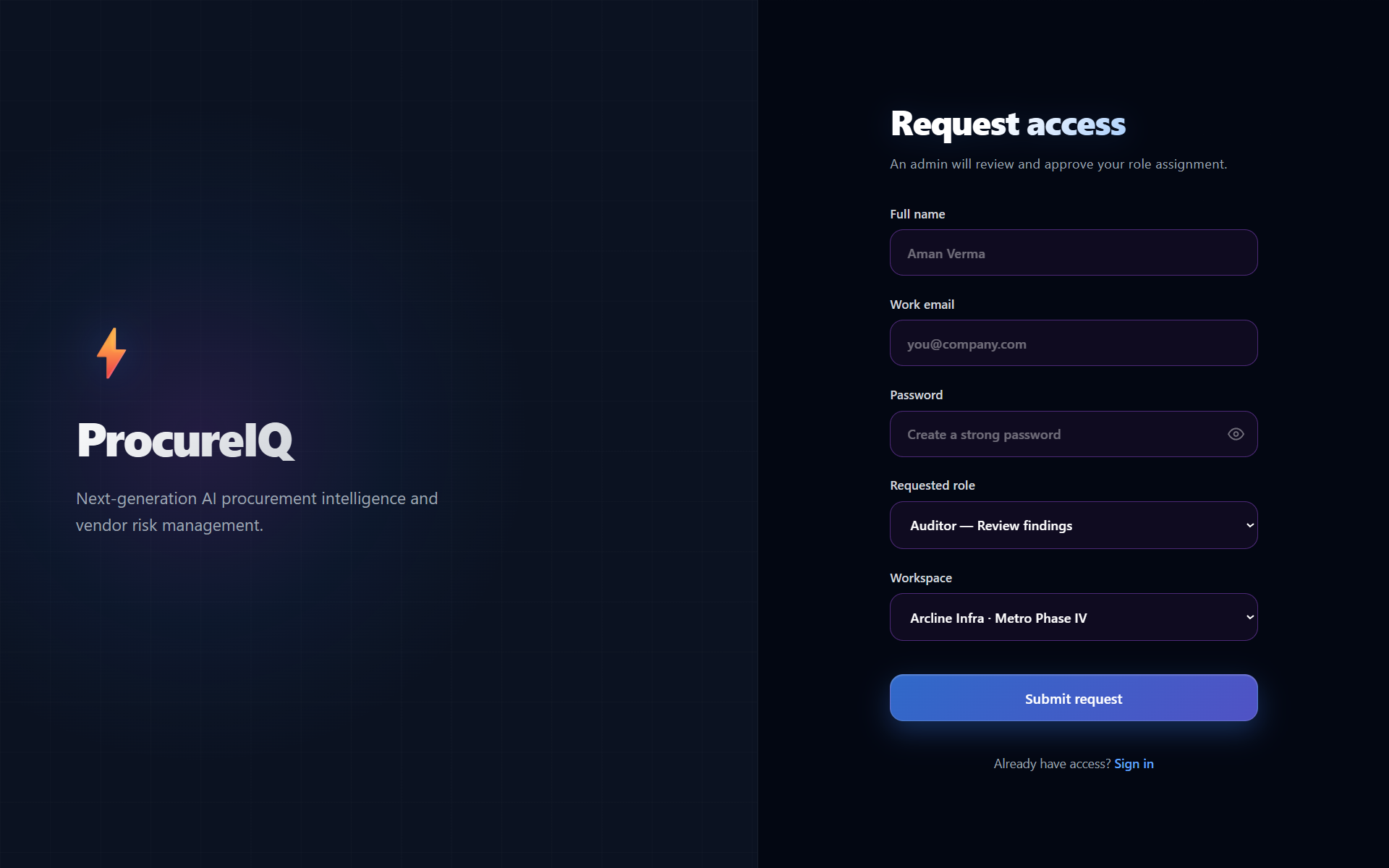
Signup Page
-
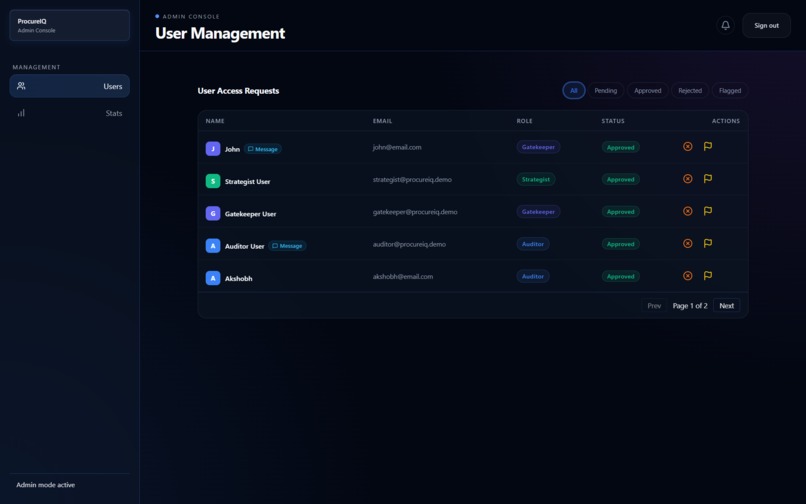
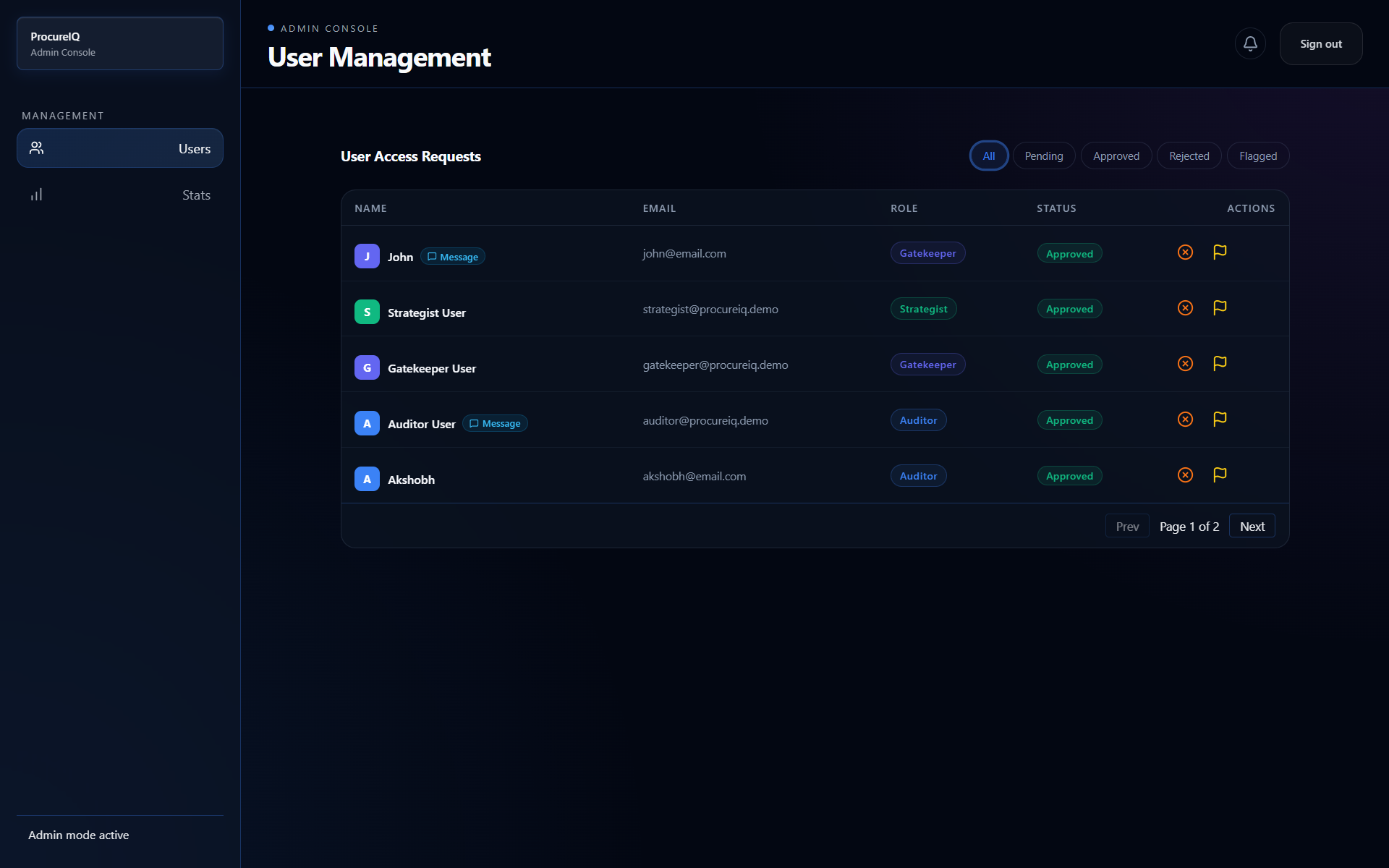
Admin Console
-
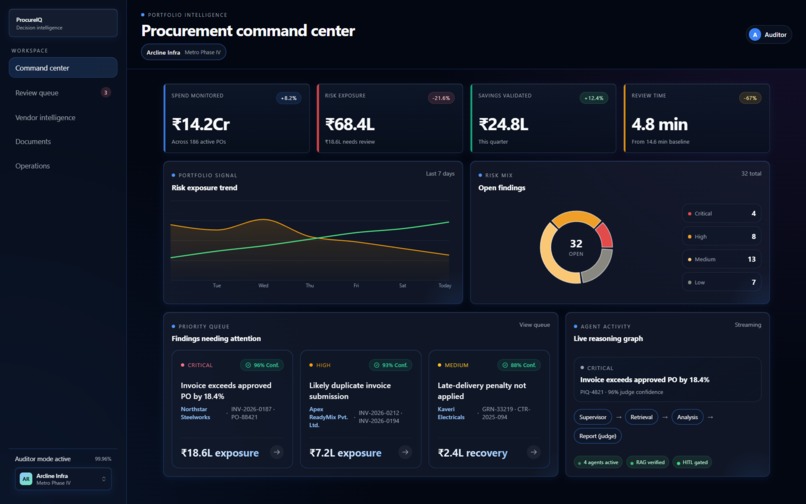
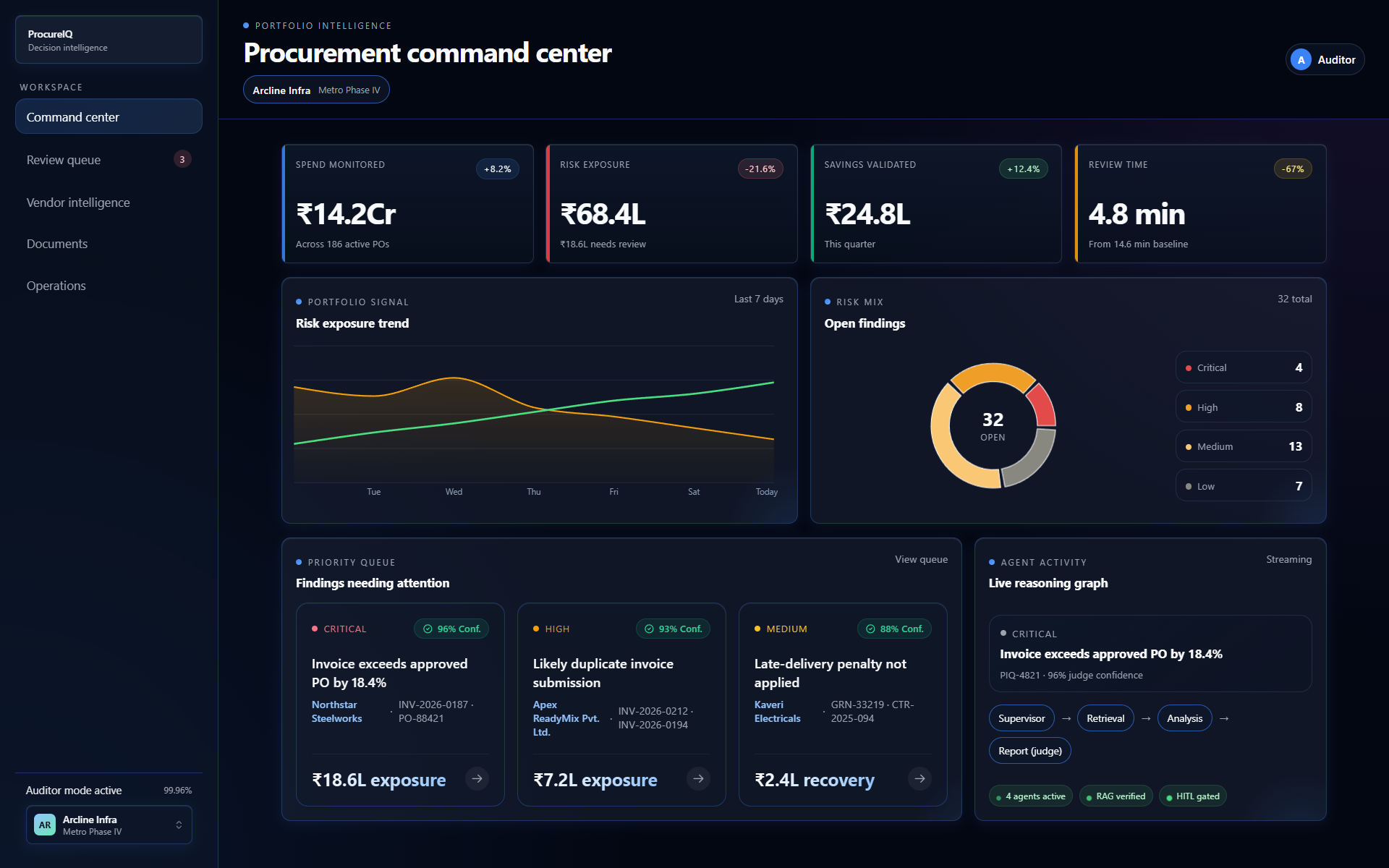
Auditor Dashboard
-
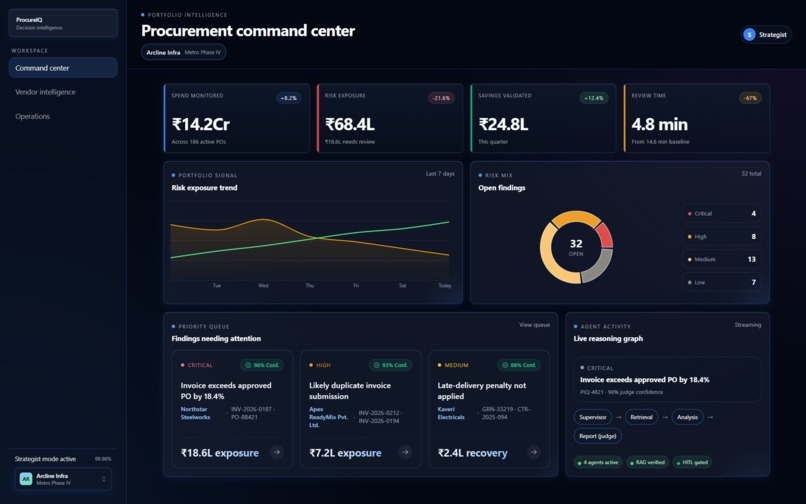
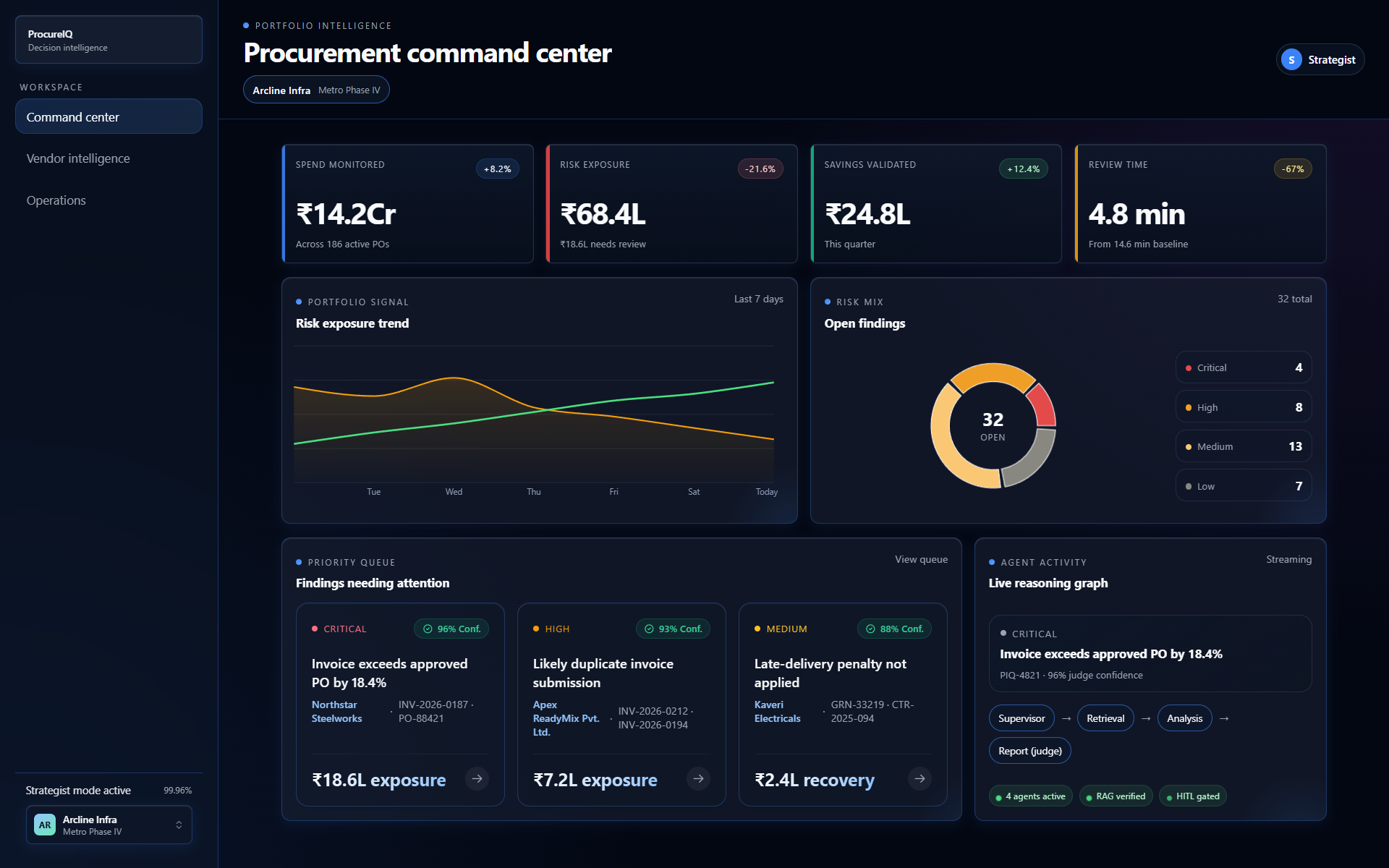
Strategist Dashboard
-
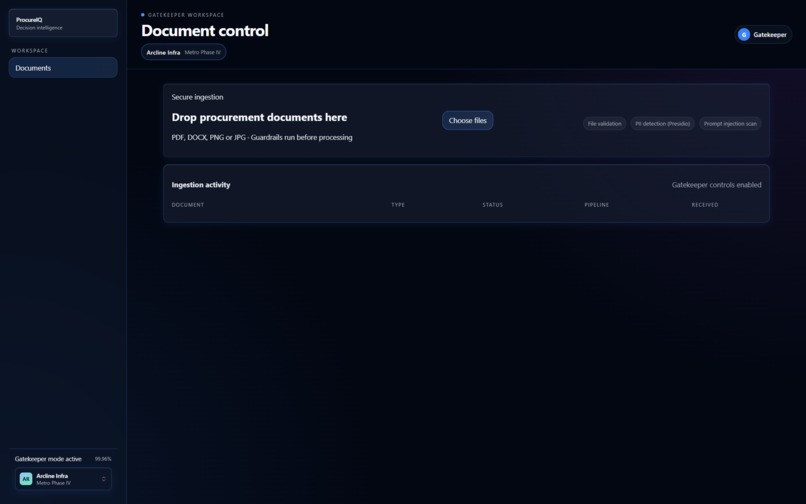
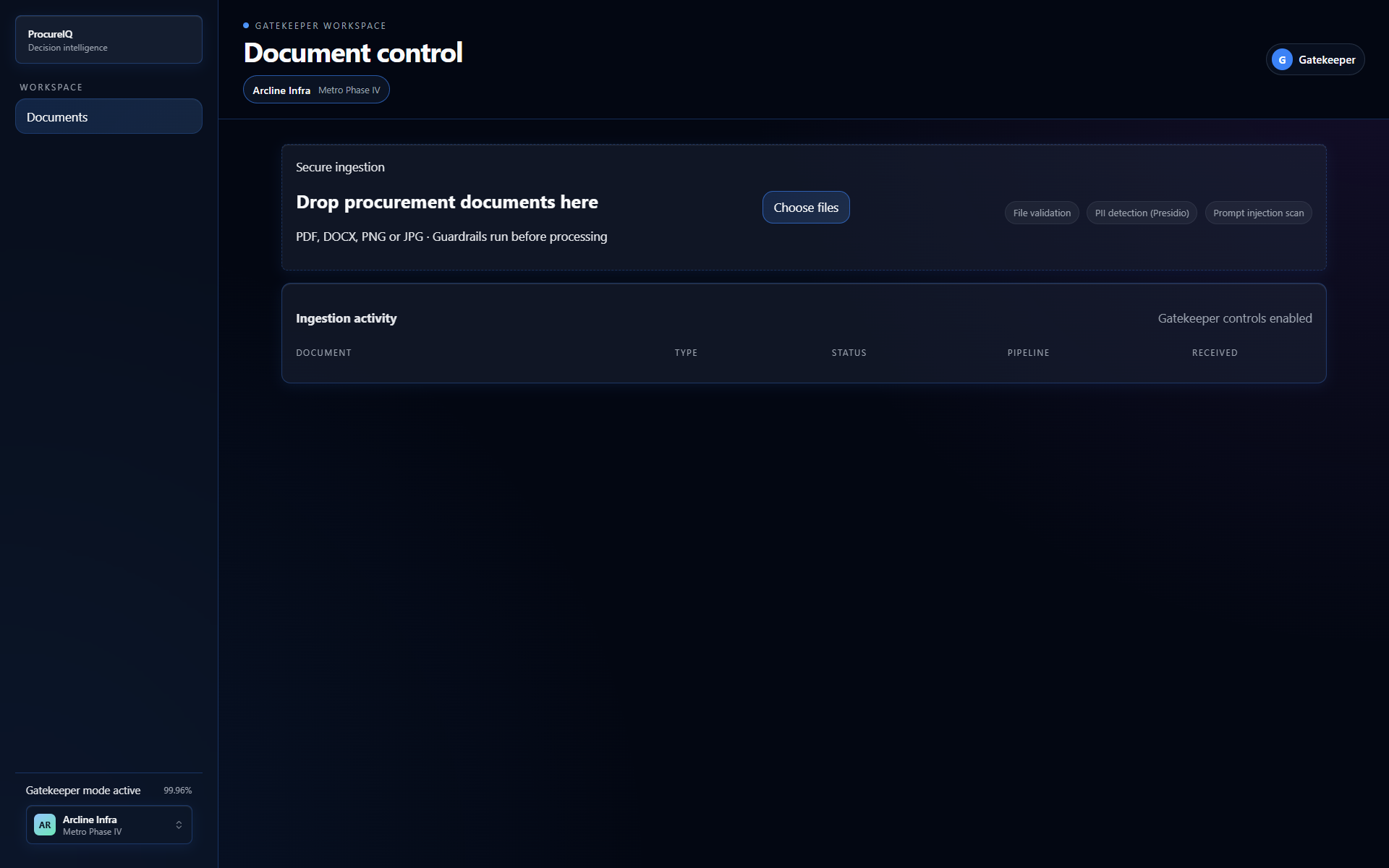
Gatekeeper Dashboard
-
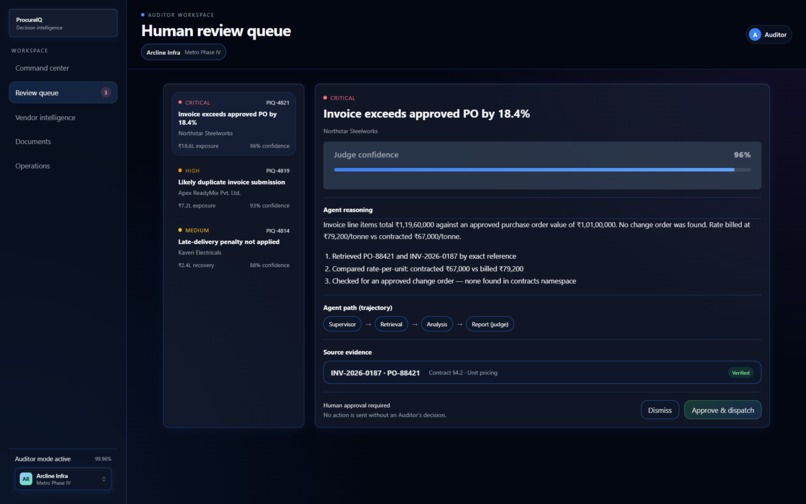
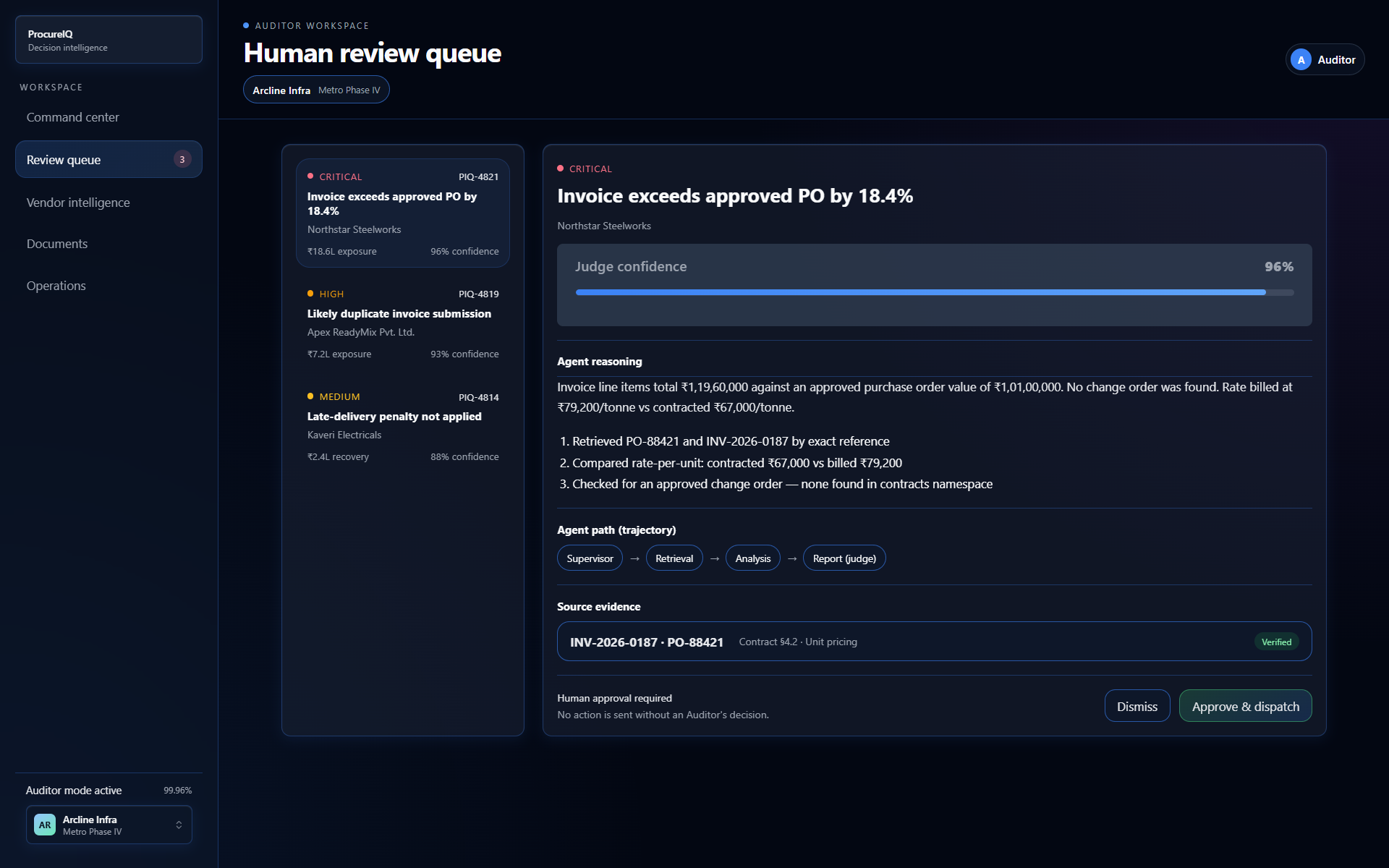
Review Queue
-
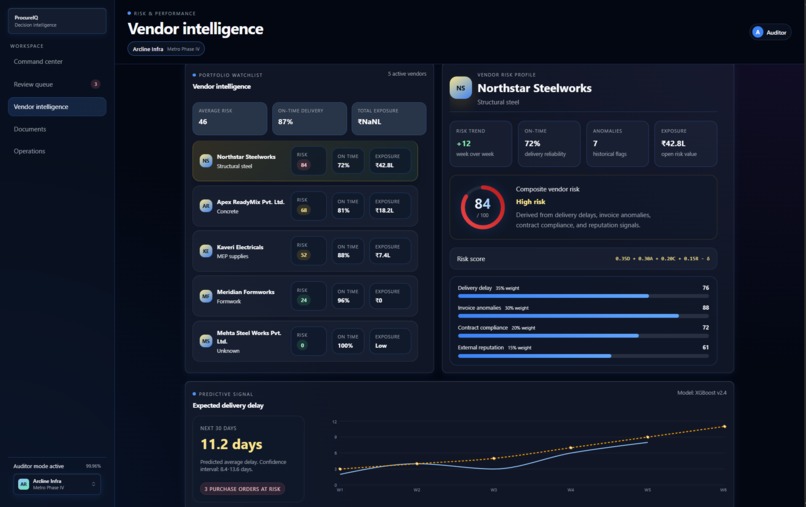
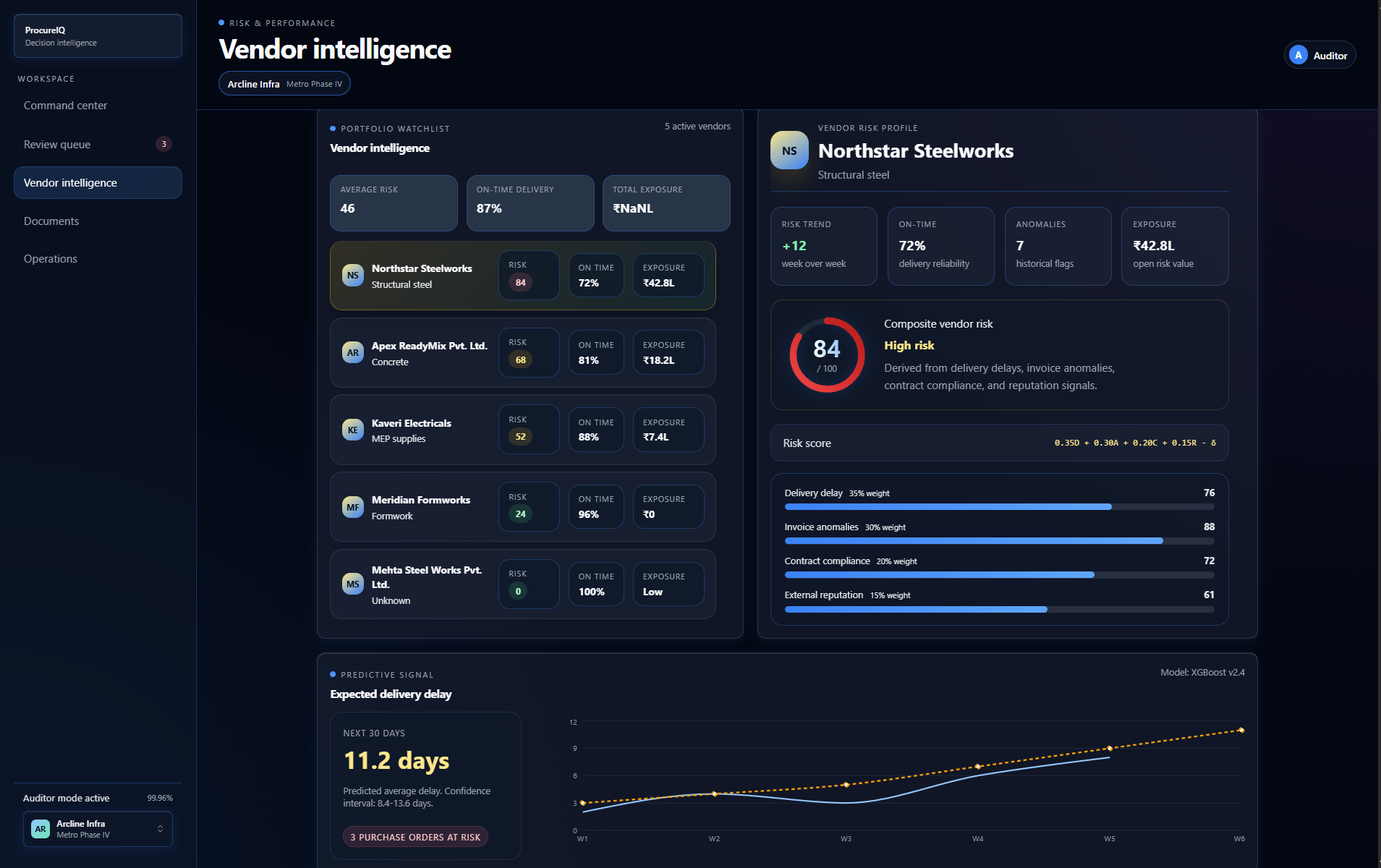
Vendor Intelligence
-
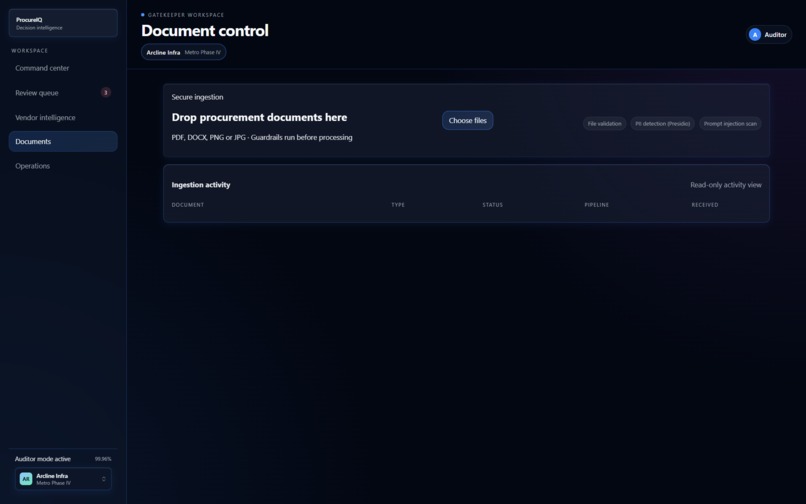
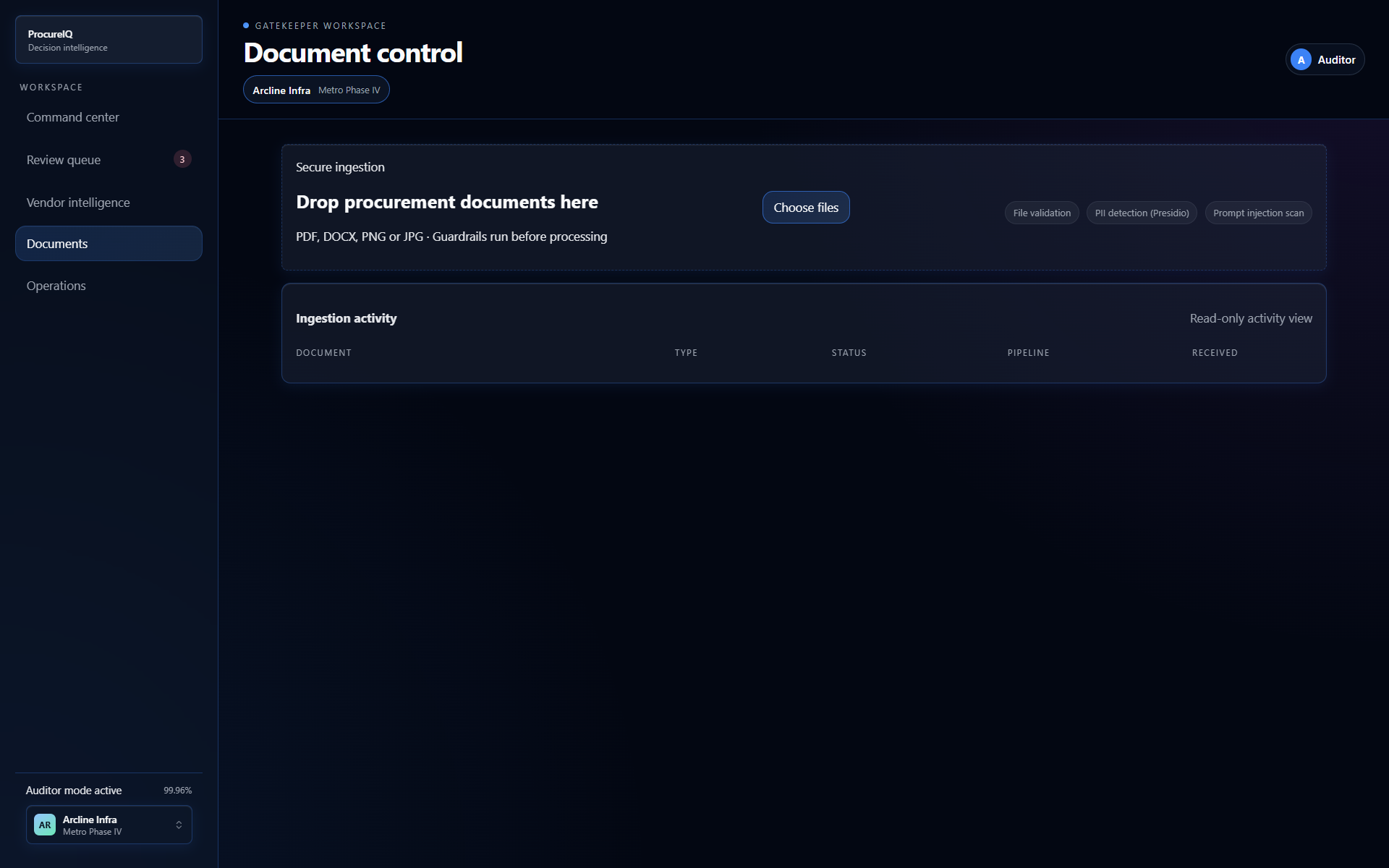
Document Control
-
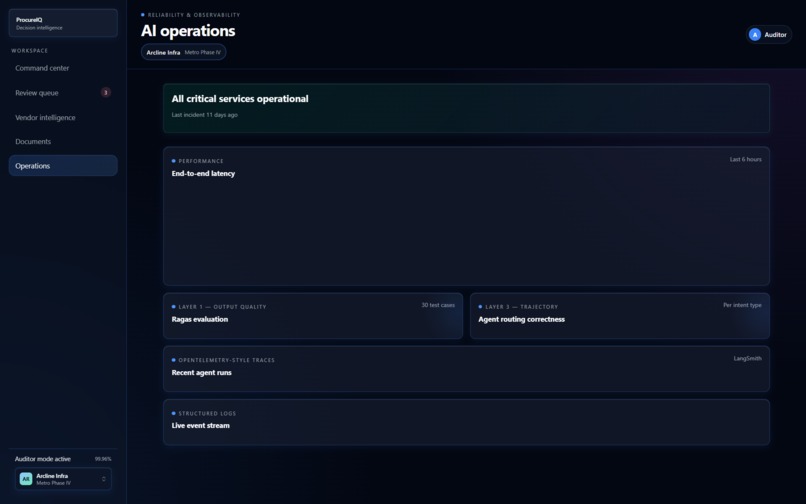
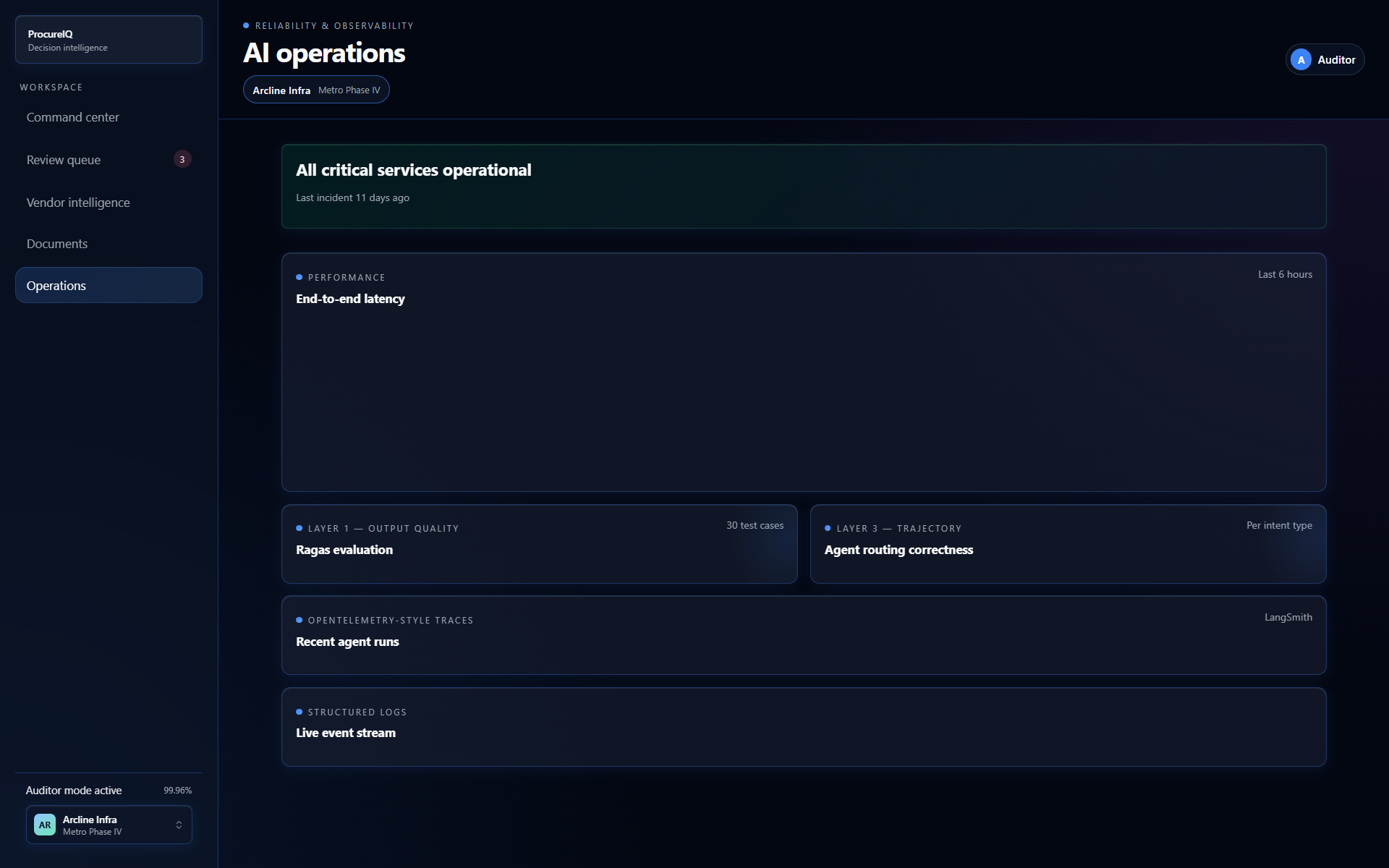
AI Operations
ProcureIQ — AI Procurement Intelligence for Construction
Inspiration
Construction is one of the world's largest industries — and one of its most financially exposed. A single infrastructure project generates thousands of contracts, purchase orders, invoices, and goods receipt notes. Yet procurement teams still cross-reference these documents manually, one at a time, under time pressure, across hundreds of vendors.
The cost of that gap is enormous. According to the ACFE 2024 Fraud Report, 25% of construction firms are victimized by procurement fraud annually, with a median loss of $250,000 per incident. The PwC Global Economic Crime Survey 2024 found that nearly 20% of companies use zero data analytics to catch procurement fraud. And only 1.5% of construction firms currently use any AI tools at all.
The problem isn't a lack of data. Existing ERP systems already capture procurement information. The problem is the lack of an intelligence layer that reasons across documents, detects risk proactively, and acts before money leaves the company.
That insight is what ProcureIQ was built to address.
What We Built
ProcureIQ is a production-grade, multi-agent Agentic RAG system with multi-modal document intelligence — built specifically for construction procurement.
It is not a chatbot. It is not a document search tool. It behaves like an experienced procurement analyst working continuously in the background — reading every document the moment it arrives, cross-checking it against every related document, and flagging problems before a single payment is released.
When an invoice is uploaded, ProcureIQ automatically:
- Retrieves the corresponding contract, purchase order, and goods receipt note
- Cross-validates unit prices, quantities, delivery timelines, and contractual clauses
- Detects anomalies such as overbilling, duplicate invoices, and unenforced penalty clauses
- Accounts for legitimate contractual tolerance clauses — reducing false positives
- Computes an explainable vendor risk score
- Predicts future delivery delays before they impact the project
- Generates a fully grounded finding with exact source citations
- Routes the finding to a human Auditor for final approval before any action fires
Every recommendation is backed by evidence. No action is taken autonomously.
How ProcureIQ Works
Construction Documents (Contracts · POs · Invoices · GRNs)
        │
        ▼
Zero-Trust Input Guardrails
(PII Scan · Prompt Injection · NSFW Check)
        │
        ▼
Async Ingestion Queue (Celery + Redis)
        │
        ▼
Parallel Document Parsing
┌────────────────┬──────────────────┬────────────────────┐
│ OCR Track      │ VLM Track        │ Layout Track       │
│ PyMuPDF +      │ Llama 3.2 Vision │ LayoutLMv3 + Donut │
│ Tesseract      │ via Groq         │ via HuggingFace    │
└────────────────┴──────────────────┴────────────────────┘
        │
        ▼
Chunking + Embedding
(Parent 512 tokens · Child 128 tokens · Metadata tagging)
        │
        ▼
Pinecone Hybrid RAG
(Dense + BM25 · 4 Namespaces · BGE Reranker)
        │
        ▼
LangGraph Multi-Agent Orchestration
(Supervisor → Retrieval → Analysis → Web Search → Report)
        │
        ▼
Output Guardrails
(Hallucination Gate · Confidence Threshold < 0.70 blocked)
        │
        ▼
Forecasting Layer
(Prophet + XGBoost · Vendor Delay Prediction)
        │
        ▼
Human-in-the-Loop Approval
(Gatekeeper · Auditor · Strategist)
        │
        ▼
Procurement Dashboard + Workflow Automation
(5 Workspaces · n8n Webhooks · Audit Trail)
Technical Architecture
ProcureIQ is a 15-stage production pipeline combining multi-modal ingestion, hybrid RAG, multi-agent reasoning, forecasting, and governance into one unified procurement intelligence system.
Five Specialized AI Agents (LangGraph)
| Agent | Responsibility |
|---|---|
| Supervisor | ReAct-style planner — classifies query intent and conditionally routes across the graph |
| Retrieval | Namespace-aware Pinecone query with Redis cache-first and BGE cross-encoder reranking |
| Analysis | Tolerance-aware cross-document comparison — PO vs Invoice vs GRN vs Contract |
| Web Search | External vendor reputation signals via Brave Search MCP server |
| Report (LLM-as-Judge) | Evaluates every finding for grounding and confidence before it reaches a human |
Vendor Risk Score
Every vendor carries a continuously updated, explainable risk score computed as:
Risk Score = 0.35·D + 0.30·A + 0.20·C + 0.15·R − δ
Where:
- D = Delivery delay rate (weighted highest — cascades into site stoppages)
- A = Invoice anomaly rate (most common financial fraud vector)
- C = Contract compliance score
- R = External reputation signal (Brave Search MCP)
- δ = Data sparsity penalty (discounts score when vendor history is insufficient)
Finding Confidence Score
Every finding carries a composite confidence score derived from three verified signals:
Confidence = f(Retrieval Score, Analysis Certainty, Citation Grounding Ratio)
Findings below 0.70 confidence are blocked by the output guardrail and never reach a human Auditor. This ensures that every finding in the review queue is already high-confidence and fully grounded.
Three-Layer Evaluation
ProcureIQ is evaluated across three independent layers — not just final-answer accuracy:
| Layer | What is measured | Tool |
|---|---|---|
| Layer 1 — Output Quality | Faithfulness, context precision, answer relevancy | Ragas |
| Layer 2 — Retrieval Quality | Precision@k, Recall@k (independent of LLM) | Custom eval |
| Layer 3 — Trajectory Quality | Agent routing correctness, path efficiency | LangGraph state + custom eval |
A GitHub Actions CI gate blocks every deployment if any layer's metrics fall below threshold — evaluation is a regression gate, not a dashboard.
What Makes ProcureIQ Different
Most AI procurement tools ask: "Summarize this invoice."
ProcureIQ asks:
- Does this invoice match the contract's unit price?
- Was the delivered quantity within the contractual tolerance clause?
- Should a late-delivery penalty have been applied under §8.7?
- Has this vendor shown similar overbilling behavior before?
- Is this vendor likely to delay the next delivery — and by how many days?
Tolerance-aware reasoning is a key differentiator. Real construction contracts — as found in actual GeM portal tenders and CPWD documents — allow vendors to deliver up to 25% more or less than the ordered quantity without penalty. A naive anomaly detection system flags every deviation as fraud. ProcureIQ checks the contractual tolerance clause first, eliminating false positives that erode auditor trust.
Zero-trust ingestion ensures every document passes three parallel safety checks before entering the pipeline — PII detection via Microsoft Presidio, NSFW screening via Llama Guard, and prompt injection filtering — before any model call occurs.
Governance-first design means ProcureIQ takes zero autonomous financial action. Every finding must pass the LLM-as-judge grounding check, then be approved by a human Auditor via the HITL panel before any workflow fires. Role-based access control enforced at the data retrieval layer — not just the UI — ensures Strategists cannot access raw invoice data and Gatekeepers cannot approve findings.
Challenges We Faced
No linked procurement dataset exists publicly. Real construction procurement documents — contracts, POs, invoices, GRNs all referencing the same project and vendor — are private business records. We solved this by extracting real clause language and structural conventions from CPWD tenders, GeM portal bid documents, and NHAI NIQ documents, then generating a 50-document synthetic anomaly corpus with intentional anomalies built in — overbilling, duplicate invoices, quantity shortfalls outside tolerance, and unenforced penalty clauses.
Construction documents are visually complex. Stamped contracts, scanned invoices, and delivery photos cannot be processed by a text-only pipeline. We built a three-track parallel parsing system — native OCR for clean PDFs, Tesseract fallback for scanned documents, and Llama 3.2 Vision with LayoutLMv3 for image-heavy and layout-critical pages — running concurrently via asyncio.gather.
Tolerance-aware reasoning required domain knowledge. A system that flags every quantity deviation as fraud is not useful — it trains auditors to ignore alerts. Encoding real contractual tolerance logic (the 25% quantity flexibility clause documented in actual GeM tenders) into the Analysis agent required going beyond generic LLM prompting into domain-specific reasoning rules.
Production safety on free-tier infrastructure. Implementing JWT-based RBAC, guardrails-ai input/output validation, Celery async
Built With
- fastapi
- groq
- langchain
- langgraph
- langsmith
- ocr
- pinecone-vectordb
- postgresql
- pymupdf
- python
- rag
- ragas
- sql
- tesseract
- typescript
- vlm


Log in or sign up for Devpost to join the conversation.