-
ProcureAI
Inspiration Every procurement team faces the same painful cycle — a vendor submits a quotation, someone manually searches for their GST registration, someone else checks sanctions lists, another person Googles for fraud news, and weeks later the PO still hasn't been raised because no one could find the IEC number. We've seen this slow down manufacturing companies, construction firms, and government contractors alike. The breaking point was realising that the data is all publicly available — it just takes a human 2-3 days to collect it. We asked: what if an AI agent could do all of it in under 5 minutes?
What it does ProcureAI is a one-click vendor compliance agent that automates the entire pre-purchase-order due diligence workflow. You enter a product and country. ProcureAI dispatches autonomous web agents that simultaneously:
Discover suppliers on TradeIndia with live pricing, MOQ, and verified status Verify GST registration — GSTIN, Active/Cancelled status, legal name, registration date Check OFAC sanctions — screens against the US Treasury's Specially Designated Nationals list Scan news and risk signals — flags fraud, legal disputes, or adverse press Locate IEC trade license — confirms import/export eligibility via DGFT records
Results are scored on a 100-point compliance model and presented as a visual dashboard with vendor scorecards, risk flags, renewal trackers, and a branded downloadable PDF report — ready to share with your procurement team, auditors, or finance approvals. Additional features include multi-supplier parallel compliance checks (select up to 6 vendors and verify all simultaneously) and side-by-side comparison cards showing GST, sanctions, news risk, and IEC status across suppliers.
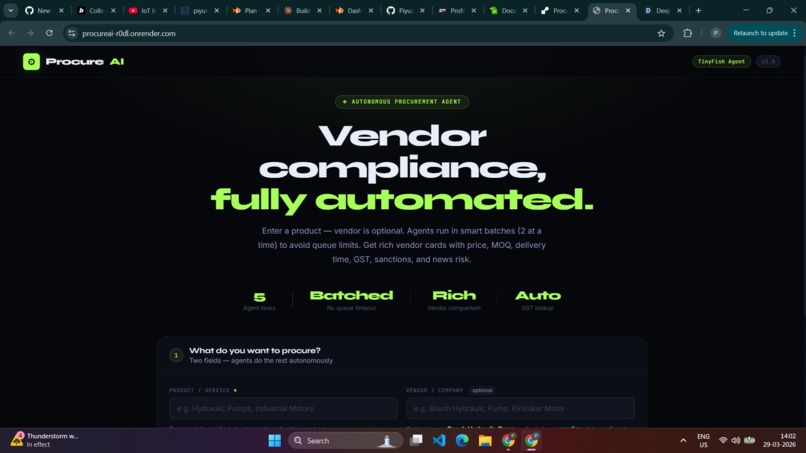
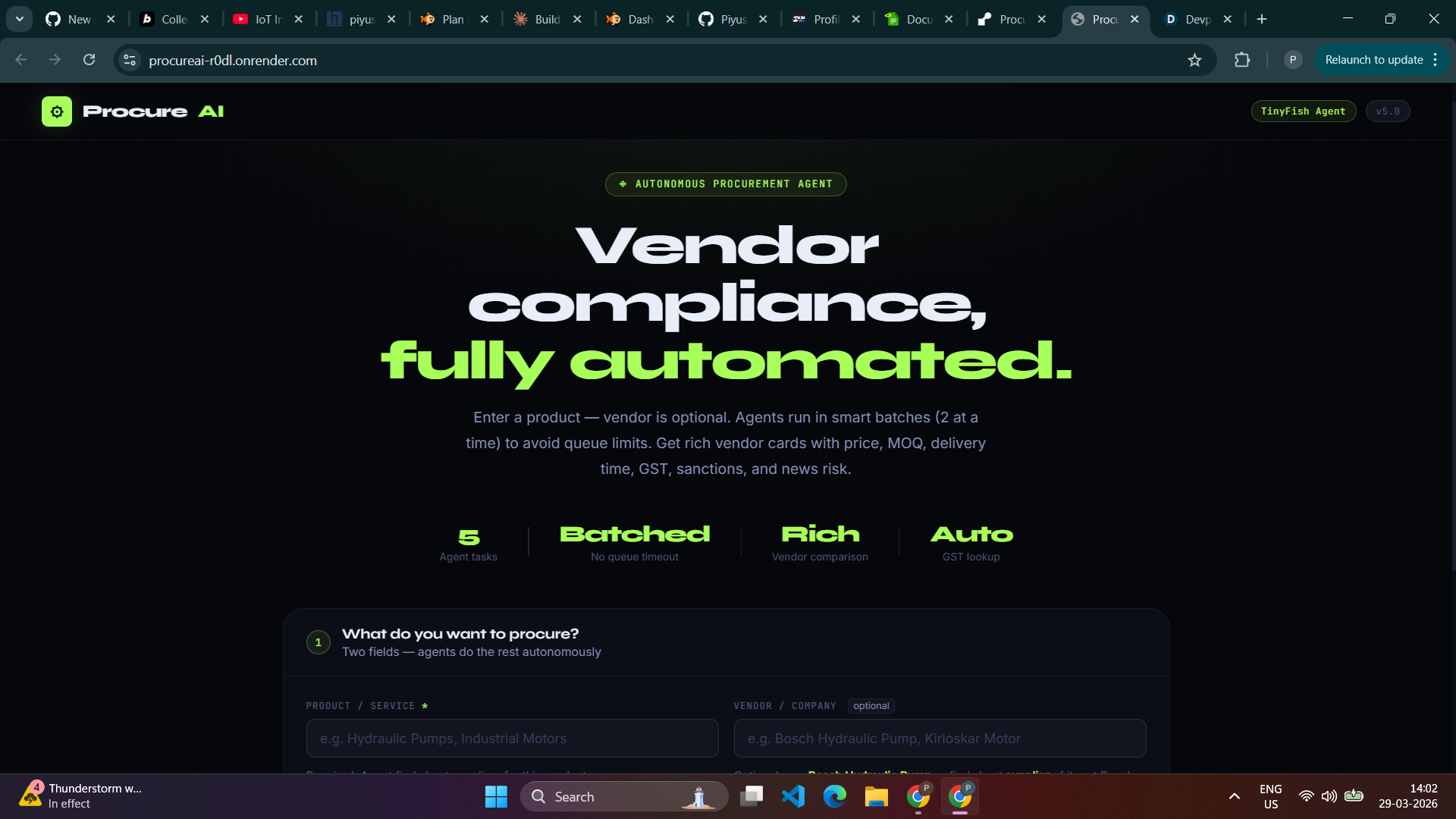
How we built it Frontend: Vanilla HTML, CSS, and JavaScript — no framework overhead, just a fast, responsive single-page dashboard with live agent log streams, animated score bars, and supplier comparison cards. Backend: Node.js proxy server that forwards requests to the TinyFish API and streams SSE (Server-Sent Events) back to the browser — keeping the API key server-side and enabling real-time progress updates. AI Agents: TinyFish Automation API launches real remote browser sessions. Each agent receives a precise, minimal goal — designed to land on results immediately, read what's visible, and return structured JSON without unnecessary navigation. We run all 4 compliance agents in parallel using Promise.all to minimise total run time. PDF Export: jsPDF generates a multi-page branded compliance report with score rings, color-coded risk flags, supplier scorecards, market pricing analysis, negotiation intelligence, and a pre-PO checklist — all formatted for sharing with a procurement team. Deployment: Render (Node.js web service) at procureai-r0dl.onrender.com Source: github.com/Piyush-Jhajhria/ProcureAI
Challenges we ran into Agent prompt engineering was the hardest part. Early versions had agents scrolling pages, clicking links, running secondary searches — turning a 90-second task into a 6-minute one. The breakthrough was learning to be extremely directive: "Read what is visible RIGHT NOW. Do NOT click anything. Do NOT scroll. Return immediately." Shorter, more imperative goals cut agent runtime by over 60%. Concurrency limits on the free TinyFish tier meant we had to be strategic about which agents run in parallel versus sequentially — and build graceful degradation so one slow or failed agent never blocks the rest of the report. PDF rendering with jsPDF required careful font-safe text handling — stripping HTML entities, avoiding Unicode characters that jsPDF's built-in fonts don't support, and building a proper multi-page layout engine from scratch since jsPDF has no automatic page-break handling. Live streaming took several iterations. The TinyFish /run-sse endpoint delivers a STREAMING_URL within seconds — but the browser's remote session cold-start takes 30-90 seconds before the agent actually navigates anywhere. Getting the UI to communicate "working but loading" versus "broken" was a UX challenge that required honest messaging rather than fake progress indicators.
Accomplishments that we're proud of
Full end-to-end compliance check — 5 agents, 4 data sources, 1 structured report — completing in under 5 minutes A scoring model that weighs GST status, sanctions, news risk, and IEC into a single 0-100 compliance score with APPROVED / REVIEW REQUIRED / REJECTED verdict Multi-supplier parallel verification — select up to 6 discovered vendors and run compliance on all of them simultaneously, with a real-time side-by-side comparison A PDF report detailed enough to send directly to a finance team or auditor, including negotiation intelligence (target price based on market minimum) and a pre-PO checklist Zero manual steps between entering a product name and having a shareable compliance report
What we learned Agentic AI is only as good as the instructions you give it. The difference between a goal that says "find the GST details for this company" and one that says "read the snippets visible on screen right now, do not navigate, return immediately" is the difference between a 4-minute agent run and a 45-second one. We also learned that streaming UX is a first-class problem — users interpret silence as failure, so communicating expected wait times honestly is more important than hiding latency behind animations.
What's next for ProcureAI: Autonomous Vendor Compliance Agent
ERP integrations — push compliance reports directly into SAP, Tally, or Zoho Books as vendor approval records Scheduled re-verification — automatically re-run compliance checks before GST or IEC renewal deadlines International expansion — DUNS lookup, EU VAT verification, UK Companies House, and US SAM.gov debarment checks Team collaboration — shared compliance dashboards where procurement managers can approve, flag, or request more information on vendors Audit trail — immutable compliance history per vendor, with timestamped snapshots for regulatory audits
Built With
- css3
- html
- javascript
- jspdf
- node.js
- tinyfish

Log in or sign up for Devpost to join the conversation.