-
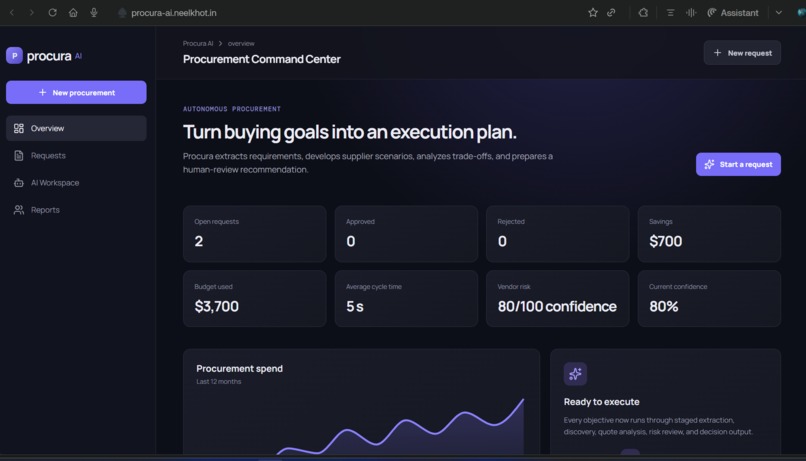
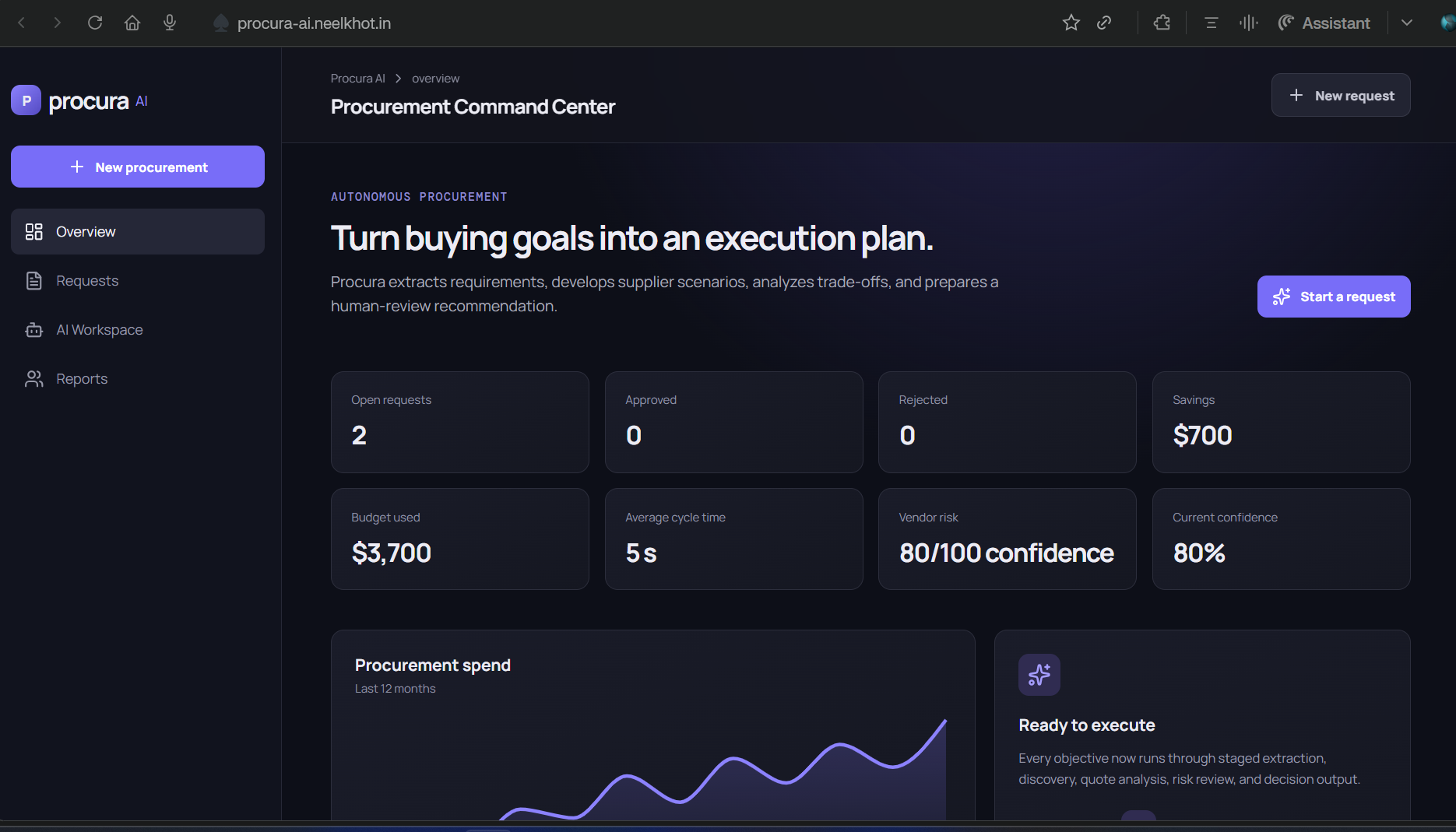
Procura AI Dashboard
-
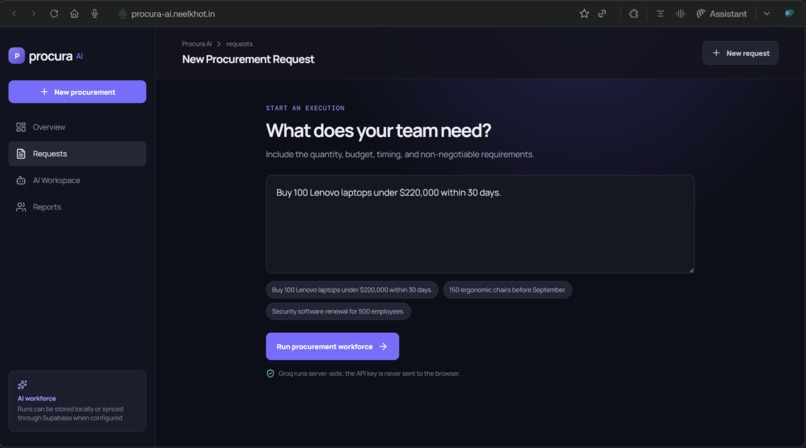
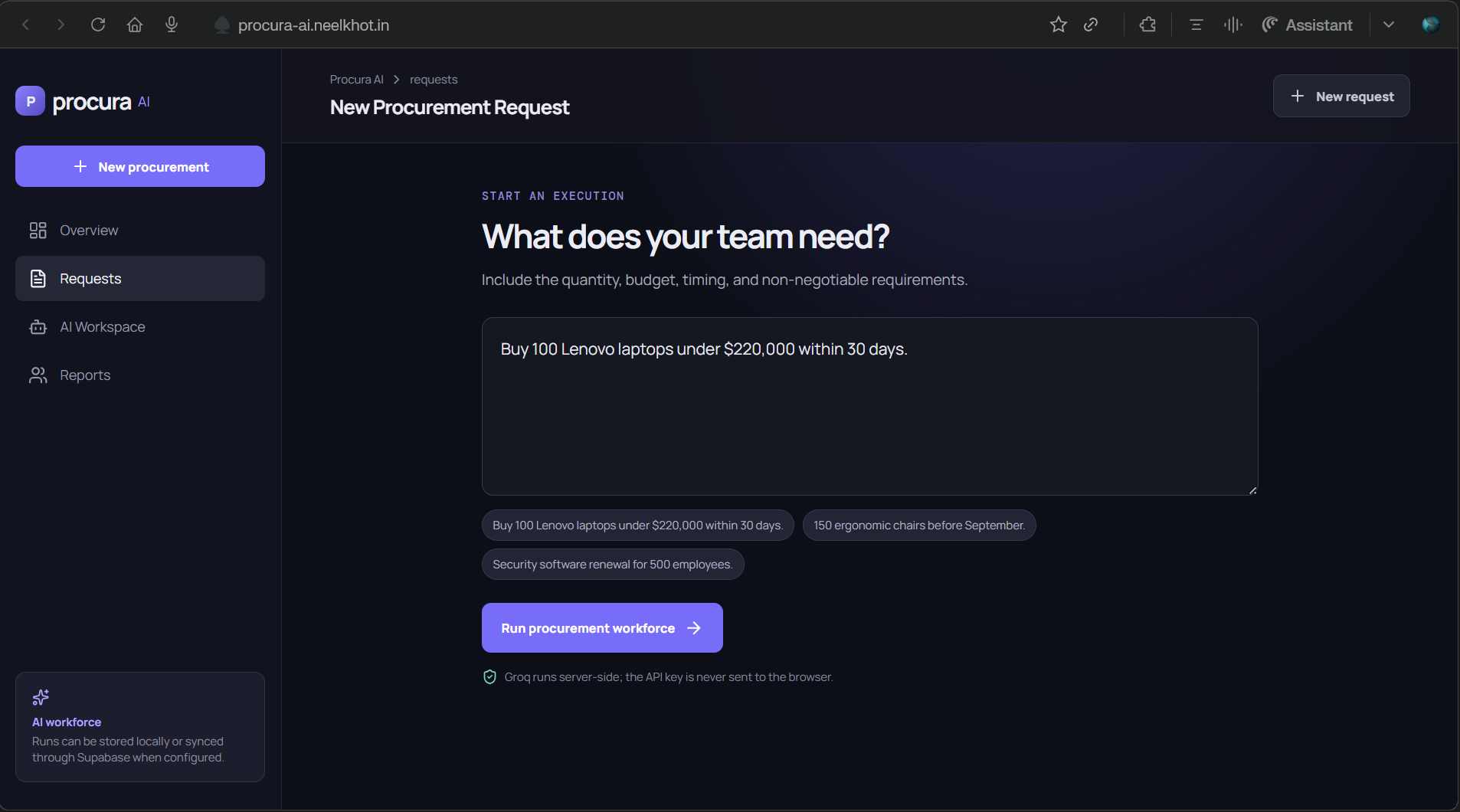
Procura AI New Procurement Request
-
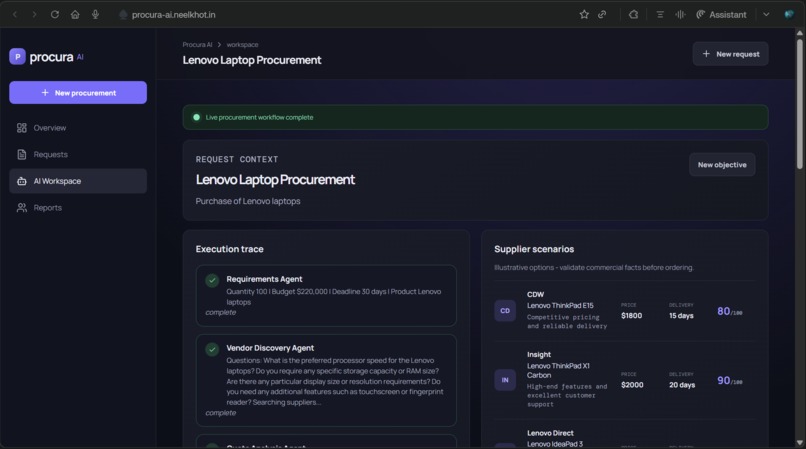
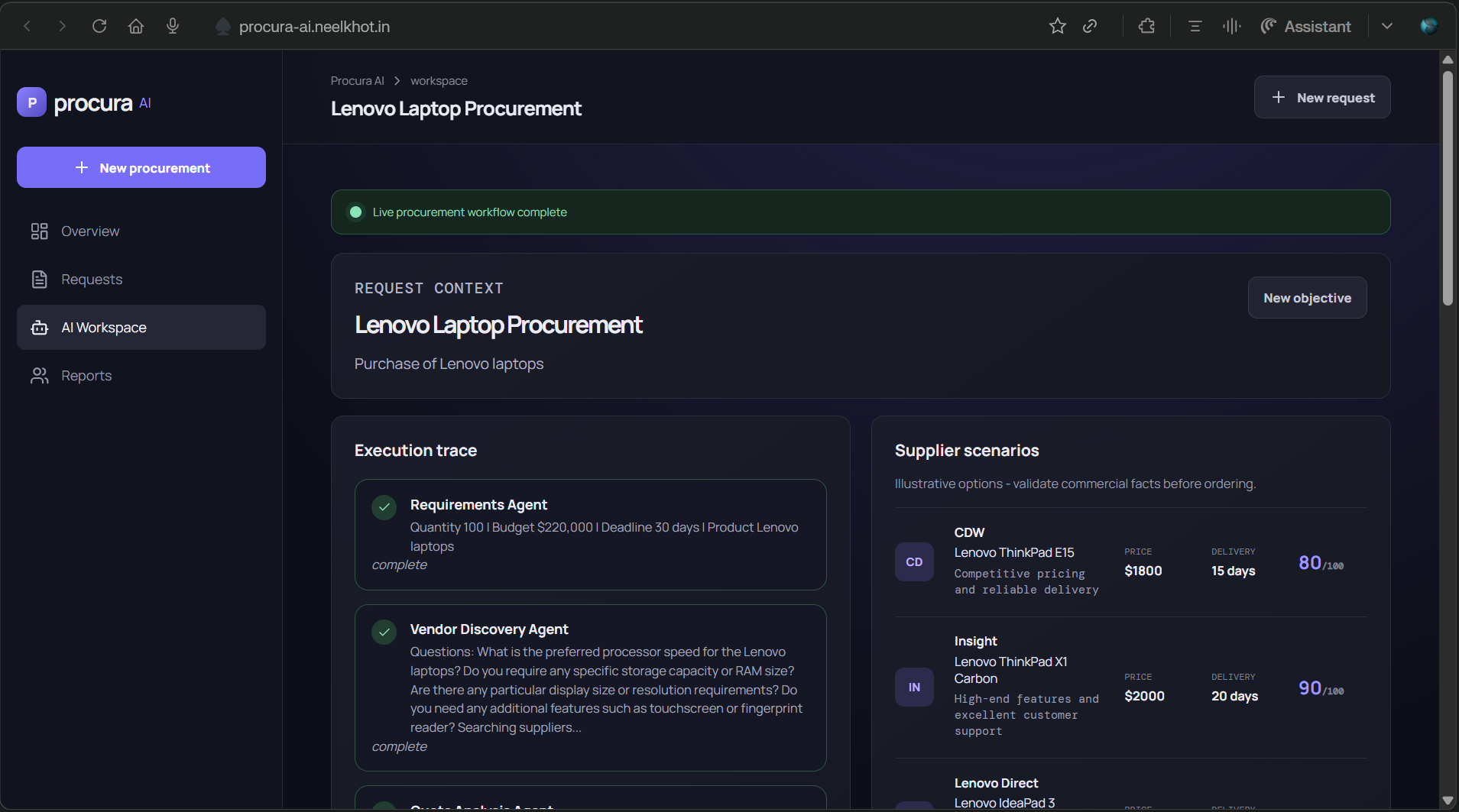
Procura AI Workspace
-
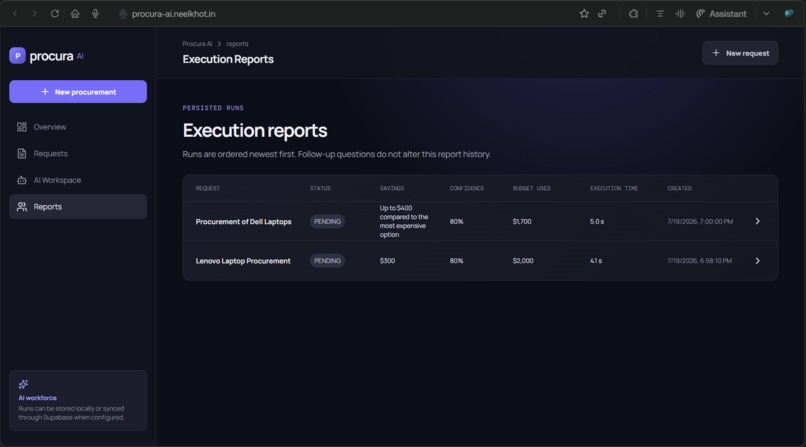
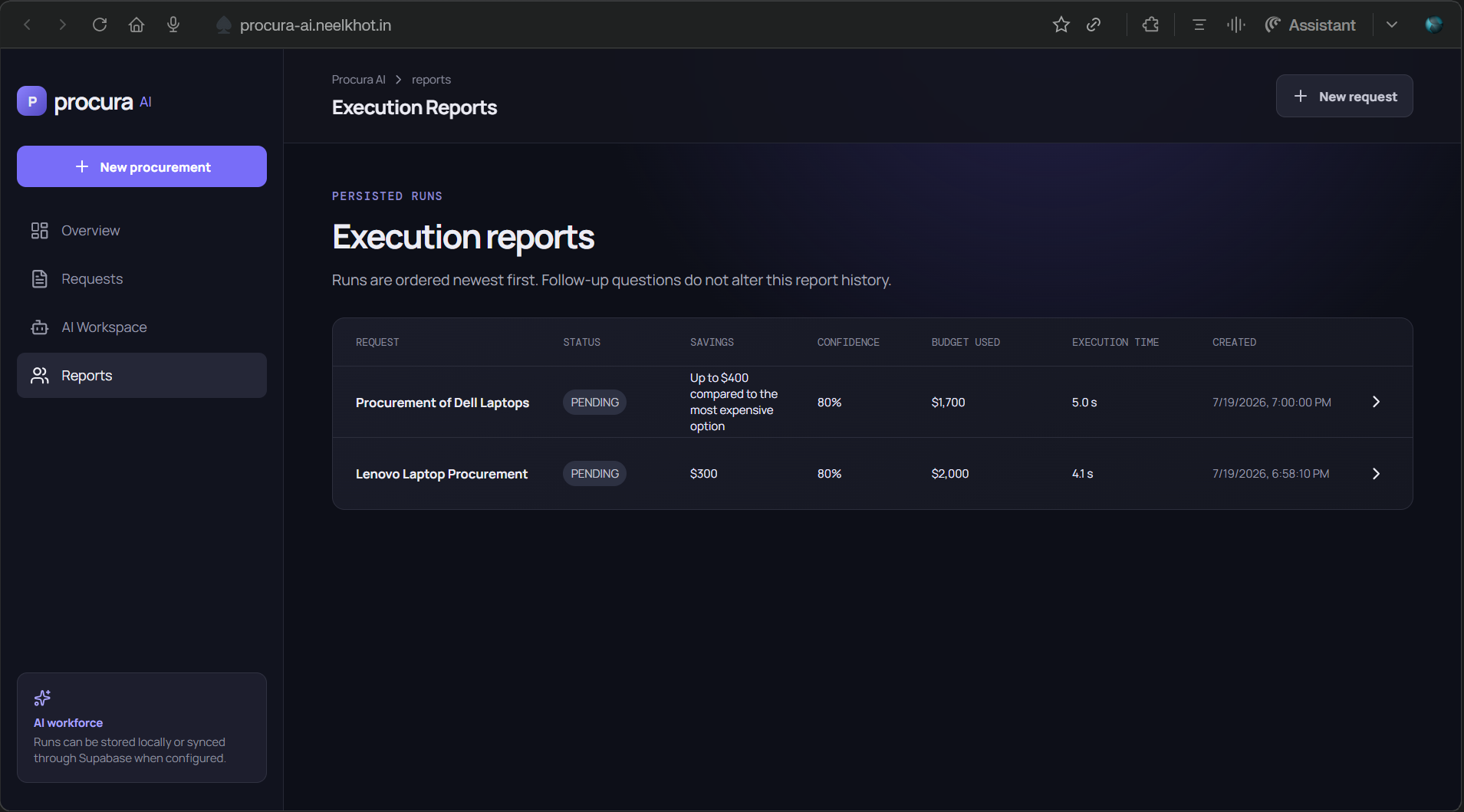
Procura AI Reports
Procura AI
An autonomous AI procurement workforce that transforms natural-language purchasing requests into explainable, approval-ready procurement decisions.
Live Demo: https://procura-ai.neelkhot.in/
Inspiration
Enterprise procurement is still surprisingly manual.
A simple request like:
"Purchase 100 Lenovo laptops under $220,000 within 30 days."
typically involves requirement gathering, vendor research, quotation analysis, risk assessment, stakeholder approvals and documentation. Most of this work is repetitive and consumes valuable time before a purchasing decision can even be made.
We wanted to explore whether AI agents could behave like a procurement team instead of just answering questions.
Rather than building another chatbot, we built an autonomous procurement workforce where specialized AI agents collaborate to complete procurement tasks while keeping humans in control of the final decision.
What it does
Procura AI converts a natural-language procurement request into a complete procurement workflow.
The system executes multiple specialized agents sequentially:
- Requirements Agent
- Vendor Discovery Agent
- Quote Analysis Agent
- Risk Assessment Agent
- Decision Agent
Each agent performs a dedicated responsibility and passes structured output to the next stage.
The result is:
- Structured procurement requirements
- Supplier scenarios
- Comparative quote analysis
- Procurement risk assessment
- Explainable purchasing recommendation
- Human approval workflow
Every procurement run is stored as a report, allowing users to revisit previous executions without affecting their original results. Users can also continue asking contextual follow-up questions through the Procurement Copilot, which maintains conversation history for the selected procurement run.
How we built it
Frontend
- React
- TypeScript
- Vite
- Tailwind CSS
Backend
- Node.js
- Express-style REST APIs
Database
- Supabase
AI
The application is designed as a provider-agnostic AI architecture.
During development and live demonstration, runtime inference is performed using the Groq API to reduce development costs while preserving the overall architecture.
The AI layer orchestrates sequential procurement agents that perform:
- Requirement extraction
- Vendor discovery
- Quote comparison
- Risk evaluation
- Procurement recommendation
How Codex accelerated development
Codex was used throughout the project as an engineering collaborator rather than simply generating isolated code.
Architecture
Codex helped design the overall multi-agent procurement architecture, breaking the workflow into specialized AI agents with clearly defined responsibilities instead of building a single conversational interface.
Product Decisions
Codex accelerated decision making by helping us evaluate implementation tradeoffs and refine the product experience.
Examples include:
- Designing sequential AI agent execution
- Creating persistent procurement reports
- Separating procurement execution from follow-up conversations
- Improving dashboard information hierarchy
- Designing supplier comparison workflows
- Refining user interactions throughout development
Engineering
Codex significantly accelerated implementation by generating and refining:
- React components
- TypeScript models
- Backend APIs
- Prompt engineering
- State management
- Responsive layouts
- Error handling
- Documentation
- Build configuration
- Bug fixes
- Code refactoring
Development was highly iterative, with Codex continuously helping improve functionality, maintainability and developer productivity.
Testing & Iteration
Codex also assisted in debugging and refinement, including:
- Fixing stalled execution workflows
- Resolving JSON parsing inconsistencies
- Improving procurement state transitions
- Correcting follow-up conversation context
- Improving report persistence
- Validating production builds throughout development
GPT-5.6 Usage
GPT-5.6 was used extensively through Codex during development.
It helped us:
- Design the system architecture
- Plan agent responsibilities
- Review implementation decisions
- Refine prompts
- Generate production code
- Refactor existing code
- Improve documentation
- Accelerate debugging
- Iterate on the overall user experience
The project was built collaboratively with Codex throughout the entire engineering process rather than using AI only for isolated code generation.
Challenges we ran into
One of the biggest challenges was making the system feel like a genuine AI workforce instead of a chatbot returning a single response.
This required restructuring the backend into sequential agent execution where every stage produces explainable outputs before handing work to the next agent.
Other challenges included:
- Maintaining execution state across multiple agents
- Preserving procurement history while supporting contextual conversations
- Producing consistent structured outputs across providers
- Designing an enterprise-grade user experience within a hackathon timeline
What we learned
Building Procura AI reinforced several ideas:
- Multi-agent systems provide significantly better explainability than single-prompt AI applications.
- Enterprise users require transparency as much as automation.
- Human approval remains an important safeguard for procurement decisions.
- AI is most effective when specialized agents collaborate around clearly defined responsibilities.
What's next
Our roadmap includes:
- Real supplier integrations
- Live quotation retrieval
- Purchase order generation
- ERP integrations
- Vendor onboarding
- Contract analysis
- Procurement analytics
- Budget forecasting
- Multi-user collaboration
- Approval chains
- Audit logging
- Autonomous supplier negotiations
Our long-term vision is to build an AI workforce capable of automating enterprise procurement while remaining transparent, explainable and human-supervised.
Built With
- codex
- gpt5.6
- javascript
- node.js
- railway
- react
- restapi
- typescript
- vercel
- vite
