-
-
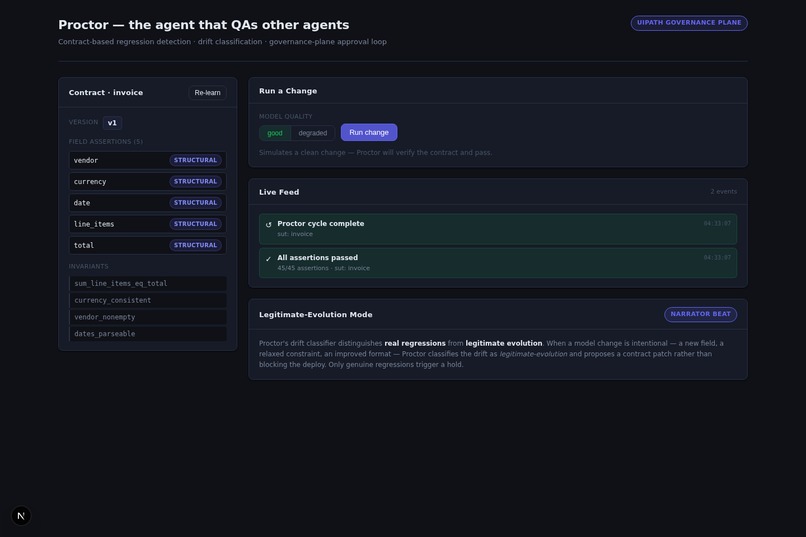
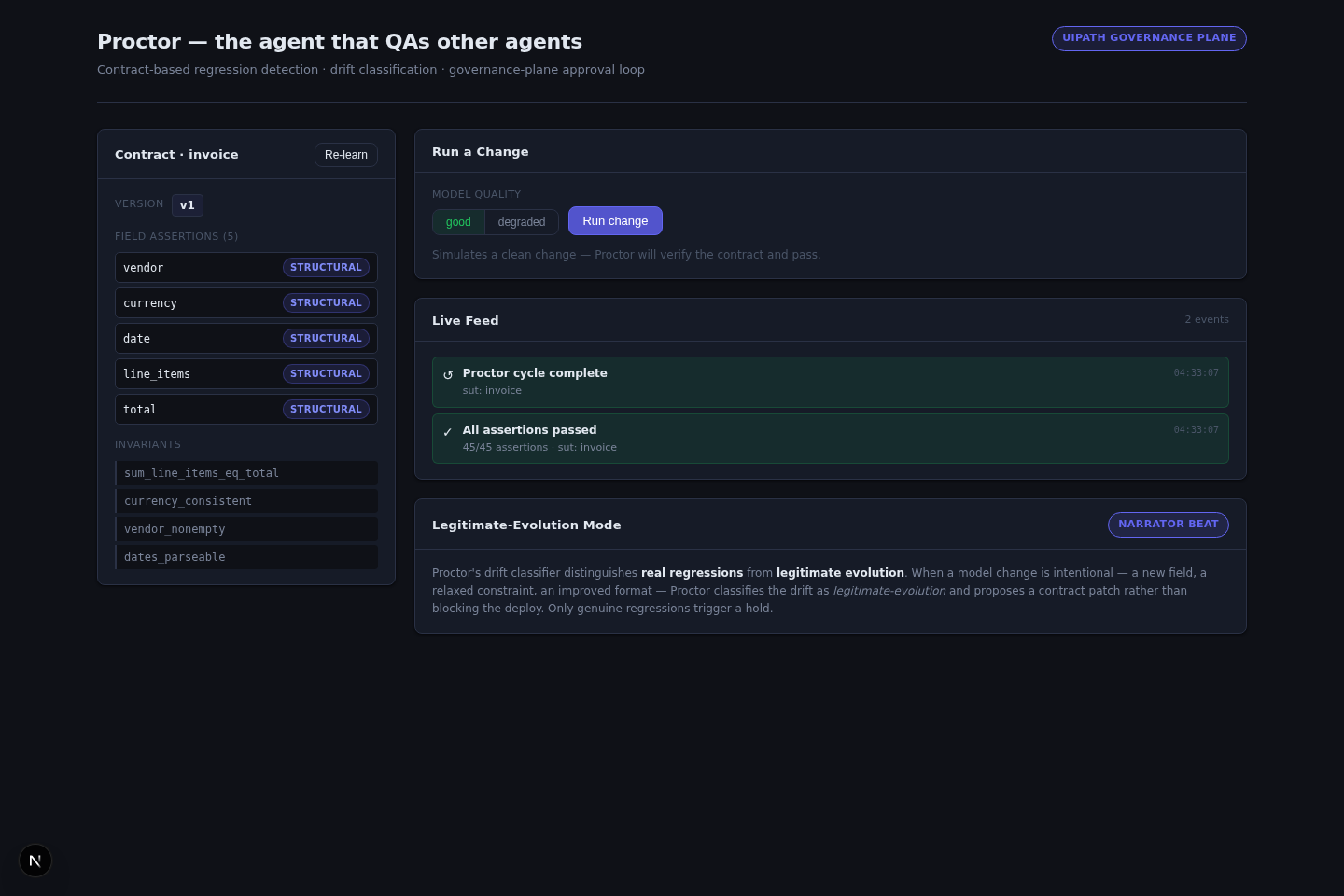
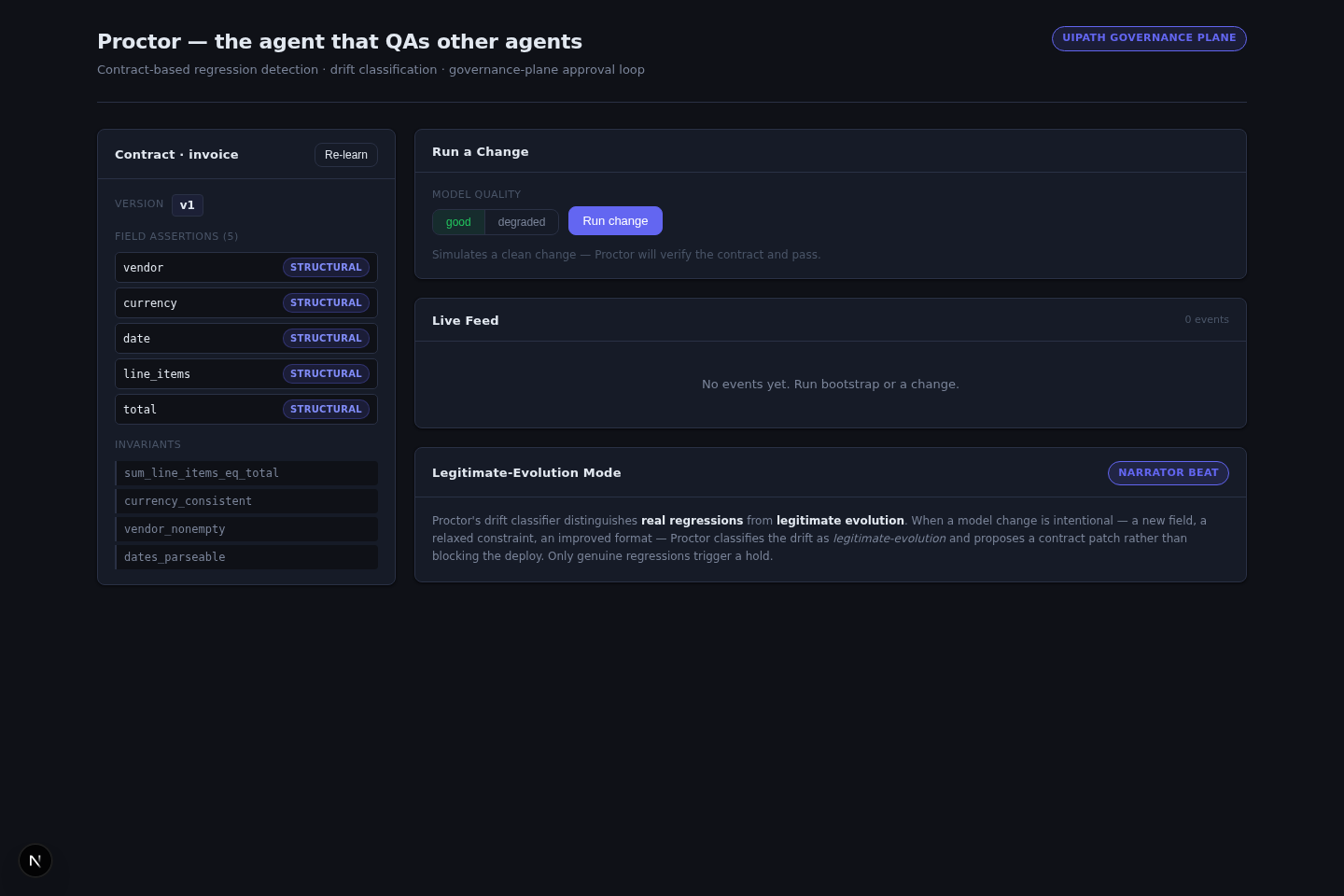
Proctor learns each agent's behavioral contract — assertions + invariants.
-
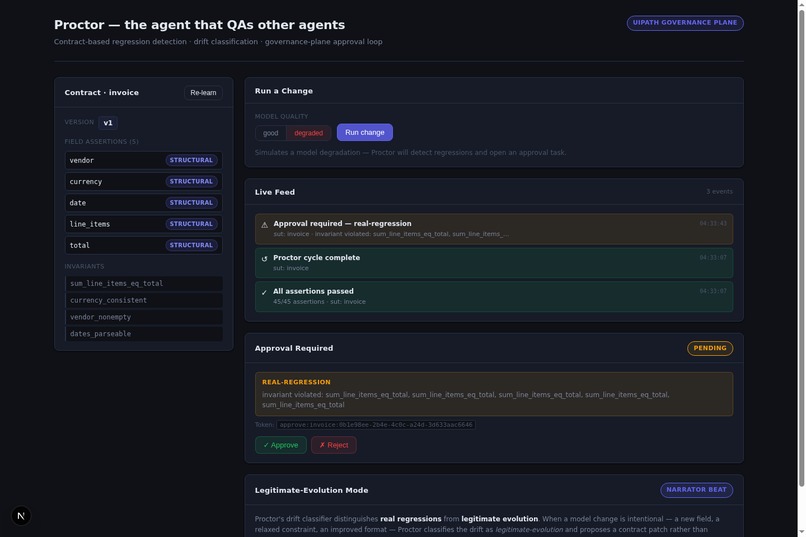
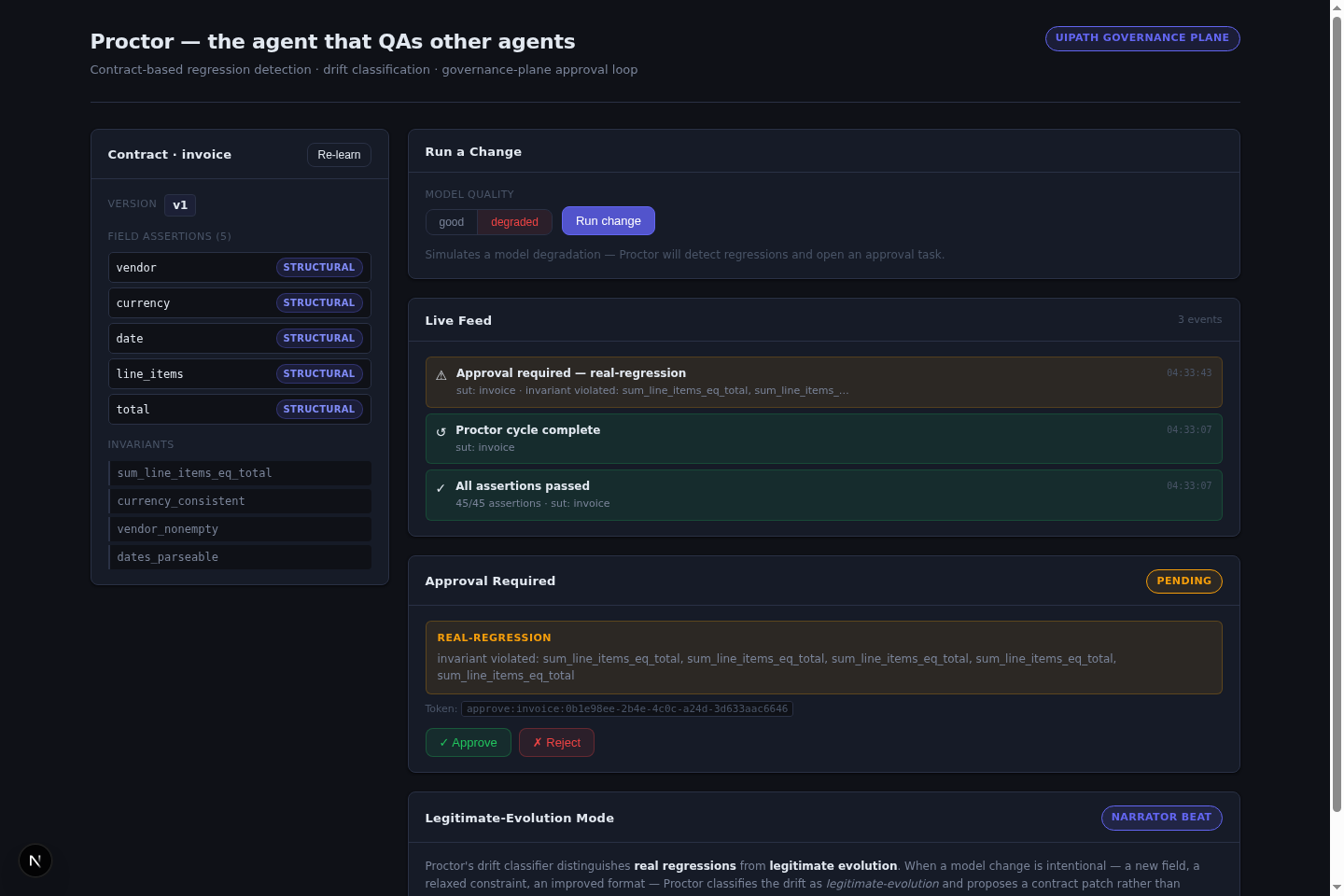
A degraded model is caught as a real regression; the durable workflow suspends for human approval.
-
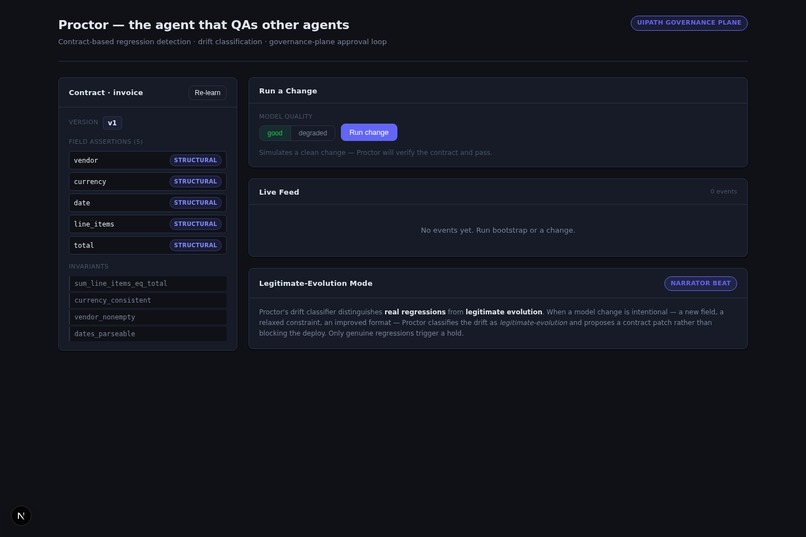
Proctor learns each agent's behavioral contract — assertions + invariants.
-
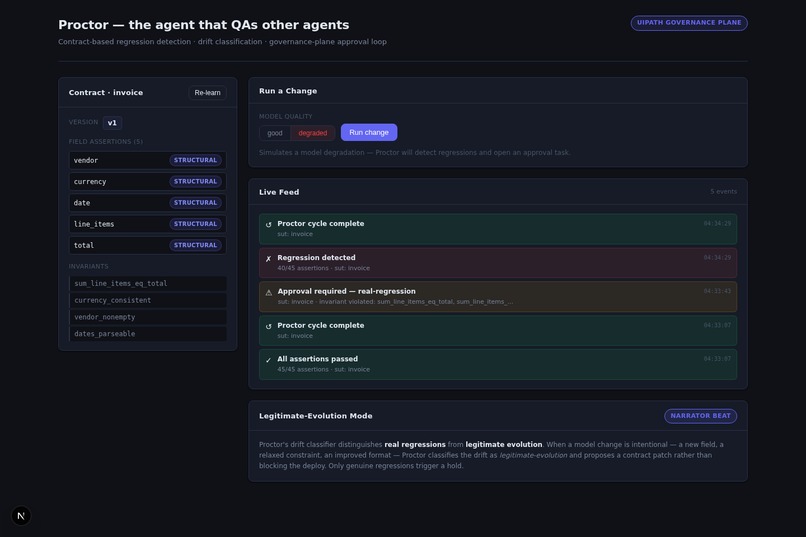
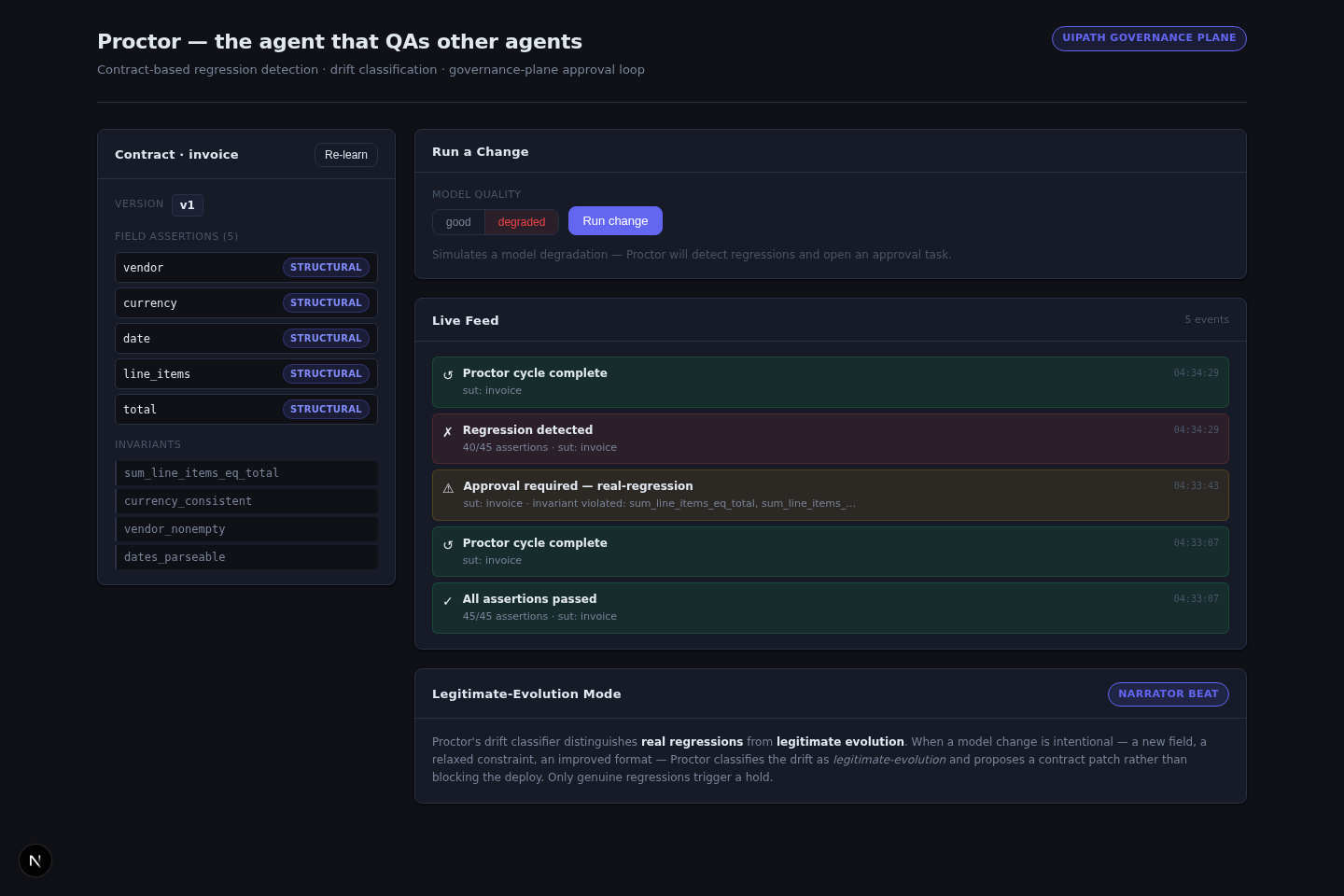
Human approves; the workflow resumes and records the decision.
Proctor — the agent that QAs other agents
Track: UiPath AgentHack 2026 — Track 3: UiPath Test Cloud*Repo:* https://github.com/OrionArchitekton/proctor (MIT)
Tagline (one line)
An agentic QA system that regression-tests non-deterministic AI automations — it learns each agent's behavioral contract, catches silent regressions when a model or prompt changes, self-heals its tests, and escalates real failures to a human — all governed by UiPath.
Inspiration
Coding agents have made it trivial to build AI automations. The hard, unsolved part is operating them safely. An LLM-based automation that extracts invoices, triages tickets, or summarizes claims gives a slightly different answer every run — so the moment someone swaps the model or tweaks a prompt, behavior can silently drift and no traditional test catches it. assertEqual(output, expected) either flakes constantly or passes on garbage. Enterprises are now deploying thousands of these agents with no regression safety net. That gap is what Proctor fills.
What it does
Proctor is a coding-agent-built QA agent that tests other AI automations:
- Learns a behavioral contract. It runs the target agent over a sample set, observes which fields are stable vs. variable, and synthesizes a contract of tiered assertions (structural / exact / semantic) plus hard invariants (e.g. line items must sum to the total).
- Detects regressions in non-deterministic output. It re-runs the agent on a change and evaluates against the contract — using semantic similarity and invariants rather than brittle equality.
- Classifies the drift. A classifier decides: real-regression (behavior got worse → alert), legitimate-evolution (output changed but is still correct → propose a contract patch), or flaky (within tolerance → ignore).
- Keeps a human in charge. On any consequential change it suspends a durable workflow on a human-approval hook — surviving interruptions for as long as the reviewer needs — then resumes and either files the regression or versions the contract.
- Orchestrates by risk. It scores which contracts to run first based on failure history and what the change touched (model / prompt / schema).
The demo system-under-test is a deliberately non-deterministic invoice-extraction agent: flip it from the "good" model to a "degraded" one and Proctor catches the broken total live, classifies it as a real regression, and routes it to a human for approval.
How we built it
- Two-altitude architecture. UiPath is the enterprise control plane — Test Cloud receives the test results, Action Center hosts the human approval task, Orchestrator/Maestro triggers runs on change, and the audit trail records every decision. The Vercel Workflow DevKit is the agent's own durable runtime — the heal-and-approve loop that survives interruptions and human-in-the-loop pauses. The two never compete for the orchestrator role; they operate at different altitudes.
- Pure, dependency-injected engine. The assertion engine, contract learner, drift classifier, risk scorer, and contract store live in a pure
@proctor/enginepackage with all LLM/I/O injected — so it's fully unit-tested and runs keyless in CI. - UiPath behind one adapter — verified live. A
UiPathGatewayinterface has aLocalGateway(disk + dashboard) and aTestCloudGateway(real Automation Cloud REST). All four surfaces are verified live against a UiPath Labs tenant with our actual code:openApprovalTaskcreated real Action Center tasks (100000126–128);triggeredRunstarted an Orchestrator job (67149929, State=Successful) on a published API workflow;pushTestResultpublishes each TestReport to an Orchestrator queue (Proctor_TestResults); governance warns honestly (UiPath has no public audit-write API). Re-runnable viascripts/live-gateway-probe.ts. (Test Cloud's Test Set execution is wired too, but this Labs tenant gates Test-Case authoring behind a local Robot install, so the queue is the live results channel.) - Built with Claude Code, the coding agent. The monorepo, engine, durable workflows, Next.js dashboard, 77 tests, and docs were built by Claude Code through a spec → plan → test-driven-implementation pipeline. The git commit history is the evidence — a self-attestation, supported by a coherent feature-by-feature commit structure. (This is the hackathon's coding-agent bonus.)
Stack: TypeScript, pnpm monorepo, Next.js, Vercel Workflow DevKit, Anthropic Claude, Zod, Vitest.
Challenges we ran into
- Testing the untestable. The central problem — asserting on non-deterministic output — drove the whole design toward invariants + semantic tolerance + a baseline-aware runner instead of golden-value equality.
- Two orchestrators, one role. Reconciling "UiPath must orchestrate" with a durable workflow engine required the altitude split: UiPath governs at the org level; Vercel Workflow gives the agent itself durability.
- Proving durability is real. We have an integration test that genuinely suspends the workflow on a hook and resumes it — verified against the runtime's event log (
hook_created → hook_received → run_completed), not mocked.
Accomplishments we're proud of
- A working end-to-end durable pause→approve→resume loop, verified live.
- A novel, defensible answer to "how do you regression-test a non-deterministic agent?"
- A clean UiPath governance seam that runs locally today and connects to Test Cloud with a single env flip.
- 76 unit + 1 integration test, all green; keyless reproducibility for judges.
What we learned
You cannot QA an AI agent the way you QA a function. The durable unit of trust is a behavioral contract enforced by absolute invariants and tolerance bands — and the governance layer (who approves, what's audited) matters as much as the detection logic.
What's next
- Populate a UiPath Test Set (needs Studio-authored test cases) so
pushTestResultruns through Test Cloud's Test Set execution in addition to the live Orchestrator-queue results channel. - Persist learned reference values for richer semantic-drift detection.
- Authentication on the approval action (production), step-granularity hardening, and a multi-SUT risk dashboard.
Try it (keyless, no API key needed)
pnpm install
pnpm demo          # narrated end-to-end logic
pnpm dev           # live dashboard at localhost:3000
pnpm test && pnpm test:int   # 76 unit + 1 durable pause/resume integration test
Built With
- anthropic-claude
- claude-code
- next.js
- pnpm
- react
- typescript
- uipath
- uipath-action-center
- uipath-orchestrator
- uipath-test-cloud
- vercel-workflow
- vitest
- zod

Log in or sign up for Devpost to join the conversation.