-
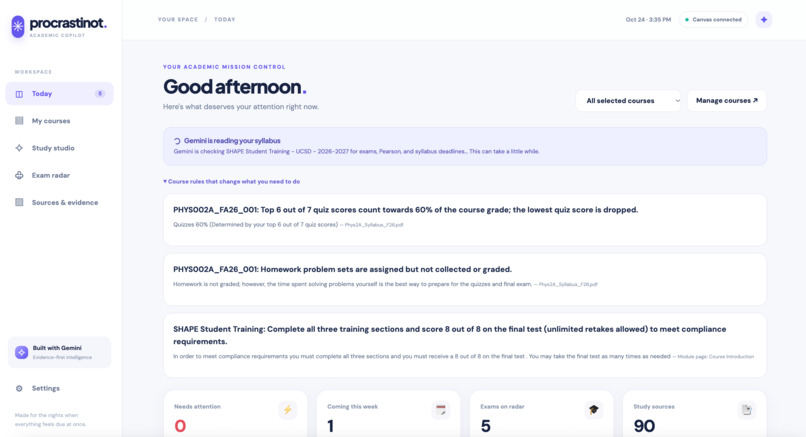
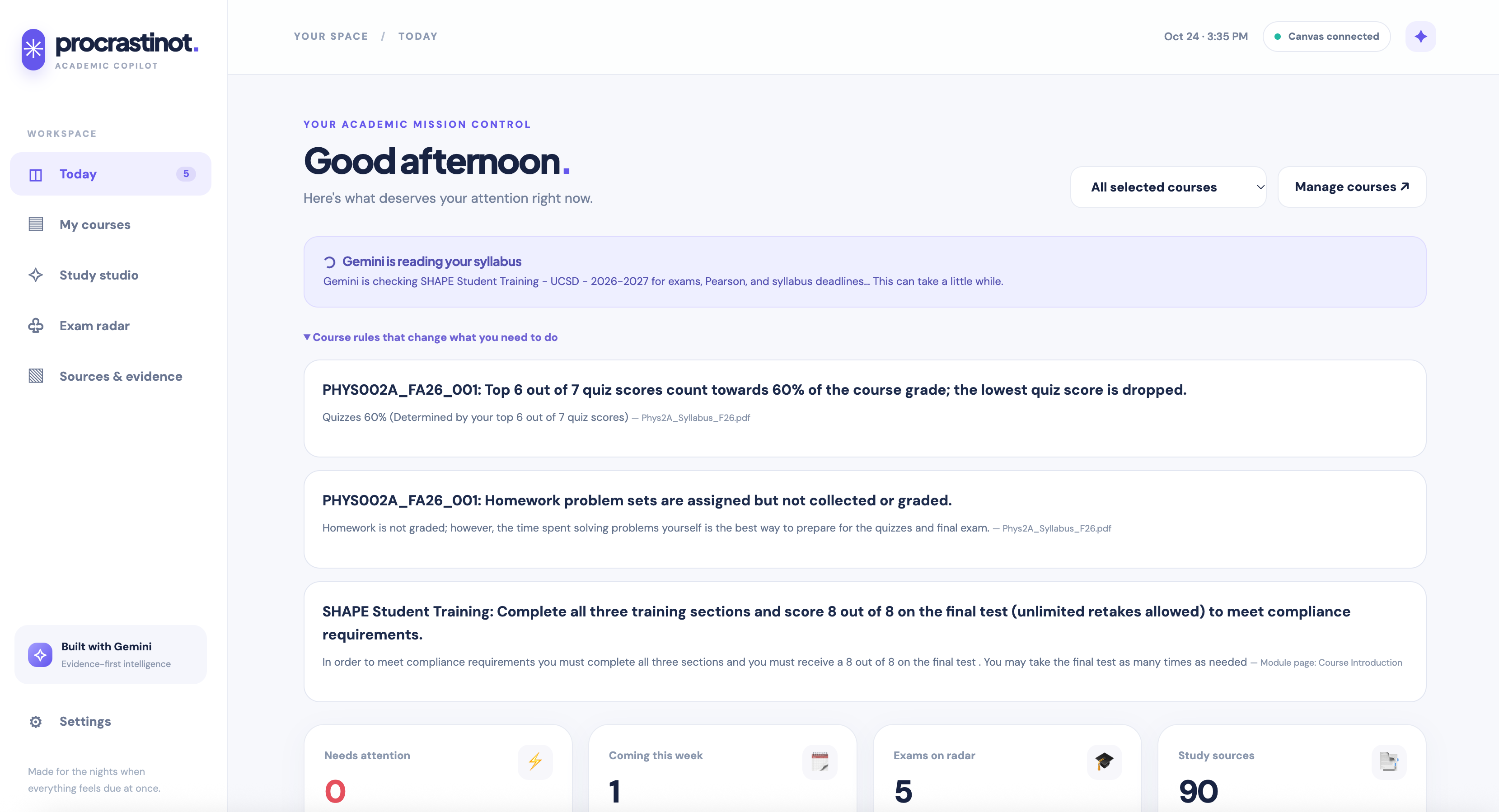
Procrastinot scanning and showing upcoming deadline and work
-
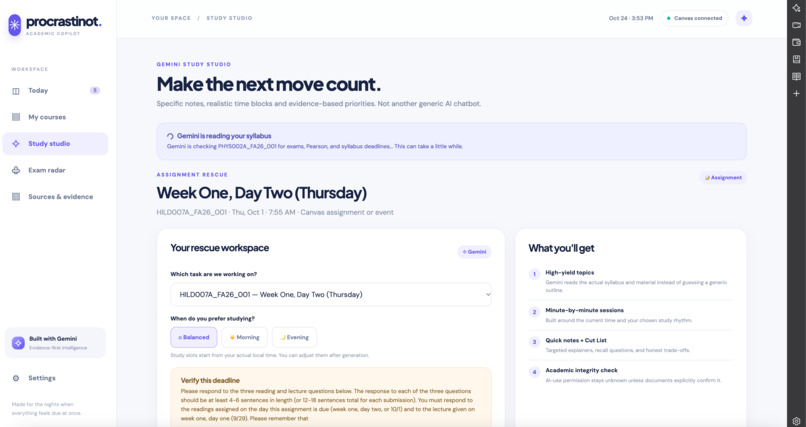
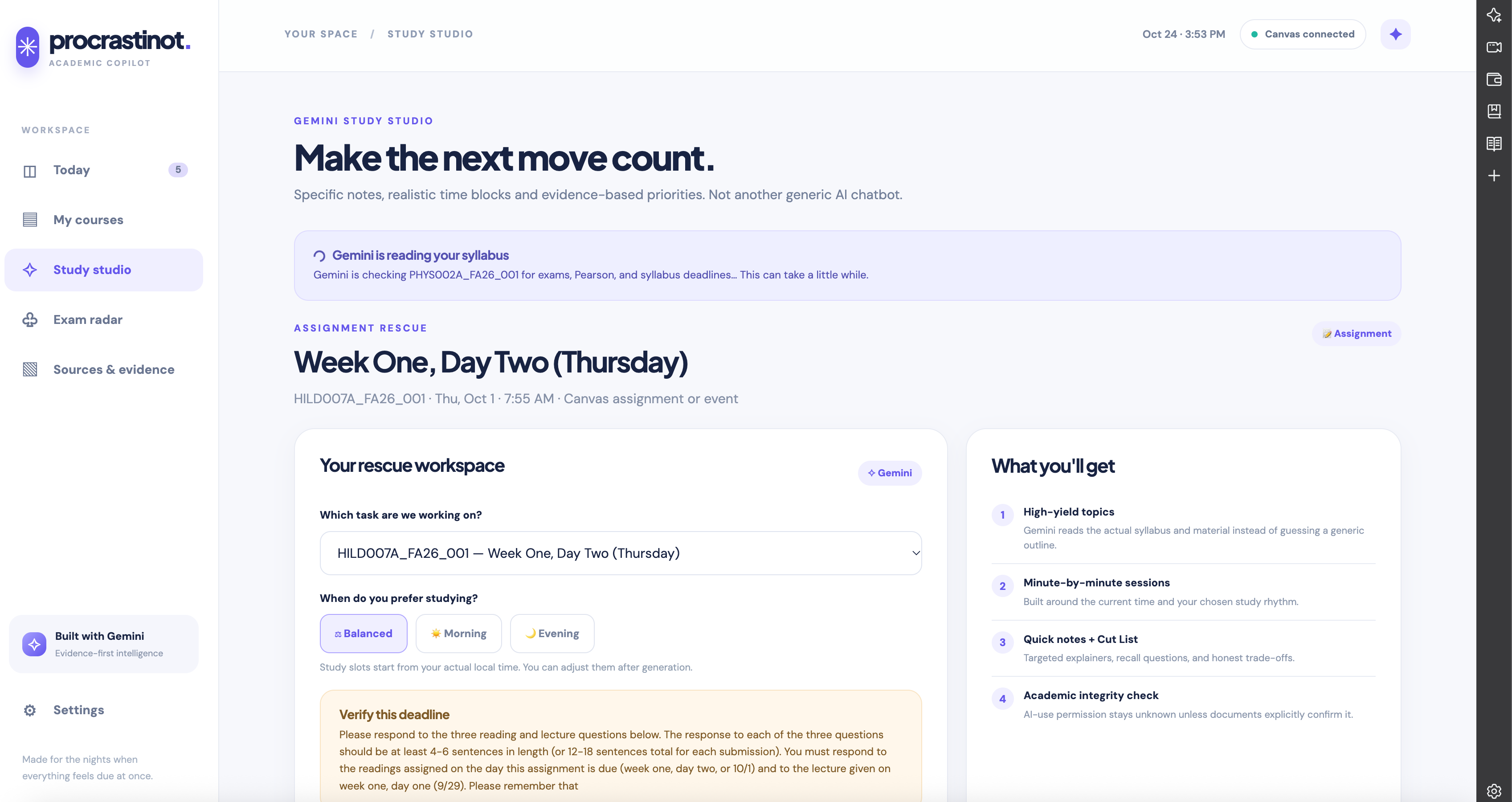
Study studio
-
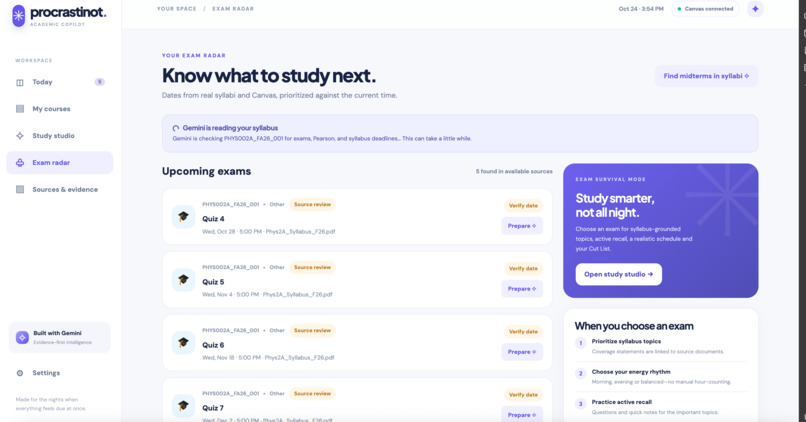
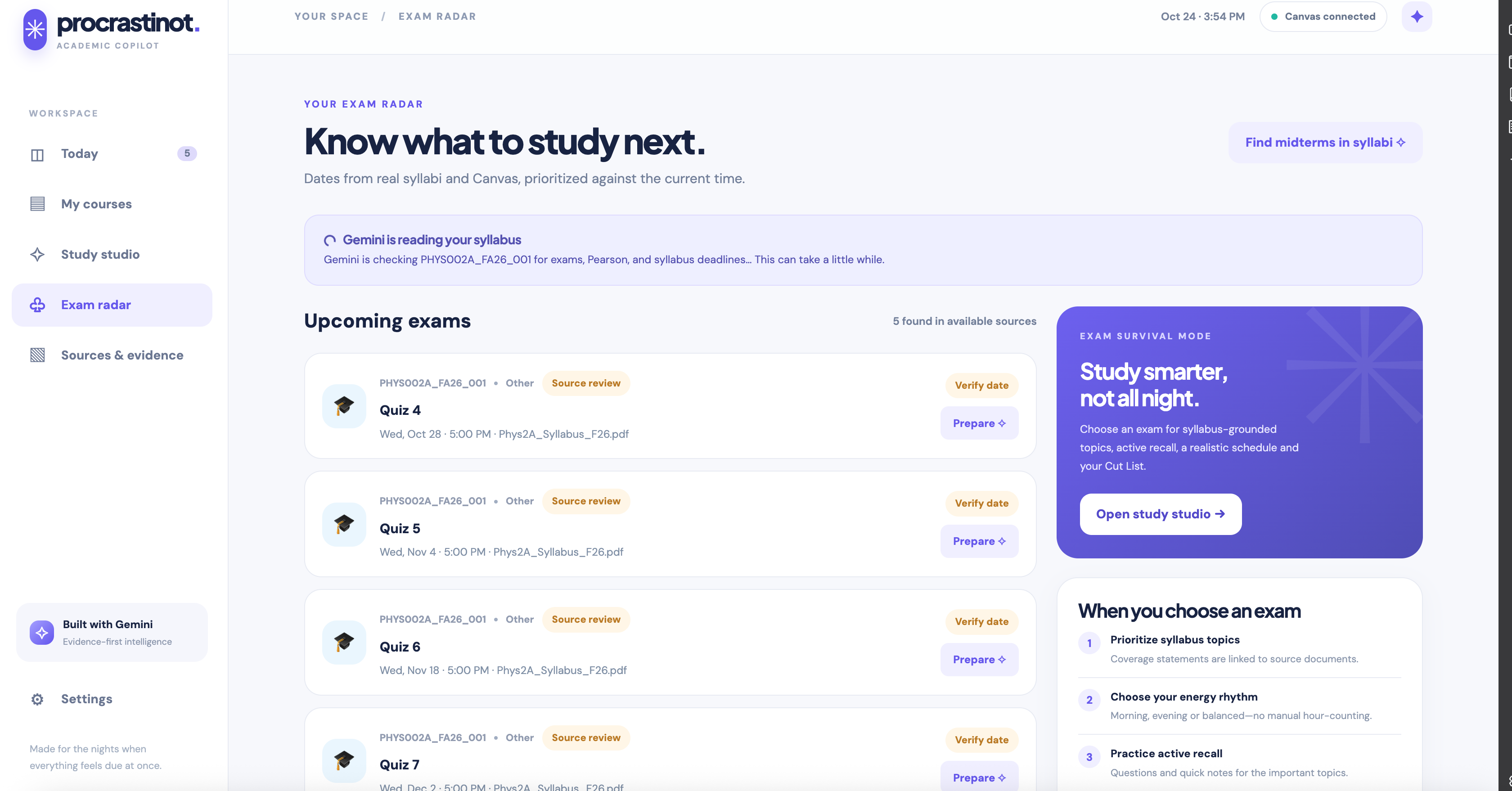
Exam hub
-
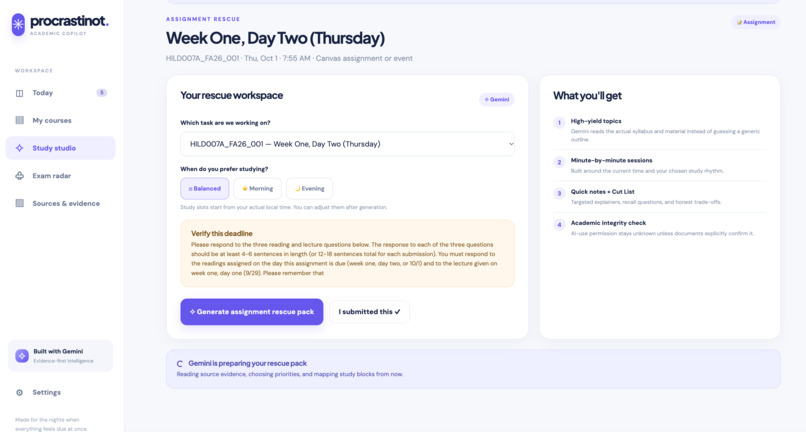
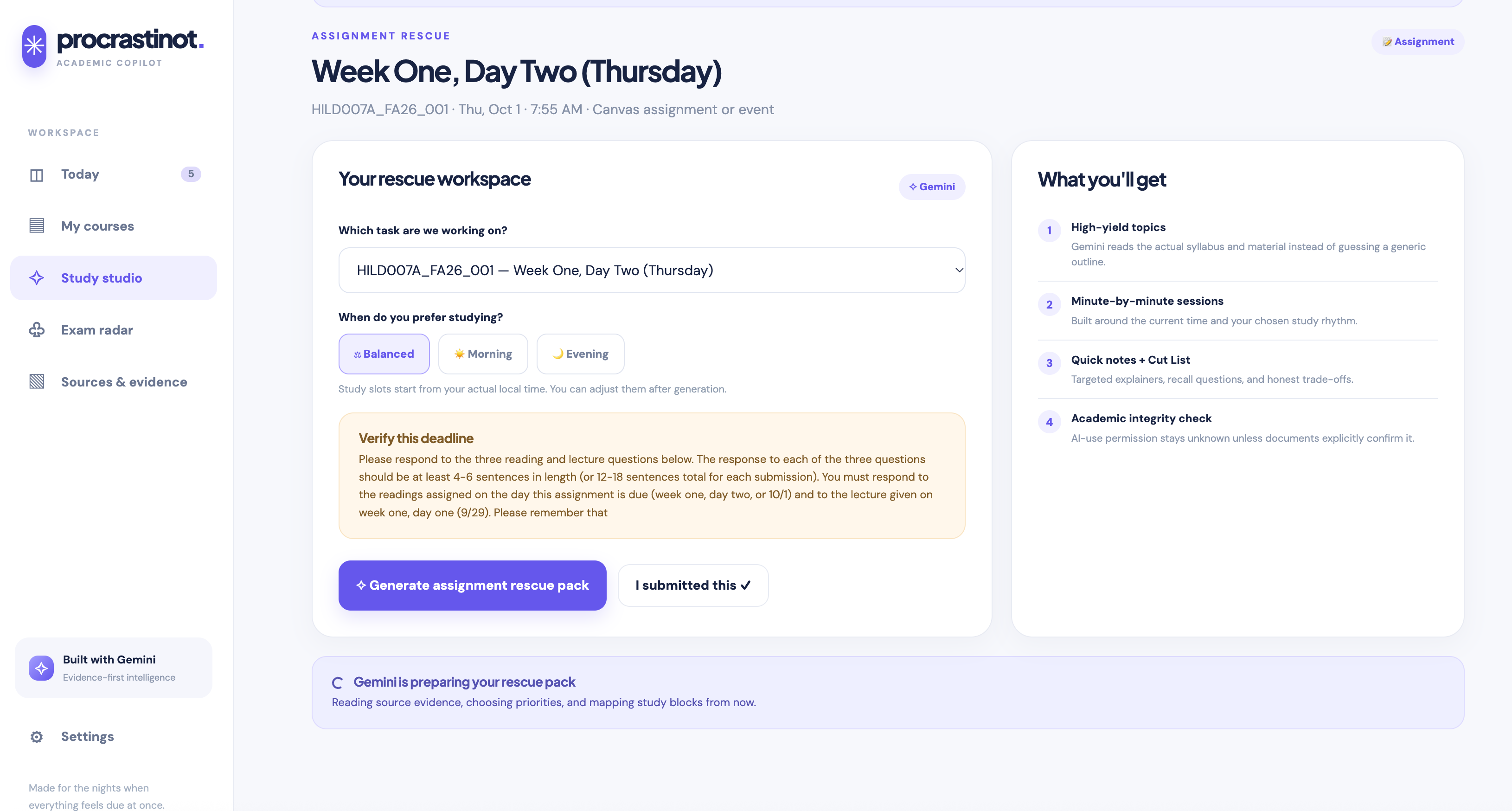
Gemini generating ideas for studying !
Inspiration
have personally struggled with procrastination and poor time management. I've missed deadlines, underestimated how much work I had left, and found myself cramming right before exams. I realized that the problem wasn't always a lack of motivation. Sometimes, I simply didn't know what needed my attention first.
That's what inspired us to build Procrastinot, an AI-powered academic assistant designed to turn overwhelming coursework into a clear, manageable plan.
What it does
Procrastinot brings students' academic responsibilities into one place and helps them figure out what to do next.
Instead of manually downloading dozens of PDFs, checking multiple course pages, and searching through lengthy syllabi, students can connect to Canvas, select their courses, and let Procrastinot collect accessible course materials.
Procrastinot uses Google Gemini to analyze syllabi, assignment instructions, course policies, and study materials. It is designed to identify important deadlines, exams, grading requirements, and course-specific rules that ordinary assignment trackers might miss.
For example, if a syllabus says students only need to complete three homework assignments before the midterm, Procrastinot can help identify that requirement rather than treating every homework as equally urgent.
The platform also includes:
- Smart deadline tracking: Organizes upcoming and past assignments and highlights urgent work.
- AI-powered syllabus analysis: Extracts deadlines, exam dates, and academic policies from course documents.
- Personalized study planning: Uses Gemini to recommend study priorities, revision topics, and realistic preparation schedules.
- Assignment rescue: Helps students understand the concepts needed for an upcoming assignment.
- Exam preparation: Turns available course materials into focused study guidance.
Our goal is simple: students shouldn't have to spend hours figuring out what to study when they could already be studying.
How we built it
We built Procrastinot using Python, FastAPI, HTML, CSS, JavaScript, browser automation, and Google's Gemini API.
The application uses a locally managed Chromium browser to let students sign into Canvas through their university's normal authentication process.
Once authenticated, our Python backend discovers available courses and attempts to retrieve accessible assignments, PDFs, and syllabus materials.
We use Google Gemini as the intelligence layer to interpret unstructured academic documents. Instead of relying entirely on Canvas assignment listings, Gemini can examine syllabus content to identify deadlines and requirements that may only be mentioned inside PDFs.
The backend processes the collected information, while our custom frontend presents deadlines, course resources, and study-planning tools through a unified dashboard.
Challenges we ran into
Our biggest challenge was accessing real academic data reliably.
Initially, we planned to use the Canvas API to retrieve courses, assignments, and files automatically. However, our university's Canvas configuration did not allow us to generate personal API access tokens.
We didn't want our project to depend entirely on mocked data, so we explored another approach: browser automation.
We built a workflow that opens a managed Chromium browser, allows students to authenticate normally through Canvas and Duo, and then retrieves course information using their existing authenticated session.
This introduced several technical challenges:
- Dynamic Canvas pages: Course files and assignments are not always exposed as simple downloadable links.
- Incomplete deadline information: Some deadlines are listed in syllabus PDFs or external platforms such as Pearson rather than Canvas's assignment calendar.
- Submission tracking: Canvas assignment data alone cannot reliably determine whether students have completed work on external platforms.
- Gemini API compatibility: We encountered model availability errors and prompt-formatting bugs while implementing syllabus analysis.
- Document interpretation: Extracting a date is not enough. The system must understand whether it represents an exam, a homework deadline, or a course policy.
We also learned that a visually polished dashboard means very little if the underlying information is inaccurate. That pushed us to improve deadline filtering, source verification, and the way we communicate uncertain information to students.
Accomplishments that we're proud of
Our biggest accomplishment was finding a way to work with real Canvas course materials despite not having direct API token access.
We successfully tested authenticated Canvas course discovery and PDF retrieval, including downloading a real syllabus from a course.
We also built an end-to-end application structure that connects course discovery, document processing, AI analysis, and a student-facing dashboard.
Another accomplishment was moving beyond the idea of a basic deadline tracker. We wanted Procrastinot to understand what students actually need to complete, not simply display every assignment in chronological order.
We're especially proud of using Gemini to explore syllabus-aware planning, where academic policies and course context can influence what the student should prioritize.
What we learned
This project taught us that building useful AI applications is about much more than calling an AI API.
We learned about browser automation, authenticated sessions, document extraction, asynchronous processing, backend/frontend integration, and working with Gemini's language models.
More importantly, we learned the importance of grounding AI-generated recommendations in reliable source material.
A study assistant that confidently provides the wrong deadline can be worse than having no assistant at all. We therefore began designing Procrastinot to distinguish confirmed information from details that require student verification.
We also learned how to adapt quickly when an original technical approach fails, especially under the pressure of a hackathon.
What's next for Procrastinot
Our long-term vision is to make Procrastinot a proactive academic companion.
We want to expand it with:
- Official Canvas OAuth integration for more reliable, secure connections across universities.
- External platform support for Pearson, Gradescope, and course-specific websites.
- Improved syllabus intelligence that understands grading policies, optional assignments, and exam schedules.
- Interactive Gemini-powered revision tools with practice questions and active recall.
- Smarter study scheduling that adapts to approaching deadlines, available time, and student progress.
- Source-backed deadline verification so students can see exactly where every important date came from.
Ultimately, we want Procrastinot to answer one question every overwhelmed student has asked:
"I have so much to do. Where do I even start?"
And instead of giving students another overwhelming to-do list, Procrastinot helps them take the next meaningful step.

Log in or sign up for Devpost to join the conversation.