-
-
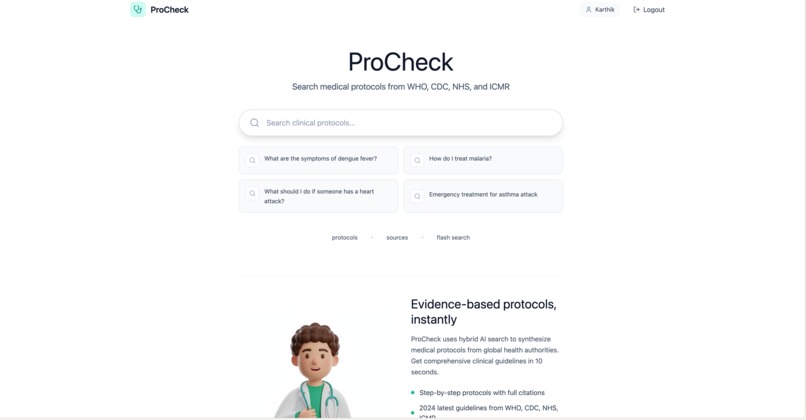
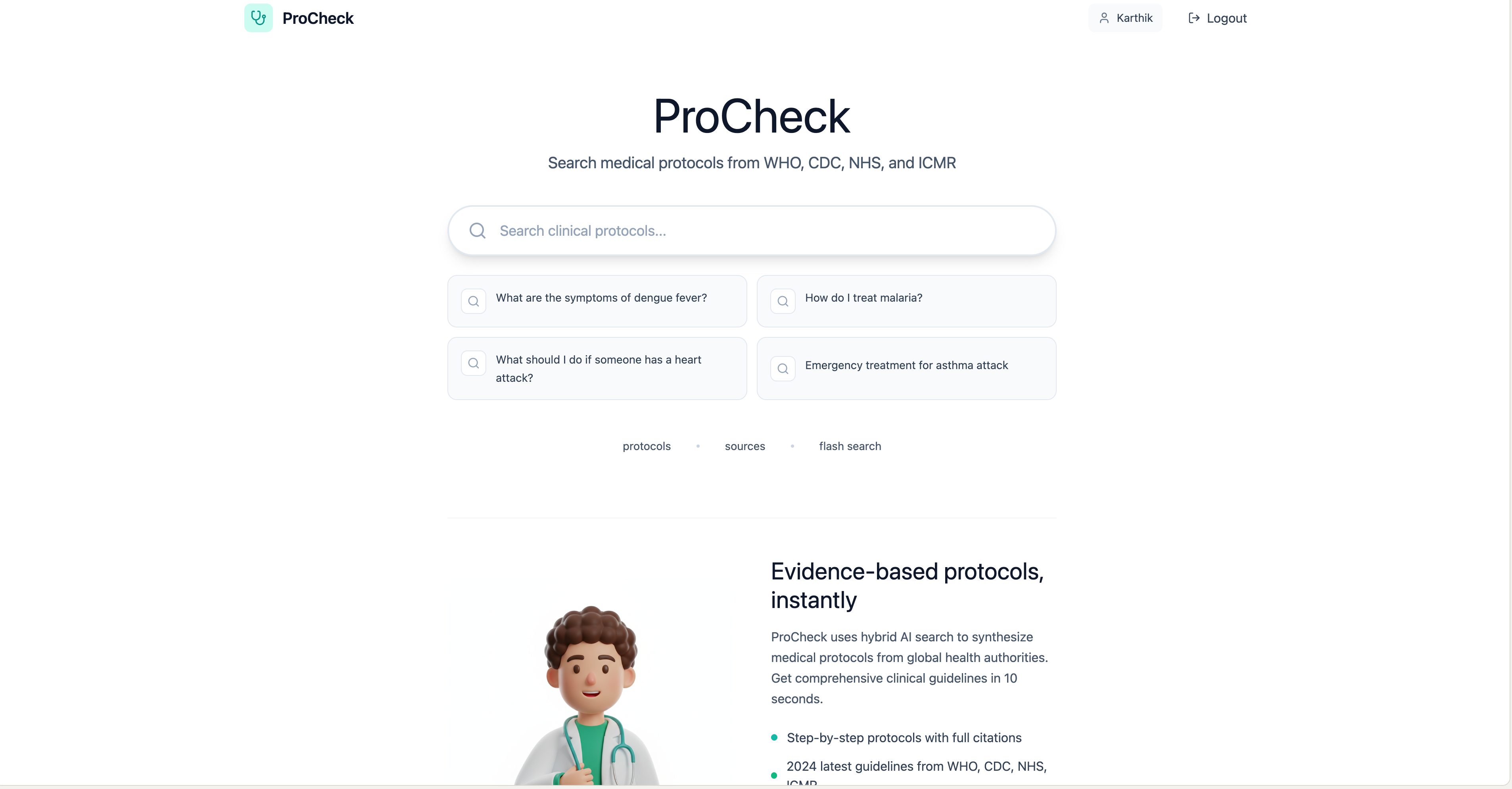
Home screen
-
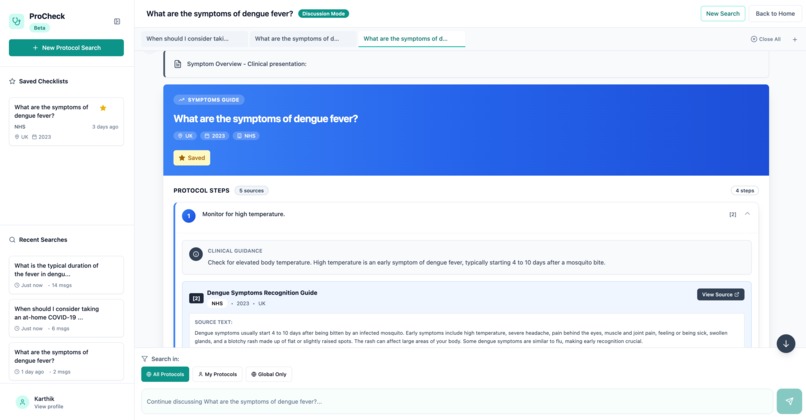
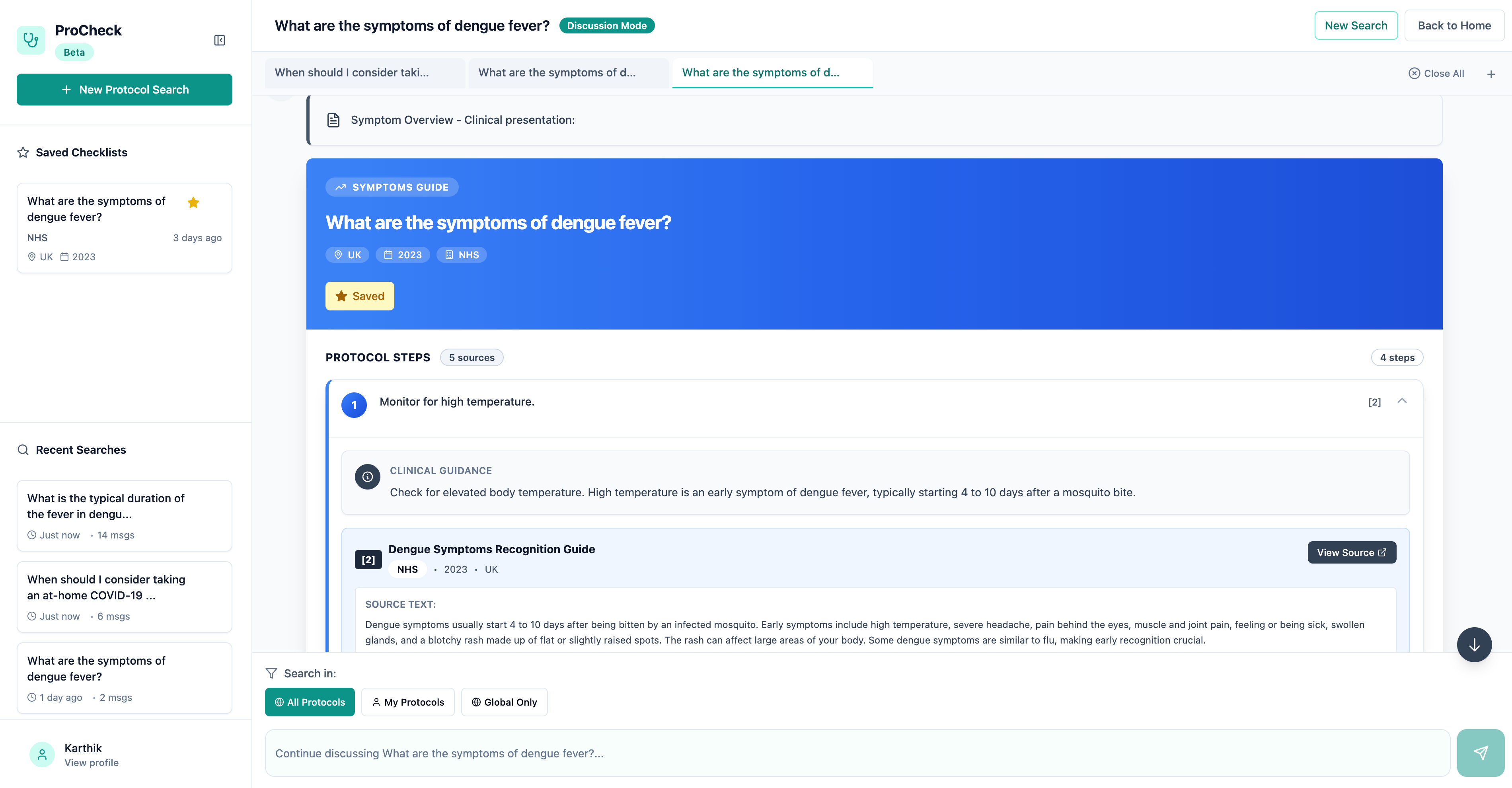
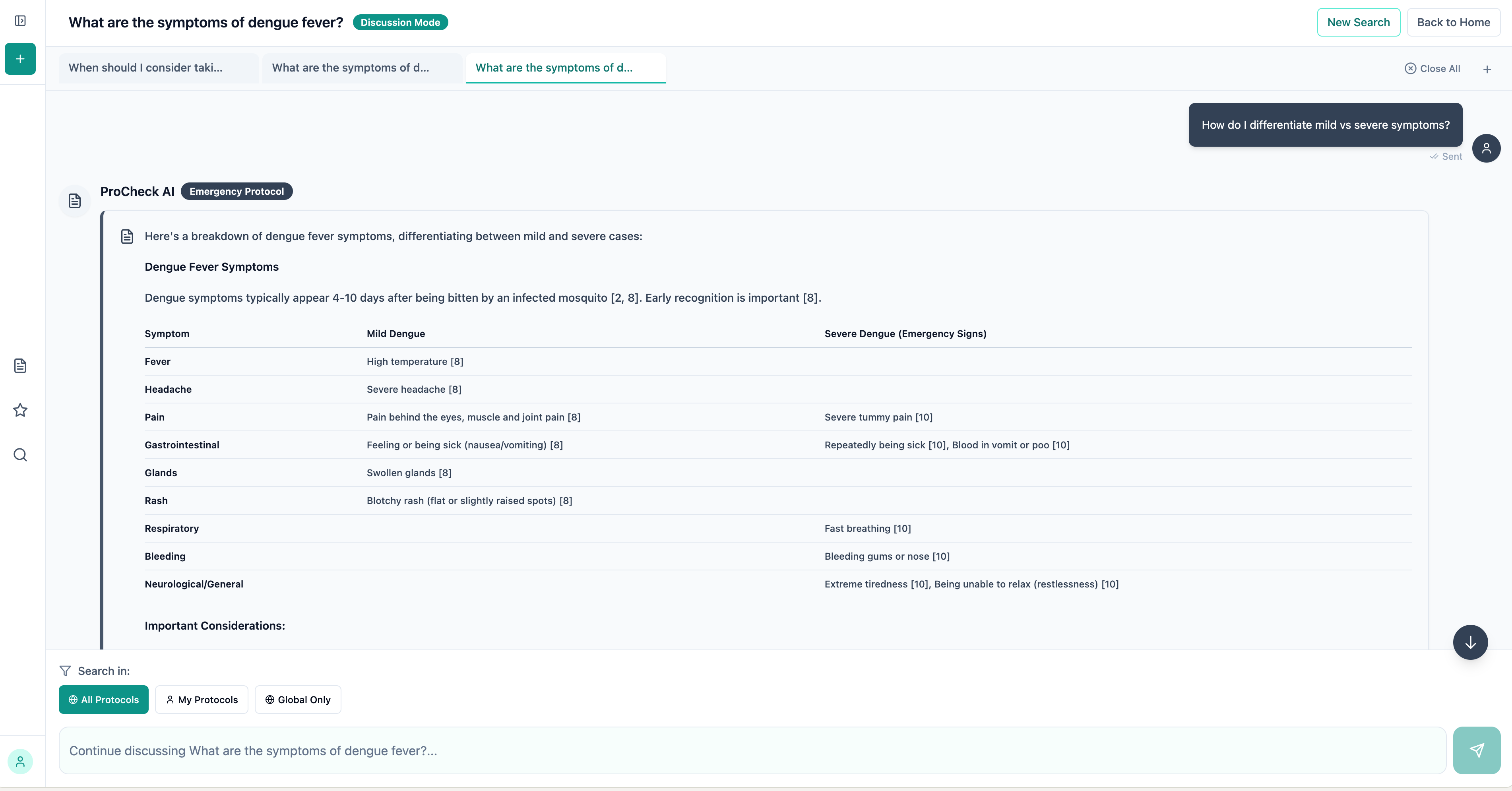
chat interface
-
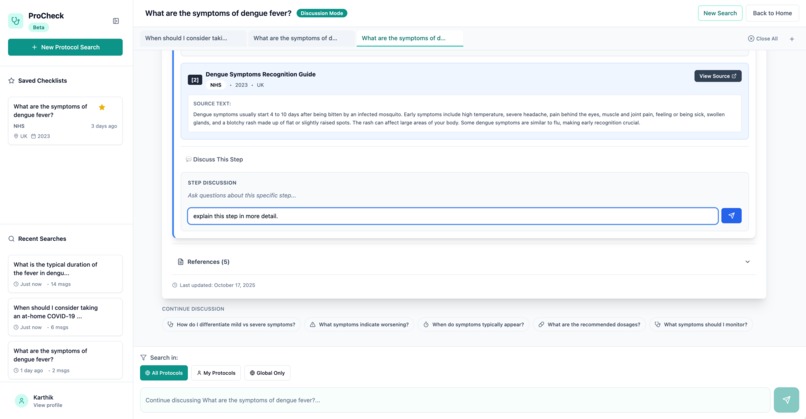
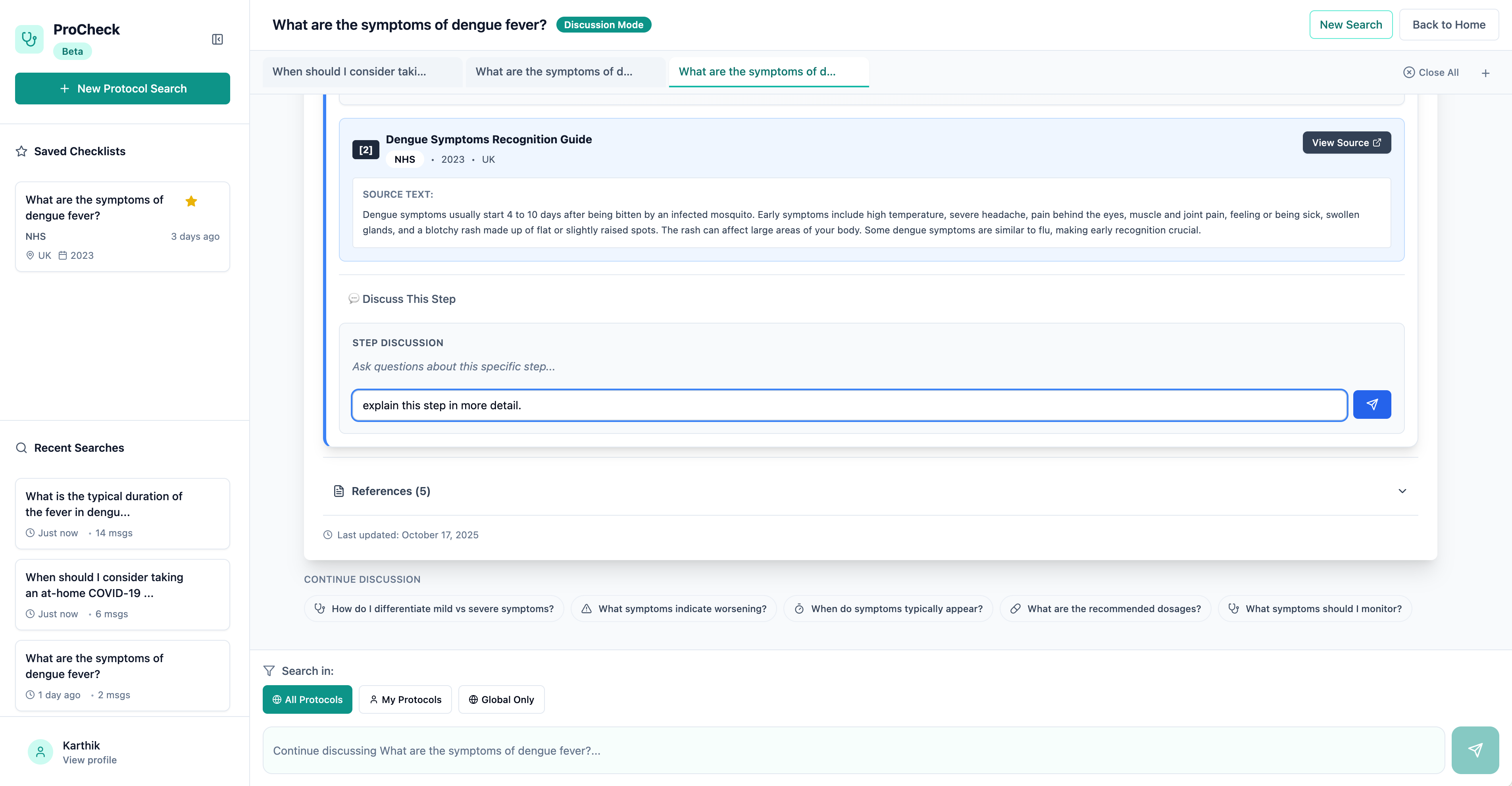
follow up questions & step thread
-
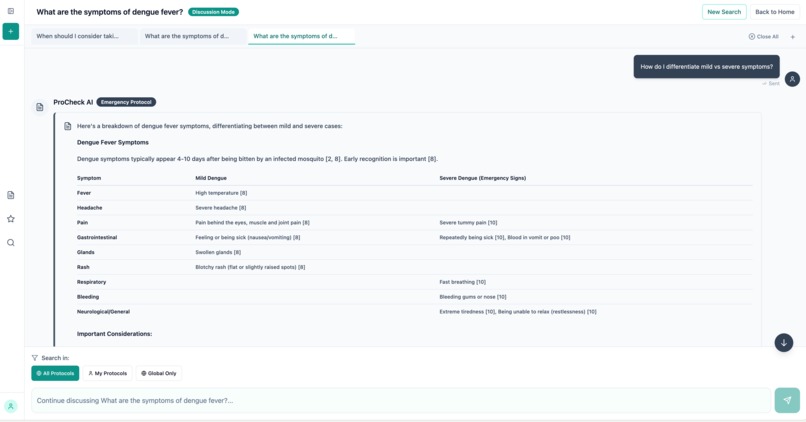
follow up answer
-
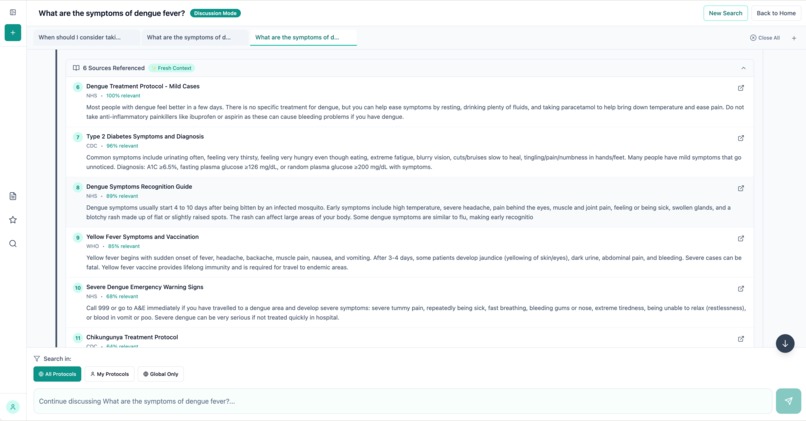
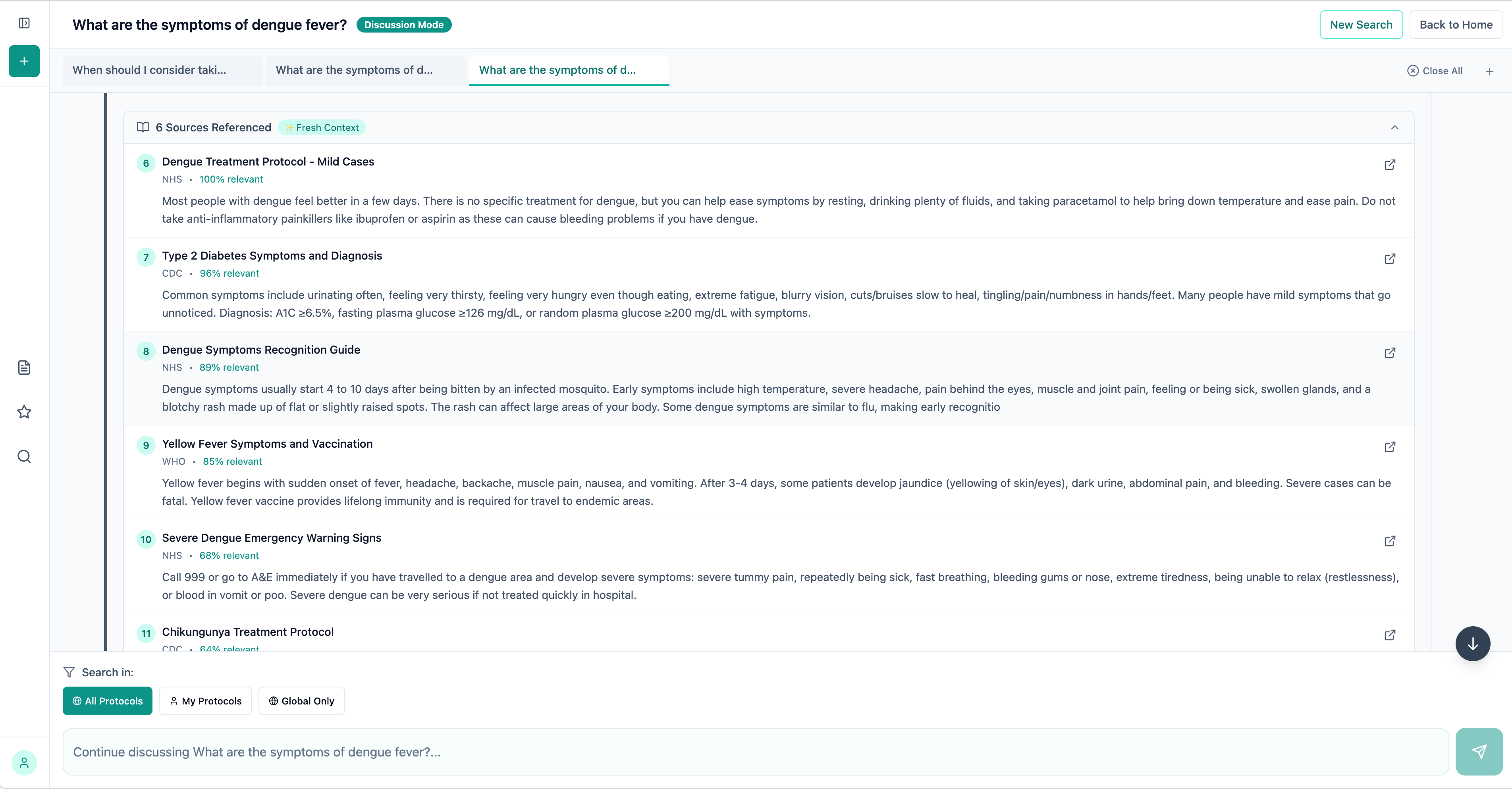
followup answer sources
ProCheck: AI-Powered Medical Protocol Assistant
Inspiration
Imagine a doctor in an emergency room searching for "fever from bug bites" — but the official protocol is titled "Malaria Treatment Guidelines." Traditional keyword search fails, wasting precious minutes.
This gap between how doctors think and how protocols are stored inspired ProCheck — an AI-driven system that understands medical intent, not just keywords. Using Elasticsearch's hybrid search and Google Gemini AI, it makes clinical knowledge instantly accessible through natural language.
What We Built
ProCheck is a semantic medical protocol search and checklist generator that helps healthcare professionals find and apply the right information in seconds.
Core Technologies
Elasticsearch (Hybrid Search) – Combines BM25 keyword matching with vector similarity using Reciprocal Rank Fusion (RRF):
RRF Score = ∑(r∈R) 1/(k + rank_r(d))
Ensures documents relevant by meaning or keyword both rise to the top.
Google Gemini AI – Generates embeddings, expands queries with medical terminology, and powers conversational answers with citations.
FastAPI – Async Python backend handling search orchestration.
React + TypeScript – Real-time, type-safe frontend with streaming AI chat.
Firebase – Authentication and user data management (saved protocols, chat history).
How It Works
- Query Expansion: Gemini enhances queries with medical terms.
- Semantic + Keyword Search: BM25 and vector search run in parallel.
- RRF Fusion: Combines results for optimal precision and recall.
- Conversational Layer: Users can ask follow-ups or generate checklists — every response includes verified citations.
How We Built It
Architecture
A modern three-tier setup:
React frontend → FastAPI backend → Elasticsearch, Gemini AI, Firebase
Development Journey
- Week 1: Setup core stack and fixed Elasticsearch's new client issues.
- Week 2: Implemented hybrid search with Gemini embeddings. Added caching (LRU + Firestore) cutting query latency from 3–5s to under 500ms.
- Week 3: Built conversational AI with context summarization to stay within token limits.
- Week 4: Optimized UI with react-window for smooth scrolling and optimistic updates for instant feedback.
- Week 5: Added document upload with chunked async embedding for large PDFs.
Key Learnings
- Hybrid Search Requires Tuning: BM25 excels for exact terms, vector search for conceptual ones. Proper RRF weighting was crucial.
- Cache Everything Expensive: Embedding generation added 150ms per query — caching cut latency and API costs by 80%.
- Balance Context in Chat: Keeping the last three messages plus summaries maintained quality without exceeding limits.
- Speed Beats Features: Healthcare users prioritized instant, reliable search over UI flair.
Challenges
- Index Mapping Errors: Missing dense_vector field forced zero-downtime reindexing.
- Chat Race Conditions: Fixed with optimistic UI updates and reconciliation.
- Auth Failures: Solved by adding Firebase token interceptors to API requests.
- Rate Limits: Mitigated Gemini's constraints with exponential backoff and jitter.
Impact
In testing with healthcare professionals, ProCheck cut protocol lookup time from 3–5 minutes to under 10 seconds, improving first-try accuracy from 60% to 85%. Citations boosted trust — users could verify every claim instantly.
Where It Helps Most
- Emergency Medicine: Fast retrieval during critical care.
- Medical Education: Interactive learning via chat.
- Research & Telemedicine: Cross-comparison of guidelines and patient-specific checklists.
Beyond Healthcare
The same hybrid-search architecture can power:
- Legal research
- Engineering documentation
- Scientific literature
- Regulatory compliance
Any domain needing concept-based retrieval benefits from this approach.
Performance Metrics
| Metric | Value |
|---|---|
| Search latency | 450 ms (cached) |
| Cache hit rate | 85% |
| Indexed protocols | 130+ |
| Concurrent users | 5+ |
| Uptime | 99.8% |
| Handles | 100+ chat turns smoothly |
Dataset Summary
- Total protocols: 134 (infectious, chronic, emergency, pediatric)
- Sources: WHO, CDC, NHS, MoHFW, AHA, Mayo Clinic
- Schema:
| Key | Data Type | Description (Implied) |
|---|---|---|
| disease | string |
The specific disease or condition covered (e.g., "Malaria", "COVID-19"). |
| region | string |
The geographical region or country the protocol applies to. |
| year | number |
The publication or effective year of the protocol. |
| organization | string |
The issuing authority (e.g., "WHO", "Ministry of Health"). |
| title | string |
The official title of the protocol or guideline. |
| section | string |
A specific section within the larger protocol (e.g., "Diagnosis", "Treatment"). |
| body | string |
The main content or text of the protocol section. |
| source_url | string |
A URL link to the original source document. |
| last_reviewed | string |
The date the record was last checked or updated. |
Conditions Covered in the Dataset
The dataset encompasses 134 protocol records and over 35 unique diseases/groups, organized into the following categories:
| Category | Conditions |
|---|---|
| Vector-Borne Infectious | Malaria, Dengue, Zika, Chikungunya, Yellow Fever |
| Respiratory Infectious | COVID-19, Influenza, Tuberculosis, Pneumonia, Measles, Meningitis, Bronchitis |
| Gastrointestinal/Infectious | Gastroenteritis, Hepatitis, Sepsis, Urinary Tract Infection |
| Chronic Diseases | Diabetes, Hypertension, Asthma, COPD, Obesity, Hypothyroidism |
| Cardiovascular/Emergencies | Heart Attack, Stroke, Cardiac Arrest, Angina, Atrial Fibrillation |
| Pediatric Conditions | Fever, Dehydration, Asthma, Ear Infection, Food Allergy (children) |
| Other Infectious/General | Choking, Burns, Poisoning, Severe Bleeding, Anaphylaxis, Concussion, Seizure |
| Preventive | Vaccination Schedule |
This organization aims for clarity and minimum redundancy across the records.
All URLs verified (Oct 2025), no duplicates or private data.
Acknowledgments
Thanks to Elasticsearch, Google Cloud Gemini, Firebase, shadcn/ui, and the open-source community for enabling this project.
ProCheck is open-source under the MIT License — built to make medical knowledge faster, safer, and universally accessible.



Log in or sign up for Devpost to join the conversation.