Inspiration
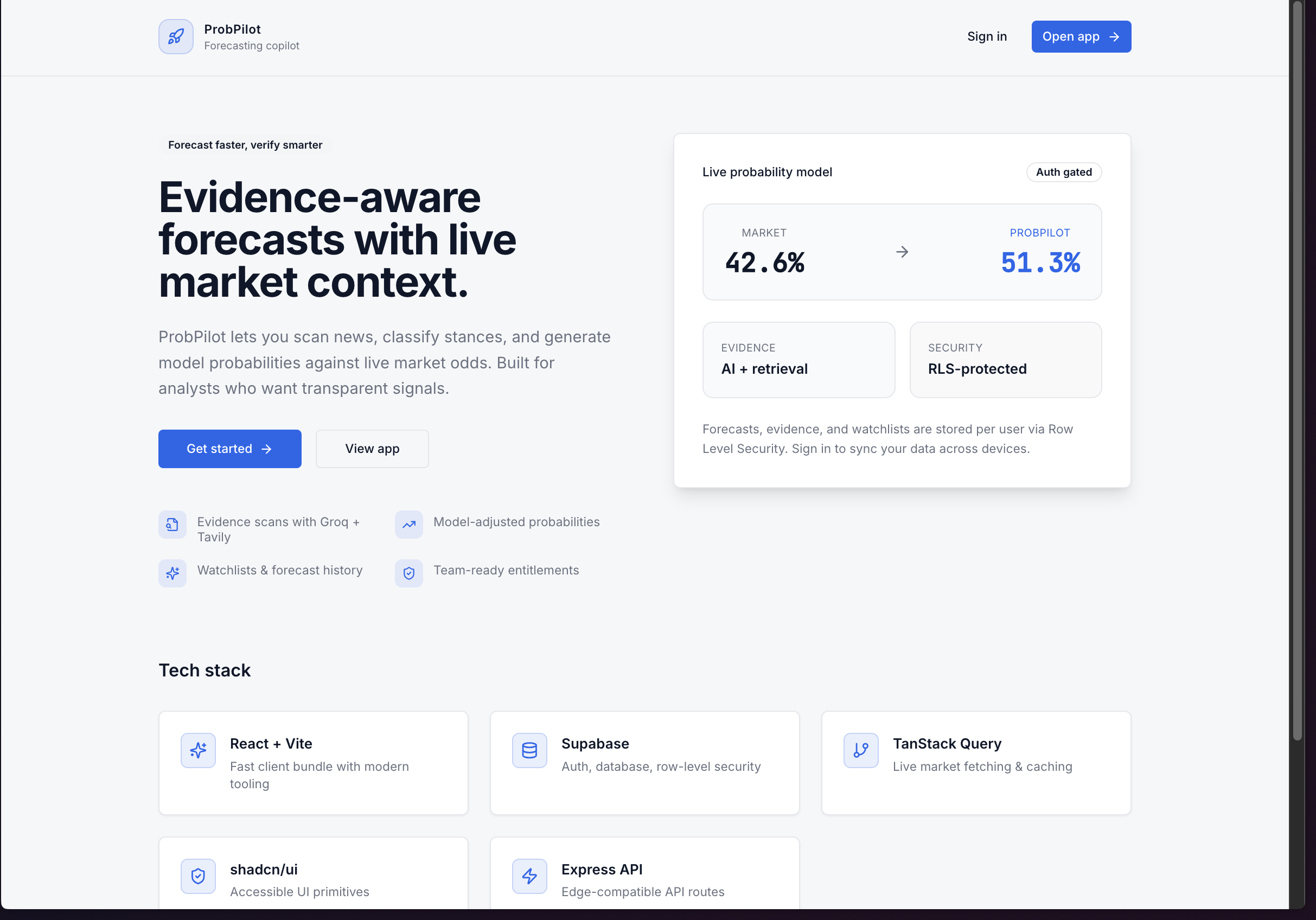
ProbPilot was inspired by the need for evidence-based forecasting in prediction markets. Traditional platforms show market odds but lack transparent, AI-driven analysis that incorporates real-world evidence. We wanted to create a tool that helps analysts make more informed decisions by scanning news, classifying stances, and generating model probabilities against live market odds.
What it does
ProbPilot is an evidence-aware forecasting copilot that:
- Scans news and evidence using Tavily search API to gather relevant information about prediction market events
- Classifies evidence stances (supports/contradicts/neutral) using Groq AI models with confidence scoring
- Generates model probabilities that adjust market odds based on collected evidence
- Provides trading recommendations (BUY YES/BUY NO/HOLD) with confidence levels and rationale
- Tracks forecast history with detailed drivers and evidence sources
- Manages user entitlements with tiered access to forecasts and evidence scans
- Integrates live market data from Polymarket and Kalshi prediction exchanges
How we built it
Frontend: Built with React 18, TypeScript, and Vite for fast development and optimized builds. Used Tailwind CSS with shadcn/ui components for a modern, accessible interface.
Backend: Express.js API server handling forecast generation and evidence scanning. Integrated Groq SDK for AI-powered analysis and Tavily API for web search.
Database: Supabase PostgreSQL with Row Level Security for user data isolation. Tables for forecasts, watchlists, user profiles, and entitlements.
AI Pipeline: Two-step process - first Tavily searches for relevant articles, then Groq LLM classifies evidence stances and generates probability adjustments.
Market Integration: Proxy configuration in Vite to fetch live data from Polymarket and Kalshi APIs, with real-time market odds and volume data.
Authentication & Billing: Supabase Auth for user management, Flowglad for payment processing with tiered subscription plans.
Challenges we ran into
AI Model Consistency: Getting Groq to consistently return valid JSON without refusing to make forecasts due to "insufficient evidence" - solved with strict system prompts and fallback mechanisms.
Evidence Classification: Accurately classifying article stances relative to prediction market outcomes - required careful prompt engineering and stance taxonomy.
Rate Limiting: Managing API limits across multiple services (Tavily, Groq, market APIs) - implemented usage tracking and entitlement system.
Real-time Data: Keeping market data synchronized while handling API rate limits - used React Query for caching and optimistic updates.
Security: Implementing proper Row Level Security in Supabase to ensure users only see their own data while allowing efficient queries.
Accomplishments that we're proud of
Evidence-Aware Forecasting: Successfully built an end-to-end pipeline that turns web content into actionable trading signals with transparent rationale.
User Experience: Created an intuitive dashboard that shows forecast usage, market trends, and detailed analysis with confidence indicators.
Scalable Architecture: Designed a system that can handle multiple users with tiered access while maintaining data security and API efficiency.
AI Reliability: Achieved consistent AI model performance with proper error handling, fallback mechanisms, and output validation.
Market Integration: Successfully integrated two major prediction market APIs with real-time data fetching and proper error handling.
What we learned
Prompt Engineering: Critical importance of precise system prompts and output validation when working with AI models for financial applications.
API Design: Value of building resilient APIs with proper error handling, rate limiting, and fallback mechanisms.
User Psychology: Users need transparency in AI-driven recommendations - showing evidence sources and confidence levels builds trust.
Performance Tradeoffs: Balancing real-time data freshness with API costs and user experience requires careful optimization.
Security First: Row Level Security and proper data isolation should be designed from the start, not added later.
What's next for ProbPilot
Advanced AI Models: Integration of larger language models for better evidence classification and forecast accuracy.
Multi-Exchange Support: Expanding to additional prediction markets and decentralized exchanges.
Portfolio Management: Tools for tracking multiple positions and portfolio-level risk management.
Mobile Application: Native mobile app for on-the-go forecasting and market monitoring.
Social Features: Community forecasts, leaderboards, and collaborative analysis tools.
Advanced Analytics: Historical performance tracking, backtesting capabilities, and strategy optimization tools.
Enterprise Features: Team accounts, API access for institutional clients, and custom integrations.
Built With
- autoprefixer
- date-fns
- embla-carousel-react
- eslint
- express.js
- flowglad
- groq-sdk
- kalshi-api
- lucide-react
- polymarket-api
- postcss
- postgresql
- radix-ui
- react
- react-hook-form
- react-query
- recharts
- shadcn/ui
- sonner
- supabase
- tailwind-css
- tavily-api
- typescript
- vercel
- vite
- zod

Log in or sign up for Devpost to join the conversation.