-
-
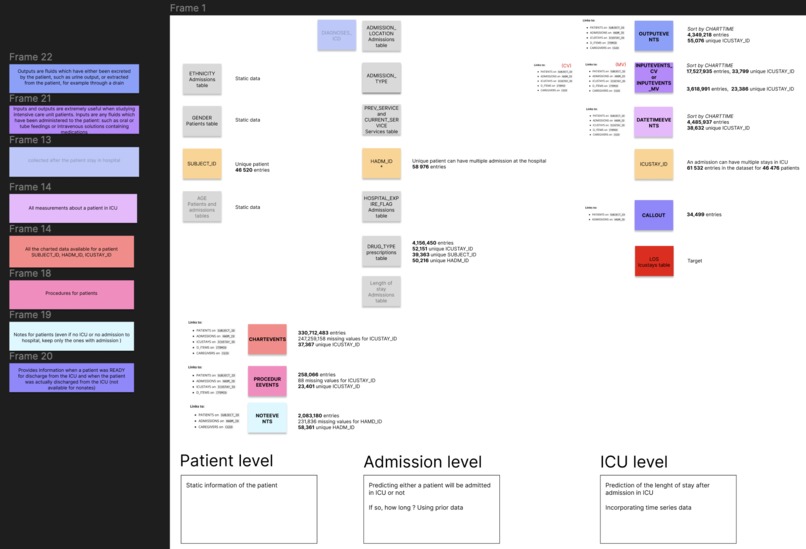
Figma board : overview dataset

Inspiration
Predicting the length of stay of a patient in the Intensive Care Unit (ICU) is a complex and challenging task for healthcare providers. ICU patients are often critically ill and require specialised medical attention and treatment, which can lead to prolonged hospital stays. Accurate prediction of the length of stay can help healthcare providers better allocate resources and plan for patient care. However, several factors make this task challenging, including the varying severity and complexity of patient conditions, the potential for unexpected complications, and the limited availability of data. Additionally, predicting the length of stay is not a static process and may need to be adjusted throughout a patient's hospitalisation as their condition changes. Therefore, healthcare providers must consider multiple variables and adopt sophisticated techniques to provide accurate predictions and improve patient outcomes.
Introduction & Methodology
The prediction of patients length of stay in ICU has been a heavily researched topic in healthcare, with Deep Learning approaches being utilised to handle the complex and varied nature of healthcare datasets. LSTM (Long Short-Term Memory), among other RNN (Recurrent Neural Network) architectures, is extensively utilised in research to capture patient history information. Moreover, various CNN (Convolutional Neural Network) models are also employed to detect patterns. However, challenges such as irregular time intervals and missing data must be addressed, often requiring the conversion of categorical and numerical data types. Due to their high complexity and long runtimes, optimising these algorithms can be a costly process. Therefore, it is advisable to explore alternative, more scalable approaches.
Genetic Algorithm is a method for solving both constrained and unconstrained optimisation problems based on a natural selection process that mimics biological evolution. It can also be used to solve prediction problems, particularly in cases where the solution space is large or the problem is complex. Genetic algorithms are a type of optimisation algorithm inspired by the process of natural selection, where a population of potential solutions to a problem undergoes iterative selection and reproduction to generate new generations of potential solutions. In the context of prediction problems, genetic algorithms can be used to search for the optimal set of parameters or features that will produce the most accurate prediction. For example, in a machine learning problem, genetic algorithms can be used to optimise the hyperparameters of a model or to select the best subset of features to include in the model. It is a useful tool for solving prediction problems, particularly when the solution space is large or the problem is complex.
Despite initial skepticism from some medical experts who view the prediction of ICU length of stay as too individualised to be feasible, genetic algorithms have the potential to identify patterns and improve predictions or improve existing methods. Careful consideration of the fitness function is crucial to ensure it is appropriate for the problem at hand. The MIMIC-III dataset is a prime example of a high-dimensional and complex dataset where genetic algorithms may prove useful.
Challenges
The MIMIC-III (Medical Information Mart for Intensive Care III) dataset complexity :
- Large and detailed: The MIMIC-III dataset is a very large and detailed dataset with over 46,000 patient records, making it one of the largest publicly available medical datasets. It contains a wide range of data, including clinical notes, lab results, vital signs, medications, and other data elements, making it complex to navigate and analyze.
- Heterogeneous data sources: The data in the MIMIC-III dataset come from a wide range of sources, including electronic medical records, bedside monitors, and other medical devices. This heterogeneity of data sources makes it challenging to integrate and analyze the data.
- Complex data models: The MIMIC-III dataset uses complex data models, such as the relational model and hierarchical model, to represent the various aspects of patient care. This complexity requires specialized knowledge and expertise to navigate and analyze the data.
- Sensitive patient information: The MIMIC-III dataset contains sensitive patient information, such as diagnoses, treatments, and medications, which require careful handling to ensure patient privacy is protected. Overall, the complexity of the MIMIC-III dataset is due to its size, the heterogeneity of its data sources, the complexity of its data models, and the sensitivity of the patient information it contains. Therefore, it is a long process to have an understanding of the dataset.

Log in or sign up for Devpost to join the conversation.