-
-
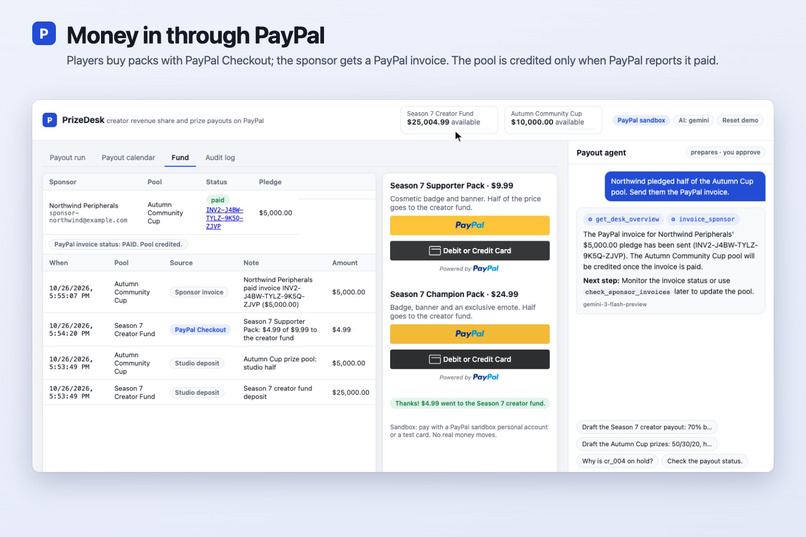
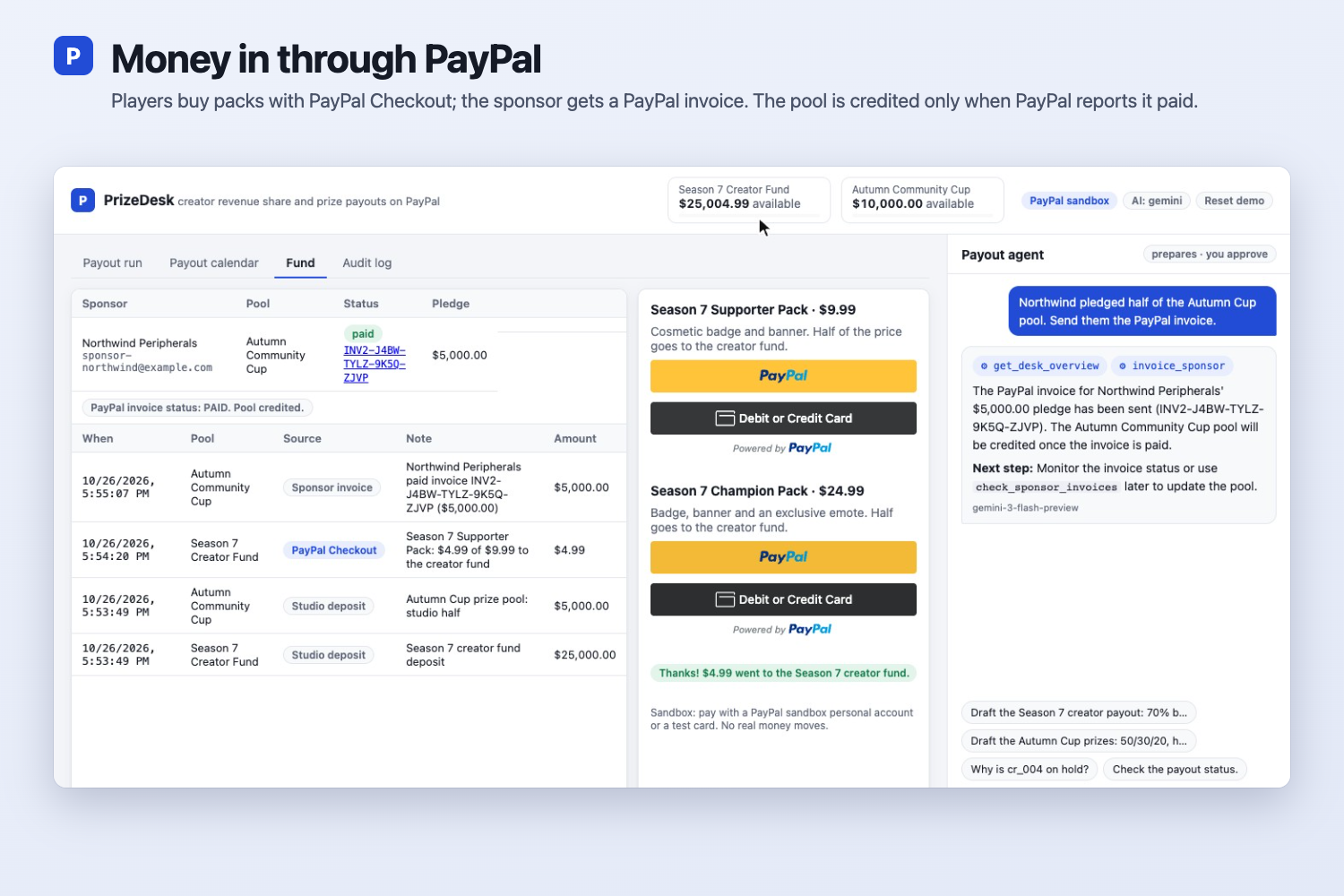
Money in: PayPal Checkout for supporter packs and a PayPal invoice to the sponsor. The pool is credited when PayPal reports it paid.
-
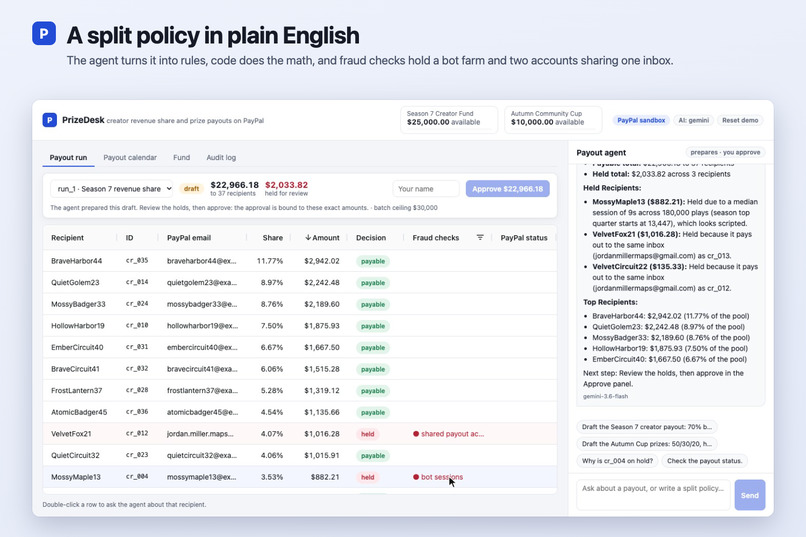
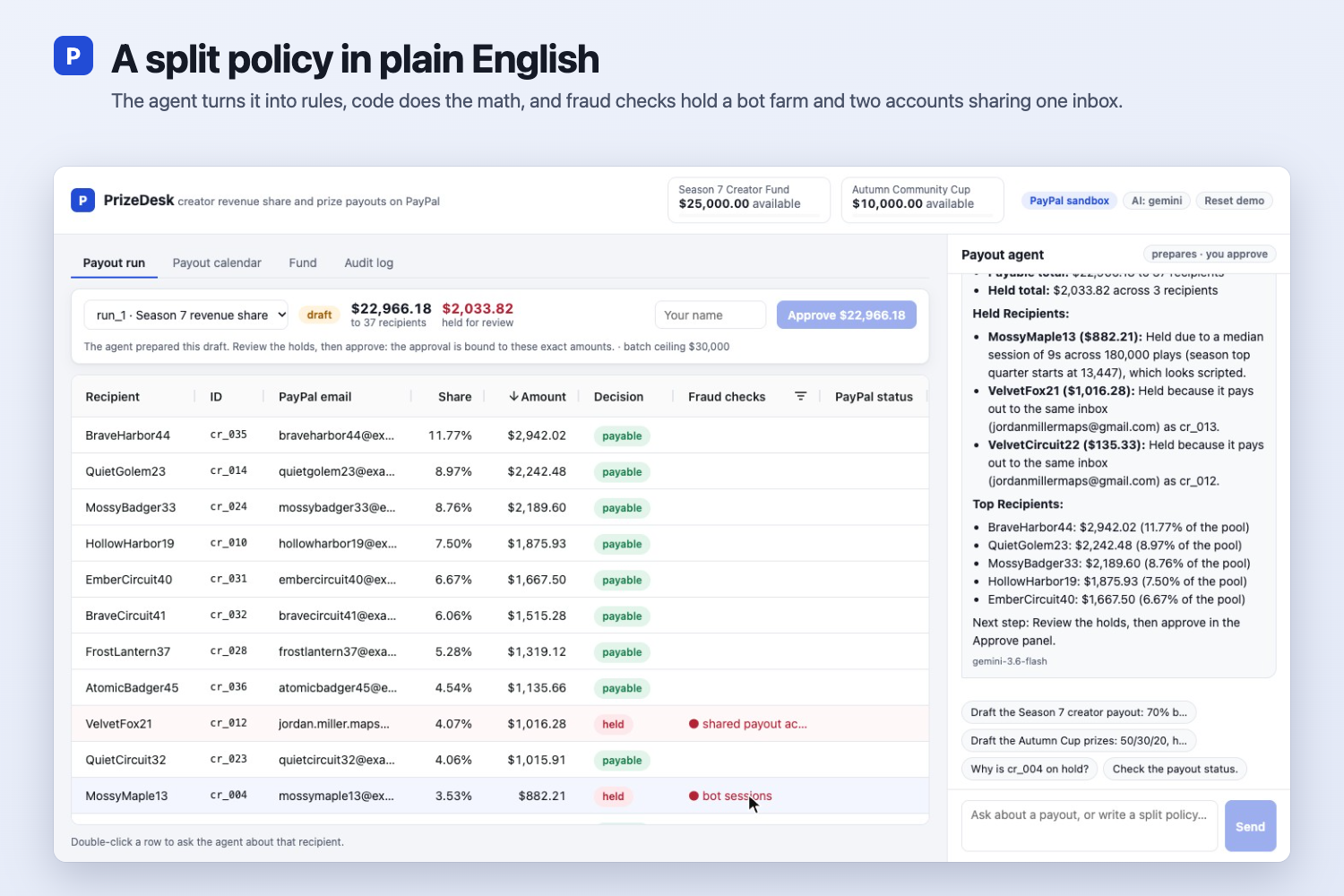
A split policy in plain English. Code does the math; fraud checks hold a bot farm and two accounts sharing one payout inbox.
-
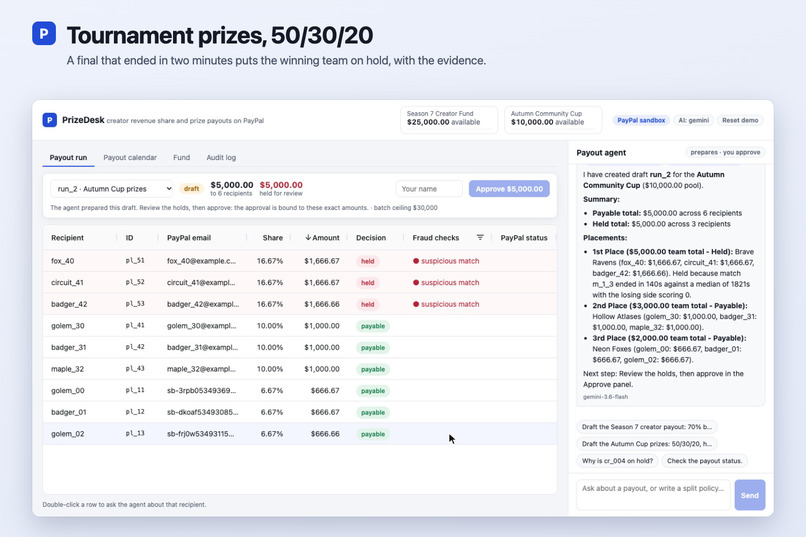
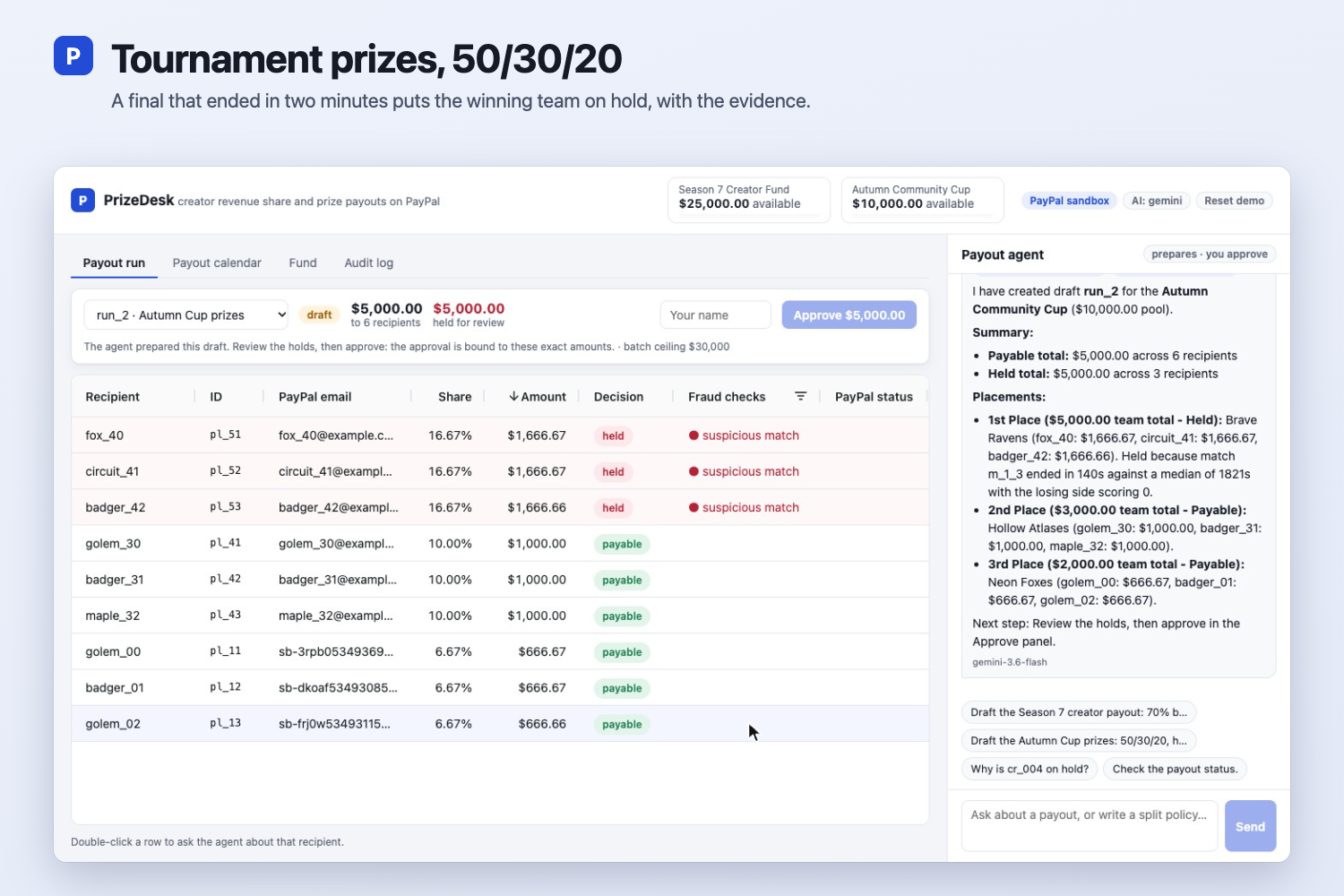
Cup prizes 50/30/20: a final that ended in two minutes puts the winning team on hold, with the evidence.
-
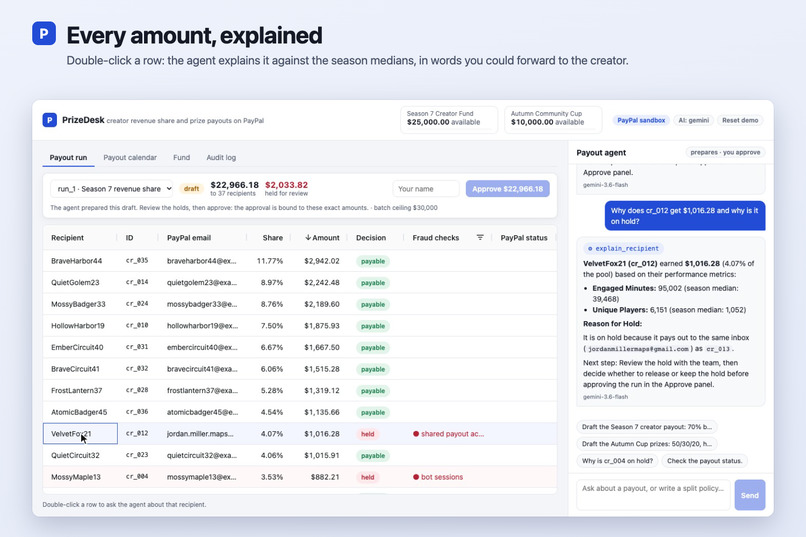
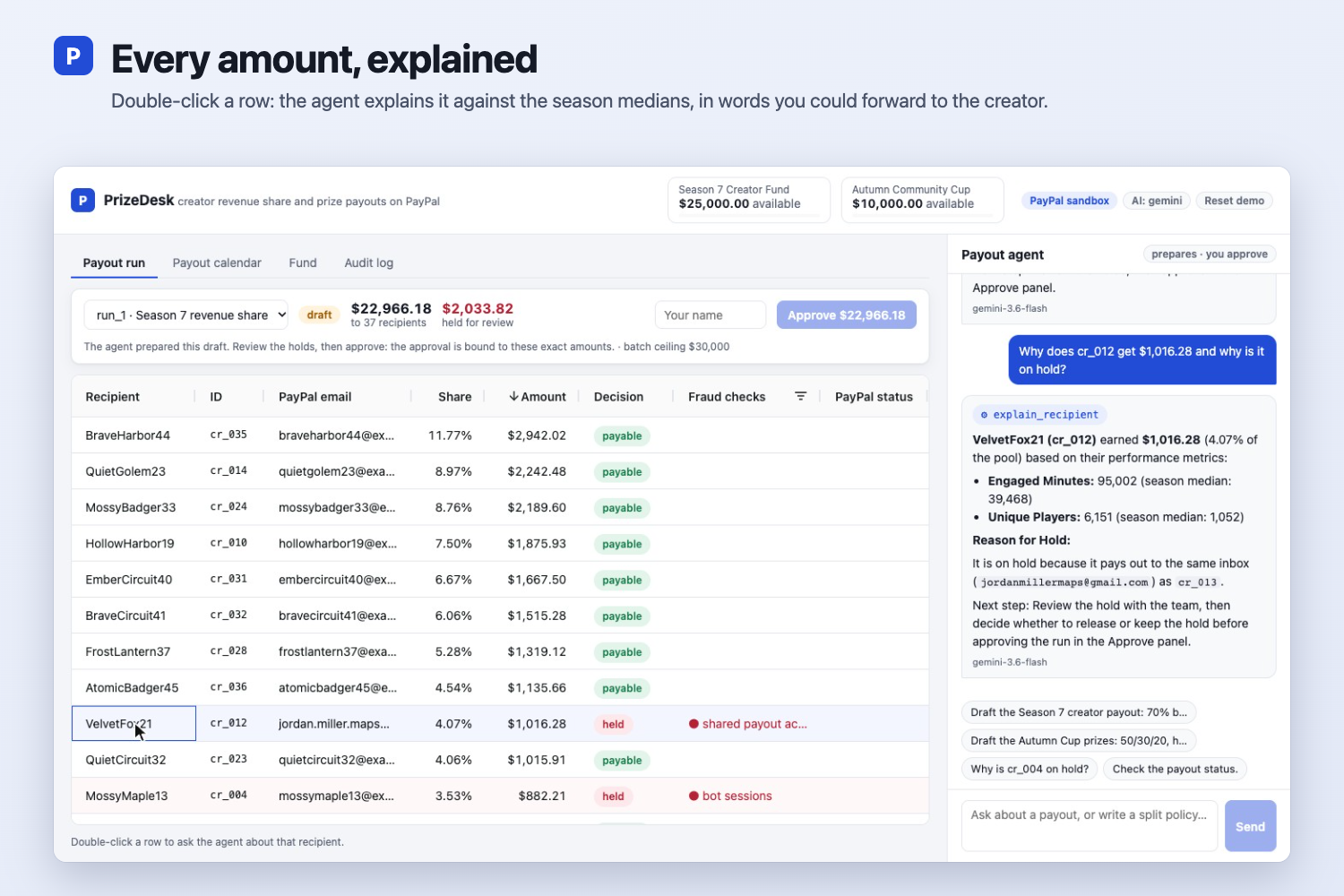
Double-click any row: the agent explains the amount against the season medians, in words you could forward.
-
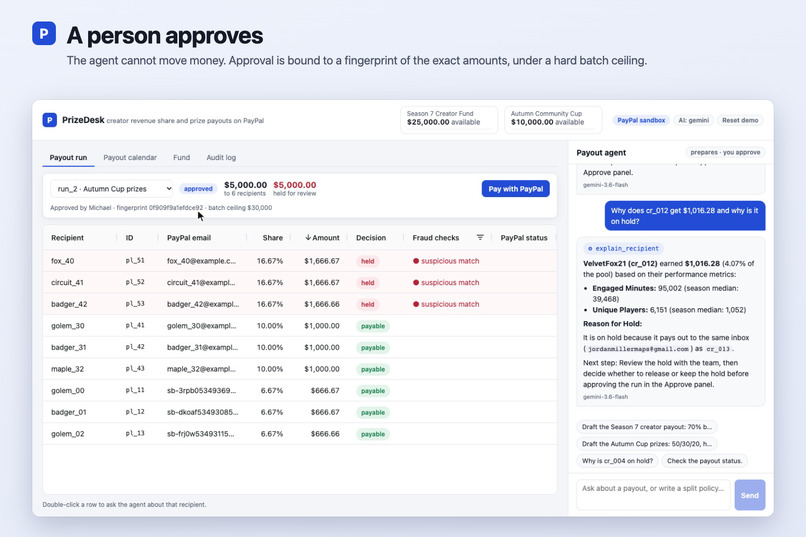
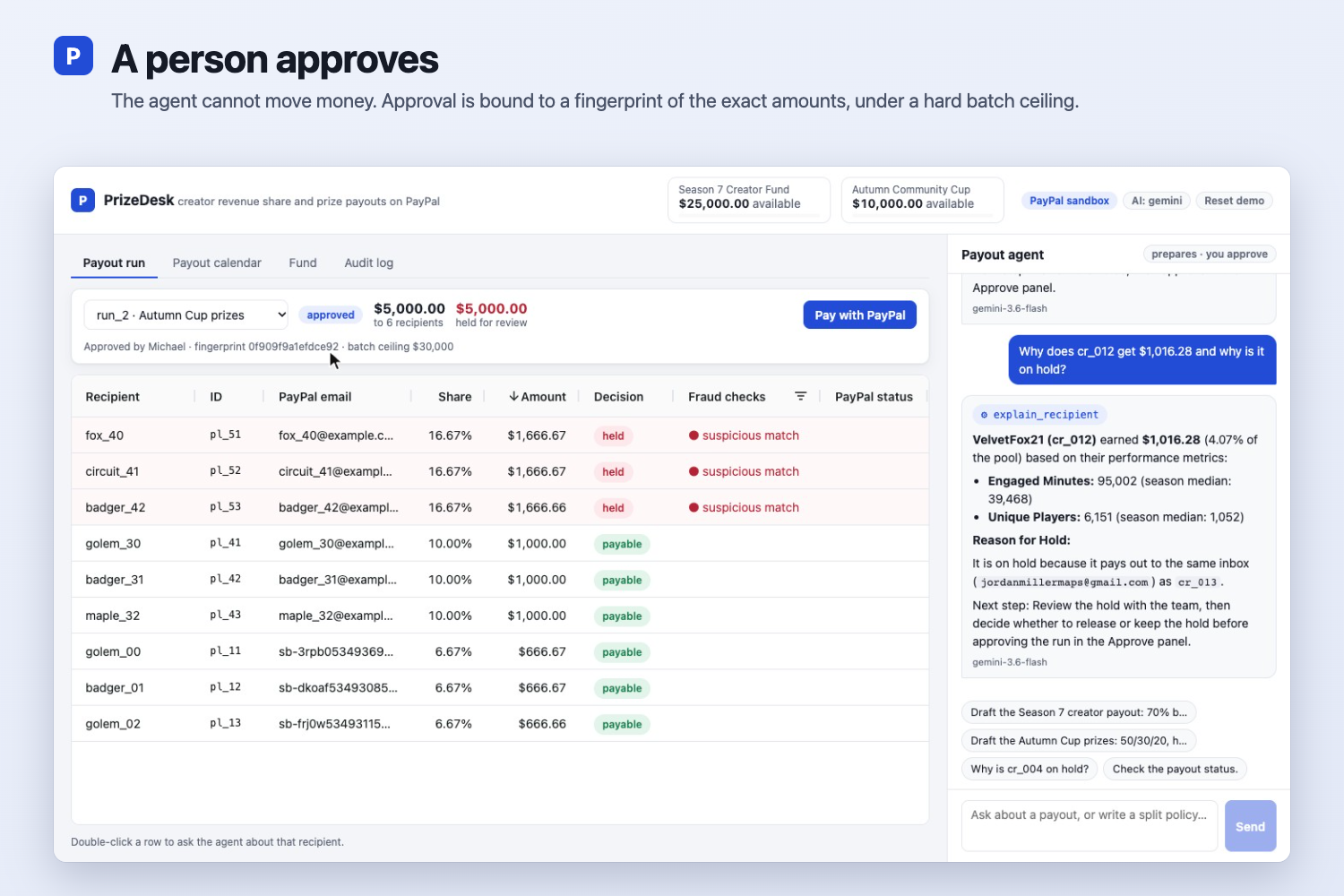
A person approves. The approval is bound to a fingerprint of the exact amounts, under a hard batch ceiling.
-
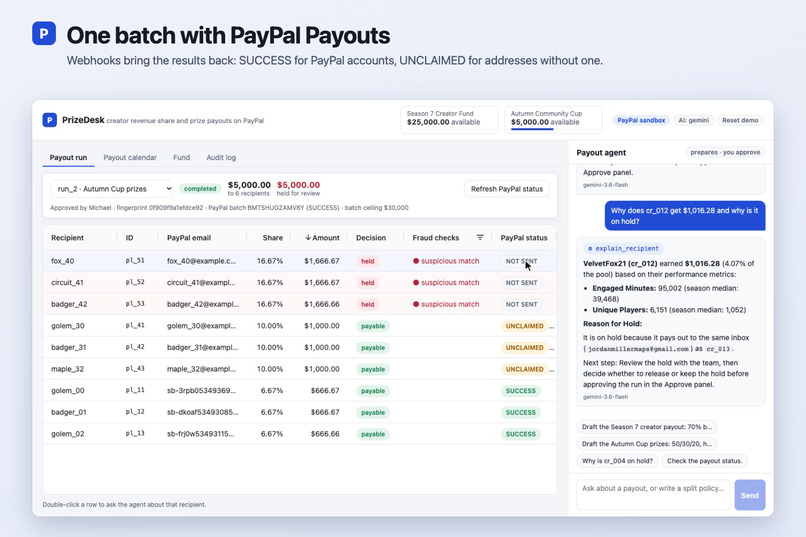
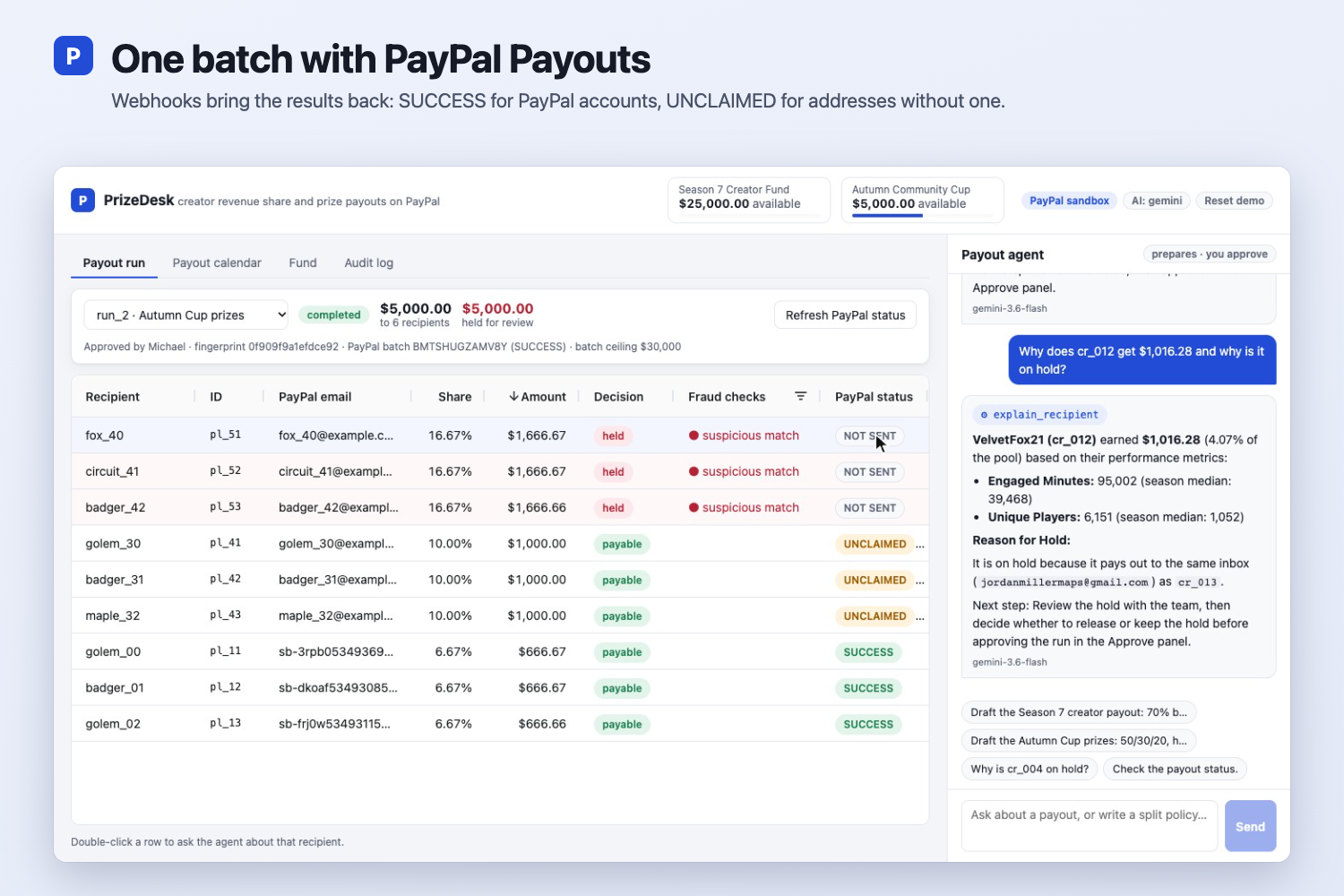
One batch with PayPal Payouts. Webhooks report SUCCESS for PayPal accounts and UNCLAIMED for addresses without one.
-
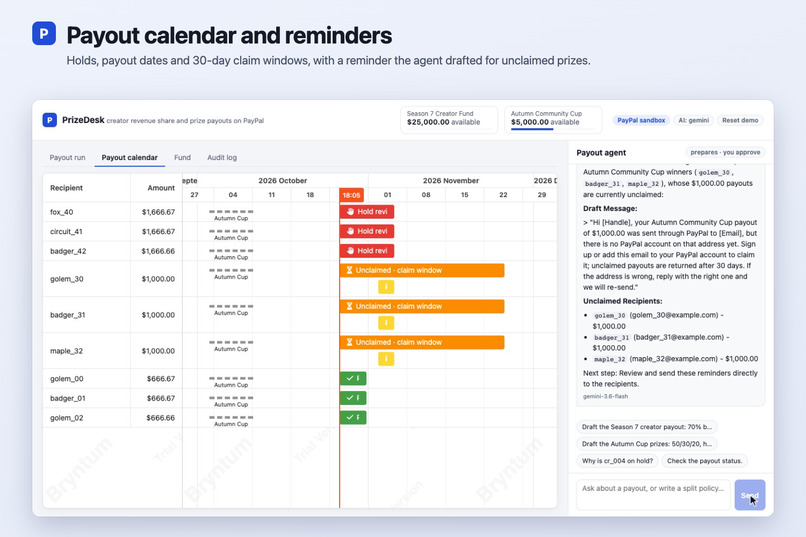
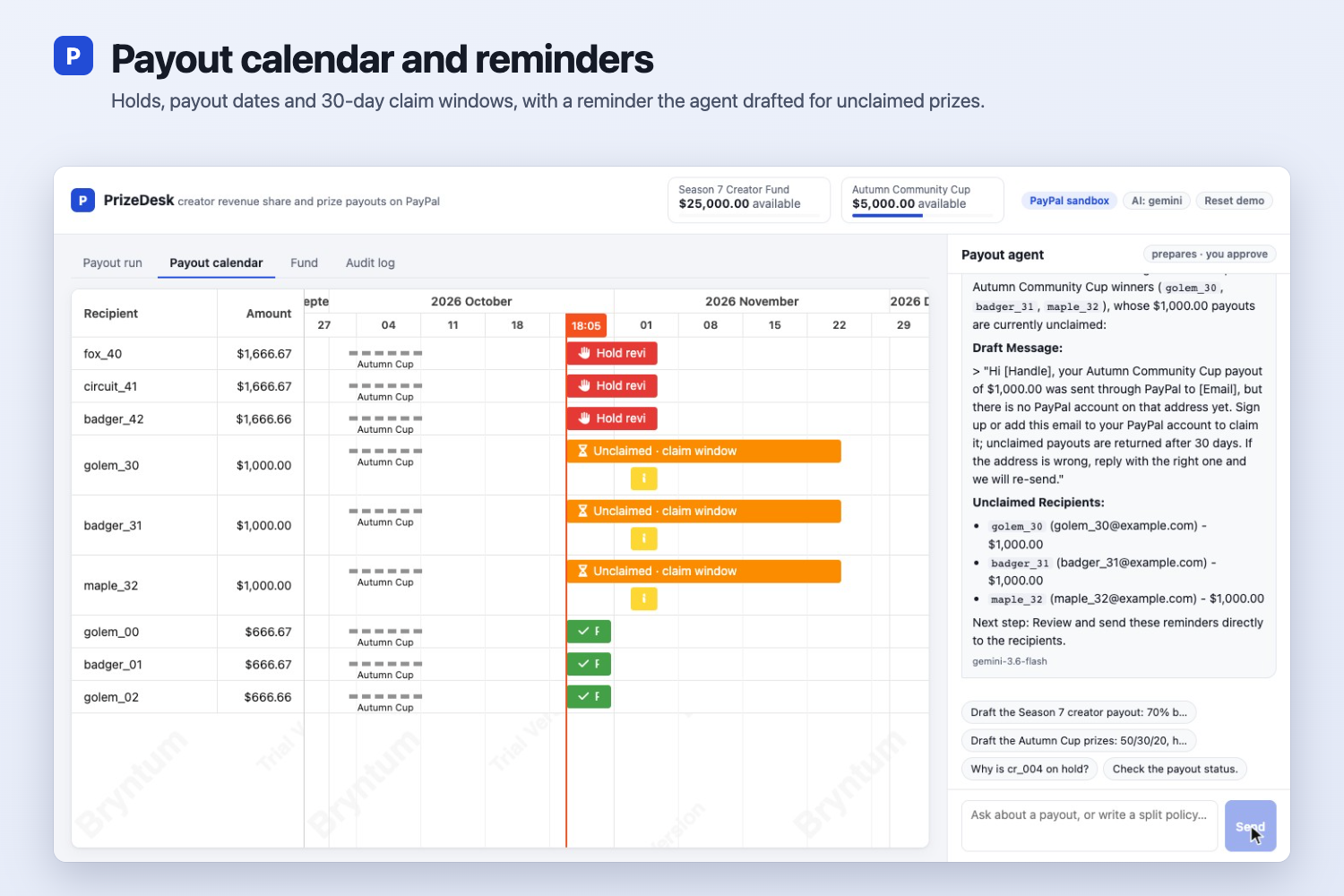
Payout calendar: holds, payout dates and 30-day claim windows, plus a reminder the agent drafted for unclaimed prizes.
-
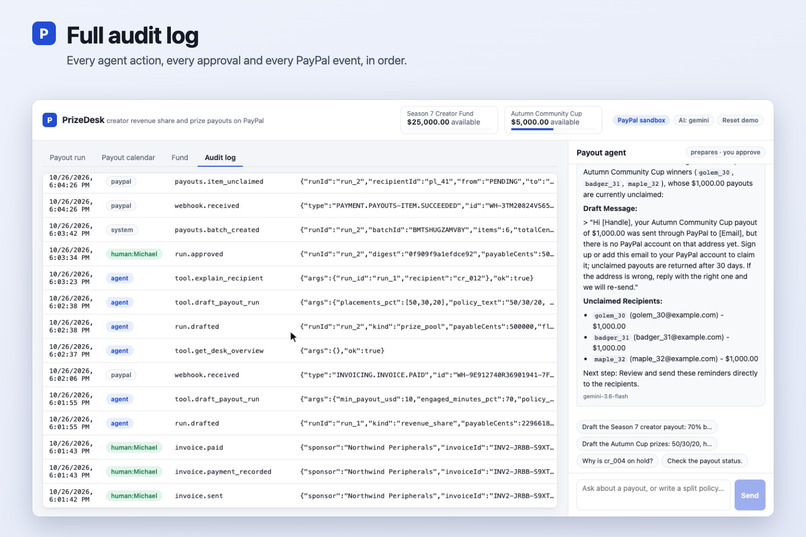
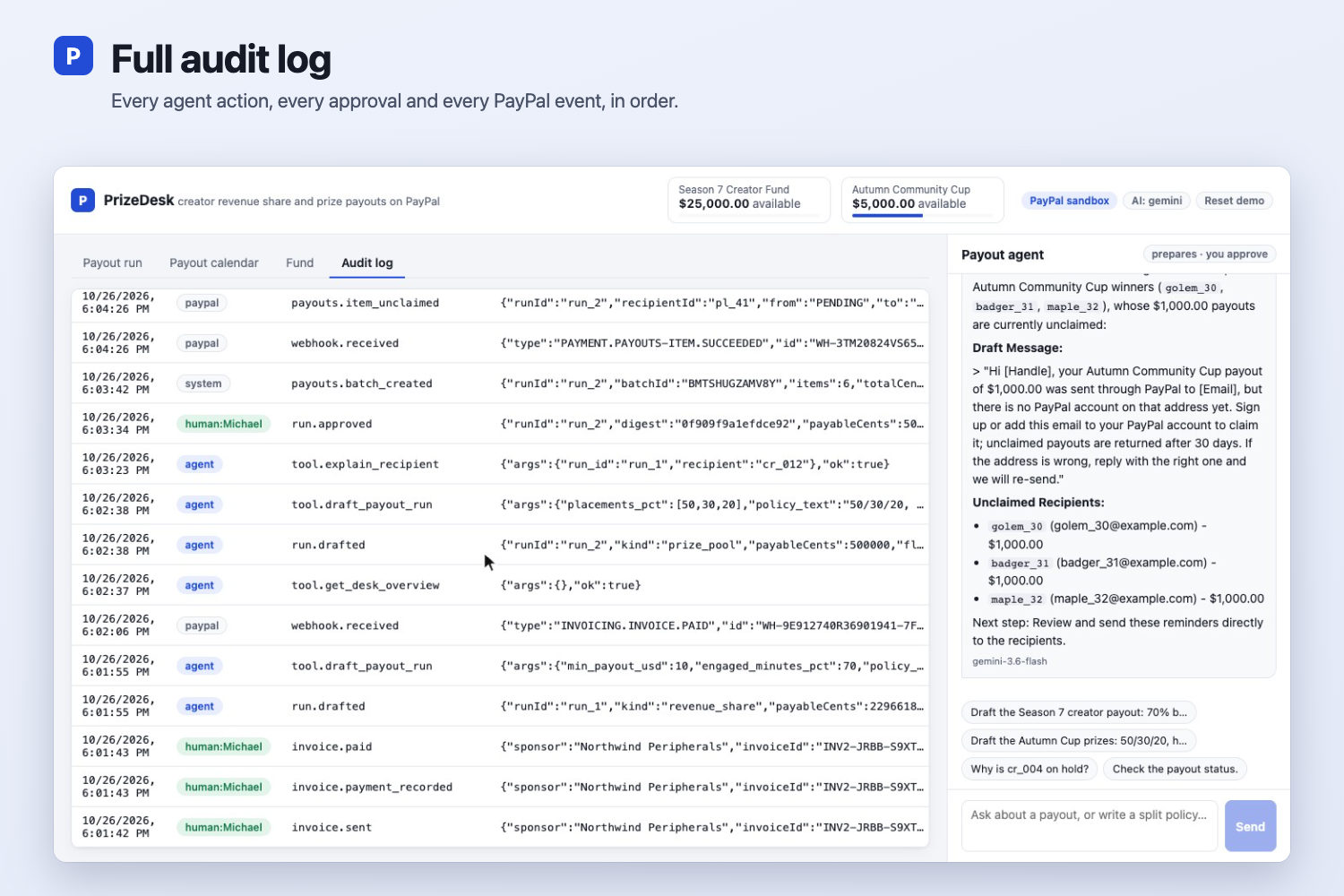
Audit log: every agent action, approval and PayPal event, in order.
Inspiration
I've spent years on monetization and LiveOps for free-to-play games. More and more studios now pay people who aren't on their payroll: map and mod makers who earn a share of season revenue, and players who win community tournaments. Almost everywhere I looked, that money still moves through a spreadsheet and dozens of manual transfers. It breaks in the same places every season:
- Farmed metrics. Bot farms and replay loops inflate a creator's numbers to grab a bigger share.
- Duplicate payees. One person registers two creator accounts that pay out to the same inbox.
- Thrown matches. A team is handed a win and walks away with the prize.
- Disputes. "Why did I get less than last season?" has no written answer.
- Unclaimed money. Payouts go to an address with no PayPal account, sit there, and bounce back 30 days later.
I wanted a tool that a community manager could trust with real money: an AI that does the tedious checking and explaining, and a human who stays in charge of every dollar that leaves.
What it does
PrizeDesk runs the whole payout cycle for two programs at once: a season creator fund (revenue share across 40 UGC creators) and a community cup (prize pool across 8 teams).
- Money in, through PayPal. Players buy supporter packs with PayPal Checkout, and half of every sale goes to the creator fund. A tournament sponsor pledges half of the cup's prize pool, so the agent sends them a PayPal invoice through the PayPal Agent Toolkit. The pool is credited only when PayPal reports the invoice paid.
- A split policy in plain English. For example: "70% by engaged playtime, 30% by unique players, cap each creator at 25%, minimum payout $10, hold anyone flagged." The agent turns it into a validated rule set. The math is done in code, never by the model, so every cent adds up.
- Fraud checks with evidence. Deterministic detectors flag bot sessions, replay farming, report spikes, accounts that share a payout inbox (including Gmail dot and plus aliases), and suspiciously short matches. Flagged recipients are held, and the agent explains each hold in one plain sentence, citing the evidence.
- Explainable amounts. Double-click any row in the payout ledger and the agent explains that recipient's amount against the season medians, in language you could forward to the creator.
- A human approves. The agent has no tool that can move money. The approval is bound to a fingerprint of the exact recipients, addresses and amounts, so any change afterwards blocks the payout. A hard per-batch ceiling applies, and a run can never pay out more than its pool has actually received.
- Pay everyone with PayPal Payouts. One batch, one click. Webhooks bring the results back in real time: who was paid, whose payout is unclaimed, what failed.
- Follow-through. A payout calendar (Bryntum Scheduler) shows earnings windows, holds under review, payout dates and 30-day claim windows. The agent drafts reminders for unclaimed payouts, and a person can pull back an unclaimed payout to re-send it. Every agent action, approval and PayPal event lands in an audit log.
How we built it
- PayPal:
- Payouts: batch create, status tracking, cancelling unclaimed items;
- Checkout: Orders v2 with the JS SDK buttons;
- Invoicing: create, send, get and record payment, via the PayPal Agent Toolkit;
- Transactions: read-only, via the toolkit;
- Webhooks: every delivery is verified with
verify-webhook-signatureand processed exactly once.
- AI:
- Google Gemini with function calling, behind a small provider interface;
- a custom agent loop with seven tools, plus two read-only PayPal Agent Toolkit tools;
- a deterministic offline model that runs the whole demo without an API key, and steps in if the LLM is out of quota (its replies are labeled as such).
- App:
- TypeScript, Express and React;
- AG Grid for the payout ledger and Bryntum Scheduler for the payout calendar;
- hosted on Render.
- Data: synthetic and generated (40 creators, 8 teams, planted fraud cases), so no real players or games are involved.
- Process: 44 automated tests cover the split engine, the fraud detectors, policy parsing, the guardrails, sponsor invoicing, webhooks, the agent and the API. I built PrizeDesk with Claude Code as an AI pair programmer; the product decisions and the payout and fraud rules come from my own LiveOps experience.
Challenges we ran into
- Keeping the model away from arithmetic. In early tests the LLM "helpfully" re-computed prize splits and got a place wrong. Now every number the agent can mention, including per-place totals, is computed in code and handed to it, and the prompt forbids deriving new figures.
- A safe public demo. Every visitor gets a private in-memory desk, routes are rate-limited, and demo payouts to unclaimable addresses are pulled back after an hour so the sandbox test money is recycled.
- Idempotency done right. Identical demo data on different desks once reused the same PayPal
sender_batch_id, and PayPal correctly refused it. Each draft now gets its own id, so a retried submit can never pay twice and two visitors never collide.
Accomplishments that we're proud of
- The full money loop runs on PayPal. Money comes in through Checkout and Invoicing, and goes out through Payouts and Webhooks, all against the live sandbox.
- Guardrails a finance team would accept. The AI does the tedious work, and a person signs off on exact amounts.
- Every hold and every amount comes with a written reason.
What we learned
- Agentic payments need hard boundaries. Agents are great at explaining and preparing. The decision to move money belongs to a person, enforced in code, not in the prompt.
- Payouts are the beginning, not the end. The unclaimed and returned cases are where most of the real work is.
What's next for PrizeDesk
- Import connectors for common game analytics exports.
- Multi-currency payouts and Venmo for US creators.
- Tax-form collection before the first payout.
- Pilots with indie studios that run creator programs.
Built With
- ag-grid
- bryntum
- express.js
- gemini
- node.js
- paypal
- paypal-agent-toolkit
- paypal-checkout
- paypal-payouts
- paypal-webhooks
- react
- render
- typescript
- vite

Log in or sign up for Devpost to join the conversation.