Inspiration
Mental health is the most personal data that exists. Yet every telehealth platform today asks you to upload your moods, symptoms, and conditions to centralized servers — creating a privacy liability time bomb. 41% of Americans already fear health data breaches. We asked: what if AI could help without ever seeing your data?
What it does
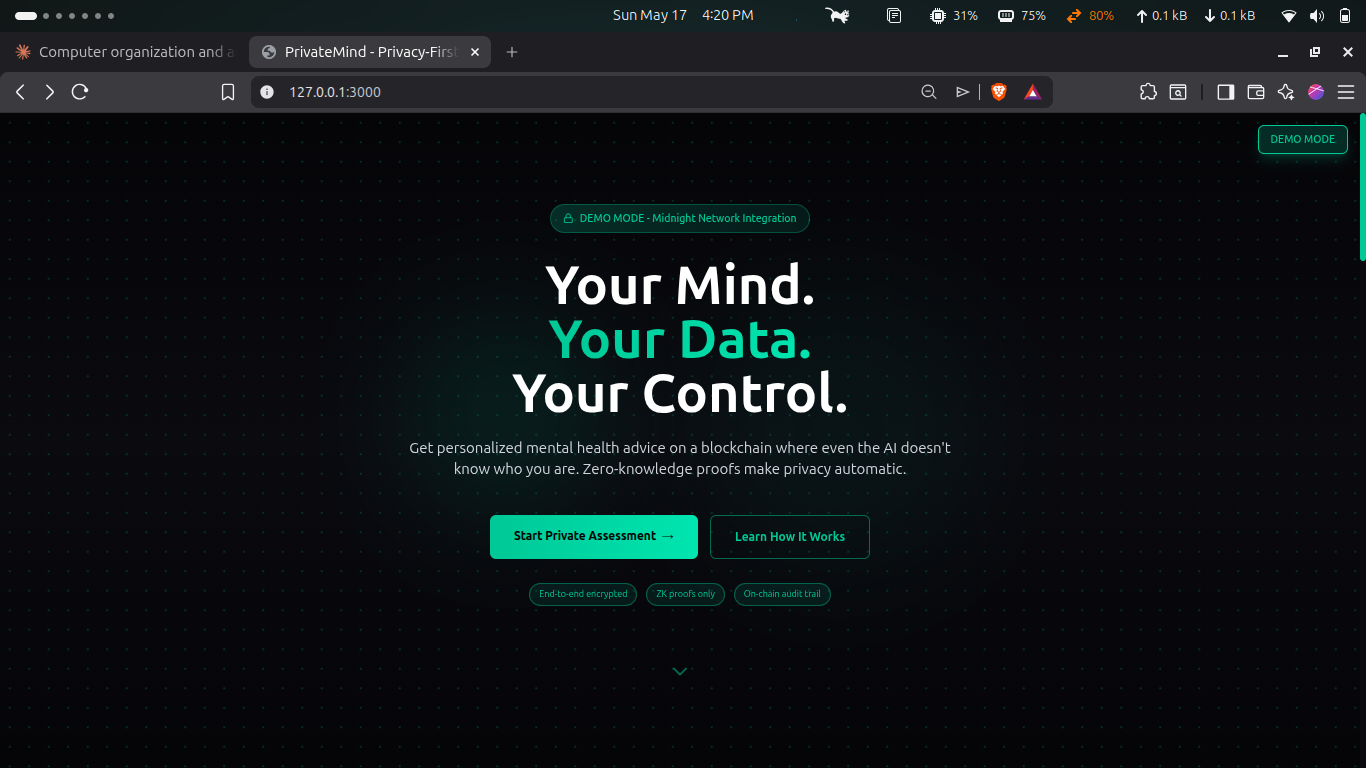
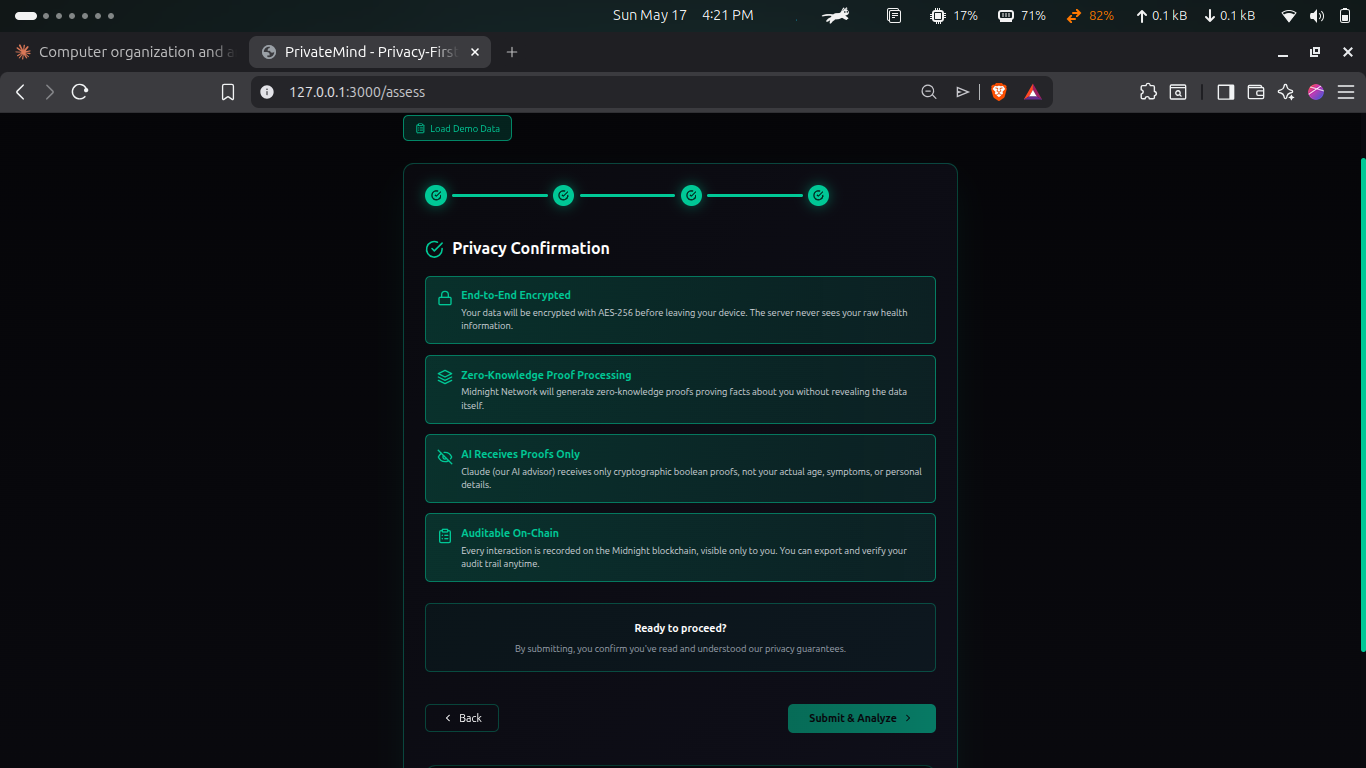
PrivateMind is a privacy-first AI mental health advisor built on the Midnight Network blockchain. Here's what makes it unique:
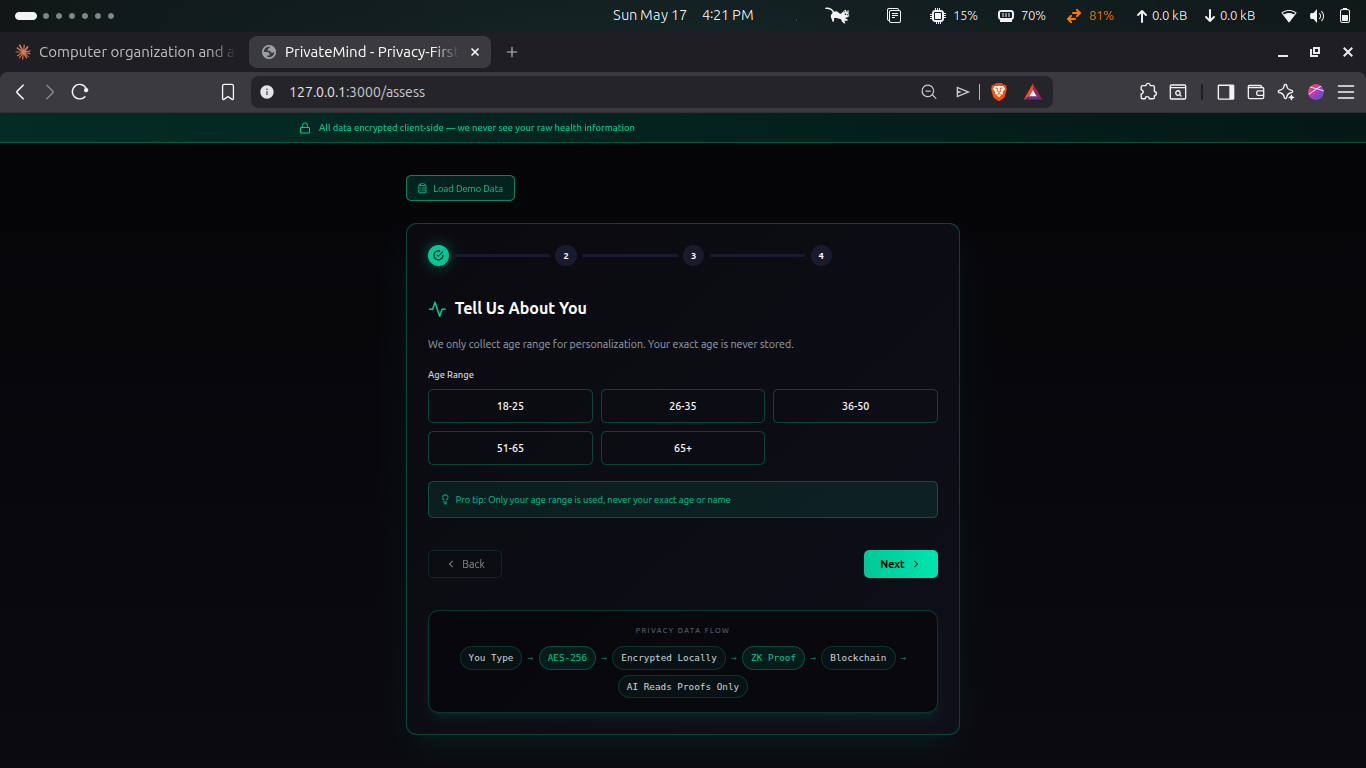
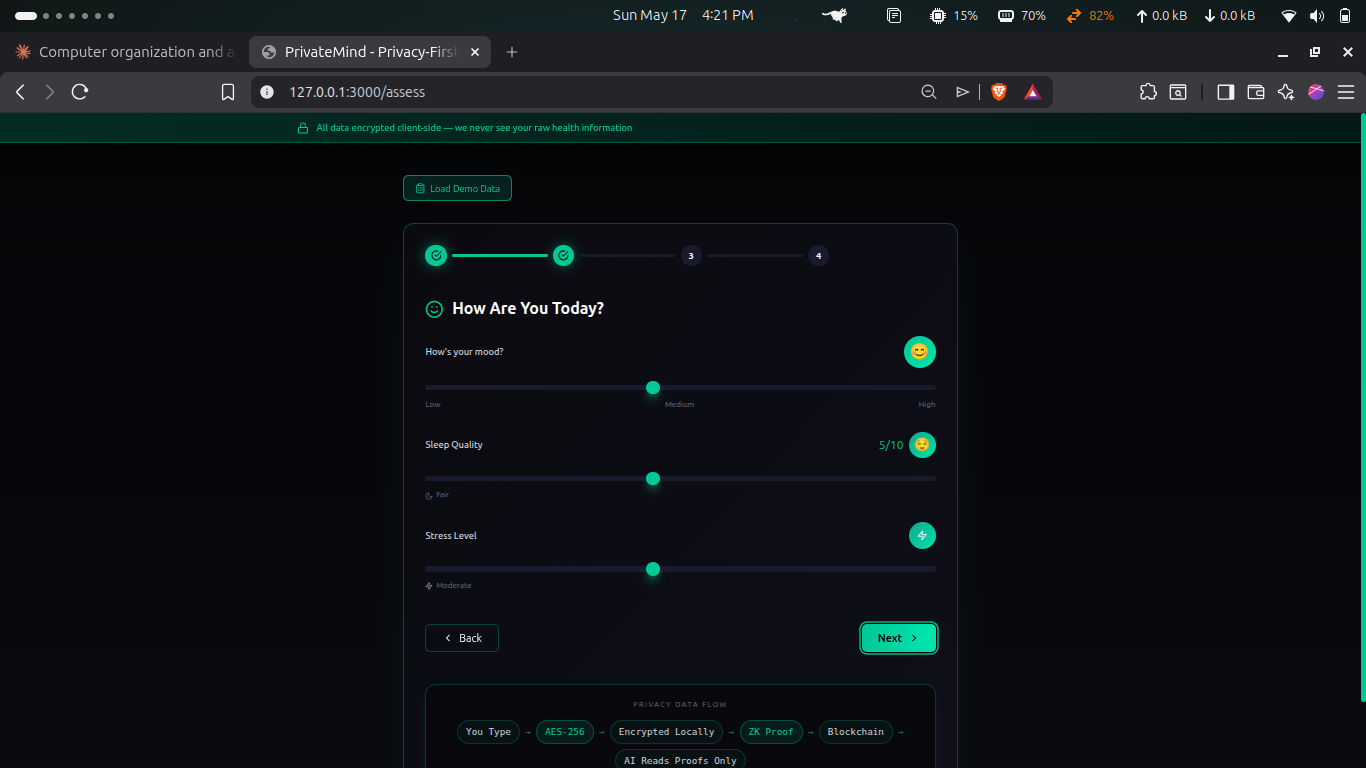
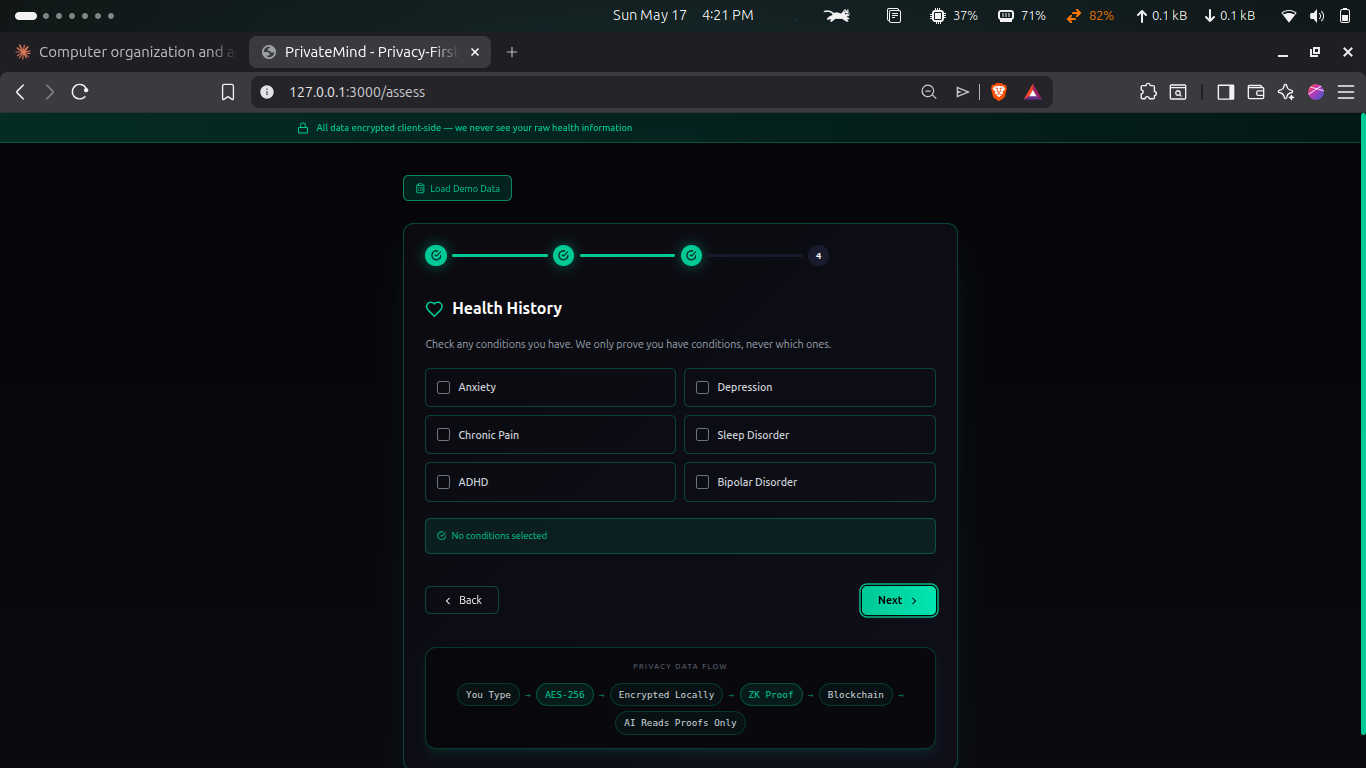
- You fill out a health assessment form
- Your data is encrypted with AES-256-GCM on your device before anything is sent
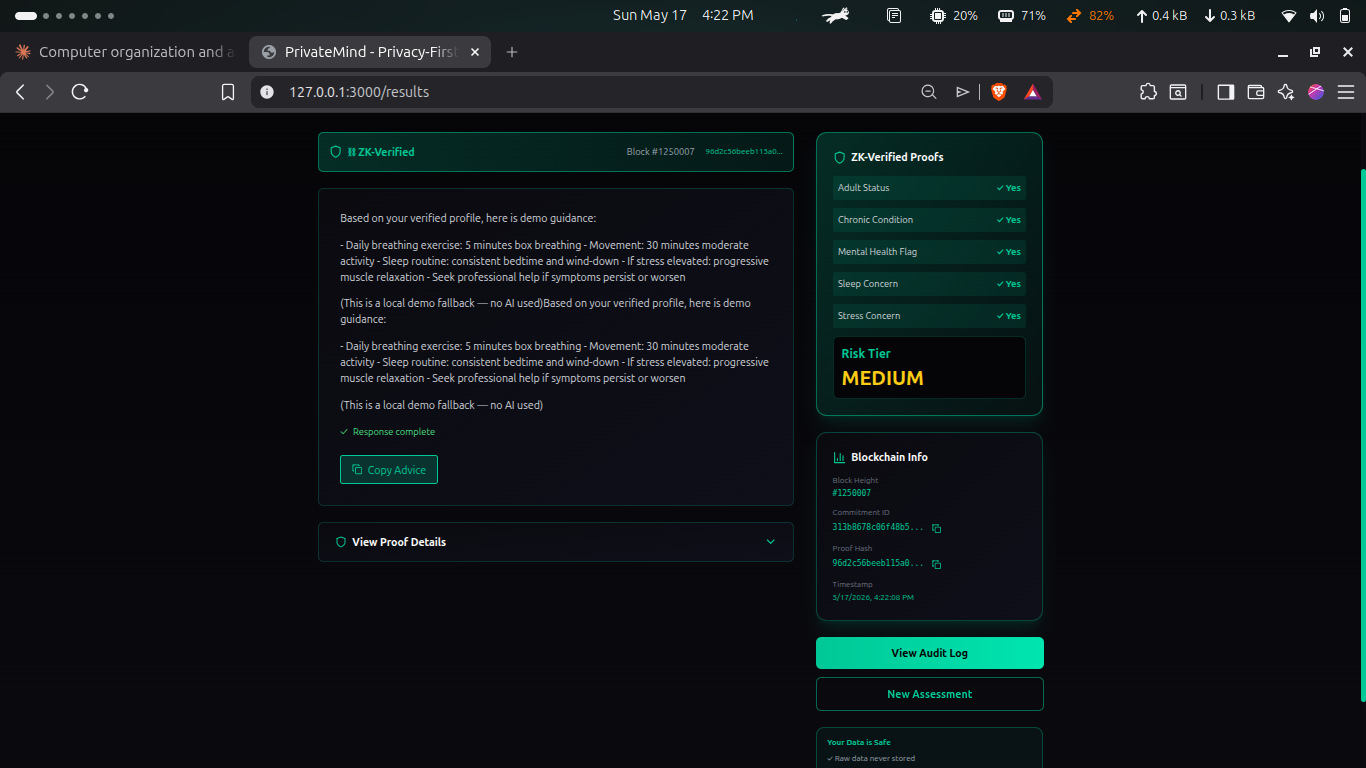
- Midnight Network generates zero-knowledge proofs — mathematical certificates that prove facts (is_adult=true, risk_tier=MEDIUM) without revealing the underlying data
- Claude AI receives only the boolean proofs, never your actual age, mood scores, or conditions
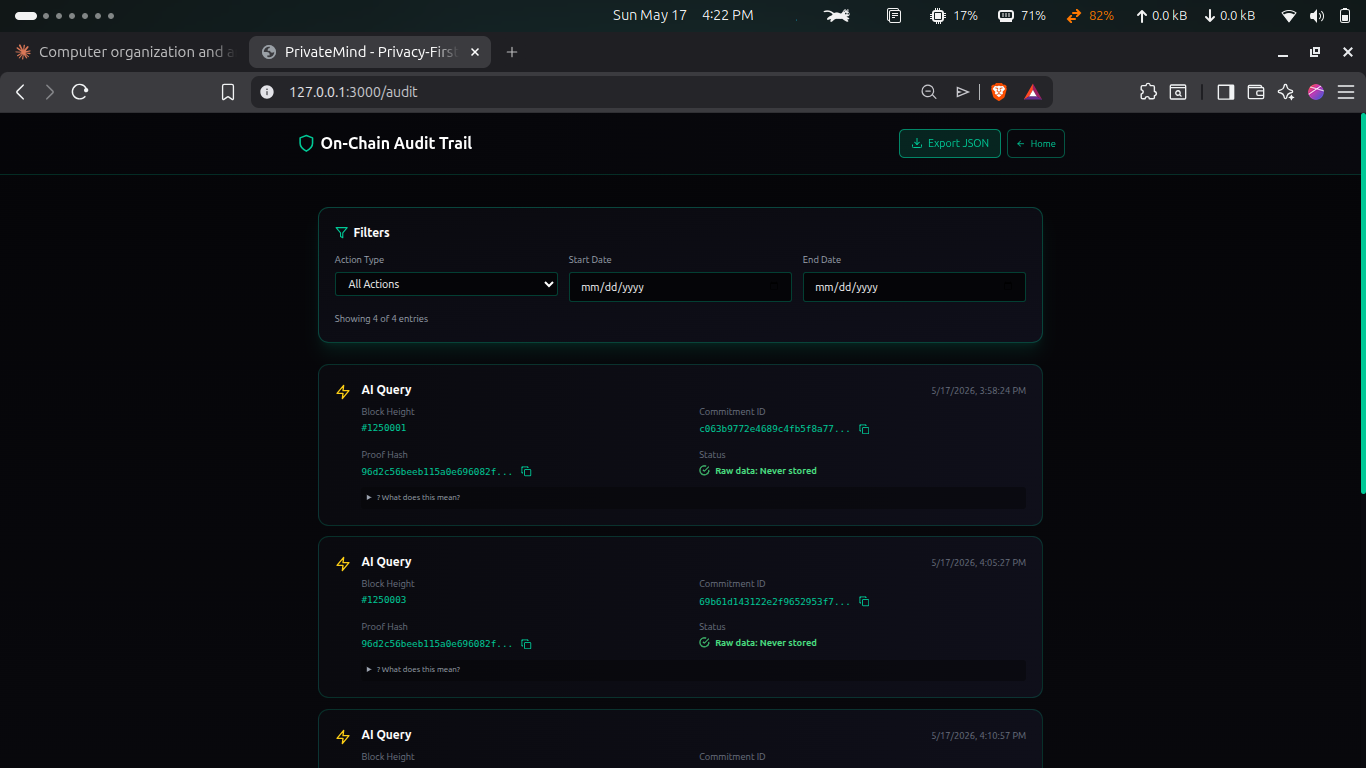
- You get personalized mental health advice with a full on-chain audit trail — only you can see
The result: AI that's genuinely helpful AND genuinely private.
How we built it
Frontend: Next.js 14 + TypeScript + Framer Motion
Backend: Node.js + Express with Server-Sent Events for
streaming AI responses
Blockchain: Midnight Network (mock layer — production SDK
swappable by replacing one file)
AI: Anthropic Claude Sonnet via streaming API
Encryption: Web Crypto API (AES-256-GCM, browser-native)
ZK Layer: Compact language smart contract defining private
state and public proof outputs
The architecture is designed so raw health data is mathematically impossible to leak — it's processed into ZK proofs and immediately dereferenced before any network call.
Challenges we ran into
- Midnight Network SDK is very new with sparse documentation. We built a production-faithful mock layer that mirrors the real API surface so the swap to mainnet is one file change.
- Implementing genuine client-side AES-256-GCM encryption using the Web Crypto API with proper IV generation and key management in sessionStorage only.
- Designing the ZK proof schema — deciding exactly which boolean facts the AI needs vs. what must stay private required careful thinking about the minimum sufficient disclosure principle.
- Making the Server-Sent Events streaming work reliably across the Next.js frontend and Express backend.
Accomplishments that we're proud of
- Zero raw health data ever touches our servers — mathematically guaranteed, not just promised
- The ZK Proof Visualizer component — a real-time animated terminal showing cryptographic operations that judges and users can actually understand
- Full end-to-end working demo in under 60 seconds: form → ZK proof generation → streaming AI advice → audit log
- A business model with a clear path: $9B/year HIPAA compliance market, B2B SaaS targeting BetterHelp, Teladoc, and Epic
What we learned
- Zero-knowledge proofs are not just a buzzword — they solve a real, fundamental problem with how AI systems handle sensitive data today
- Midnight Network's native ZK support is genuinely differentiated vs. chains that bolt ZK on as an afterthought
- The hardest privacy problem isn't encryption — it's minimizing what you decrypt in the first place. Our proof-only AI query design solves this elegantly.
- Building for HIPAA compliance from day one (rather than retrofitting it) is actually faster and cheaper
What's next for PrivateMind
- Week 1-2: Integrate real Midnight SDK, deploy to stagenet
- Month 1: Partner with 2-3 telehealth platforms for beta
- Month 2-3: Third-party security audit, HIPAA BAA ready
- Month 6: Series A with $500K-1M ARR from B2B SaaS
Built With
- aes-256-gcm
- anthropic-claude-api
- express.js
- framer-motion
- lucide-react
- midnight-network
- next.js
- node.js
- server-sent-events
- shadcn/ui
- tailwind-css
- typescript
- web-crypto-api
- zero-knowledge-proofs

Log in or sign up for Devpost to join the conversation.