-
-
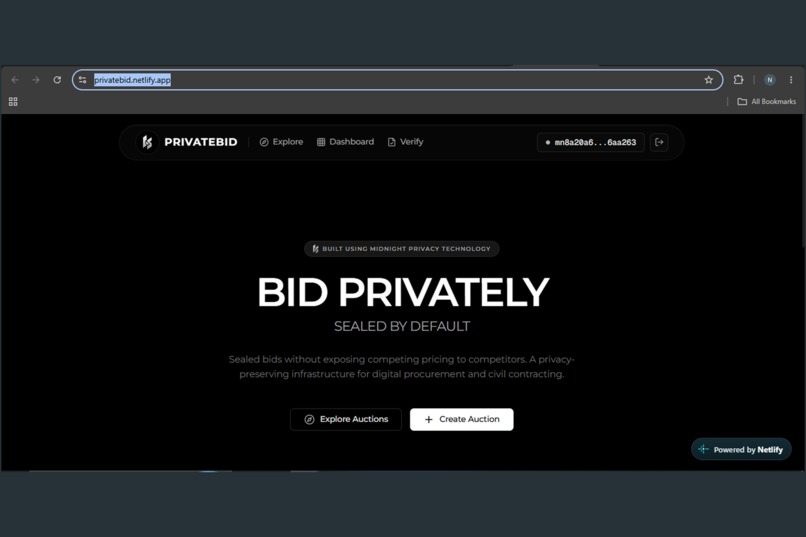
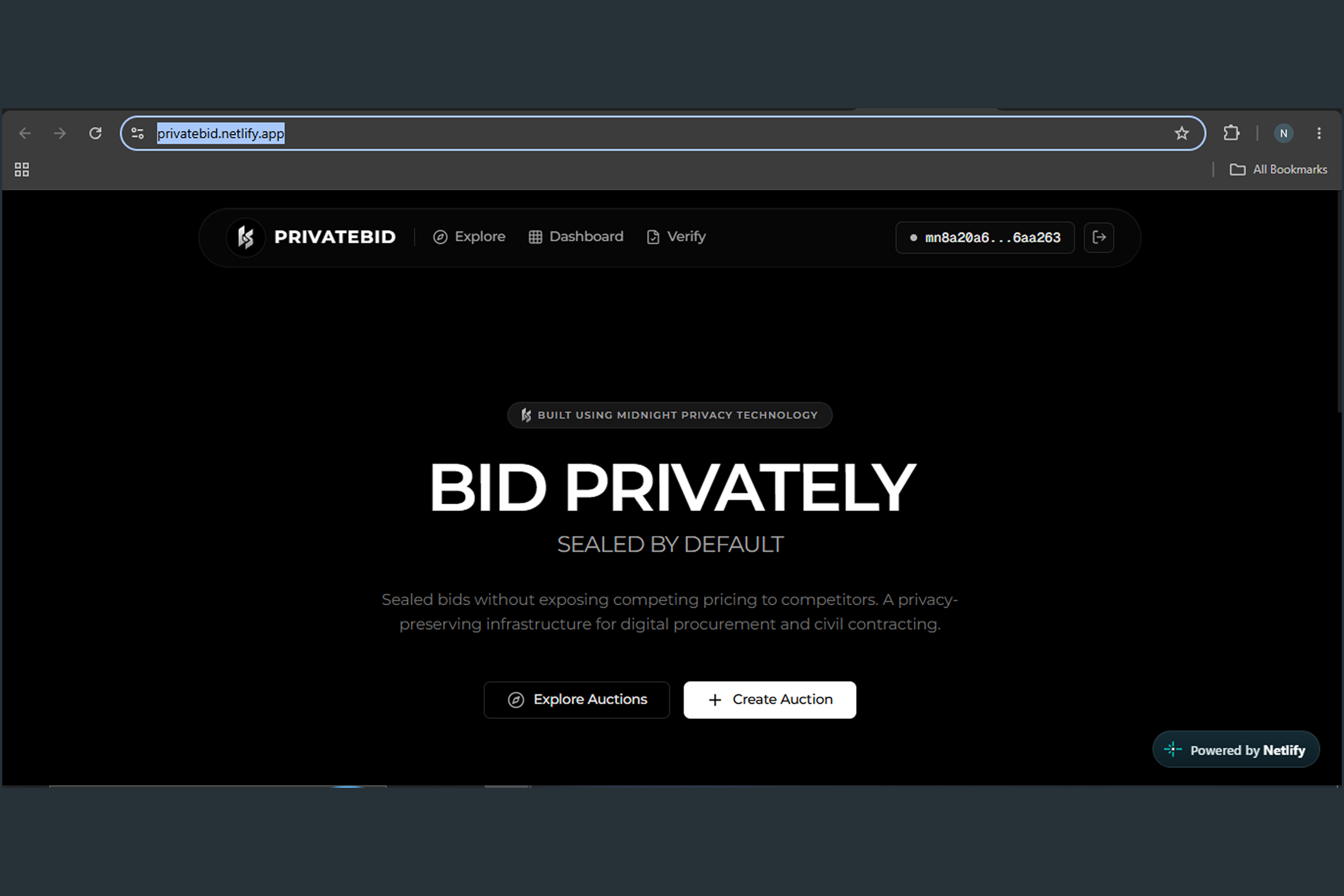
Hero section
-
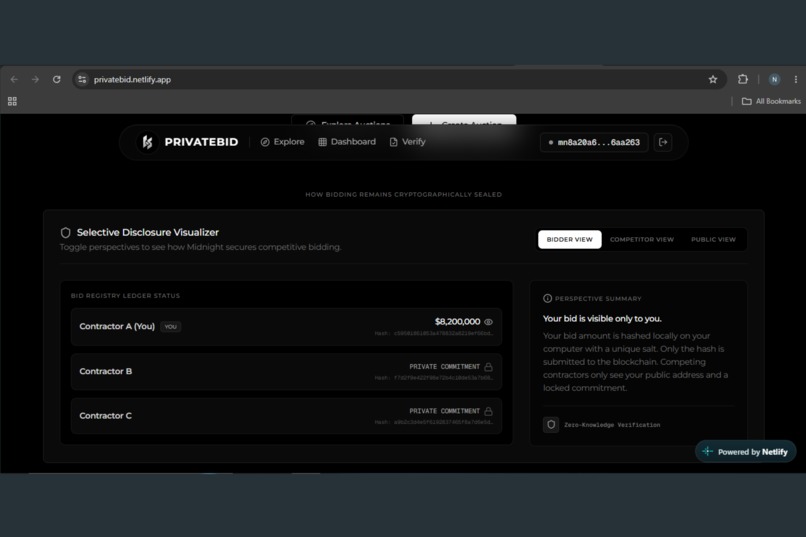
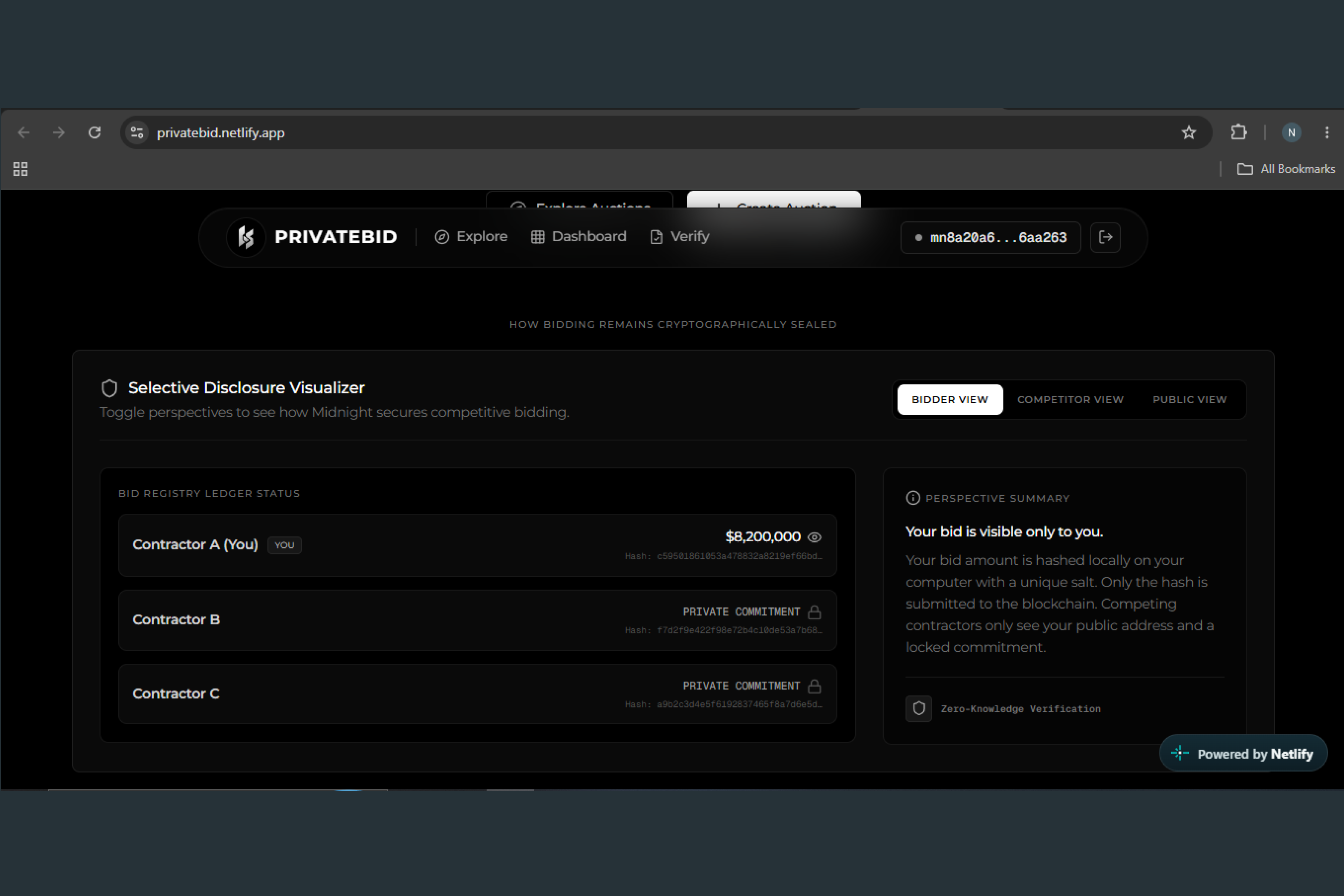
Selective Disclosure Visualizer
-
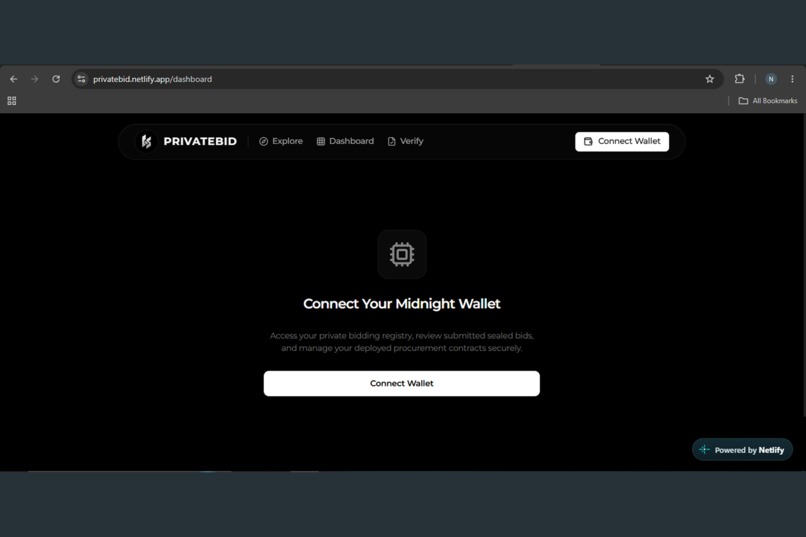
Connect Wallet
-
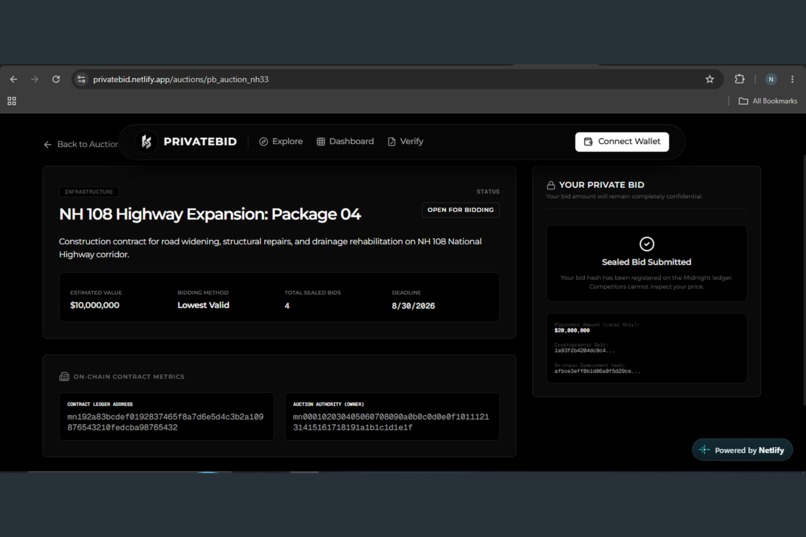
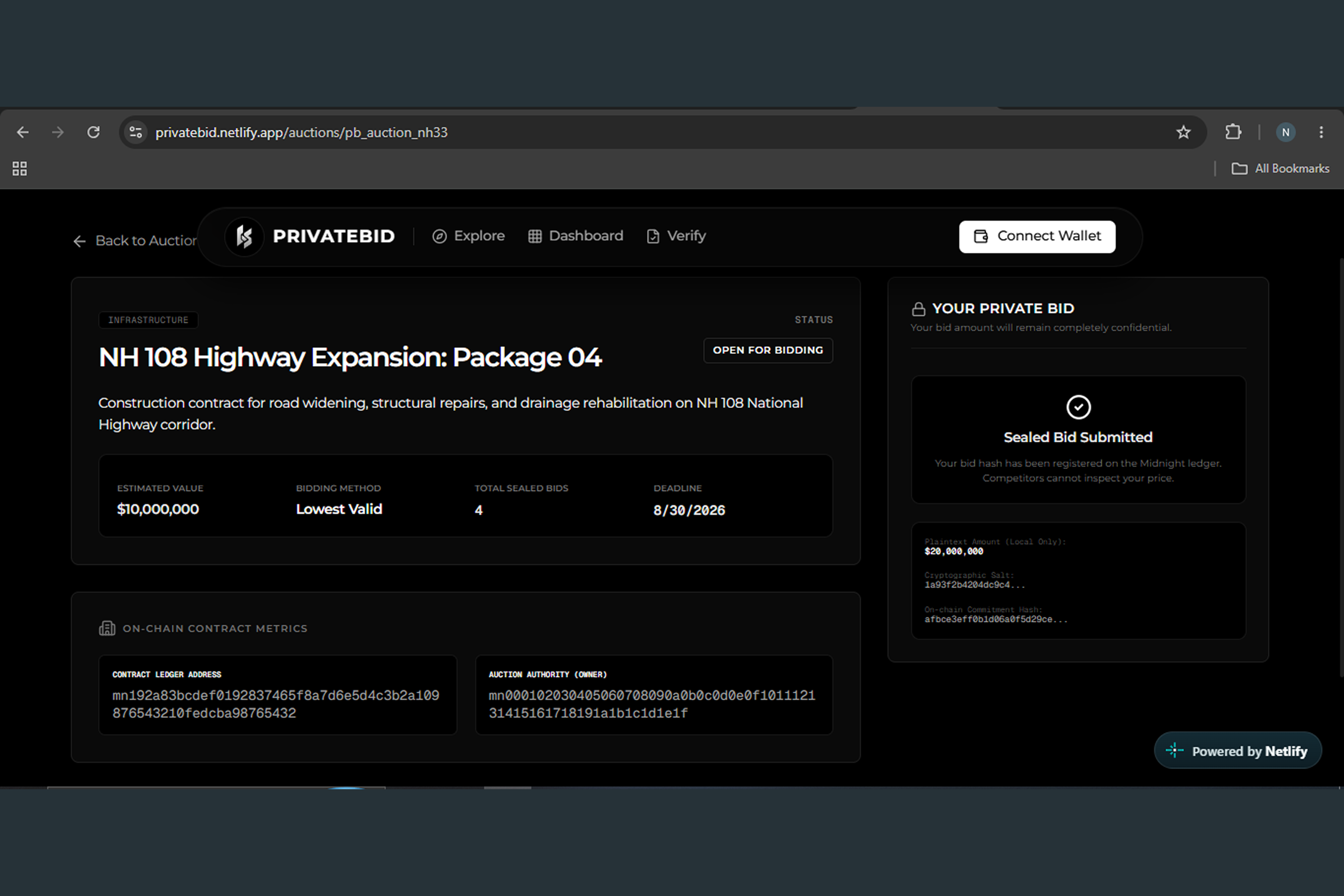
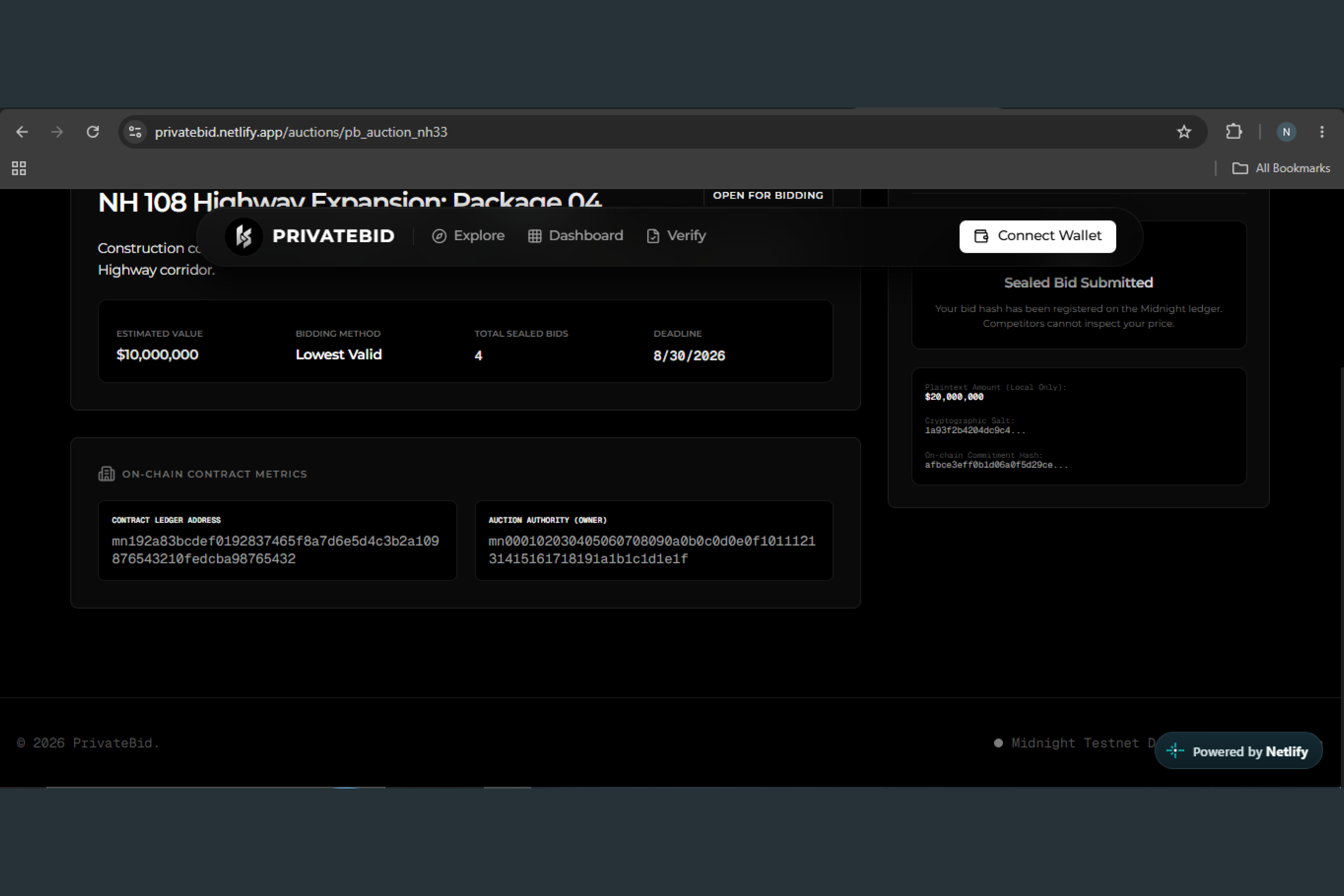
Bidding Project Section
-
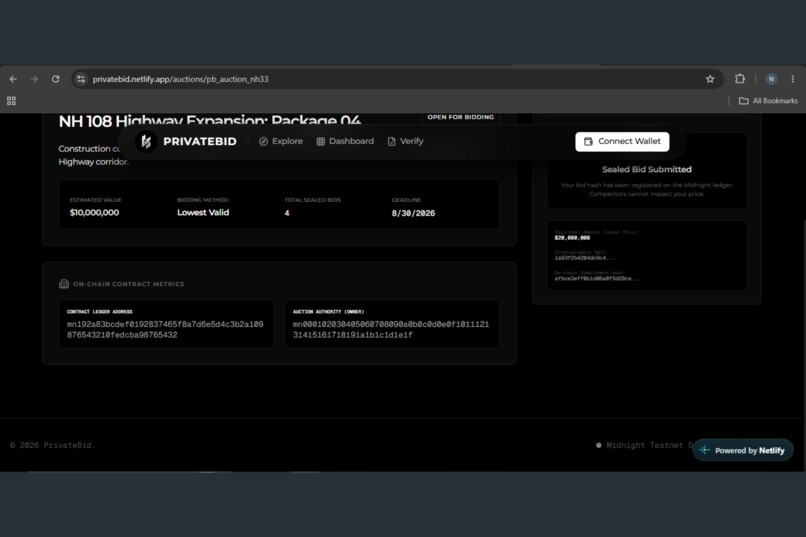
Bidding Project Section 2
-
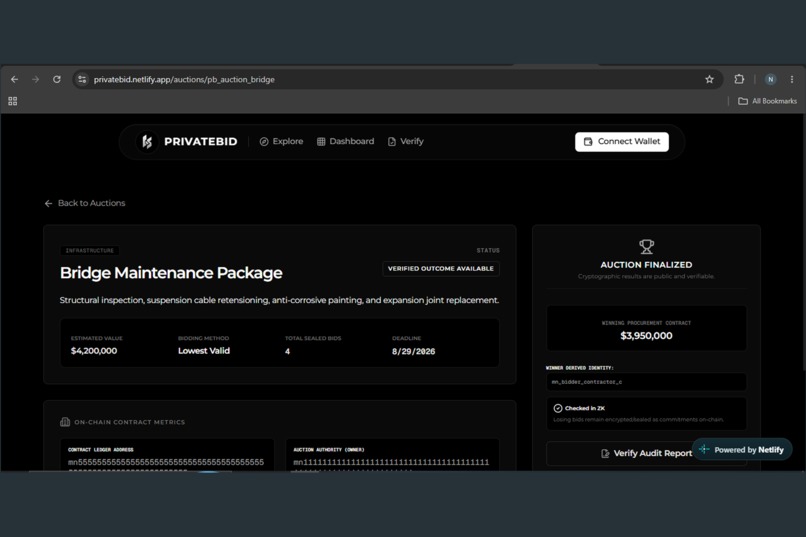
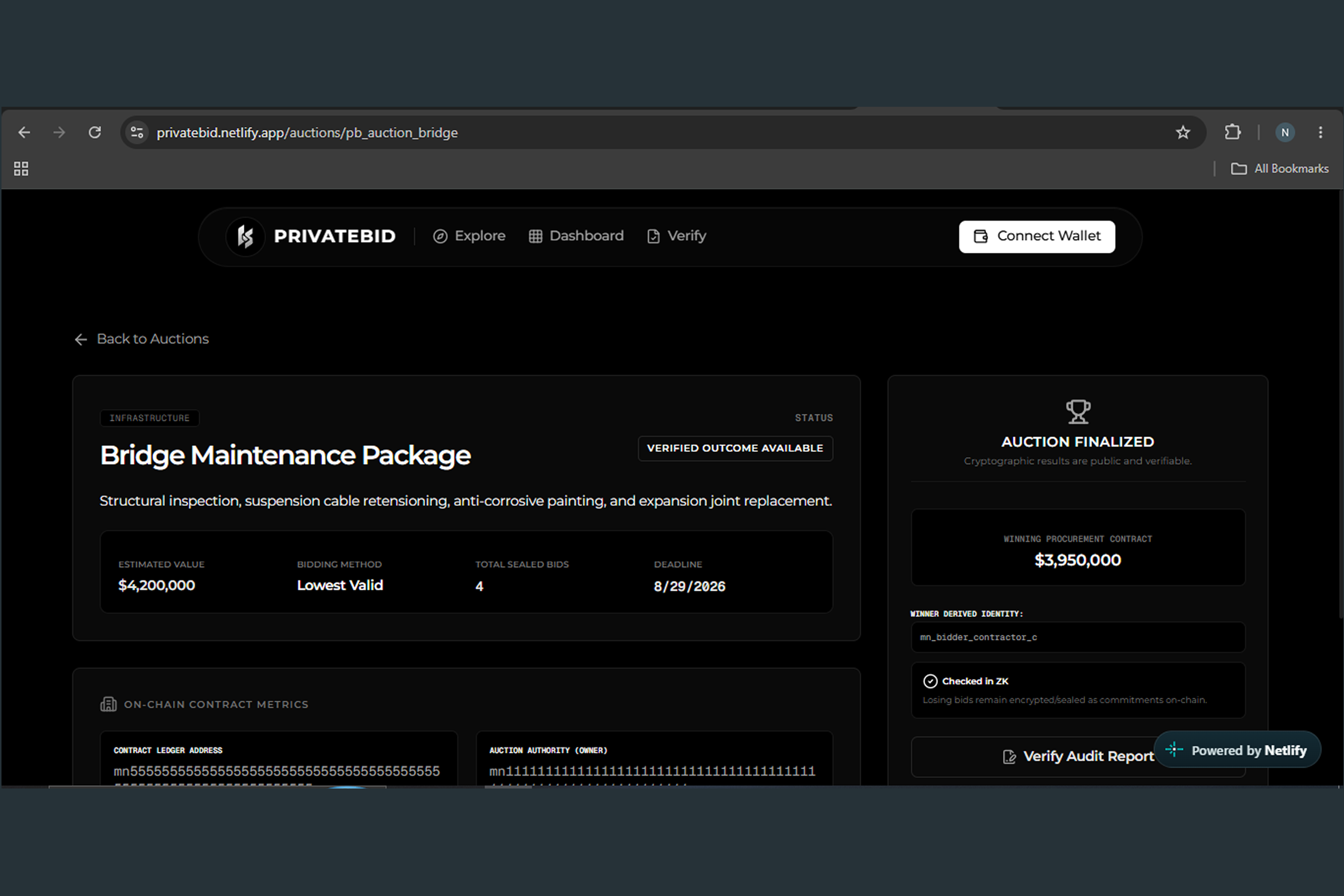
Bridge Maintenance package section
-
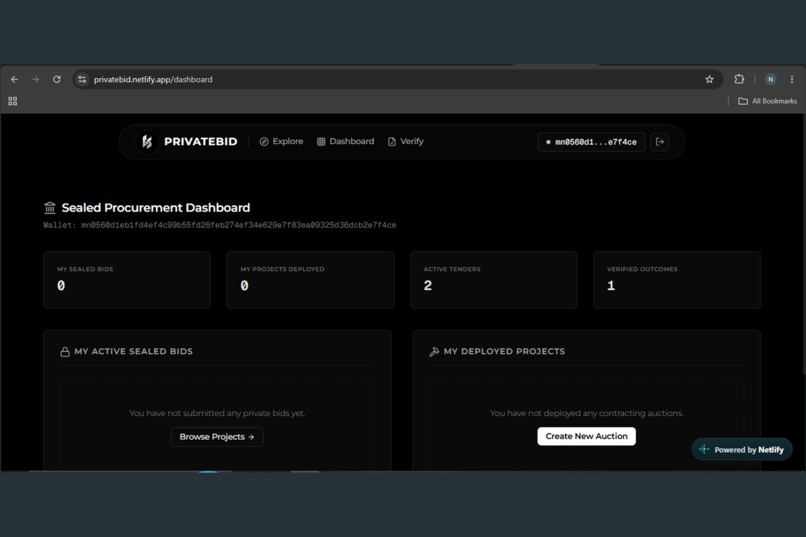
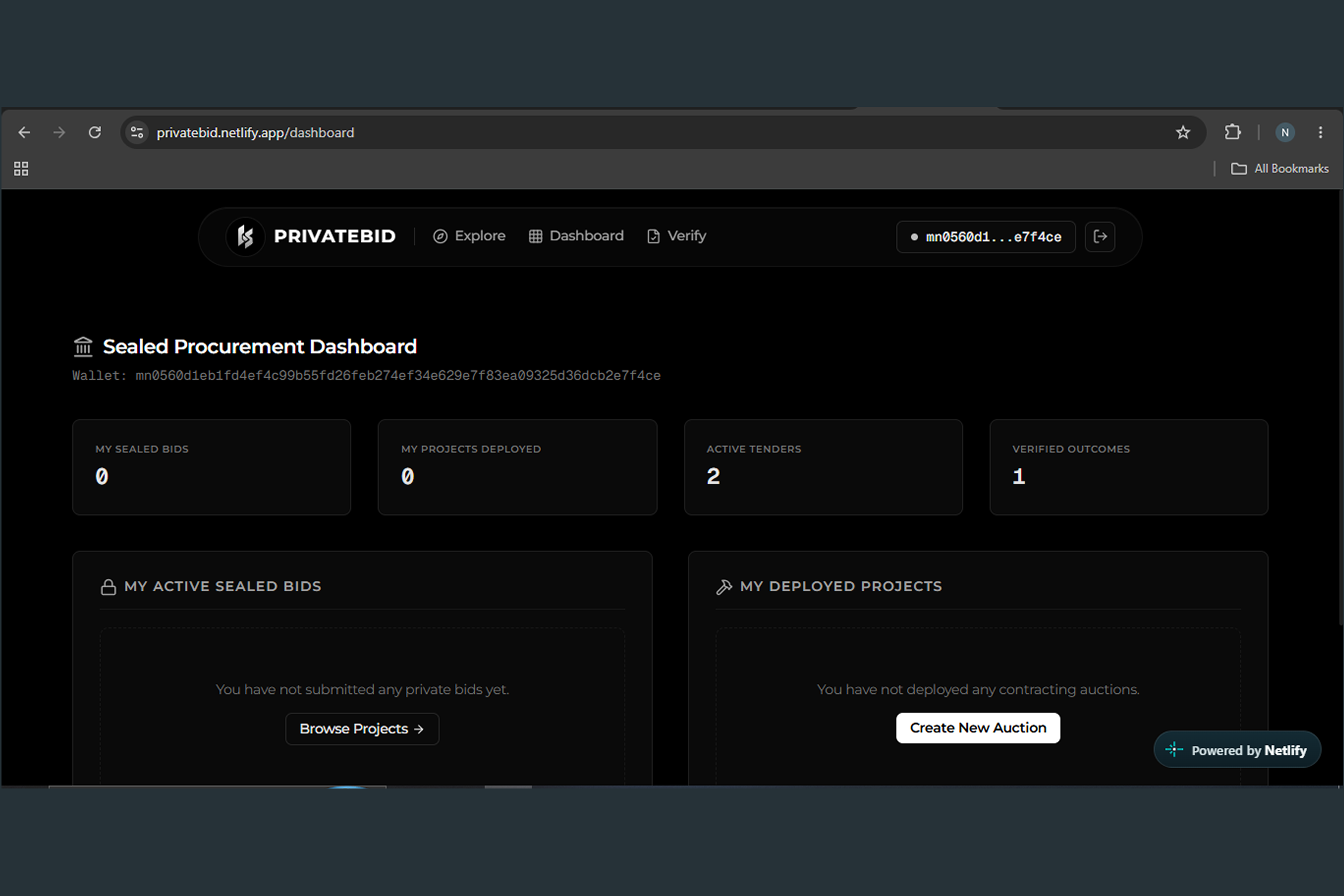
Sealed Procurement Dashboard
Inspiration
Traditional procurement and tendering systems often require bidders to reveal sensitive pricing information to a centralized authority. This creates concerns around bid manipulation, strategic undercutting, collusion, and unnecessary exposure of commercially sensitive data.
We wanted to explore a simple question:
Can a tender be transparent without making every bid public?
That led to PrivateBid — a privacy-first procurement system where bids remain sealed while the outcome can still be verified.
What it does
PrivateBid enables organizations to conduct confidential sealed-bid procurement using privacy-preserving blockchain technology.
- Bids stay private — competing bidders cannot see each other's offers.
- Privacy by default — sensitive bid information is protected throughout the process.
- Verifiable outcomes — the system can verify that bidding rules were followed without exposing confidential bids.
- Blockchain-backed integrity — important procurement events can be recorded in a tamper-resistant environment.
- Procurement dashboard — organizers can create tenders, manage bids, and determine outcomes through a unified interface.
- Fairer competition — bidders can compete without being influenced by competitors' submitted prices.
PrivateBid is designed around the principle:
Bid privately. Verify publicly.
How we built it
PrivateBid combines a modern web application with blockchain-based privacy technology.
Technology
- Frontend: React
- Styling: Modern responsive UI
- Blockchain: Midnight
- Privacy: Zero-knowledge / privacy-preserving computation
- Smart contracts: Midnight-compatible contract architecture
- Development: TypeScript / JavaScript and modern web tooling
The application separates the user experience from the underlying privacy and verification layer. Users interact with a familiar procurement interface, while sensitive bid information is handled through the privacy-preserving architecture.
The goal was not to put everything on-chain, but to use blockchain and zero-knowledge technology where it provides a meaningful advantage: verifiability without unnecessary data exposure.
Challenges we ran into
The biggest challenge was balancing privacy, verifiability, and usability.
A procurement system needs to prove that the rules were followed, but revealing too much information can defeat the purpose of sealed bidding.
We had to think carefully about:
- How bids can remain confidential while still producing a verifiable result.
- How to integrate privacy-preserving blockchain technology into a practical web application.
- Designing a workflow that feels as simple as a traditional procurement platform.
- Understanding the trade-offs between on-chain verification, privacy, and application performance.
- Communicating complex zero-knowledge concepts through a simple user experience.
Another challenge was making sure that blockchain was solving a real problem, rather than being added simply because the project was a Web3 hackathon.
Accomplishments that we're proud of
We're proud of turning a relatively complex cryptographic concept into a product that can be understood through a familiar procurement workflow.
What we're most proud of:
- Making confidential bidding the core of the product.
- Using blockchain for a meaningful purpose rather than as a database replacement.
- Connecting privacy-preserving technology with a real-world procurement problem.
- Building a clean and focused interface around an otherwise technically complex system.
- Creating a concept that can extend beyond a hackathon into a real procurement infrastructure layer.
Most importantly, PrivateBid demonstrates that transparency does not necessarily require exposing sensitive information.
What we learned
Building PrivateBid taught us that privacy and transparency don't have to be opposites.
We learned how zero-knowledge and privacy-preserving technologies can change the design of applications where sensitive information needs to remain confidential but outcomes still need to be trusted.
We also learned that successful Web3 products should start with the problem, not the blockchain.
The most important question became:
What should be verifiable, and what should remain private?
That distinction shaped the architecture and user experience of PrivateBid.
What's next for PrivateBid
PrivateBid is currently focused on the core sealed-bidding experience, but the concept can evolve into a broader privacy-preserving procurement infrastructure.
Our next steps include:
- Multi-organization procurement
- Enterprise and government procurement workflows
- Stronger zero-knowledge verification mechanisms
- Automated procurement rules and compliance checks
- 🪪 Privacy-preserving bidder verification
- Advanced tender analytics without exposing sensitive bid data
- Dispute resolution and independently verifiable audit trails
- Integration with existing procurement systems
- Improved accessibility and mobile support
Our long-term vision is to make PrivateBid a trusted layer for confidential digital procurement — where organizations can get transparency, accountability, and fairness without sacrificing commercially sensitive information.
Built With
- applications
- blockchain
- contracts
- cryptography
- cybersecurity
- dao
- decentralized
- ethereum
- fintech
- knowledge
- midnight
- privacy
- procurement
- proofs
- smart
- web3
- zero

Log in or sign up for Devpost to join the conversation.