-
-
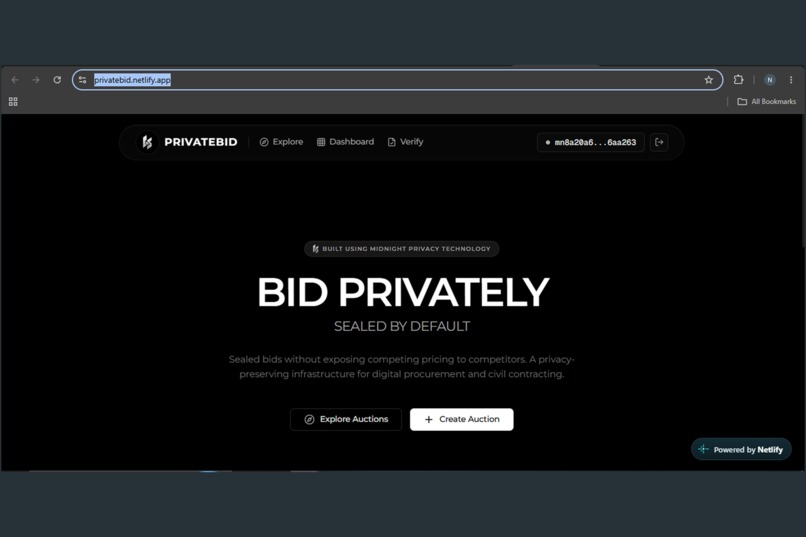
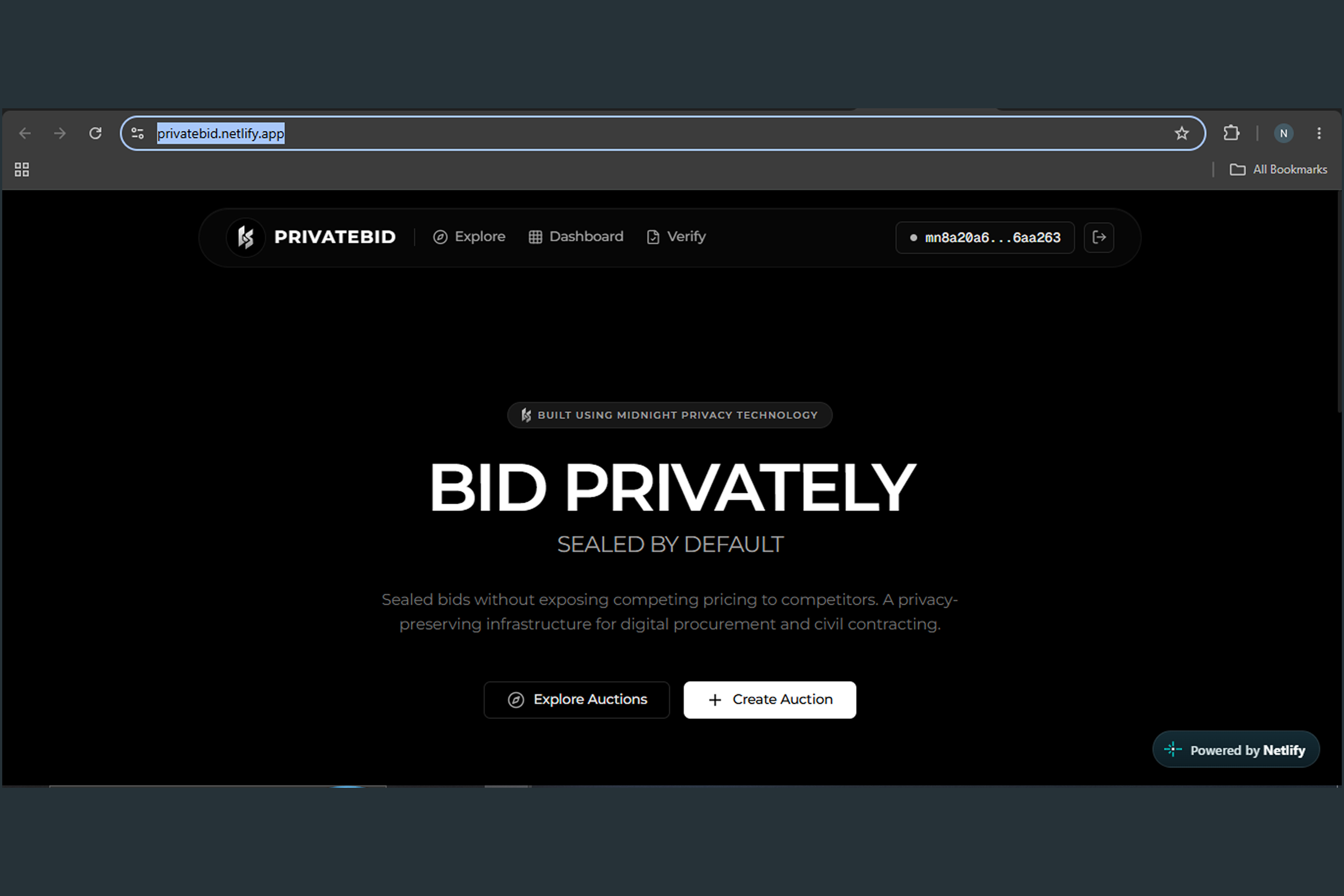
Hero Section
-
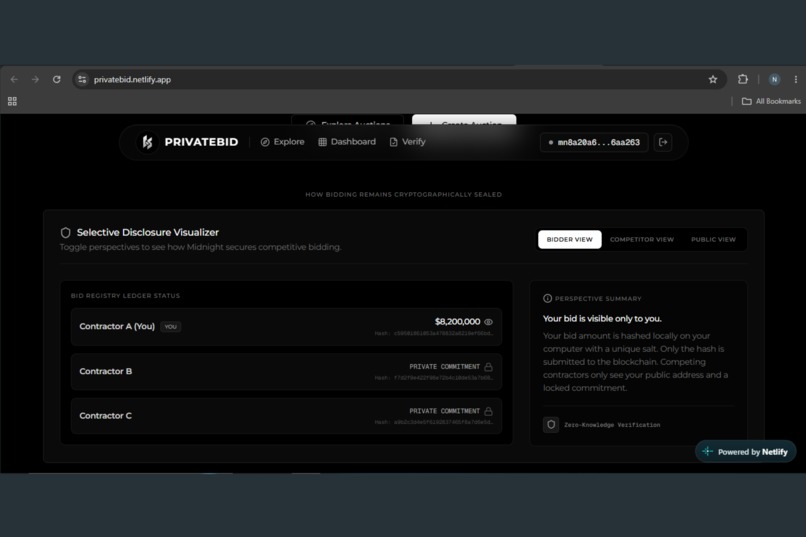
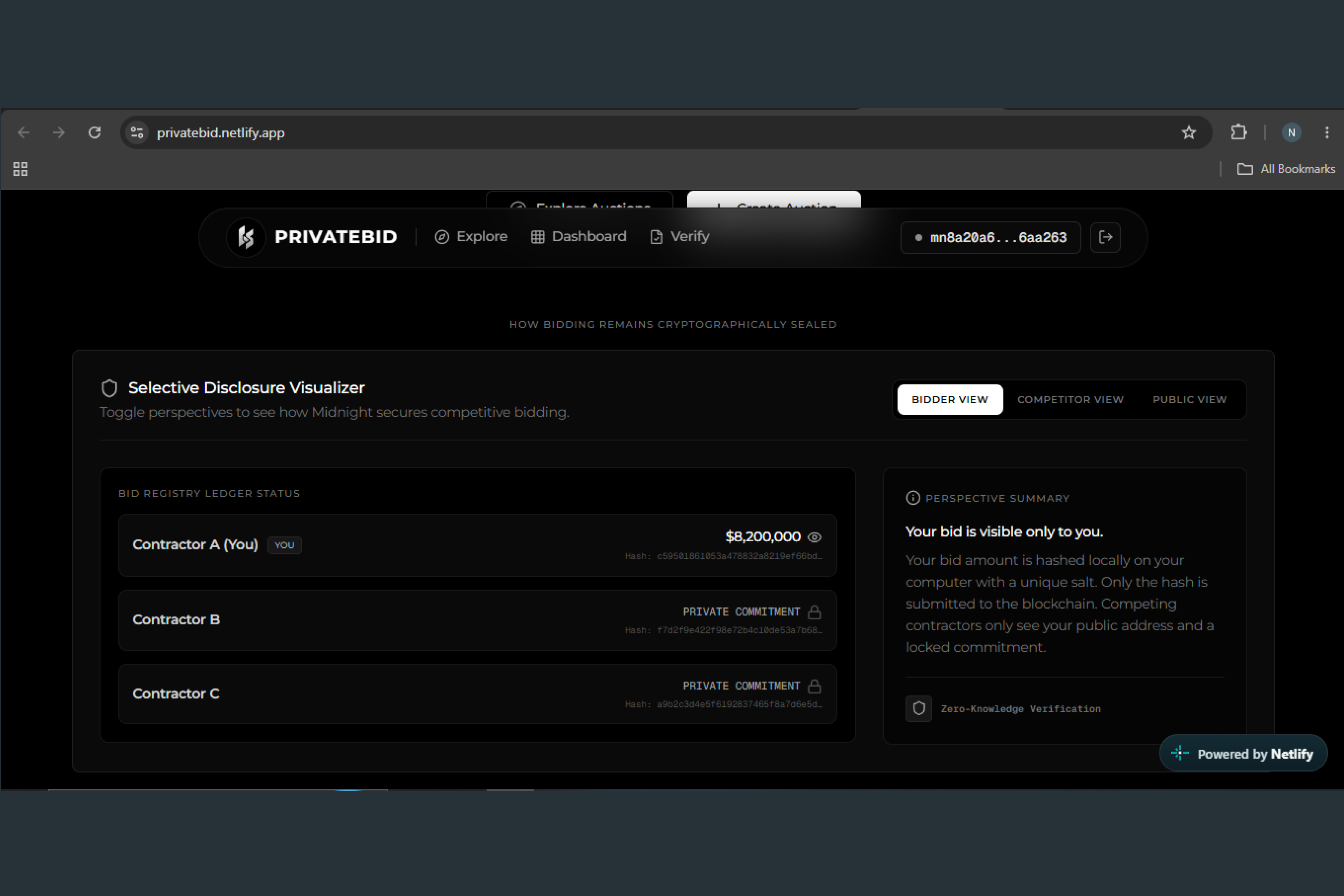
Selective Disclosure Visualizer
-
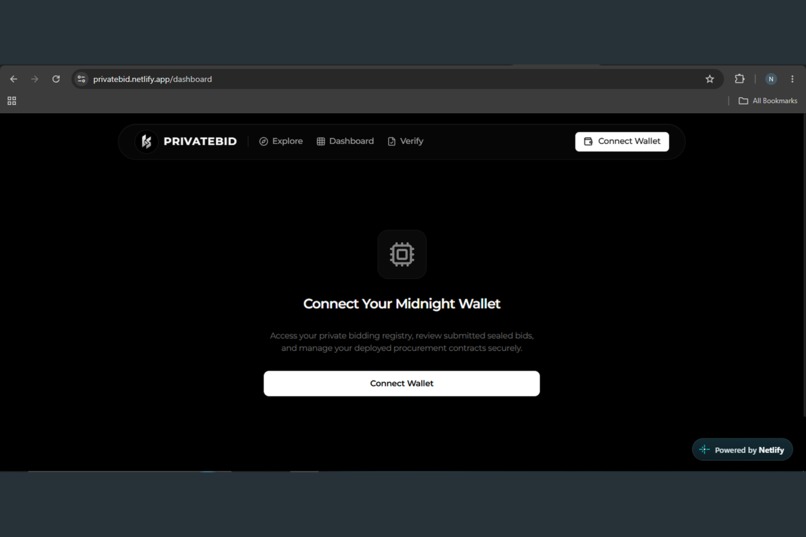
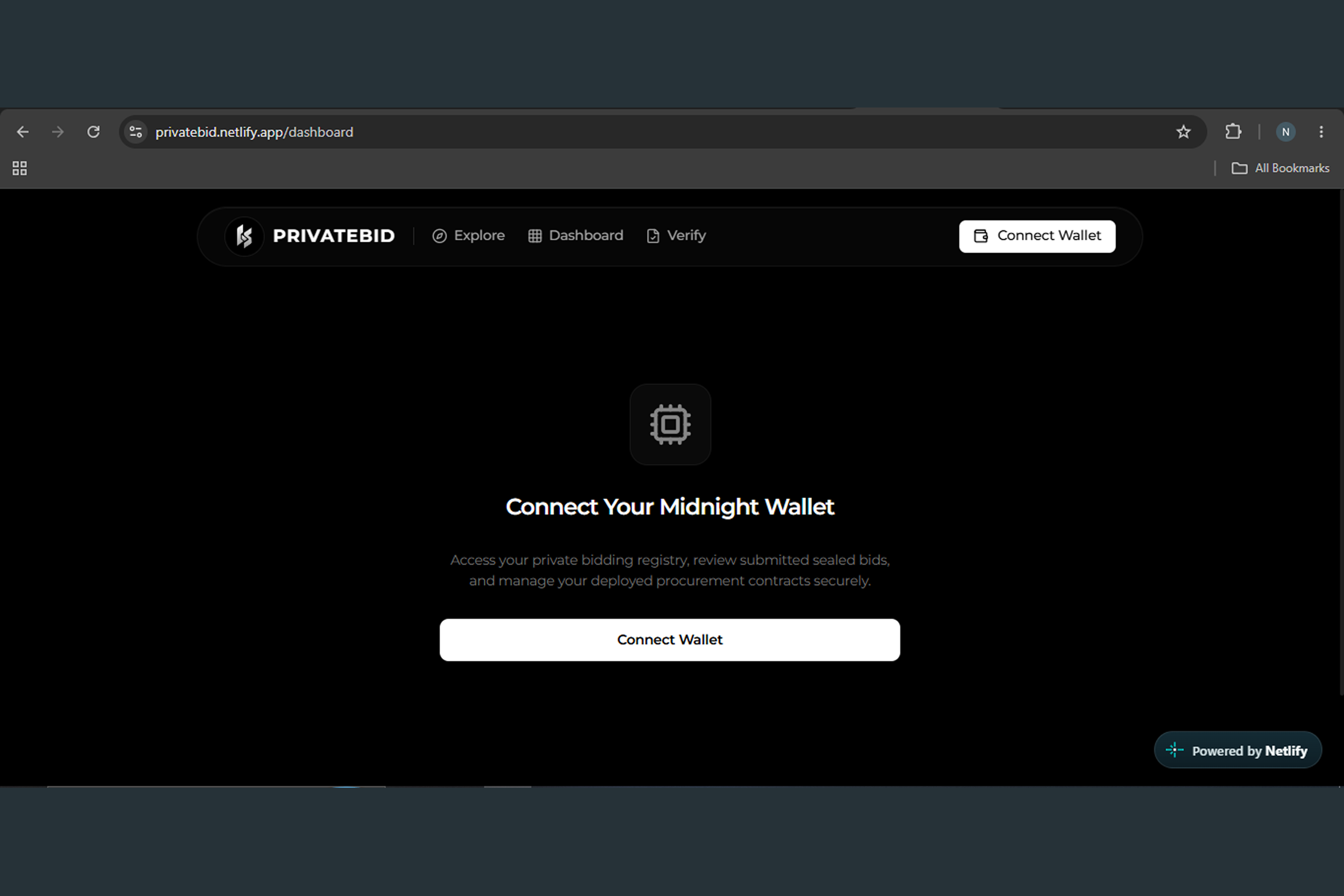
Midnight wallet
-
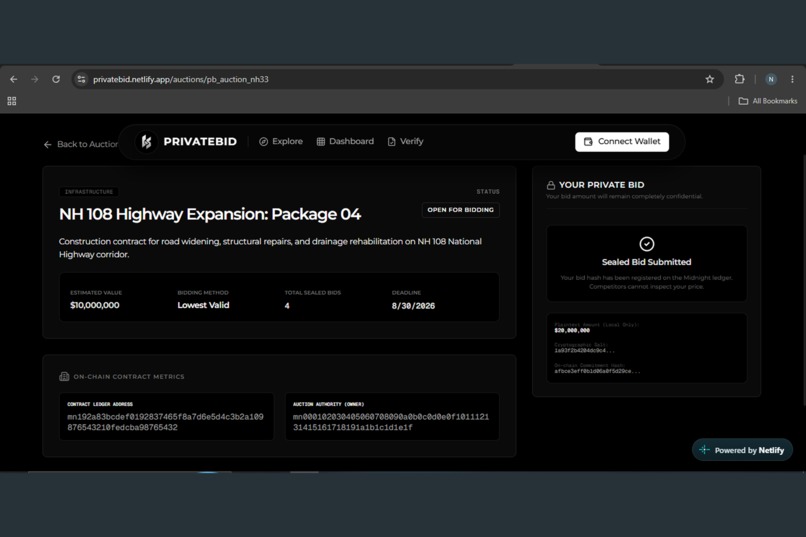
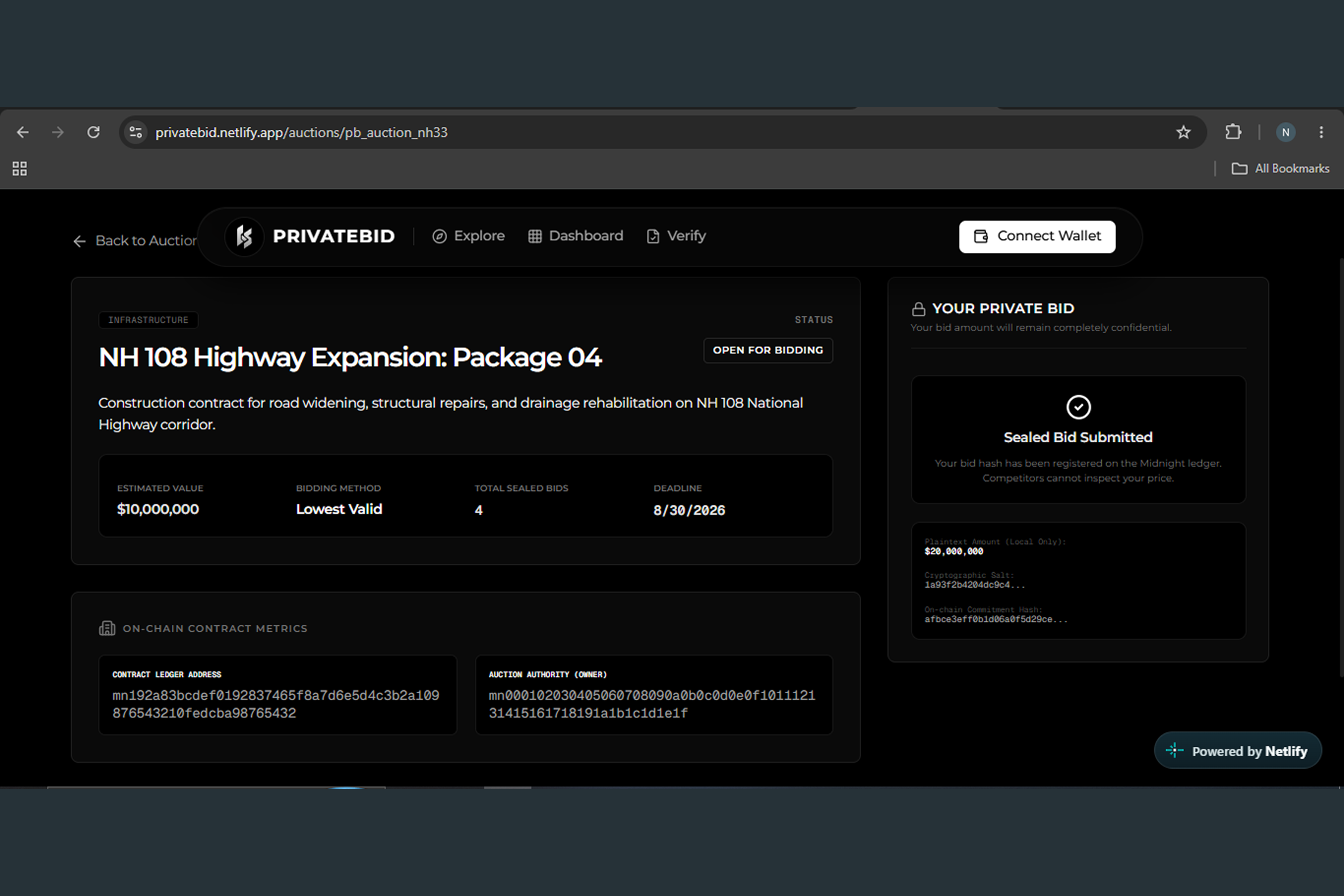
NH 108 Contract
-
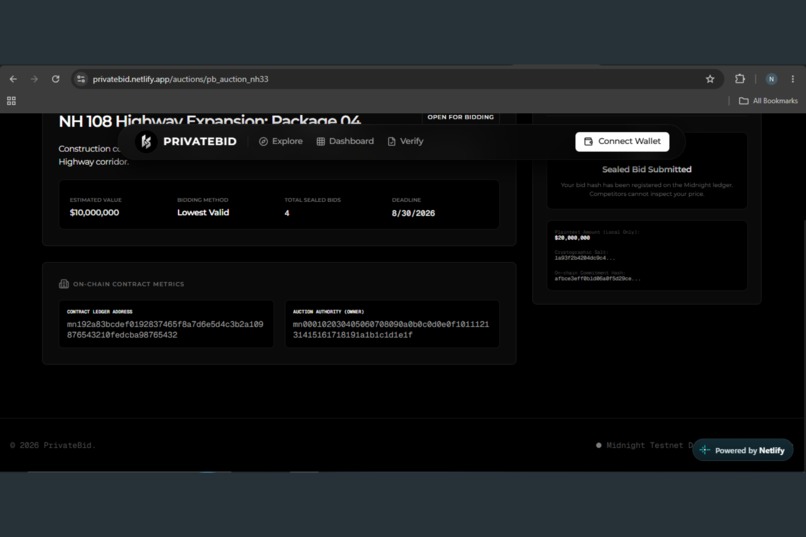
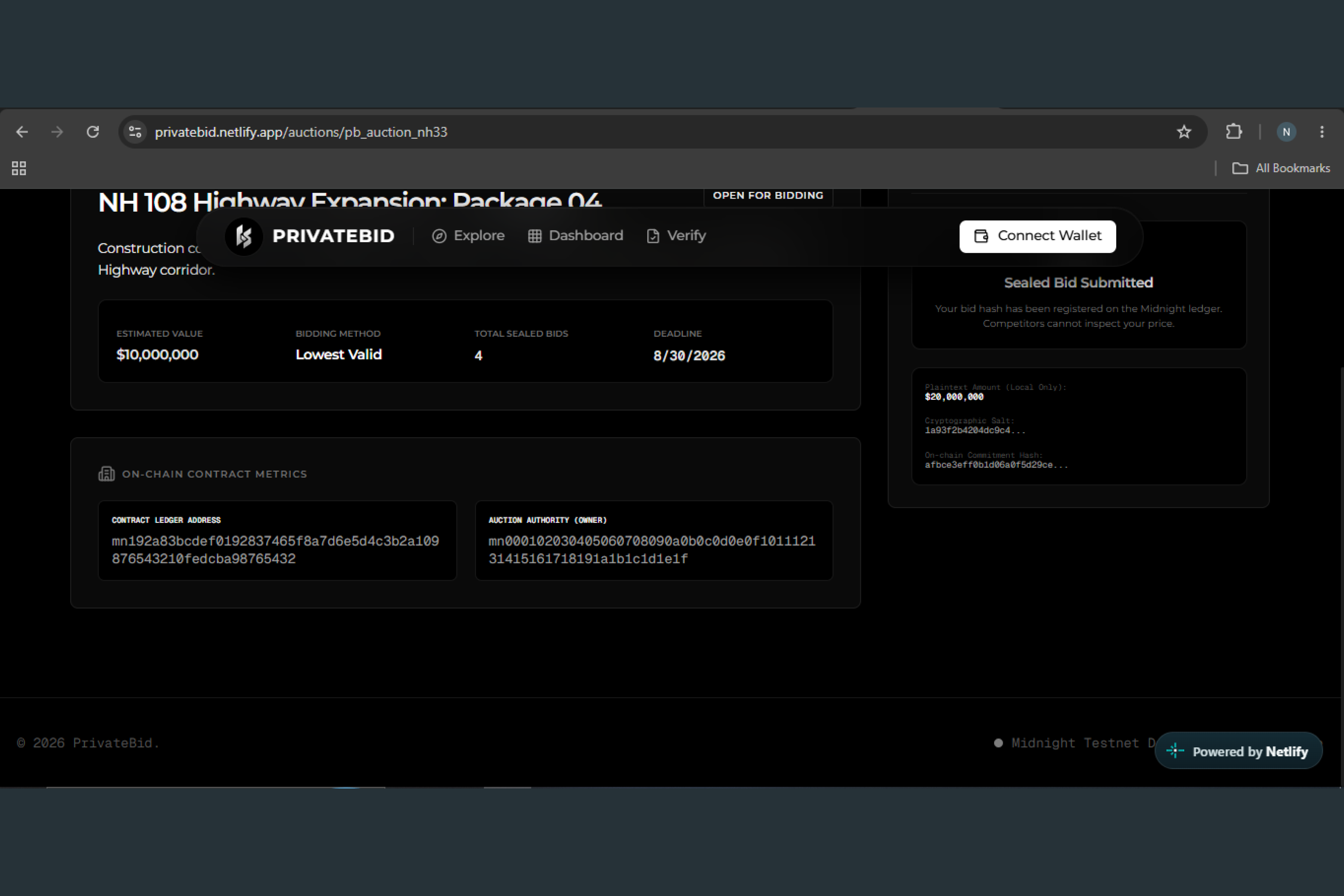
NH 108 Bid Details
-
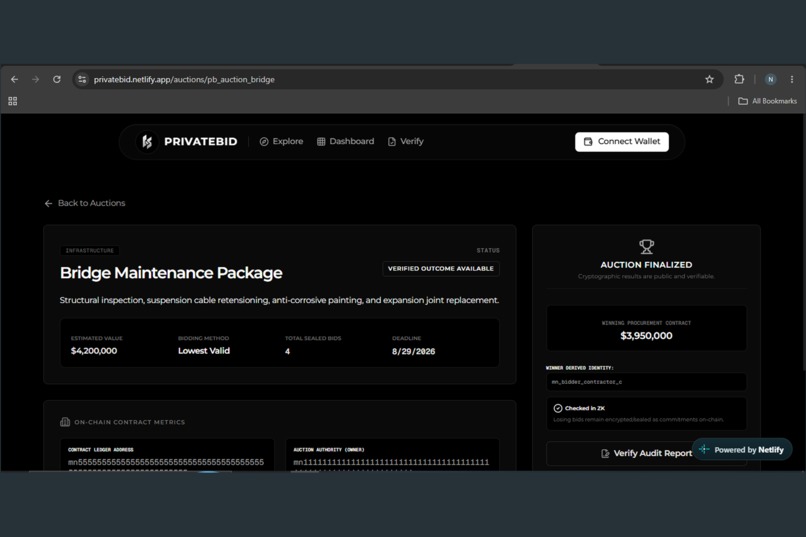
Bridge Maintenance Package
-
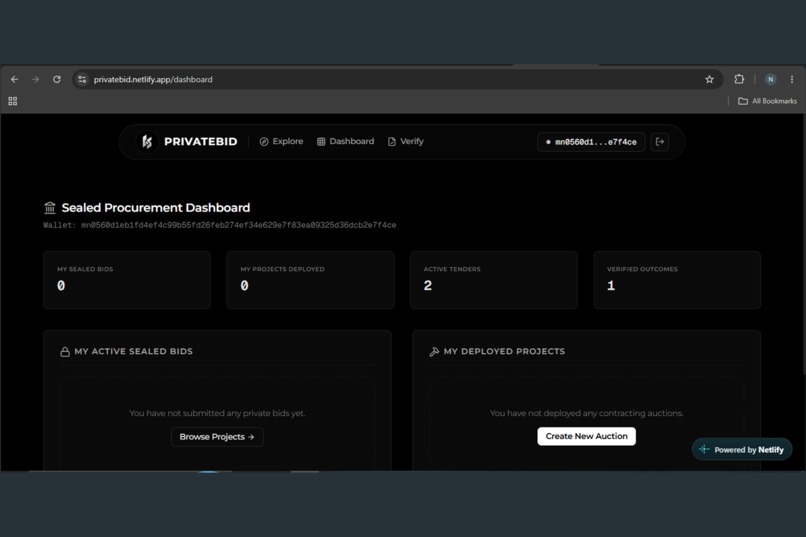
Sealed Procurement Dashboard
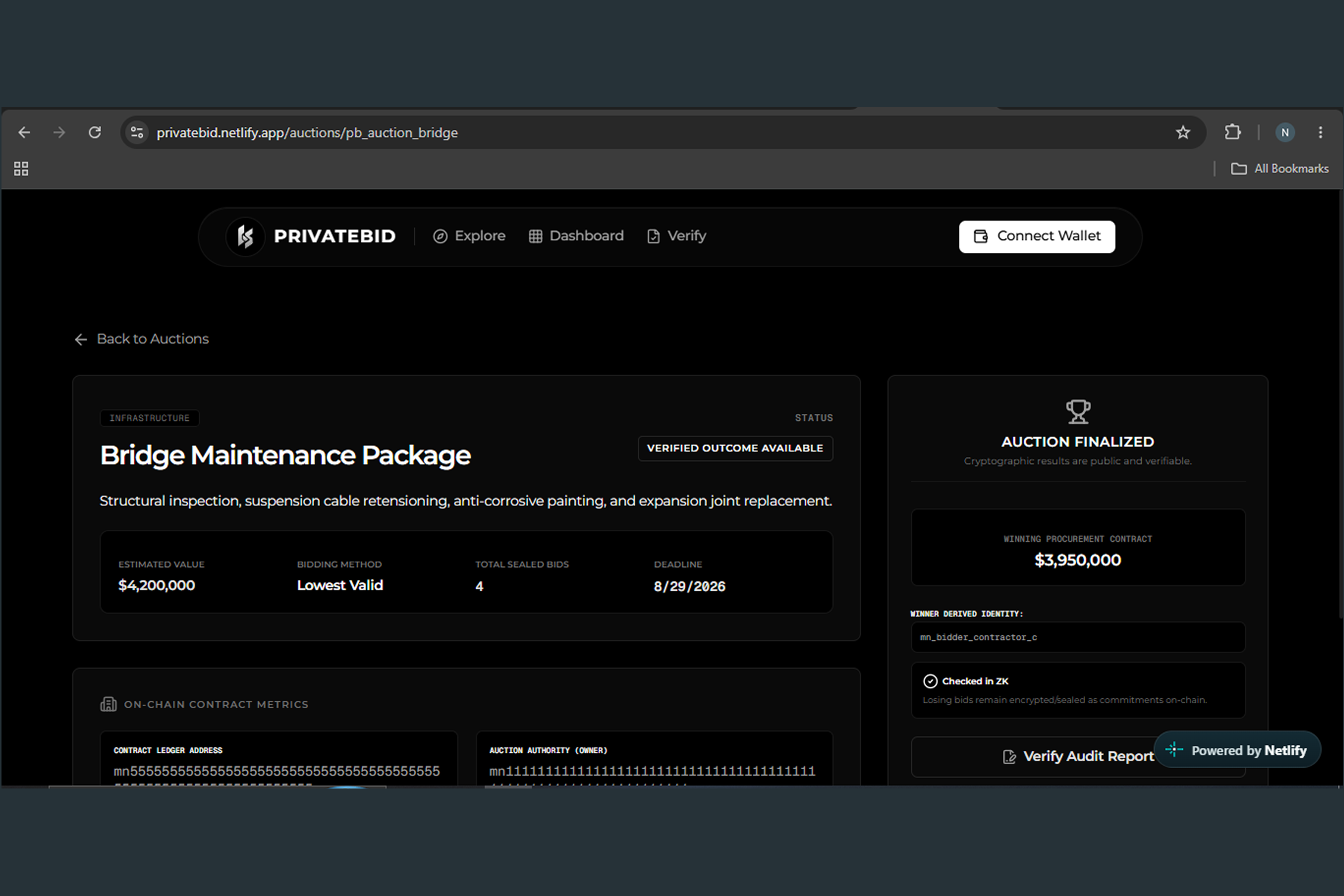
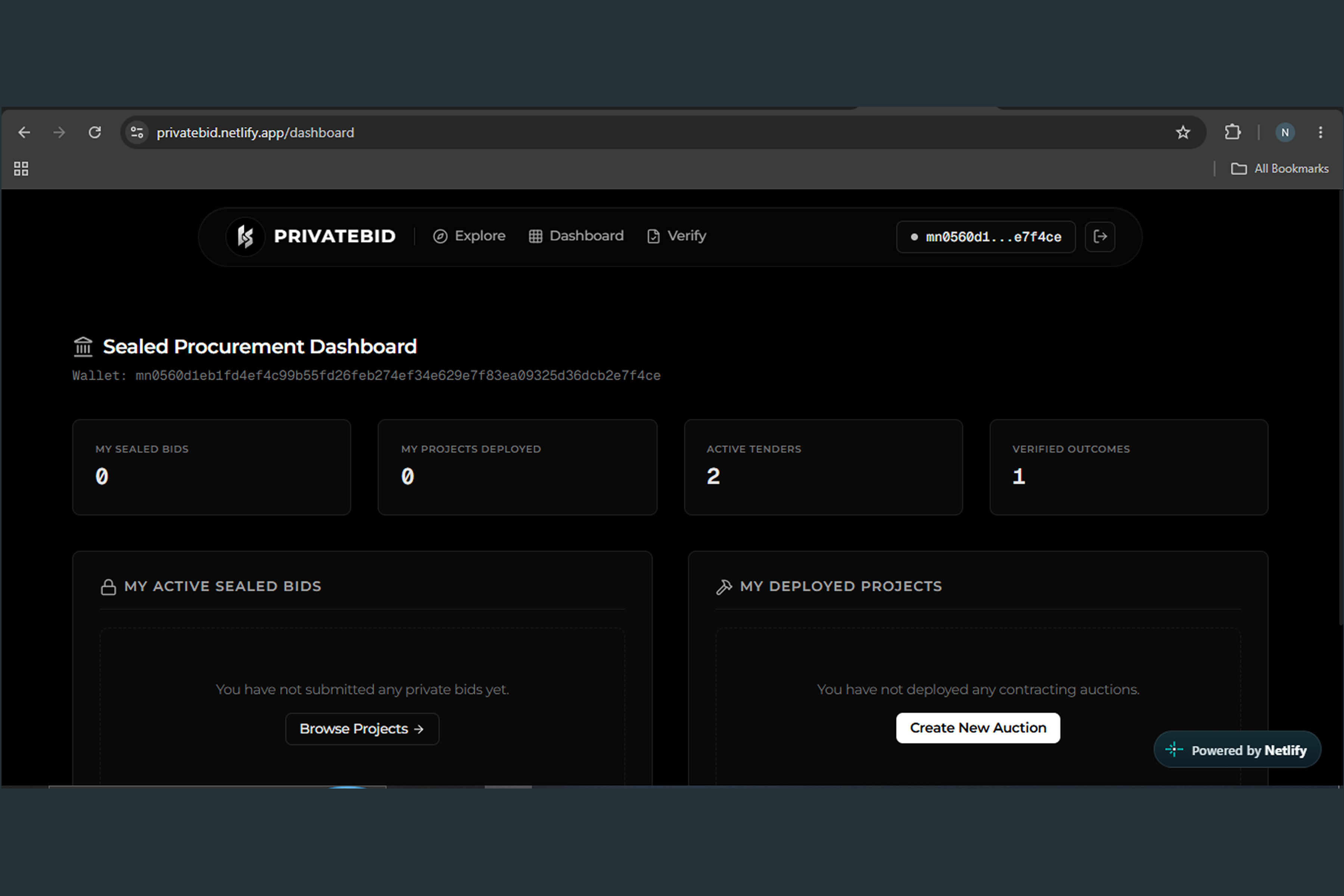
Inspiration
Auctions are built around a simple idea: everyone should be able to compete fairly without knowing what others are willing to pay.
On a public blockchain, however, transparency can become a weakness. If bids are visible, participants can inspect competing bids and potentially change their strategy before the auction ends.
We wanted to explore a different approach:
Can an auction remain verifiable without making everyone's bids public?
That question led us to build PrivateBid — a sealed-bid auction system where the bid stays private while the outcome can still be verified.
What it does
PrivateBid allows participants to submit sealed bids without exposing their actual bid values to other participants.
The system is designed around three principles:
- Private bids — participants don't need to reveal their bid amount publicly.
- Verifiable results — the auction outcome can still be independently verified.
- Trust-minimized execution — cryptographic proofs reduce the need to trust a centralized auction operator.
Instead of treating privacy and transparency as opposites, PrivateBid uses zero-knowledge technology to provide both where they matter.
Bid privately. Verify publicly.
How we built it
PrivateBid combines a user-facing auction interface with blockchain-based logic and zero-knowledge proofs.
The general flow is:
- A seller creates an auction and defines its rules.
- Participants submit their bids privately.
- The bid information is protected rather than exposed as ordinary public blockchain data.
- Zero-knowledge techniques are used to prove that the required conditions were satisfied without unnecessarily revealing private information.
- The auction determines the winning result.
- The result can be verified without requiring everyone to see every participant's bid.
We built the project around the Midnight blockchain, using its privacy-focused architecture and zero-knowledge capabilities as the foundation for the sealed-bid mechanism.
The frontend provides the interaction layer, while the blockchain and cryptographic logic handle the privacy and verification side of the auction.
Challenges we ran into
The biggest challenge was balancing privacy, verifiability, and usability.
A system can hide everything, but then users have no way to know whether the auction was executed correctly. On the other hand, exposing too much information defeats the purpose of a private auction.
We had to think carefully about what information actually needs to be public and what should remain private.
Working with privacy-preserving blockchain concepts also introduced a learning curve. Zero-knowledge proofs are fundamentally different from simply storing data on a traditional blockchain, so designing the auction flow required us to think about verification as well as execution.
We also had to turn a technically complex concept into an interface that a normal user could understand without needing to know how zero-knowledge proofs work.
Accomplishments that we're proud of
We're proud that PrivateBid turns an abstract privacy concept into a concrete auction experience.
Instead of building another application that simply puts existing auction logic on a blockchain, we focused on a specific problem:
How can participants compete without exposing their bids while still maintaining trust in the result?
We're especially proud of combining:
- Sealed-bid auction mechanics
- Privacy-preserving blockchain infrastructure
- Zero-knowledge verification
- A simple user-facing auction experience
The project also gave us an opportunity to work with Midnight's privacy-oriented blockchain model and understand how zero-knowledge technology can be applied to a real-world interaction rather than being used only as a theoretical concept.
What we learned
We learned that blockchain transparency doesn't necessarily mean that every piece of information needs to be public.
There is a major difference between verifying that something happened correctly and revealing all the private information behind it.
Zero-knowledge proofs make this distinction particularly powerful: a system can prove that a condition is true without exposing the underlying secret.
We also learned that privacy should be considered at the protocol level rather than added as an afterthought. Once private information has been unnecessarily exposed on a public network, it cannot simply be made private again.
Most importantly, PrivateBid changed how we think about blockchain applications: sometimes the most useful information is not the information that everyone can see, but the information that everyone can verify.
What's next for PrivateBid
PrivateBid is currently focused on the core sealed-bid auction experience, but the same privacy model could be extended to many other use cases.
Next, we want to explore:
- More advanced auction mechanisms
- Multiple auction types
- Stronger on-chain verification
- Better wallet and user onboarding
- Auction history and verifiable receipts
- Private procurement and tendering
- Enterprise and DAO-based bidding
- More complex zero-knowledge conditions
Our long-term goal is to make PrivateBid more than an auction interface.
We want to explore it as a general privacy-preserving bidding and decision-making layer where sensitive values can remain private while the final outcome remains trustworthy and publicly verifiable.
Built With
- applications
- auction
- blockchain
- contracts
- cryptography
- decentralized
- midnight
- privacy
- sealed-bid
- smart
- web3

Log in or sign up for Devpost to join the conversation.