Proposal Management is finished and deployed:
✅ Created deployment transaction for 'privadao_proposal_management_v1.aleo'
Broadcasting transaction to https://api.explorer.aleo.org/v1/testnet/transaction/broadcast...
⌛ Deployment at1ruqsury6t3ql8g5mypcnvvm24jz6wng5llragp3s7u2rh43vkyrsyms3le ('privadao_proposal_management_v1.aleo') has been broadcast to https://api.explorer.aleo.org/v1/testnet/transaction/broadcast.
PrivaDAO: Privacy-Preserving Decentralized Autonomous Organization
Inspiration
The rise of Decentralized Autonomous Organizations (DAOs) has revolutionized community-driven decision making, but many existing solutions lack robust privacy features. We were inspired to create PrivaDAO to address this gap, combining the transparency of blockchain technology with the privacy protection that many organizations and individuals require for sensitive voting processes.
What it does
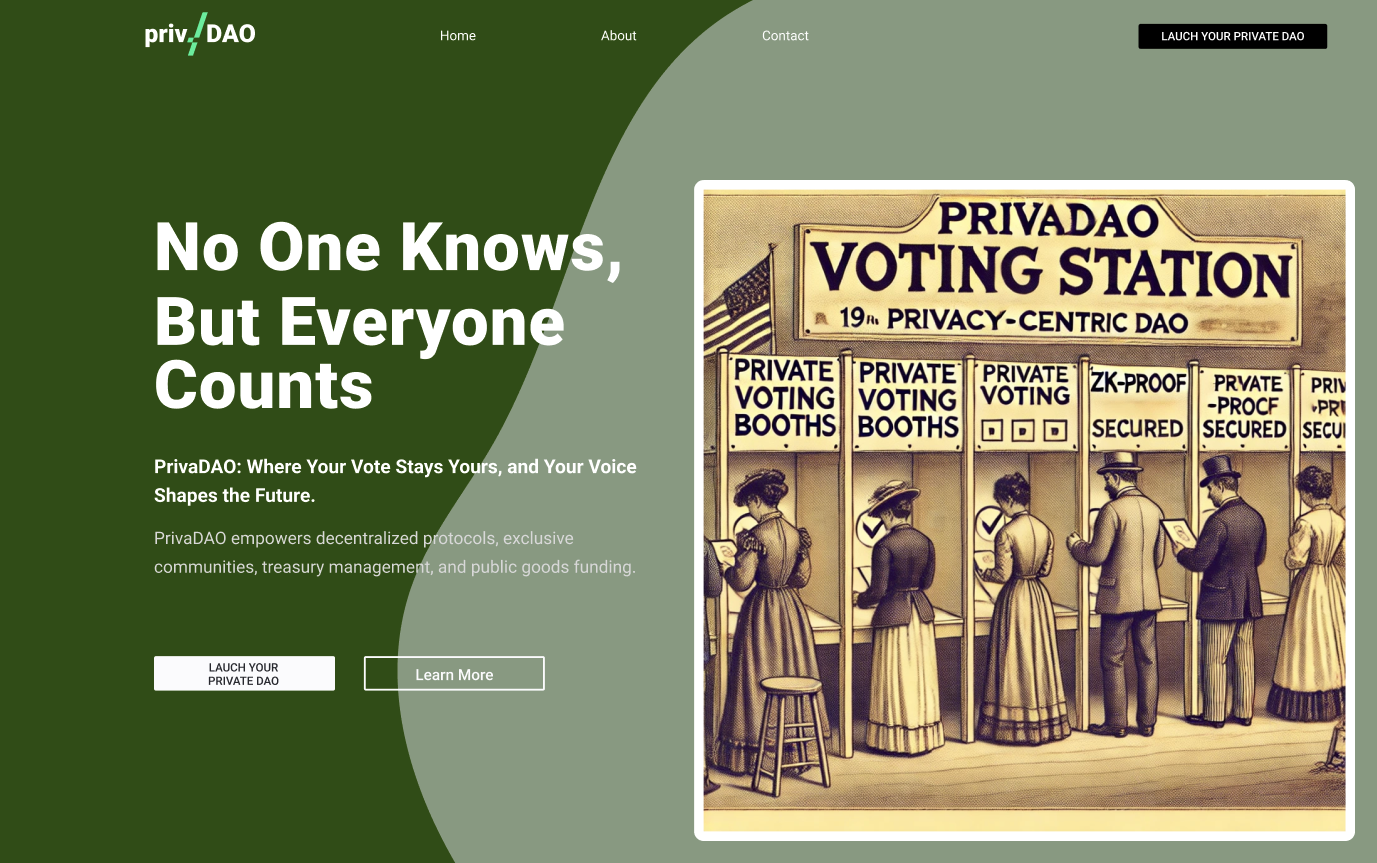
PrivaDAO is a comprehensive DAO management system built on the Aleo blockchain, leveraging its zero-knowledge proof capabilities to offer:
- Private Voting: Members can cast votes without revealing their choices, protecting individual privacy while ensuring verifiable results.
- Flexible Proposal Systems: Supports various proposal types and voting mechanisms, including single-choice, multiple-choice, and ranked-choice voting.
- Reputation System: A dynamic reputation scoring system that evolves based on member participation and contribution.
- Delegation: Members can delegate their voting power to trusted representatives, enhancing participation and expertise utilization.
- Treasury Management: Secure handling of DAO funds with multi-signature requirements for critical actions.
- Slashing Mechanism: A system to penalize malicious actors, maintaining the integrity of the DAO.
How we built it
We developed PrivaDAO using the Leo programming language, specifically designed for writing private applications on the Aleo blockchain. Our development process involved:
- Designing the core data structures (structs) to represent proposals, votes, and user reputations.
- Implementing key transitions for proposal creation, voting, and execution.
- Developing a conviction voting system for more nuanced decision-making.
- Creating a reputation system that updates based on user actions and time.
- Implementing privacy-preserving voting using homomorphic encryption techniques.
- Extensive testing and optimization to ensure efficiency and correctness.
Challenges we ran into
- Leo Language Limitations: As a relatively new language, Leo posed challenges in terms of available documentation and best practices.
- Privacy vs. Transparency Balance: Striking the right balance between maintaining privacy and ensuring sufficient transparency for DAO operations was a constant challenge.
- Complex State Management: Managing the state of proposals, votes, and user reputations across multiple transitions required careful planning and execution.
- Efficient On-Chain Computations: Optimizing computations to minimize transaction costs while maintaining functionality was a significant challenge.
Accomplishments that we're proud of
- Successfully implemented a privacy-preserving voting system on a blockchain platform.
- Developed a flexible and extensible DAO framework that can accommodate various governance models.
- Created a nuanced reputation system that encourages active and positive participation.
- Implemented complex voting mechanisms like ranked-choice and conviction voting in a privacy-preserving manner.
What we learned
- Deep insights into zero-knowledge proofs and their applications in governance systems.
- Proficiency in Leo programming and best practices for developing on the Aleo blockchain.
- The intricacies of designing cryptoeconomic systems that balance incentives, security, and usability.
- The importance of careful state management in complex blockchain applications.
What's next for PrivaDAO
- User Interface Development: Create an intuitive front-end interface for easy interaction with the DAO.
- Integration with DeFi Protocols: Allow the DAO to interact with other decentralized finance protocols for treasury management.
- Advanced Proposal Types: Implement more sophisticated proposal types, such as parametric proposals for automatic execution.
- Cross-Chain Functionality: Explore possibilities for cross-chain governance to increase interoperability.
- Formal Verification: Conduct formal verification of critical components to ensure robustness and security.
- Community Building: Foster a community of developers and users to contribute to and utilize PrivaDAO.
PrivaDAO represents a significant step forward in privacy-preserving governance for decentralized organizations. By combining advanced cryptographic techniques with thoughtful mechanism design, we aim to set a new standard for secure, private, and effective decentralized decision-making.
Built With
- leo

