-
-
Privacycheck
Inspiration
In an increasingly digital world, the lines between public and private information are constantly blurring. We were inspired by the growing need for individuals and businesses to proactively manage their digital footprint and protect sensitive data. The idea was to create an accessible, intuitive tool that empowers users to understand and mitigate privacy risks in their text-based communications before they are shared, fostering a safer online environment.
What it does
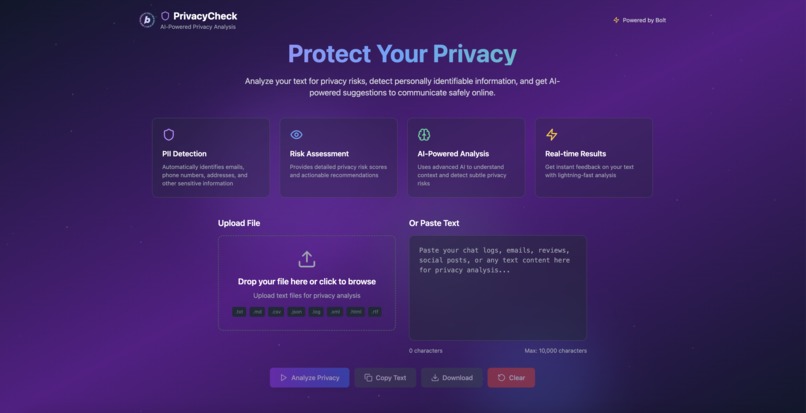
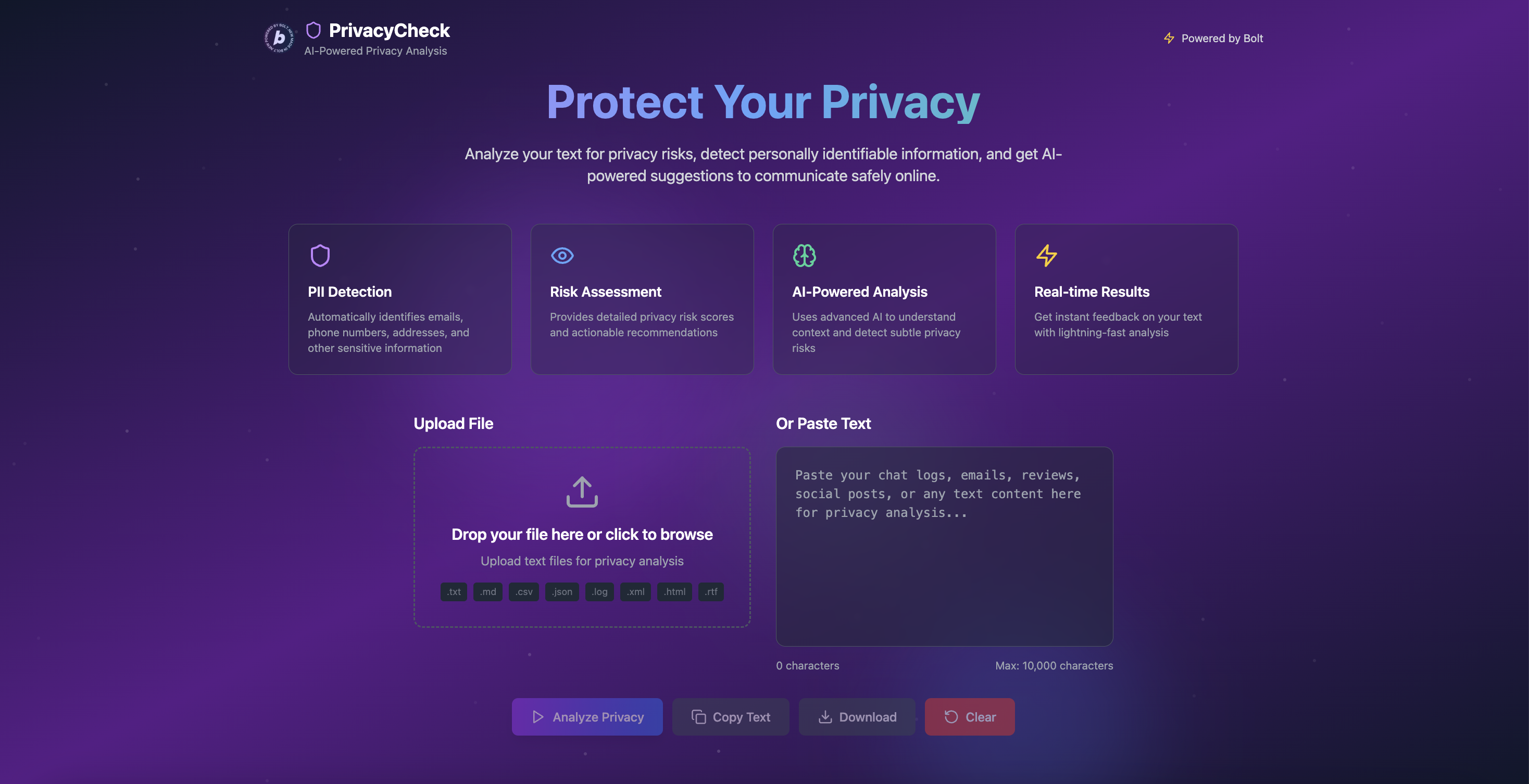
PrivacyCheck is an AI-powered tool designed to analyze text for potential privacy risks. It identifies Personally Identifiable Information (PII) such as names, email addresses, phone numbers, and even high-risk data like SSNs and credit card numbers. Beyond PII, it performs sentiment and tone analysis to flag potentially harmful or inappropriate language. The application provides a clear privacy risk score, detailed findings, and actionable recommendations, including suggestions for redacting sensitive information, helping users make informed decisions about their content.
How we built it
PrivacyCheck was built using a modern web development stack to ensure a responsive, efficient, and user-friendly experience. We leveraged React and TypeScript for the frontend, providing a robust and scalable component-based architecture. Tailwind CSS was used for rapid and consistent styling, allowing us to create a clean and intuitive user interface. The core analysis logic is implemented in TypeScript, utilizing regular expressions for PII detection and keyword-based algorithms for sentiment analysis, all bundled with Vite for fast development and optimized builds. Lucide React icons enhance the visual clarity of the various privacy findings and recommendations.
Challenges we ran into
One of the primary challenges was balancing the depth of analysis with performance, especially when simulating real-time processing for larger text inputs. Crafting comprehensive and accurate regular expressions for diverse PII patterns proved intricate, as real-world data can be highly varied. Developing a nuanced sentiment analysis that could identify subtle risks beyond simple positive/negative classifications was also a significant hurdle. Additionally, designing a user interface that effectively communicates complex analytical results in an easily digestible format required careful consideration and iteration.
Accomplishments that we're proud of
We are particularly proud of the intuitive user experience that makes advanced privacy analysis accessible to everyone. The clear visualization of PII items, sentiment risks, and actionable recommendations helps users quickly grasp potential issues. The dynamic risk dashboard provides an immediate overview of the text's privacy posture. We're also proud of the modular and maintainable codebase, which allows for future enhancements and scalability.
What we learned
Through the development of PrivacyCheck, we gained deeper insights into the complexities of natural language processing for privacy and security applications. We learned the importance of providing clear, actionable feedback to users when dealing with sensitive topics like data privacy. Furthermore, we reinforced our understanding of building performant and responsive web applications using React's component lifecycle and state management, and how to effectively integrate various analytical modules into a cohesive product.
What's next for PrivacyCheck
For the future of PrivacyCheck, we envision several enhancements. We plan to integrate more advanced AI/ML models for even more accurate and context-aware PII detection and sentiment analysis. Expanding support for additional document types (e.g., PDFs, Word documents) and exploring integrations with popular communication platforms could significantly broaden its utility. We also aim to introduce user accounts to allow for analysis history, custom redaction rules, and team collaboration features, making PrivacyCheck an even more powerful tool for digital privacy management.
Built With
- css-frameworks/libraries:-react
- html
- javascript
- languages:-typescript
- lucide
- react
- tailwind-css

Log in or sign up for Devpost to join the conversation.