-
-
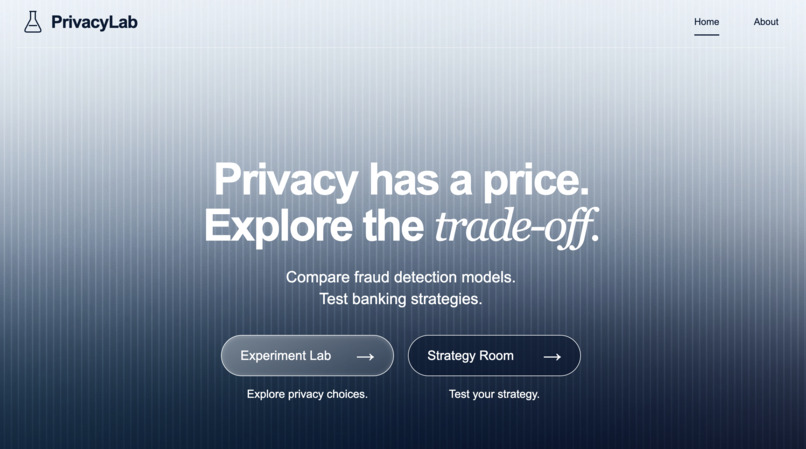
PrivacyLab: what does protecting customer privacy cost a bank, and when is sharing data worth it?
-
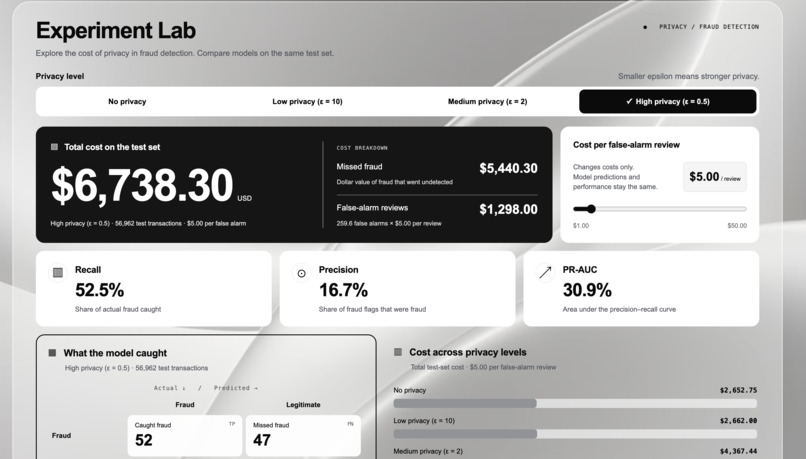
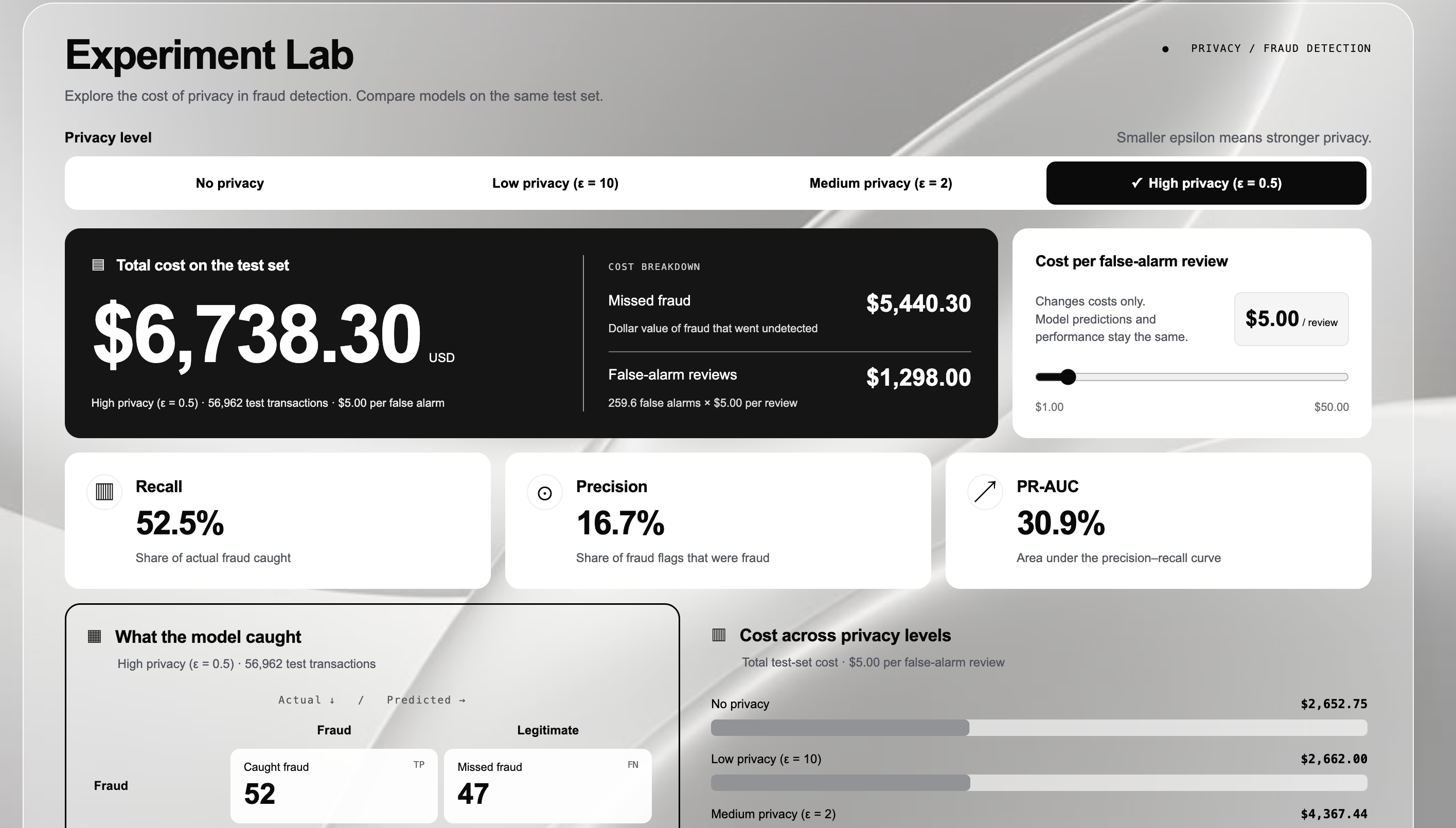
Real fraud models trained on 284,807 credit card transactions. At strong privacy (ε = 0.5), fraud losses rise from $2,653 to $6,738.
-
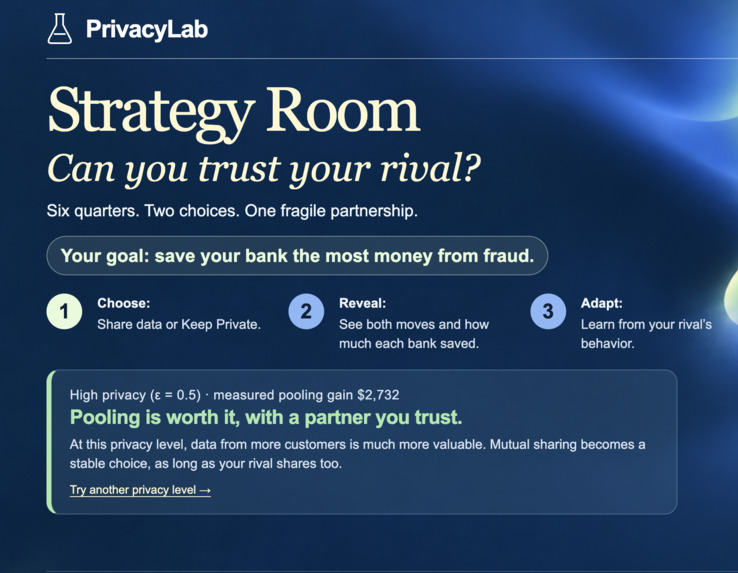
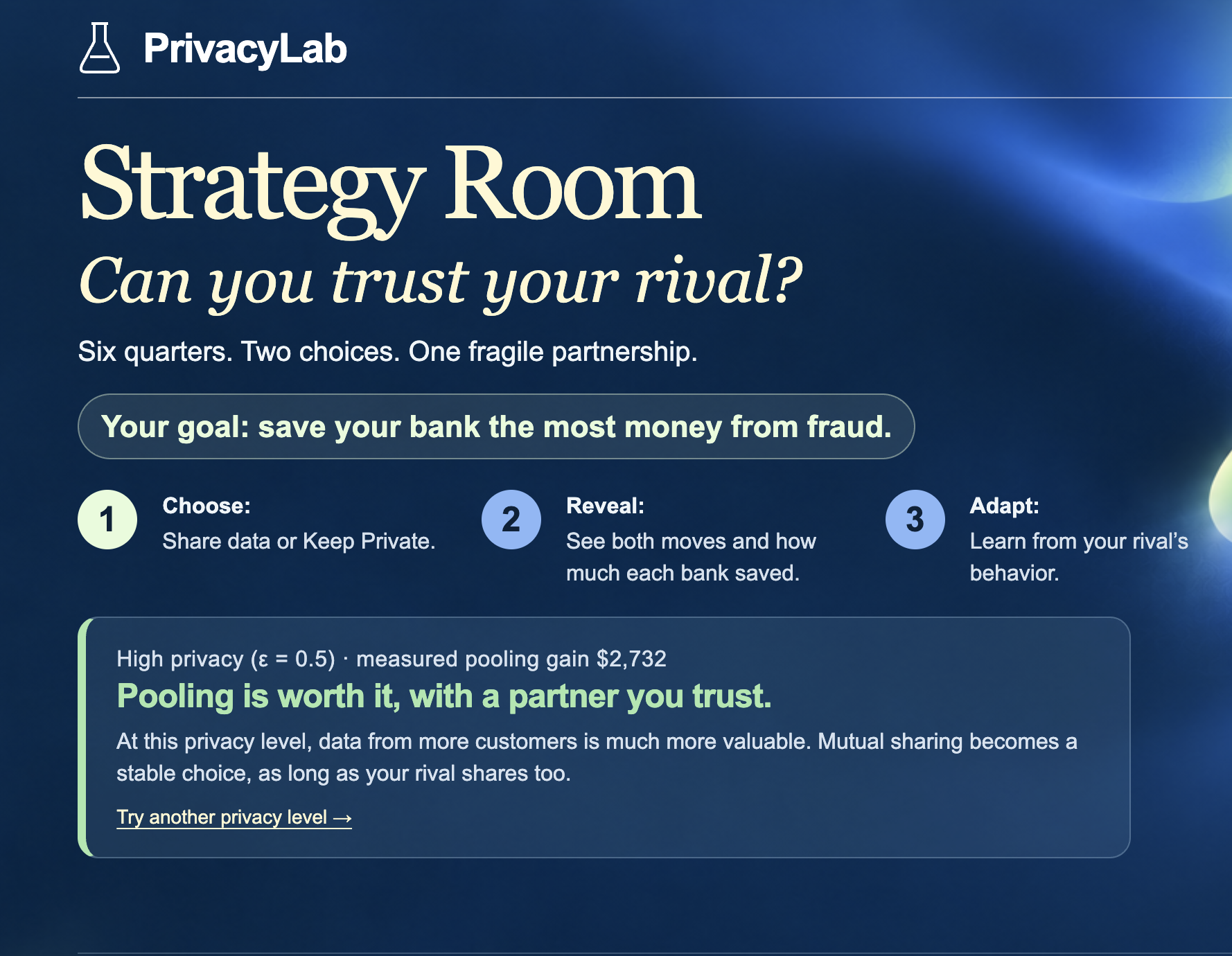
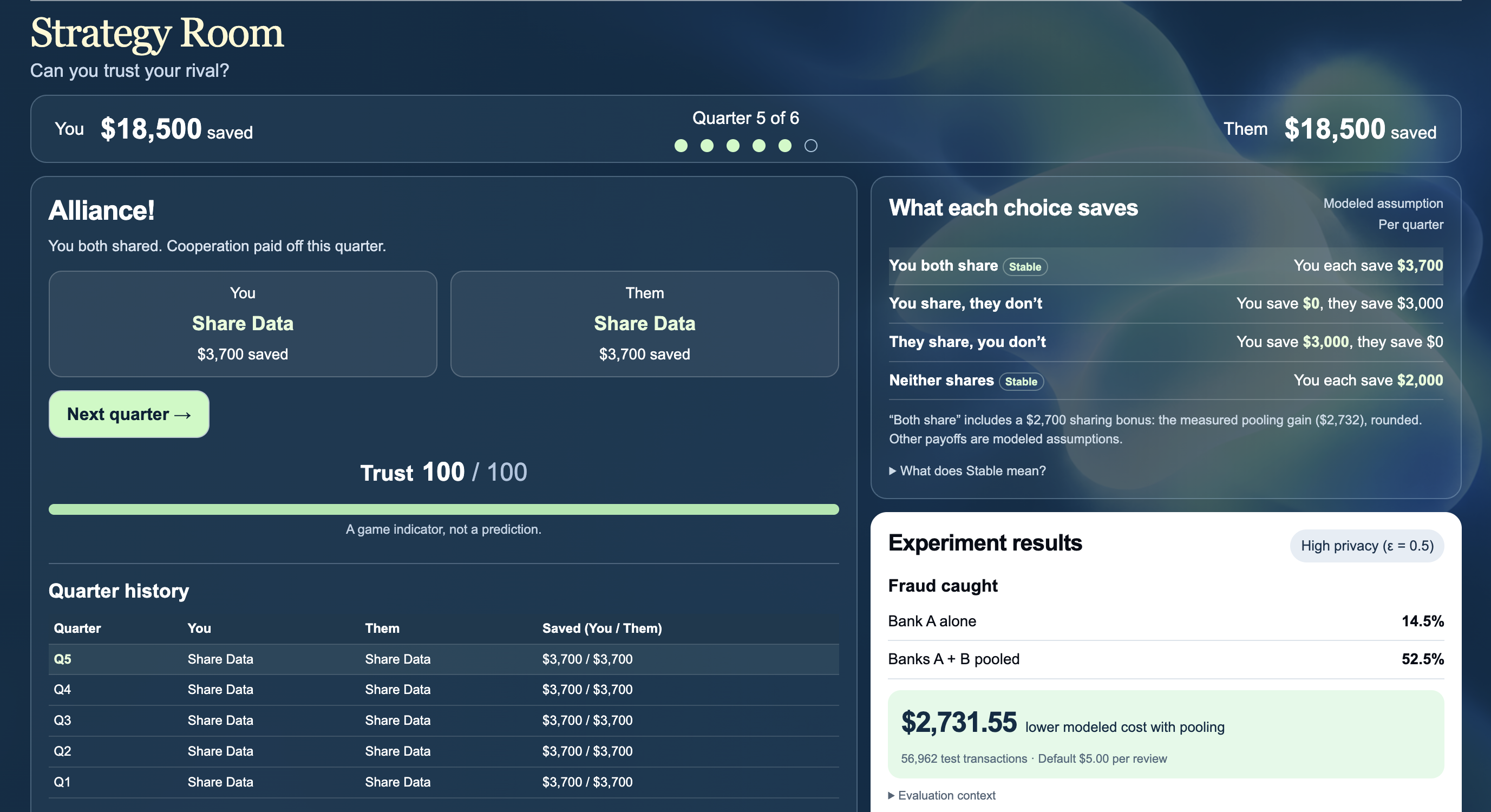
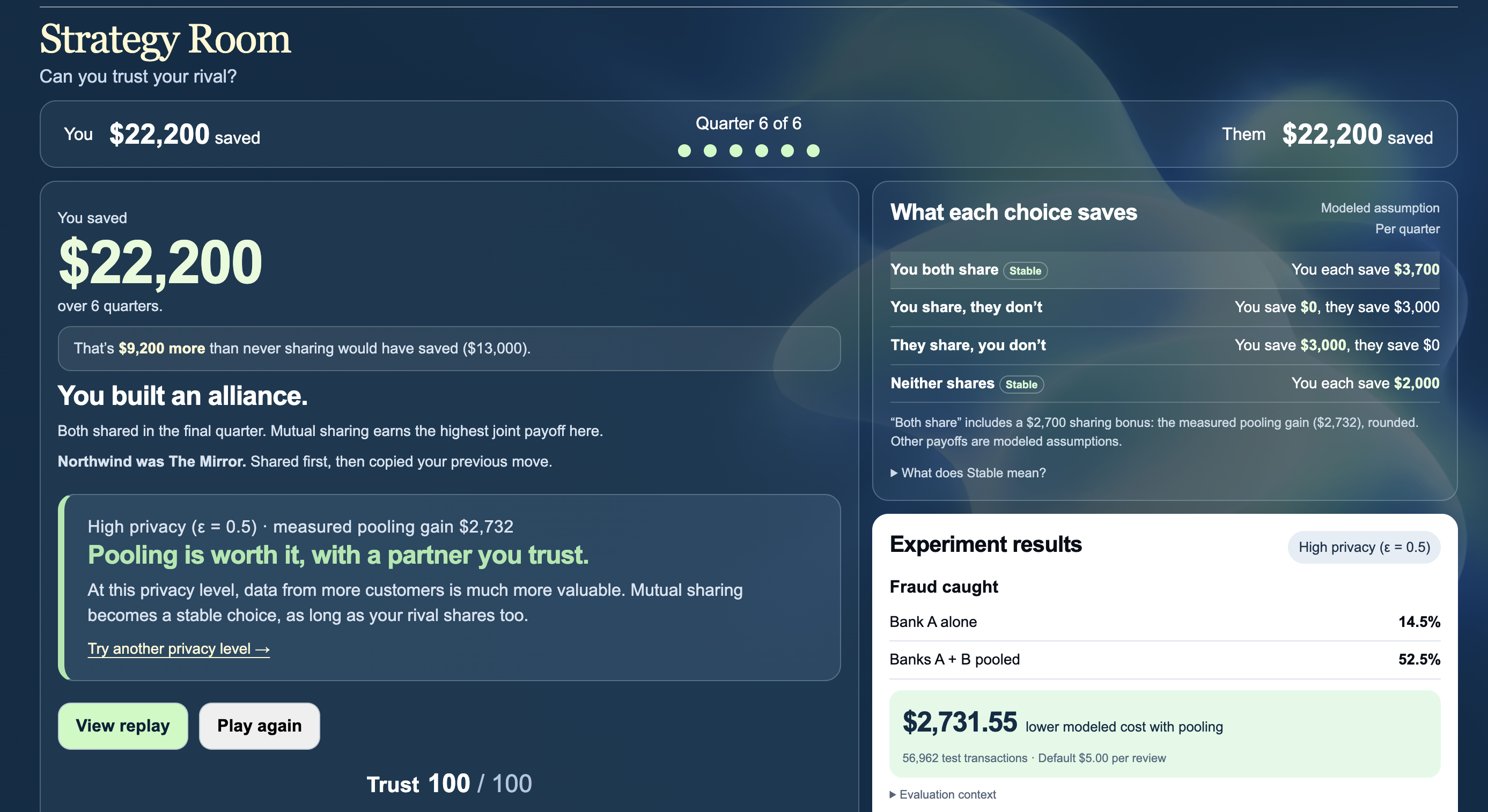
The privacy level from the Lab sets the game. At strong privacy, pooling is worth it, but only with a partner you trust.
-
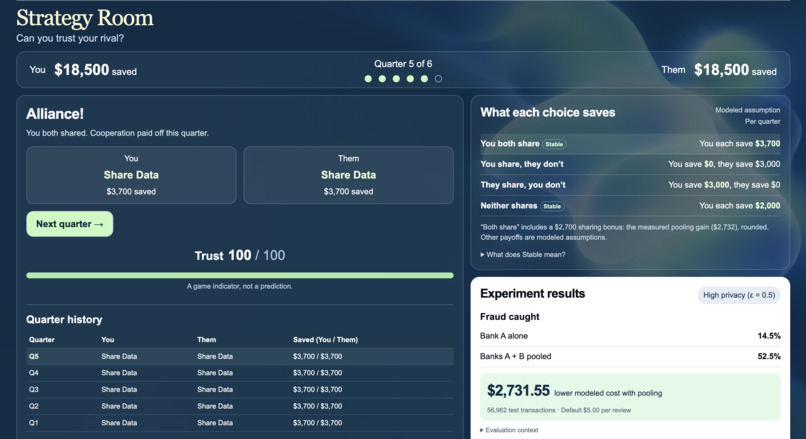
Each quarter, share your fraud data or keep it private. Both moves are revealed at once, along with what each bank saved.
-
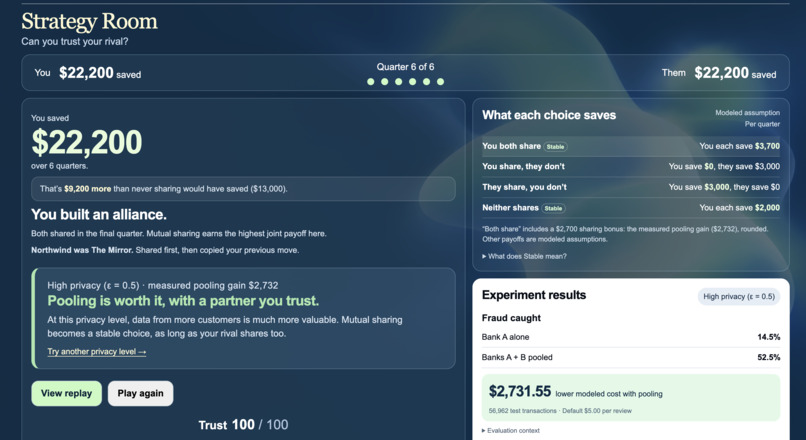
Sharing every quarter with a fair rival saved $22,200, which is $9,200 more than never sharing.
-

Team PrivacyLab at DubHacks 2026.
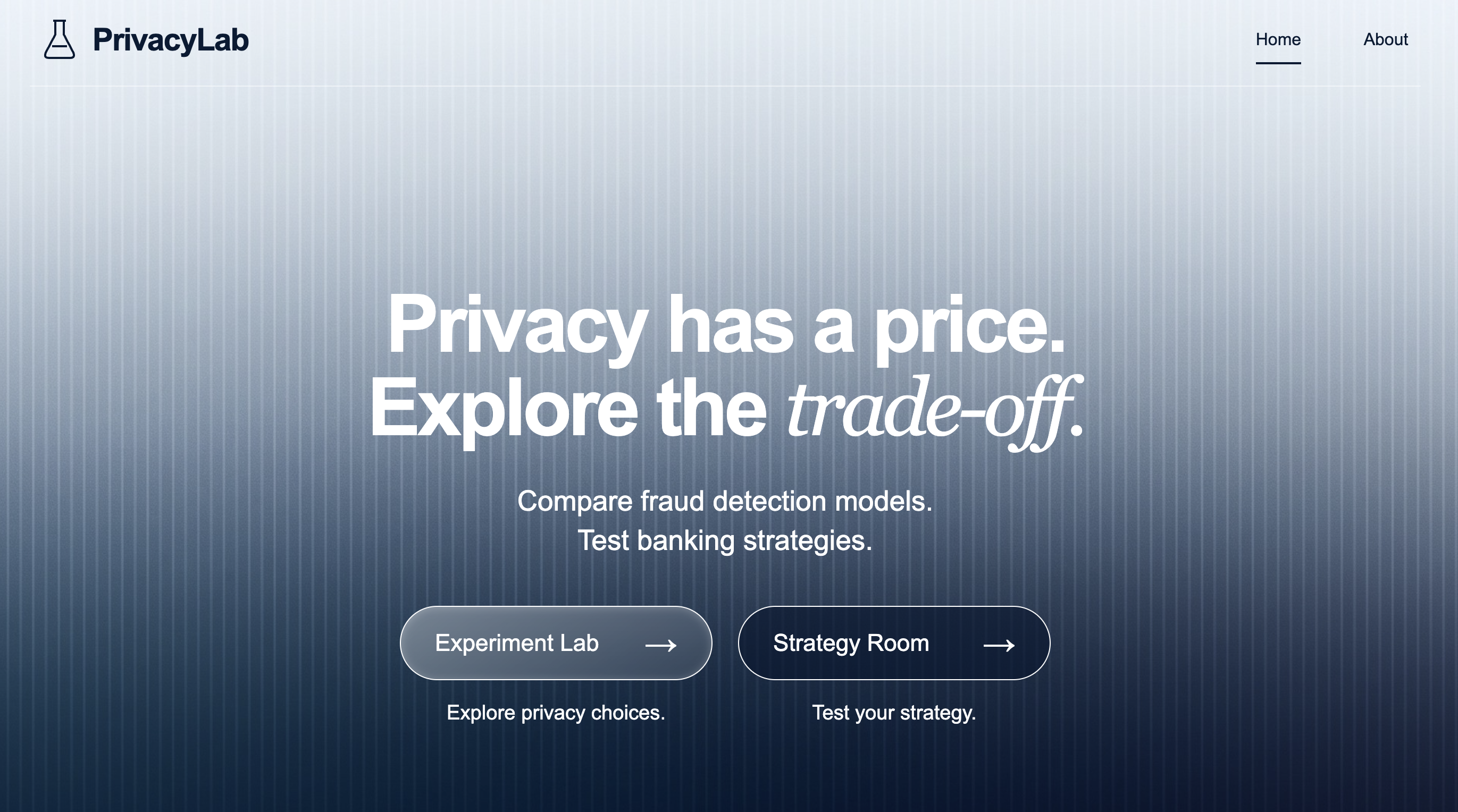

We connected machine learning, business costs, and game theory in one working experience.
Try it here: Privacy Lab
Inspiration
Privacy has a price. But how do you put a number on it?
Organizations want to catch fraud without exposing the people behind their data. Protecting privacy can affect model performance, while combining data with another organization introduces another question: can you trust your partner to cooperate?
We built PrivacyLab to make these trade-offs understandable through real experiments and an interactive game.
What it does
Experiment Lab: Compare fraud detection models across privacy levels. See how much fraud they catch, how many false alarms they generate, and what those mistakes cost. Adjust the cost of reviewing a false alarm to explore different business assumptions.
We turn model mistakes into a simple business cost:
$$ \text{Modeled Cost} = \text{Missed Fraud Amount} + (\text{False Alarms} \times \text{Cost per Review}) $$
Strategy Room: Bring your selected privacy level into a six-quarter banking simulation. Choose whether to share data or keep it private, respond to a rival’s hidden behavior, and review the consequences.
What we discovered
Combining data barely helped one model and transformed another.
At our strongest privacy setting, fraud detection rose from 14.6% to 52.5%, lowering modeled cost by about $2,732. Without privacy protection, combining data saved just $10.
These results come from two simulated banks drawn from one dataset.
What we learned
Better models don’t automatically make better partnerships. Combining data can help, but partners still need a reason to share. That gap between technical benefit and human cooperation became the heart of our game.
Challenges we ran into
- Spotting rare fraud: A model could label everything legitimate and still look accurate. We needed measures that exposed its mistakes.
- Preserving useful patterns: We had to prepare bounded training inputs without losing the signals that help detect fraud.
- Making research playable: We connected real experiment results to a game while clearly labeling its assumed rewards and penalties.
How we built it
We built the machine learning pipeline with Python, scikit-learn, and diffprivlib, using a real credit card fraud dataset. We evaluated private models across five random seeds to capture variation.
The pipeline exports results to a React and TypeScript application, with Recharts visualizations and deployment on Vercel. Training runs offline; users explore the results in their browser.
The privacy guarantee covers model training, not the entire application or validation process.
What’s next
We want to test more realistic differences between institutions, explore federated training, and expand the simulation to multiple partners.
PrivacyLab makes the trade-offs visible and lets you experience the decisions behind them.
Built With
- claude
- codex
- css
- eslint
- figma
- gemini
- github
- godaddy-registry
- html
- kaggle
- numpy
- pandas
- pytest
- python
- react
- react-native
- scikit-learn
- typescript
- vercel
- vite


Log in or sign up for Devpost to join the conversation.