-
-
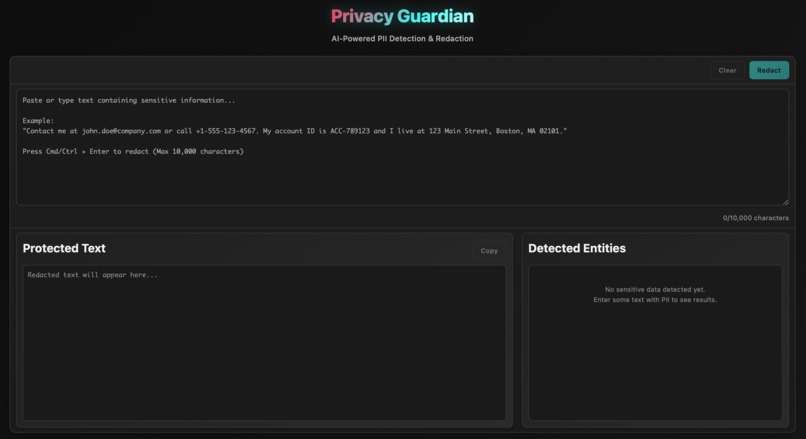
User Interface

Inspiration
The inspiration for Privacy Guardian came directly from my fascination and concurrent concern with the explosion of Generative AI. Tools like ChatGPT are revolutionary, but I couldn't shake a fundamental question: What happens to our data when we ask a question?
The idea that personal, sensitive information—a name, an NRIC, a private address—could be bundled in a prompt and sent to a third-party cloud service felt like a critical vulnerability in this new AI-driven world.
When I saw the Privacy Meets AI hackathon, it felt like the perfect opportunity to address this. I wasn’t against AI; I wanted to find a way to interact with it safely. The vision was to create a digital shield—a tool that would stand guard and ensure the user, and only the user, remains in control of their data.
What it does
Privacy Guardian is a full-stack, on-premises application that acts as a secure shield between a user and any cloud-based LLM service. In real-time, it scans user prompts for Personally Identifiable Information (PII) and redacts it, replacing sensitive data with anonymized placeholders.
Its core function is its privacy-first design: all detection and redaction happen locally on the user's device or within a trusted environment. It does not use any external APIs or online LLMs for its critical function, which guarantees that sensitive user data never leaves the secure perimeter.
How I built it
I approached this project with a full-stack mindset, focusing on a powerful backend and an intuitive frontend.
The Backend Foundation
- Built with Python + FastAPI for high performance and asynchronous capabilities.
- Essential for a responsive, real-time tool.
The Core Engine
- Regex Engine: Precise detection for structured patterns (e.g., emails, passport numbers).
- spaCy NER Model: Flexible detection for general, unstructured entities (e.g., names, locations).
- Context-Aware Capture Layer: Uses keyword cues to dramatically reduce false positives.
Making it Smart
- Advanced Adjudication Logic: Introduced a specificity score system to intelligently prioritize the most accurate match when detections overlap.
- Intelligent Entity Merging: Combines fragmented results (e.g.,
"Dr."+"Evelyn Reed") into a single, cohesive entity.
The User Interface
- Built with React + TypeScript.
- Simple workflow: paste text, click a button, and immediately see sanitized output.
Challenges I ran into
Balancing Precision and Recall
- Regex = precise but misses many cases.
- AI = higher recall but prone to mistakes.
- Solution: a hybrid, multi-layered engine that leverages the strengths of both.
- Regex = precise but misses many cases.
Overlapping Detections
- Multiple layers often detected the same entity.
- Solved by creating a specificity-based adjudication system with a clear hierarchy of trust.
- Multiple layers often detected the same entity.
Real-World Messiness
- PII is rarely clean (e.g., names with titles, fragmented addresses).
- Required iterative entity-merging logic to ensure natural, correct redactions.
- PII is rarely clean (e.g., names with titles, fragmented addresses).
Accomplishments that I'm proud of
- The Multi-Layered Engine: A hybrid system that is more robust and accurate than any single method alone.
- The Context-Aware Capture Layer: A novel feature developed to solve false positives in pattern matching.
- 100% On-Premise Design: Entire application runs locally, with no external API calls for its core function.
- A Complete Full-Stack Application: Delivered a functional prototype with a performant backend and responsive frontend within hackathon timeframe.
What I learned
This project was an incredible learning experience.
Technical Takeaways
- Gained practical experience in NLP by architecting a hybrid system that combines rule-based and ML techniques.
- Built a full-stack system, connecting a performant FastAPI backend with a React frontend.
Conceptual Takeaways
- Reinforced the belief that privacy and AI can coexist.
- Demonstrated that on-premise processing and thoughtful architecture can enable innovation without sacrificing data security.
What's next for Privacy Guardian
Integration of Fine-Tuned Models
- Pipeline ready for models like DeBERTa-v3.
- Plan to integrate custom-trained models into the engine as high-accuracy alternatives to spaCy.
- Pipeline ready for models like DeBERTa-v3.
Broader PII Support
- Expand JSON configuration to support more international PII types for global usefulness.
Easy Deployment
- Containerize with Docker to create a simple, self-contained deployment package.
Browser Extension
- Long-term goal: evolve into a browser extension that automatically redacts PII before submission on any website.
Built With
- and-get-/status.-no-external-or-cloud-based-apis-were-used-for-the-core-functionality.-platforms
- css3
- datasets
- fastapi
- get-/health
- git
- npm
- pandas
- pydantic
- python
- python-dotenv
- pytorch
- react
- restapi
- scikit-learn
- seqeval:-libraries-supporting-the-model-fine-tuning-and-evaluation-pipeline.-apis-internal-rest-api:-the-project-uses-its-own-self-hosted-api-with-endpoints-like-post-/redact
- services-&-databases-cloud-services:-none.-a-core-feature-of-your-project-is-its-on-premises-design
- spacy
- transformer
- typescript
- uvicorn
- vite


Log in or sign up for Devpost to join the conversation.