Inspiration
Enterprises don't avoid frontier LLMs because they're weak — they avoid them because prompts carry customer data. We wanted the split to be structural, not policy: the model that sees secrets runs on hardware we control; the model that reasons never sees a secret at all.
What it does
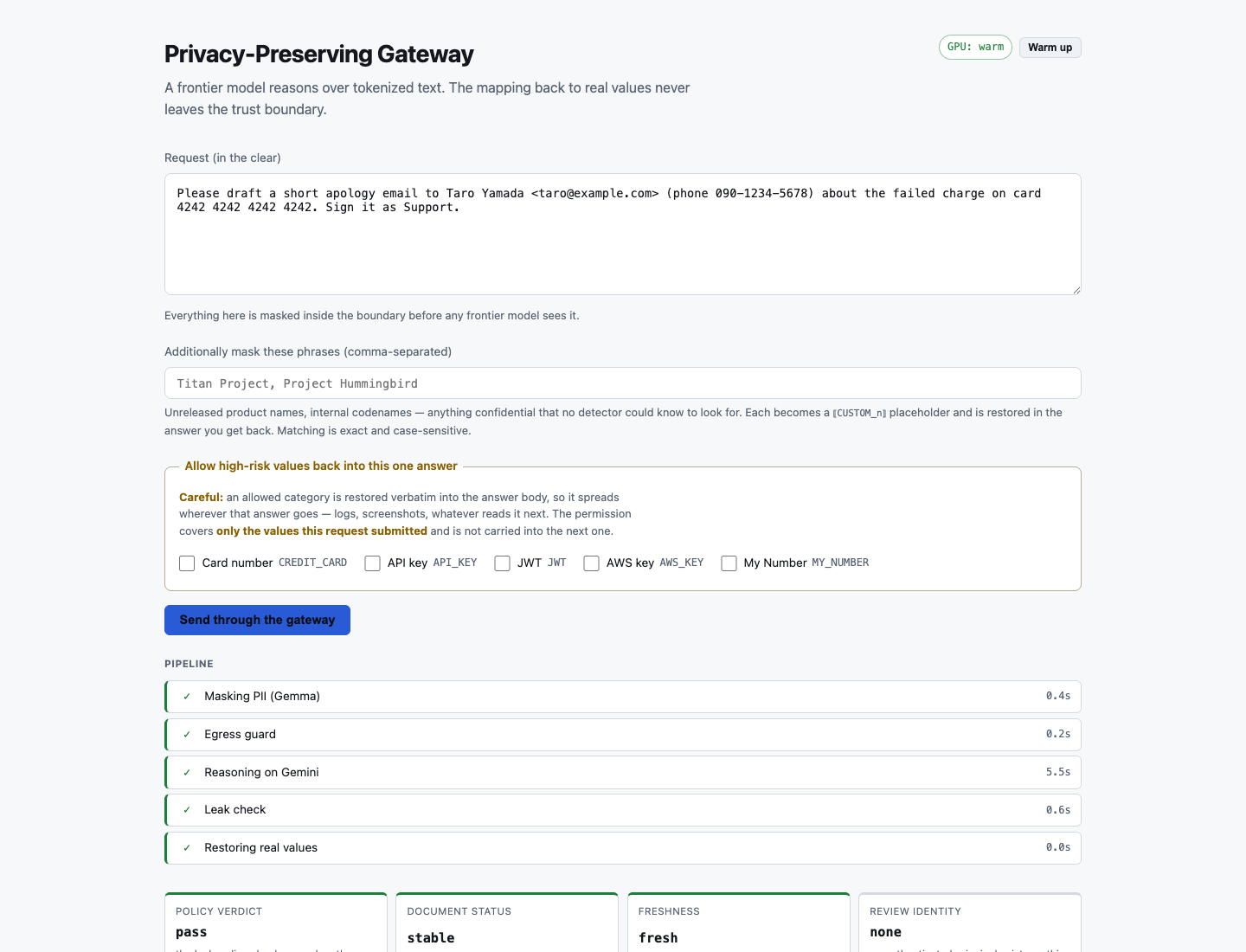
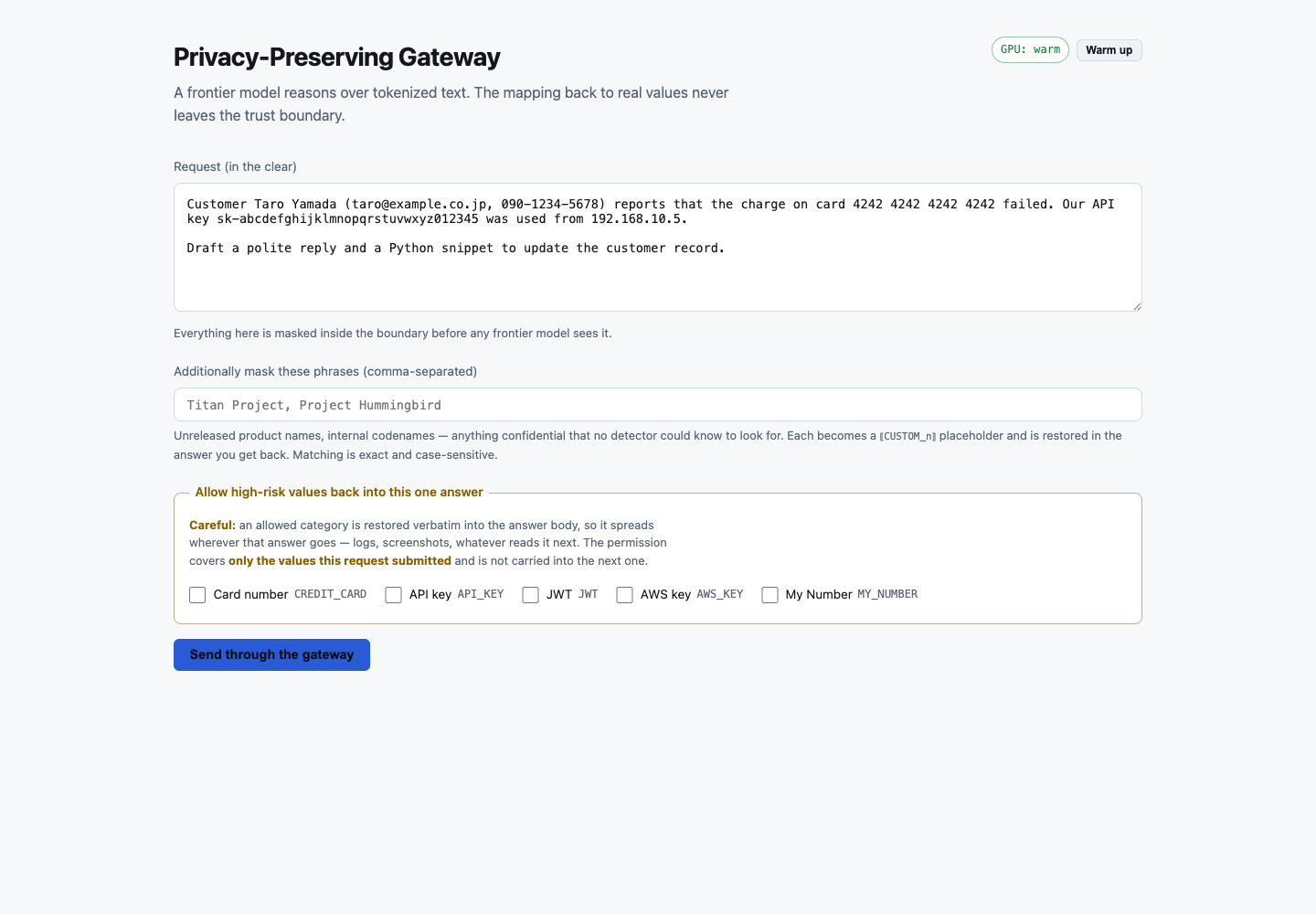
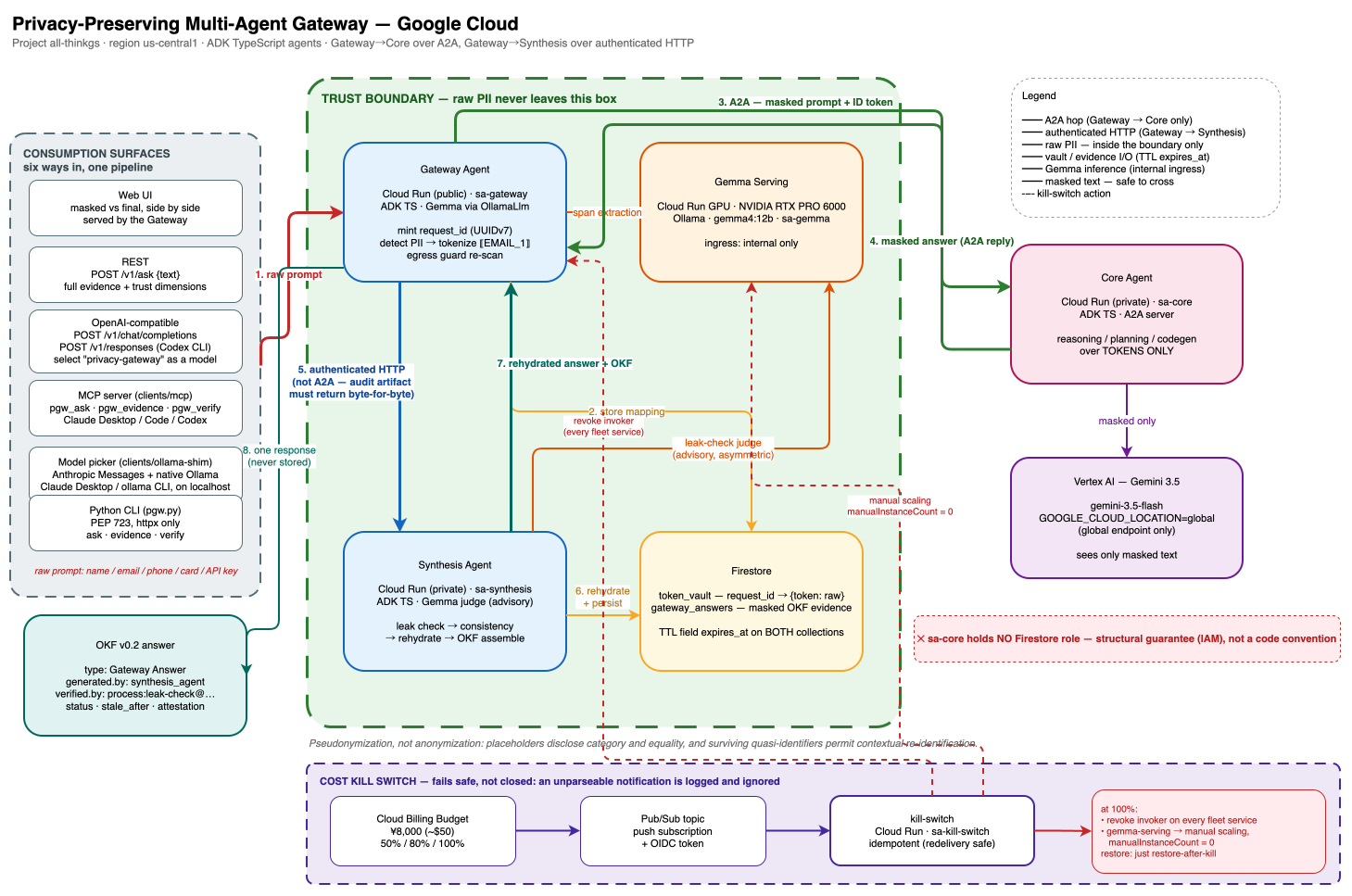
- Gateway Agent (Gemma on a Cloud Run RTX PRO 6000 GPU) detects PII with deterministic regexes (emails, phones, cards with Luhn, API keys, JWTs, Japanese My Number) plus Gemma span extraction for names/addresses, and swaps values for typed placeholders (⟦PERSON_1⟧). Mappings live in a Firestore token vault, TTL'd, one vault per request.
- Core Agent (ADK TypeScript + Gemini 3.5 Flash on Vertex AI) receives only the masked prompt over the A2A protocol and reasons over opaque tokens. Its service account has no Firestore role — the boundary is IAM, not a code convention.
- Synthesis Agent (Gemma) runs a deterministic leak-check attester plus a
Gemma judge with veto-only power, rehydrates only after every gate passes,
and emits the answer as an OKF v0.2 document: provenance, a
process:leak-check@<sha256>verifier, and digests you can replay withjust verify-answer. - User-defined secret terms close the gap no detector can: an unreleased
product name or an internal codename has no lexical shape, so the requester
names it in
mask_termsand it is substituted for ⟦CUSTOM_1⟧ before any detector runs. Both boundary scans then look for the literal string — the one check that proves the masking worked rather than re-running the pattern that decided it. The term list is never persisted to evidence or logs; matched values are stored only in the TTL'd Token Vault for rehydration, like every masked value. The audit record keeps a count only. - Fail closed, everywhere: extraction failure, placeholder injection, vault
expiry, invented tokens, a surviving secret term, or a flagged leak → no
answer, only masked evidence ("content withheld"). High-risk categories
(cards, keys) are withheld by default; they are restored only through an
explicit per-request opt-in, recorded as
disclosure_requested, while the stored evidence remains masked either way. - Consume it six ways: web UI, REST, an OpenAI-compatible endpoint —
the real Codex CLI runs against it as its model, a full
codex execturn (~59 KB of instructions masked chunk by chunk) answering in ~30 s warm — an MCP server for Claude Desktop/Claude Code, a localhost model-picker shim (Anthropic Messages + native Ollama APIs), and a single-file PEP 723 Python CLI. - Fleet operations: one request = one Cloud Trace trace across all hops; structured logs behind a typed allowlist; scale-to-zero GPU; a billing budget that trips a kill switch which unpublishes the gateway.
How we built it
ADK TypeScript (@google/adk 2.x) for all three agents; A2A for discovery and
the Gateway→Core hop; Ollama serving Gemma 4 12B on Cloud Run's NVIDIA RTX PRO
6000; Vertex AI gemini-3.5-flash via the global endpoint; Firestore with TTL
for the vault and masked evidence; the whole platform declared in Terraform
(50+ resources, least-privilege service accounts, Direct VPC egress with
Private Google Access, internal ingress). zod validates every boundary.
800+ unit tests and 70+ browser E2E specs; the full gate runs in CI on pushes to
main and on every pull request — lint (oxlint/oxfmt), typecheck, tests,
Terraform validation, secret scanning, and SHA-pinned actions — with the runs
themselves as the canonical
evidence: https://github.com/kexi/privacy-gateway/actions/workflows/ci.yml Two adversarial design reviews by an external AI reviewer are in
docs/reviews/, with our responses and the diffs they produced.
Challenges we ran into
- L4 GPUs were exhausted in us-central1; Google suggested RTX PRO 6000, which ships an auto-granted quota — we switched the same afternoon.
gemini-3.5-flashexists only on the global Vertex endpoint — regional us-central1 404s. Core pinsGOOGLE_CLOUD_LOCATION=global.- Making refusal real: our first implementation rehydrated before deciding and persisted refused output. The re-review caught it; now every gate runs before a single rehydration, and refusals persist hashes only.
- Cloud Run internal ingress + Direct VPC egress: private-ranges-only routing silently bypasses the VPC for run.app URLs; the fix is all-traffic egress through a subnet with Private Google Access.
- Preventing the vault from becoming an oracle: an early session-oriented design would have let a caller-controlled identifier select a vault entry — and so resolve another request's placeholders. We removed sessions entirely; every request gets one unpredictable, server-generated UUIDv7 vault key.
- Safe streaming: a privacy gateway cannot stream tokens before inspecting the complete answer — displayed content cannot be taken back. The OpenAI-compatible stream releases a single checked chunk only after every gate passes; refusals return no partial answer.
- Treating probabilistic models as untrusted components: Gemma may veto a release, but it can never certify one. The release verdict comes from deterministic TypeScript checks, and missing or malformed results fail closed.
What we learned
Pseudonymization is not anonymization — placeholders disclose category and equality, and we say so. The honest version of "trust me" is an attestation you can replay: OKF v0.2's generated/verified/attestation fields turned our audit trail into a standard, portable artifact instead of bespoke JSON.
What's next
Shipped since: the model-picker shim (clients/ollama-shim), so Claude Desktop's
gateway-provider picker can select privacy-gateway directly — it turned out to
require the Anthropic Messages API, not the Ollama protocol, so the shim serves
both, and a per-request disclosure opt-in, so a caller can ask for the high-risk
values they submitted back in their answer without loosening the deployment's
policy. Still ahead: multimodal input — every surface is text-only today and
refuses an image part outright rather than dropping it, because regex plus a text
model cannot find, mask or verify PII inside a picture; in-boundary Gemma vision
extraction is the way to support it honestly. Also ahead: authenticated human
review (IAP) to unlock the human-reviewed trust tier; per-tenant disclosure
policies.
What we are proud of
We did not build a regex wrapper around an API call. We built a deployable security boundary with separate identities, private services, request-scoped storage, independent release gates, end-to-end tracing, and replayable evidence — and then pointed the real Codex CLI at it and watched a full, 59 KB-of-instructions turn come back masked, reasoned and verified in ~30 seconds.
Gemma integration (bonus)
Gemma 4 12B performs both privacy-critical functions — PII span extraction and the leak-check judge — self-hosted on a Cloud Run GPU inside the trust boundary. This is not a garnish: the product's core guarantee depends on an open model that never leaves our infrastructure.
Built With
- a2a
- cloud-run
- firestore
- gcp
- gemini
- gemma
- mcp
- ollama
- terraform
- typescript
- vertex


Log in or sign up for Devpost to join the conversation.