-
-
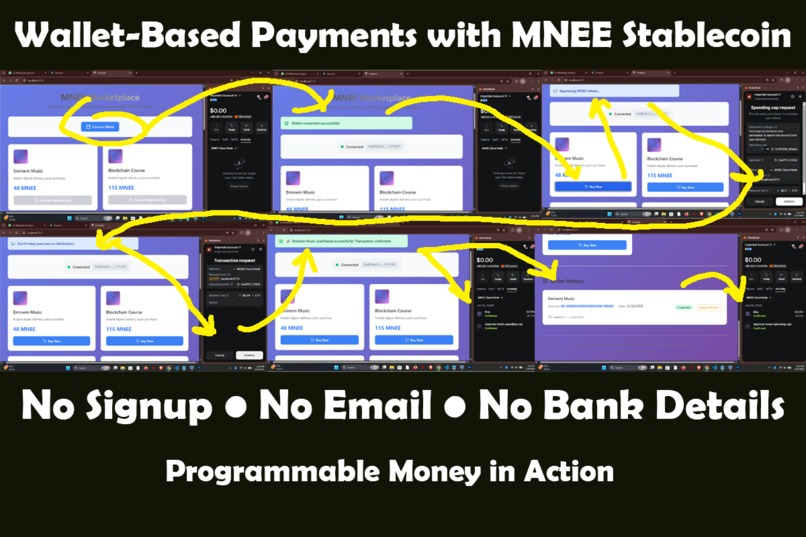
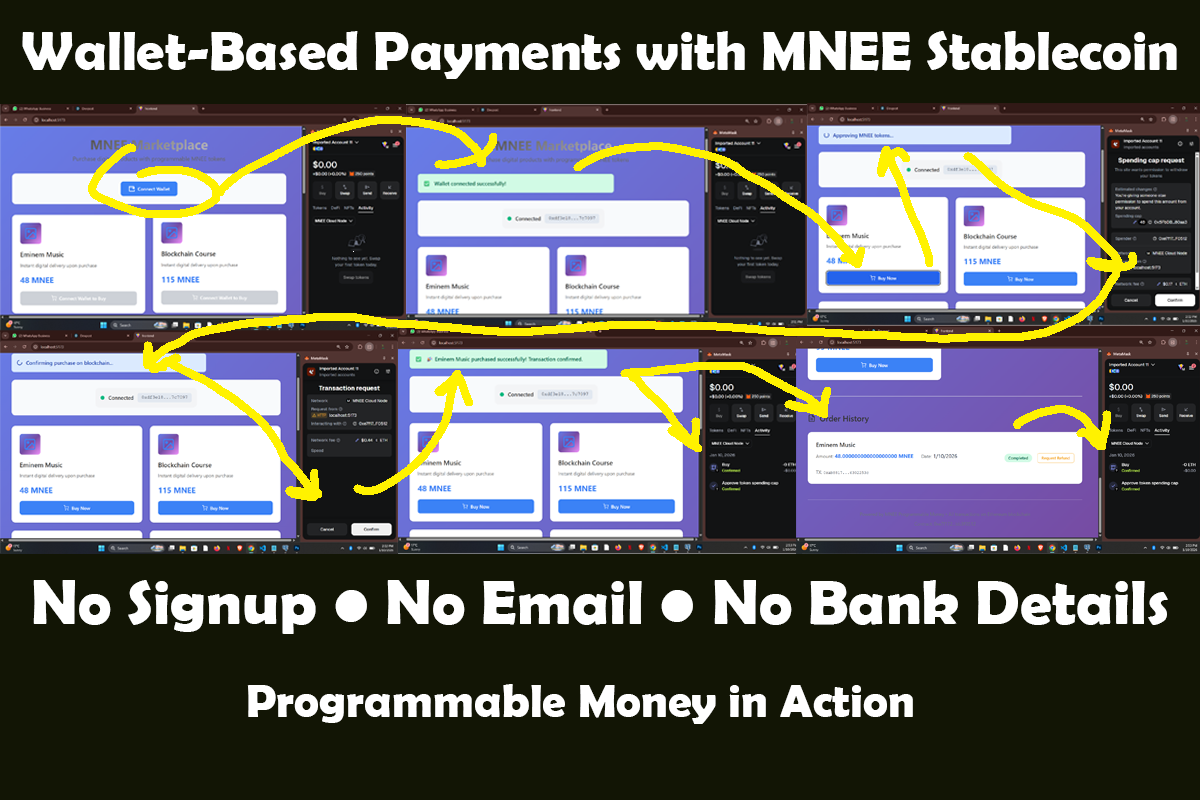
Payment UI
-
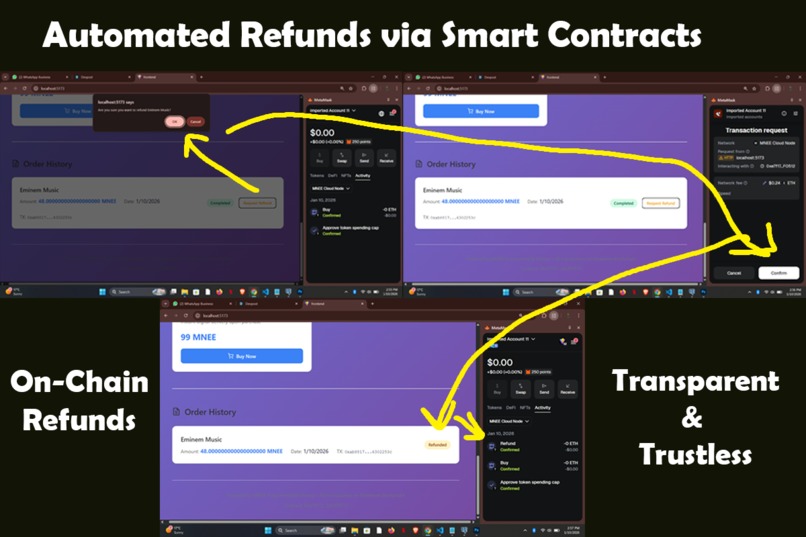
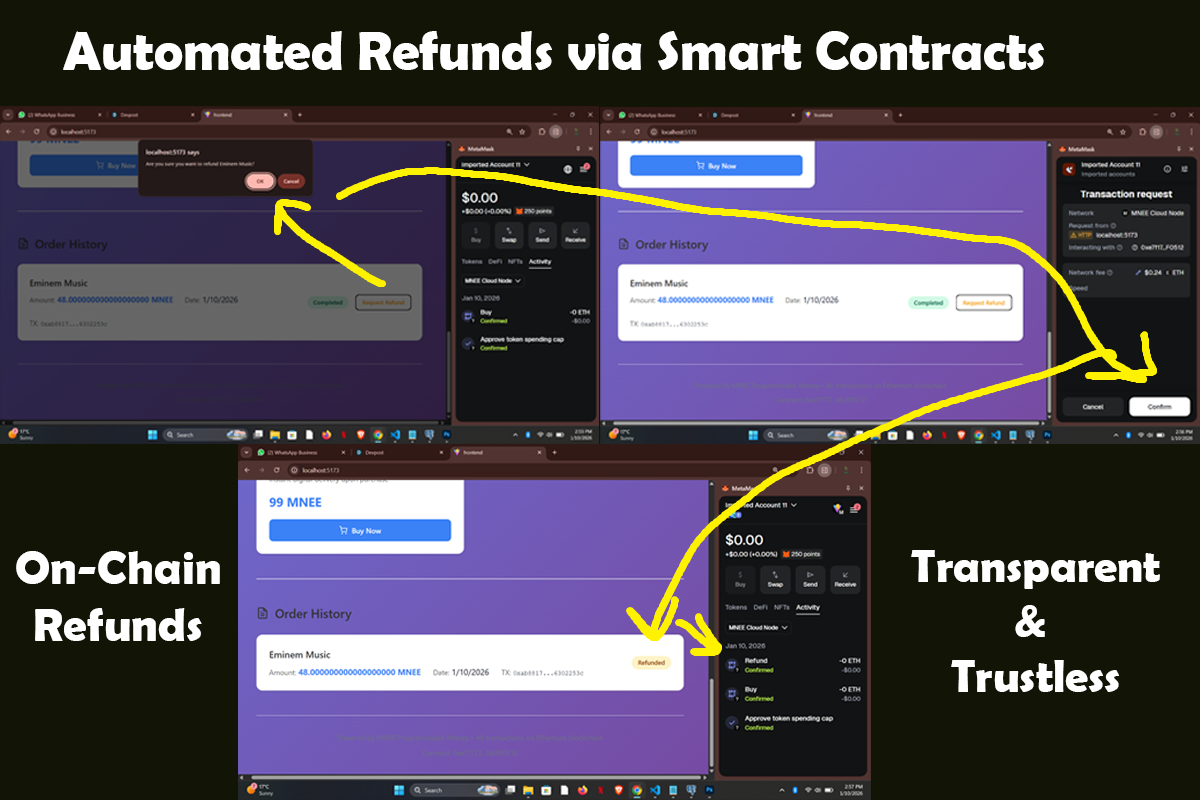
Automated Refund UI Using Smart Contract
-
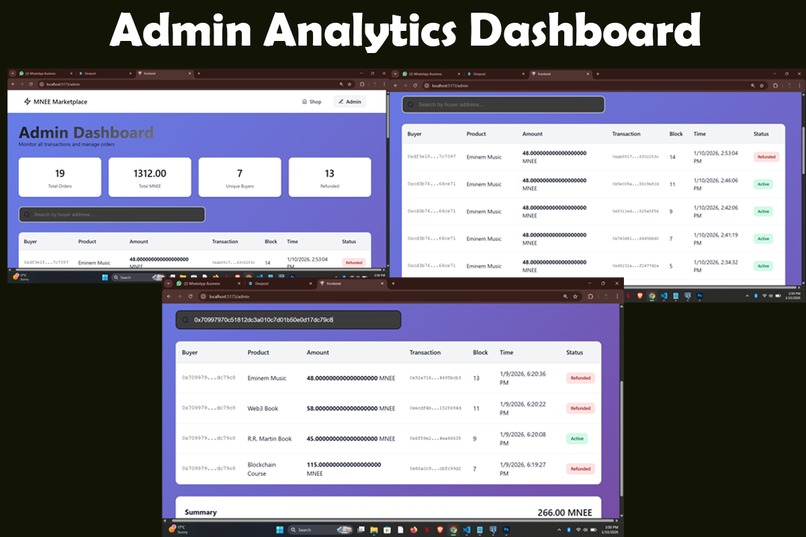
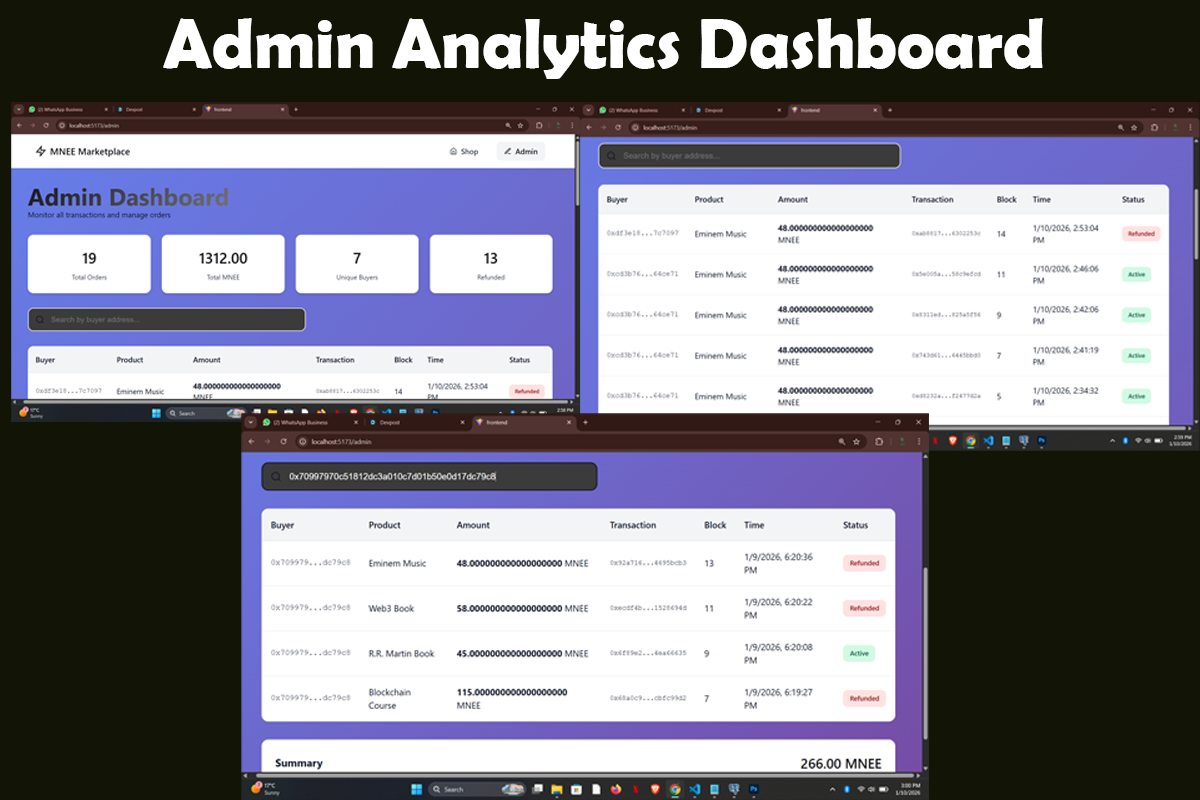
Transaction Analysis Dashboard
Inspiration
I frequently shop online, but I always face the same recurring problems: repeated logins, forgotten passwords, constant password resets, and the need to re-enter personal details such as name, email, and phone number every time I visit a new e-commerce platform.
Often, these small but repetitive frictions discourage me from even trying new websites. In reality, this means we might miss better products or new ideas simply because the process feels too inconvenient.
This ongoing frustration inspired me to imagine an e-commerce platform where users would not need to share any personal data at all — no email, no phone number, no name, and no bank details.
While studying blockchain fundamentals through Binance Academy (over 20 hours of coursework) and completing certifications such as BNB Chain Developer Specialization and Introduction to Aptos, I realized that this idea was technically possible. The question was not if, but how.
The breakthrough came when I explored the concept of programmable money in e-commerce. I realized that if payments were handled through a stablecoin, the user’s public wallet address alone could act as their identity. Since a public address is already visible on the blockchain, sharing it does not compromise privacy.
This is where MNEE, a USD-backed stablecoin, became the perfect foundation. Once I imagined MNEE as the primary medium of exchange, the idea of a privacy-first, wallet-based e-commerce DApp naturally took shape.
What it does
This DApp protects user identity and privacy by completely removing centralized user accounts.
In traditional applications, users are forced to provide personal data just to access services. This creates risks, friction, and dependency on centralized systems. Users cannot provide random data either, because returning to the platform later requires the same credentials.
My DApp eliminates all of these problems.
Users simply visit the application and connect their wallet. Their public address becomes their identity — an address that is already publicly visible and safe to share. Once connected, users can freely purchase products using MNEE stablecoin without any intervention from the platform owner.
If a product is not satisfactory, users can request a refund directly. No support tickets, no emails, no account recovery — the smart contract handles everything.
In short, users can shop online without sharing any personal information, while still retaining full control over payments and refunds.
How we built it
Technologies Used
To build this decentralized application (dApp), we used a combination of blockchain, web, backend, and Smart Contract to ensure security, automation, and usability.
Blockchain & Smart Contracts
Solidity – Used to write smart contracts for handling payments, refunds, and access control.
Ethereum – The dApp is built on Ethereum, using the MNEE USD-backed stablecoin for all transactions.
Hardhat – Used as the development environment for compiling, testing, and deploying smart contracts.
Ethers.js – Used to interact with smart contracts from the frontend and backend.
Frontend
JavaScript
HTML & CSS
Web3 Wallet Integration (MetaMask) – For wallet-based authentication and transaction signing without traditional login/signup.
Backend & Off-Chain Services
Node.js – Backend runtime for handling API logic and database operations.
Express.js – Used to create backend APIs.
Off-chain Database (PostgreSQL) – Stores transaction metadata such as user public address, product ID, payment status, and refund status for analytics and history tracking.
Tools & Platforms
VS Code – Primary development environment.
Git & GitHub – Version control and public code repository.
Testnet Deployment – Smart contracts deployed and tested on Ethereum test networks.
Key Highlights
No user accounts, emails, or passwords are required — wallet address acts as the sole identity, ensuring privacy.
Payments and refunds are fully automated and enforced by smart contracts.
Challenges we ran into
I faced many challenges throughout this project. Although my theoretical understanding of blockchain was strong due to my studies, this was my first fully functional DApp, which made the practical implementation entirely new and demanding.
One of my greatest strengths is that I clearly understand what I am building and why. This clarity allowed me to use AI tools very effectively. I built this entire DApp within six days, dedicating approximately 12 to 15 hours each day, and heavily leveraging AI assistance throughout the development process.
I primarily used ChatGPT, along with limited use of Grok, Gemini, and DeepSeek. The real challenge was not using AI itself, but clearly communicating my exact intent to the AI. I spent significant time writing, erasing, and refining plans, while also anticipating where AI responses could lead me into unproductive loops. Being mentally prepared for these situations helped me stay in control and actually enjoy the development process.
The most difficult technical challenge was synchronizing on-chain and off-chain data. User actions are first recorded on the blockchain, then fetched by the backend, stored in PostgreSQL, and finally reflected on the frontend. Ensuring this pipeline worked reliably and consistently required careful design and debugging.
An even tougher issue emerged when restarting the local system — database state synchronization after shutdowns required additional handling. While this problem has been largely resolved in the local environment, it remains an ongoing challenge during live VPS deployment, which I am still actively working to improve.
Accomplishments that we're proud of
At the beginning, I genuinely believed that building this project using only theoretical knowledge and AI assistance was nearly impossible.
However, by planning clearly and executing step by step, I was able to turn that theory into a fully working DApp. The fact that this project not only exists but runs successfully is my biggest achievement.
Creating a complete, functioning Web3 application within a short time frame using AI as a development partner feels like a personal breakthrough and a defining milestone for me.
What we learned
I learned an immense amount through this project.
Most importantly, I gained a deep practical understanding of how blockchain transactions actually work — how blocks are connected, how state changes propagate, and how smart contracts interact with off-chain systems.
What was once theoretical knowledge became tangible and intuitive. This experience reinforced my belief that privacy-first applications will become increasingly important as users grow tired of constantly sharing personal data on centralized platforms.
What's next for Privacy-First E-Commerce DApp with MNEE
In the future, I would like to further develop and potentially publish this project if MNEE stablecoin continues to exist long-term.
One of the biggest challenges in crypto adoption remains price volatility. Stablecoins like MNEE solve this problem. As more reliable stablecoins enter the ecosystem, privacy-first commerce DApps like this can become a realistic alternative to traditional e-commerce platforms.
This project represents a step toward that future.
Built With
- blockchain
- css
- ethereum
- ethers.js
- express.js
- hardhat
- html
- javascript
- metamask
- node.js
- off-chain
- postgresql
- smartcontract
- solidity

Log in or sign up for Devpost to join the conversation.