Inspiration
Waste segregation is still largely dependent on people manually identifying and separating waste. In homes, colleges, and public spaces, incorrect segregation makes recycling difficult and increases the amount of waste sent to landfills.
We wanted to build an affordable system that could make waste segregation automatic at the point where waste is discarded. This led us to Prithv-E, an AI-powered smart bin that uses computer vision to identify waste and automatically direct it to the appropriate compartment.
Our goal was not just to make a “smart dustbin”, but to combine AI + embedded systems + mechanical automation into a practical and scalable waste-management solution.
What it does
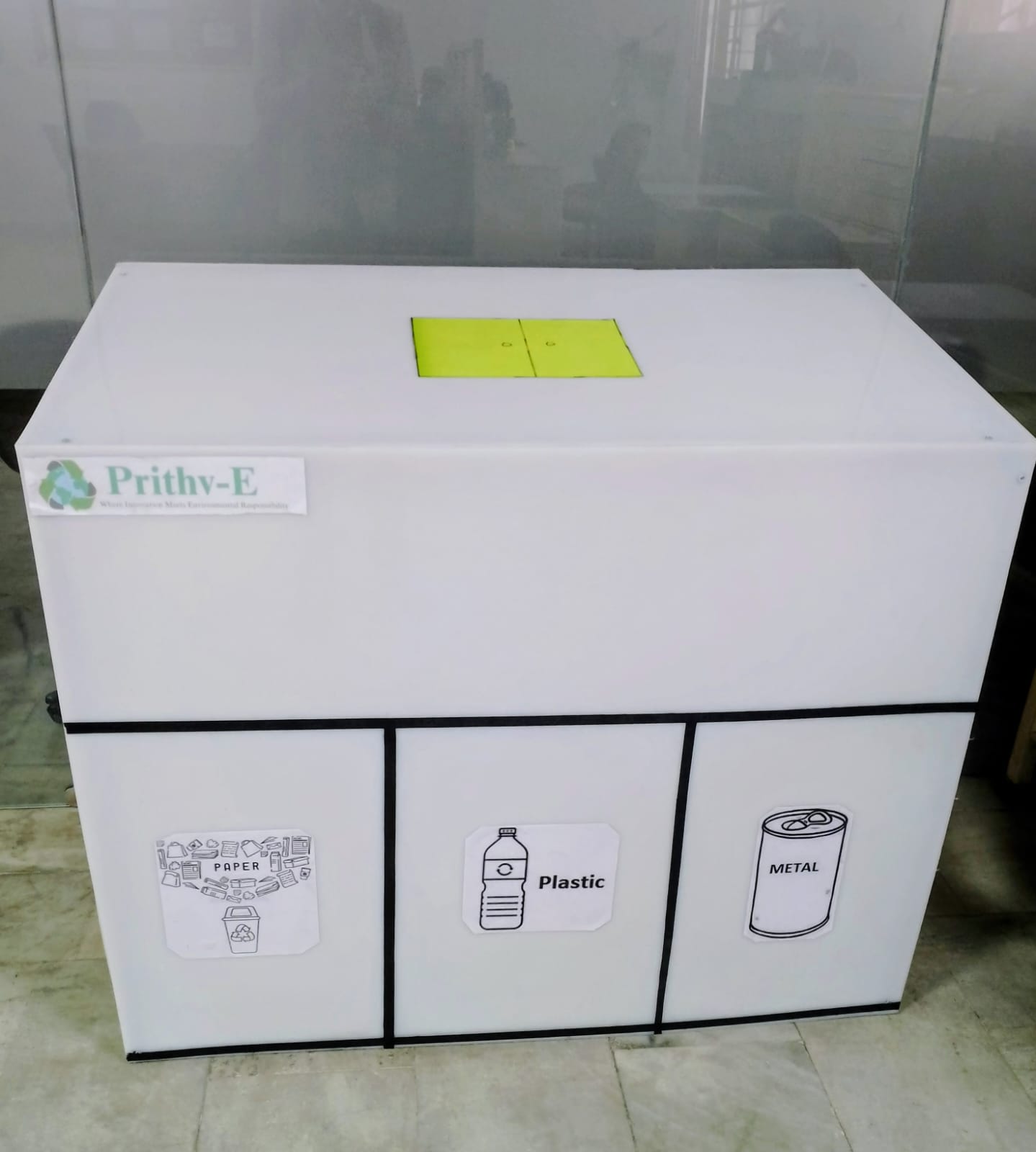
Prithv-E automatically identifies the type of waste placed inside it and routes the waste into the corresponding compartment.
The system uses a camera to capture an image of the incoming waste. A lightweight MobileNetV2-based image classification model running on a Raspberry Pi processes the image and predicts the waste category.
Based on the prediction, the controller activates a servo-driven mechanism that directs the waste toward the appropriate compartment.
The overall workflow is:
Waste → Camera → AI Classification → Controller → Mechanical Sorting → Correct Compartment
This reduces dependence on manual segregation and can help improve the quality of recyclable waste.
How we built it
Prithv-E combines hardware, computer vision, machine learning, and mechanical automation.
Hardware
- Raspberry Pi 4
- Pi Camera Module
- Arduino-based control system
- Servo motor
- Custom mechanical waste-routing mechanism
- HDPE sheet-based bin structure
AI & Software
- MobileNetV2 for image classification
- TensorFlow Lite for lightweight edge inference
- Python for AI and hardware integration
- Camera-based image acquisition
The model is designed to run locally on the edge device instead of depending completely on cloud processing. This helps reduce latency and makes the system more suitable for environments with limited or unreliable internet connectivity.
Challenges we ran into
One of our biggest challenges was making an AI model work reliably in a physical environment rather than only on a dataset.
Waste can appear in different shapes, orientations, lighting conditions, and backgrounds. We therefore had to think about image quality, model efficiency, inference speed, and real-world placement of the camera.
Another challenge was integrating the AI prediction with the physical sorting mechanism. A correct classification is only useful if the mechanical system can reliably act on that prediction.
We also had to balance accuracy, processing speed, hardware limitations, and cost while designing the prototype.
Accomplishments that we're proud of
We are proud of building a working prototype that combines AI-based computer vision with physical waste segregation instead of treating AI as a standalone software feature.
Some key accomplishments include:
- Developed an AI-based waste classification pipeline using MobileNetV2.
- Optimized the model for edge inference using TensorFlow Lite.
- Integrated camera-based image recognition with a physical sorting mechanism.
- Built a custom prototype using affordable and locally available components.
- Designed the system with scalability and household/institutional deployment in mind.
- Developed Prithv-E as a practical approach toward reducing incorrect waste segregation at the source.
What we learned
Prithv-E taught us that building an AI-powered hardware product is very different from building a software-only application.
We learned how to connect machine learning predictions with real-world physical actions, optimize AI models for edge devices, work with embedded hardware, and design around practical constraints such as cost, latency, mechanical reliability, and environmental conditions.
Most importantly, we learned that successful innovation requires the AI model, hardware, software, and user experience to work together as one system.
What's next for Prithv-E Smart Bin
Our next goal is to improve the model using a larger and more diverse waste dataset and increase classification accuracy across real-world lighting and environmental conditions.
We also plan to add features such as:
- Real-time bin-fill monitoring
- Automatic lid operation
- Improved sorting reliability
- Waste analytics and monitoring dashboard
- Better mechanical design for different waste types
- Low-cost production-oriented design
In the long term, we envision Prithv-E being deployed in homes, educational institutions, offices, and public spaces to make waste segregation simpler, smarter, and more accessible.
Built With
- arduino
- python
- raspberry-pi
- sensor
- ultrasonic

Log in or sign up for Devpost to join the conversation.