-
-
-
deployment game html
Inspiration
We wanted to create a game that captures the fast, satisfying action of classic arcade shooters while giving it a modern cyberpunk identity. Our goal was to make something players could open in their browser and understand almost immediately—move, aim, shoot, dodge, and survive. The idea of defending Sector 7’s reactor core from rogue machines gave the game a clear mission and helped shape its neon, high-stakes atmosphere.
What it does
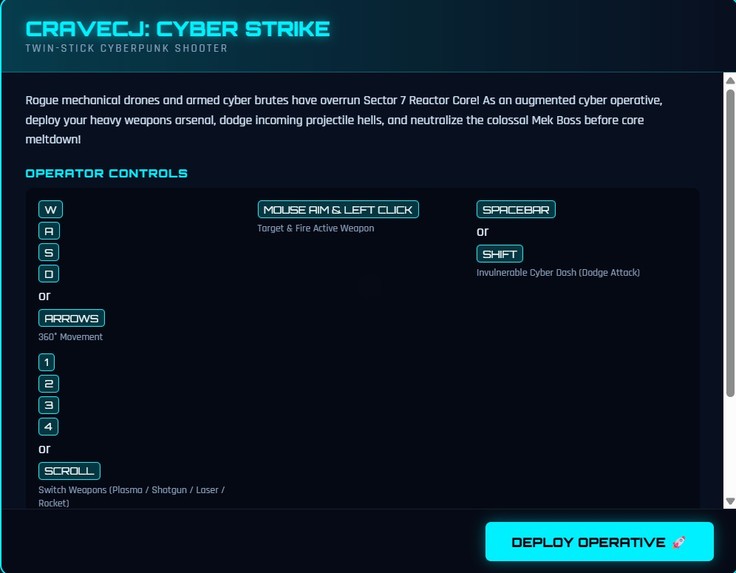
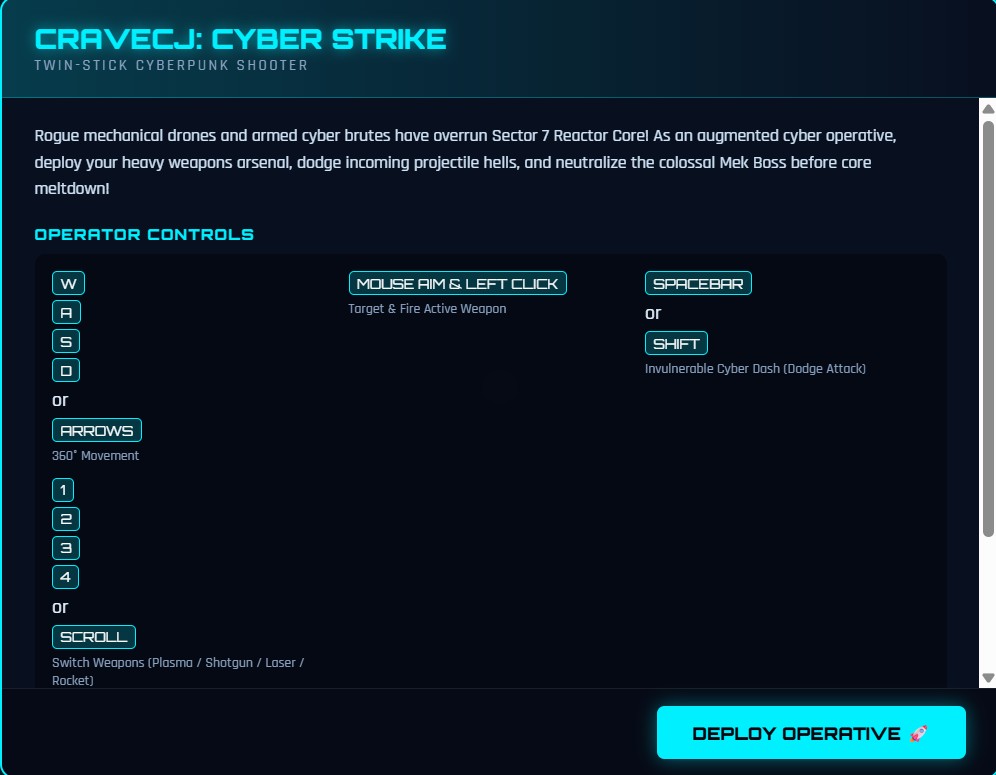
PrismWorkz presents CraveCJ: Cyber Strike, a browser-based twin-stick cyberpunk shooter in which the player controls an augmented operative fighting through ten waves of mechanical drones and cyber brutes before confronting the Mek Boss.
Players move with WASD or the arrow keys, aim and fire with the mouse, and use an invulnerable Cyber Dash to escape dangerous attacks. They can switch between four weapons: an infinite-ammo Plasma Blaster, a close-range Scatter Shotgun, a piercing Beam Laser, and an explosive Rocket Launcher. The game also includes health, an energy shield, enemy tracking, scoring, sound, and a final victory screen.
How we built it
We designed PrismWorkz as a browser-first, real-time game centered around a continuous game loop. The game manages player movement, mouse aiming, weapon firing, enemy behavior, projectiles, collisions, damage, visual effects, scoring, and wave progression while keeping everything responsive.
We created a reusable weapon system so that each weapon could have its own firing rate, range, damage, and behavior. We also developed a wave-management system that introduces enemies over time and tracks when the player is ready to advance. The interface was designed alongside the gameplay so players can quickly see their active weapon, ammunition, health, shield, dash status, score, and remaining enemies. Finally, we deployed the project online so anyone can start playing directly from a link without installing anything.
Challenges we ran into
One of our biggest challenges was maintaining smooth and responsive gameplay while many enemies, projectiles, effects, and collision checks were active at the same time. Even small delays are noticeable in a fast shooter, so we had to think carefully about how frequently objects were updated and removed.
Balancing the four weapons was another challenge. Each weapon needed to feel powerful while still having a clear purpose. The shotgun had to reward close-range play, the laser needed to be useful against lines of enemies, rockets needed satisfying area damage, and the plasma weapon had to remain dependable without making the other options unnecessary.
We also had to balance the ten-wave progression. The difficulty needed to increase enough to remain exciting without overwhelming new players too early. Clear visual feedback for damage, shields, weapon switching, and the Cyber Dash was especially important during intense moments.
Accomplishments that we're proud of
We are proud that we completed a full gameplay loop rather than only building a technical demo. Players can launch the game, learn the controls, fight through multiple waves, experiment with four different weapons, face the final challenge, receive a score, and play again.
We are also proud of the game’s visual consistency. The neon interface, cyberpunk setting, weapon effects, enemy encounters, and reactor-core storyline all support the same identity. Most importantly, the game feels immediately playable while still giving players several mechanics—such as weapon switching, shield management, aiming, positioning, and dashing—to master.
What we learned
Building PrismWorkz taught us that good game development is about more than adding features. Mechanics need strong feedback to feel satisfying. Sound, movement, impact effects, readable health information, and clear reactions from enemies can make a simple action feel much more powerful.
We also learned the importance of separating game systems. Keeping weapons, enemies, player controls, collisions, waves, and interface updates organized made it easier to debug problems and introduce new mechanics. Playtesting showed us that balancing is an ongoing process: values that appear reasonable in code can feel completely different once the game is played at full speed.
What's next for PrismWorkz
Next, we plan to expand PrismWorkz with additional enemy classes, more complex attack patterns, new environments, and bosses with multiple phases. We would also like to introduce upgrade choices between waves, allowing players to create different builds and giving each playthrough more variety.
Other possible additions include difficulty modes, online leaderboards, achievements, controller support, mobile-friendly controls, accessibility settings, improved sound design, and more advanced visual effects. Our long-term goal is to turn the current ten-wave experience into a larger replayable cyberpunk action game while preserving its fast, accessible browser gameplay.
Built With
- antigravity
- vercel

Log in or sign up for Devpost to join the conversation.