-
-
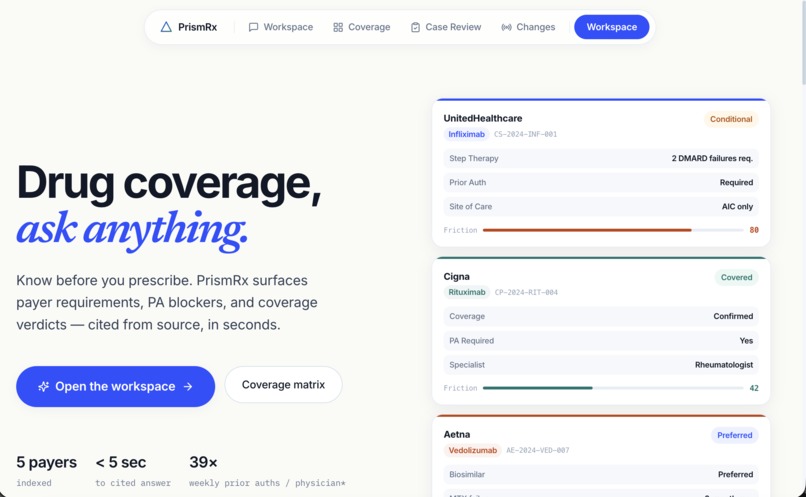
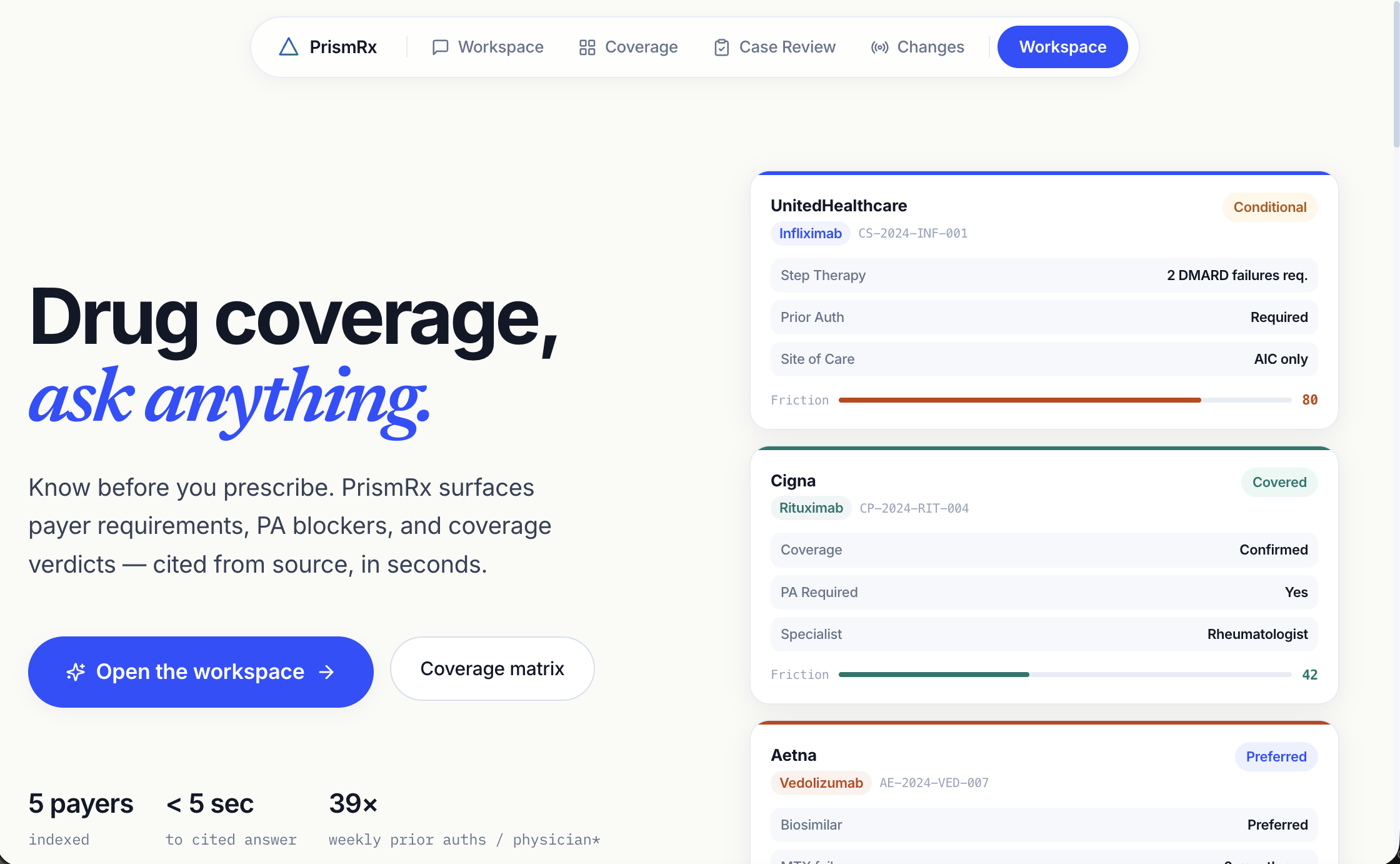
PrismRx - A Drug Coverage and Comparison Site for your immediate medical queries
Inspiration
Market access teams spend too much time manually searching payer websites, PDFs, and policy documents just to answer basic but critical questions: Is this drug covered? What prior authorization criteria apply? What changed this quarter? That process is slow, repetitive, and hard to scale. We built PrismRx to make payer policy intelligence faster, clearer, and more actionable for pharma teams, specialty pharmacies, and hub services.
What it Does
PrismRx is an AI payer policy intelligence platform for pharmaceutical market access teams.
It helps users: • Ask natural-language questions about payer coverage and prior authorization requirements • See cited policy evidence behind every answer • Compare payer coverage across drugs in a Coverage Matrix • Simulate access friction for a patient case with the PA Simulator • Track quarter-over-quarter payer policy changes in Radar
Instead of manually digging through policy documents, users get structured, evidence-backed answers in seconds.
How we built it
We built PrismRx using Next.js 14 App Router and TypeScript for the frontend and application architecture. We used Framer Motion to create a polished, responsive product experience. The AI assistant streams responses in real time via SSE and uses AWS Bedrock to generate answers grounded in our indexed payer policy repository. We also built structured UI widgets for coverage cards, blocker lists, comparison tables, and change diffs so users get answers in a format that is immediately useful, not just raw text.
Our dataset currently uses synthetic and public payer policy documents, covering roughly 5 payers across 12 drug families.
Challenges we ran into
One of the biggest challenges was translating messy policy language into structured, trustworthy outputs. Payer documents are often inconsistent, nuanced, and difficult to compare across plans. Another challenge was designing an AI experience that feels fast and helpful while still showing evidence clearly enough for users to trust the answer. We also had to balance flexibility in natural-language questions with deterministic UI elements like coverage tables, blockers, and before/after change tracking.
Accomplishments that we're proud of
We are proud that PrismRx goes beyond a simple chatbot. It combines conversational AI with purpose-built workflows for real market access use cases. We built an experience where users can move from a question to evidence to comparison to action in one place. We are also proud of the Radar and PA Simulator features, which turn static policy documents into something much more operational and decision-ready.
What we learned
We learned that trust matters as much as speed in healthcare-facing workflows. It is not enough for AI to provide an answer; users need to see where it came from and why it matters. We also learned that structured outputs are often more valuable than freeform responses when people are making access decisions. Finally, we saw how much opportunity there is to modernize payer policy review with AI-native interfaces.
What's next for PrismRx
Next, we want to expand the number of payers, drug classes, and policy documents we index. We also want to improve policy normalization, make change tracking more granular, and support deeper workflow integrations for pharma and specialty pharmacy teams. Longer term, we see PrismRx evolving into a system of intelligence for market access, helping teams monitor policy shifts, anticipate barriers, and make faster strategic decisions at scale.

Log in or sign up for Devpost to join the conversation.