-
-
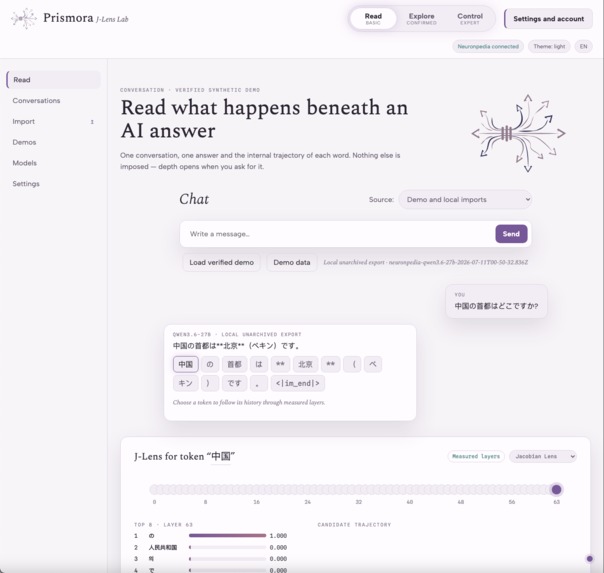
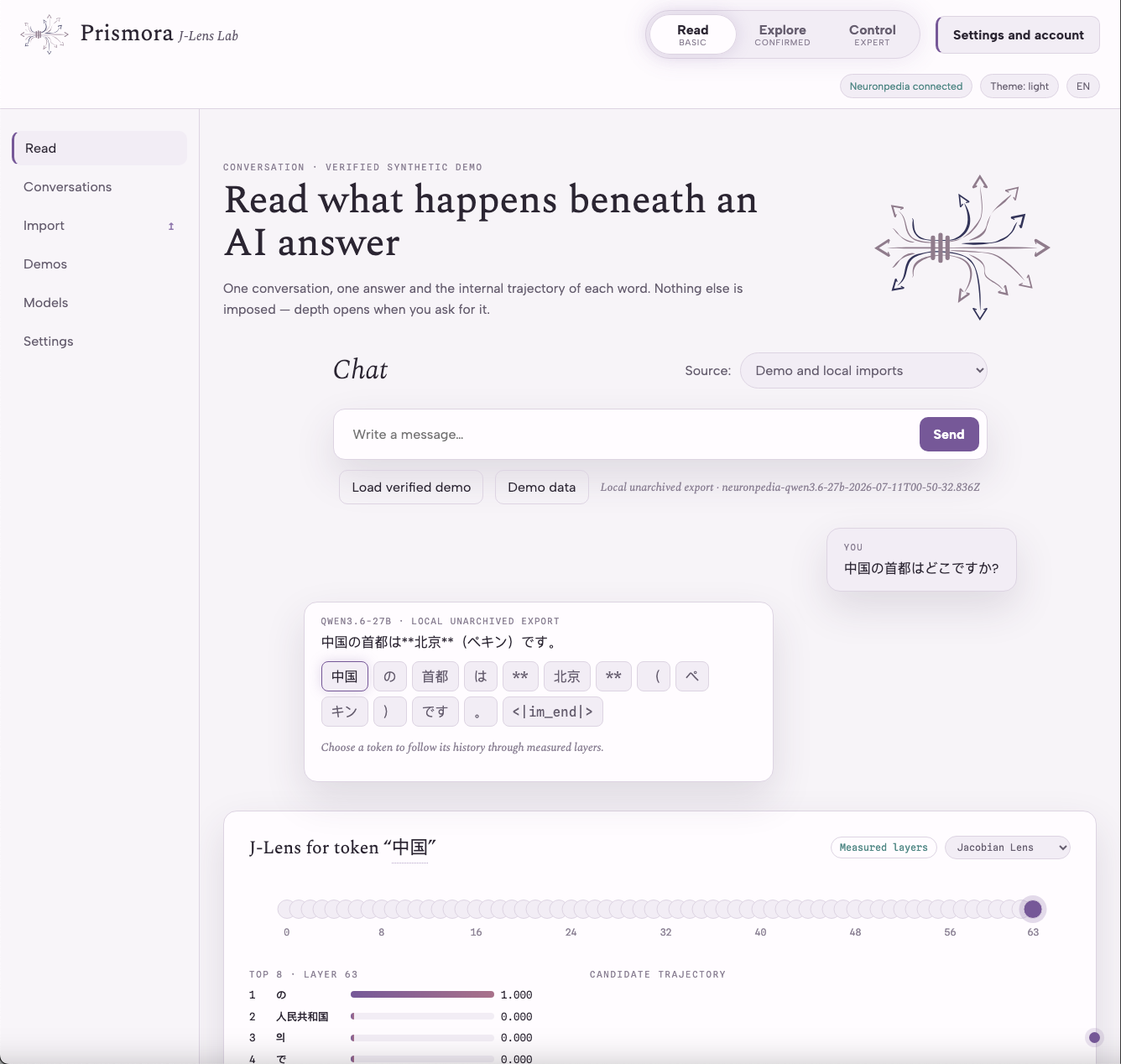
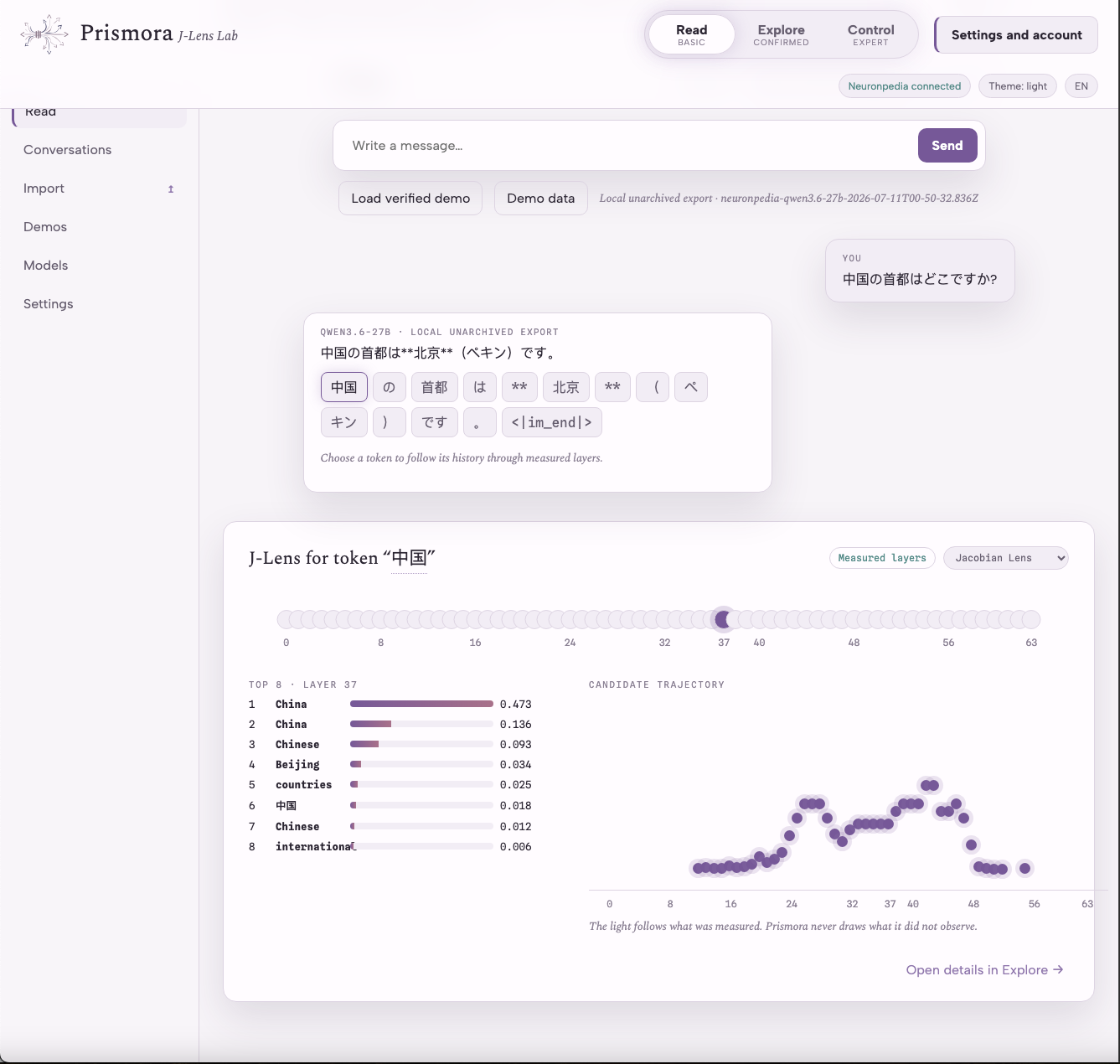
Progressive Read view: follow one generated token through the model’s measured J-Lens layers.
-
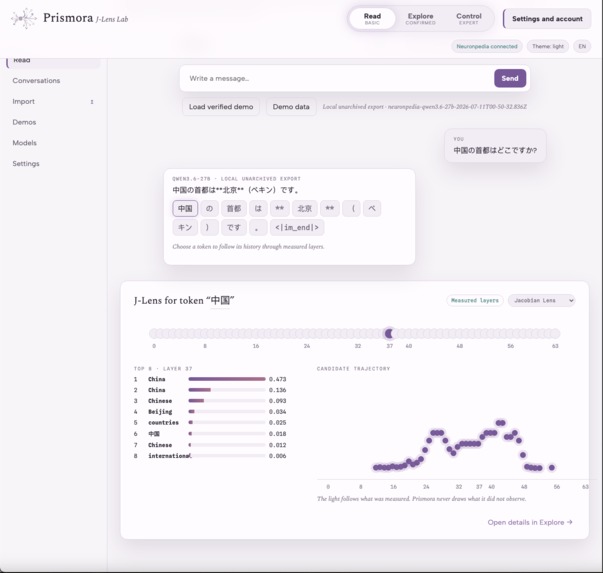
Layer-by-layer token trajectory with top-8 candidates and explicit measured-layer coverage.
-
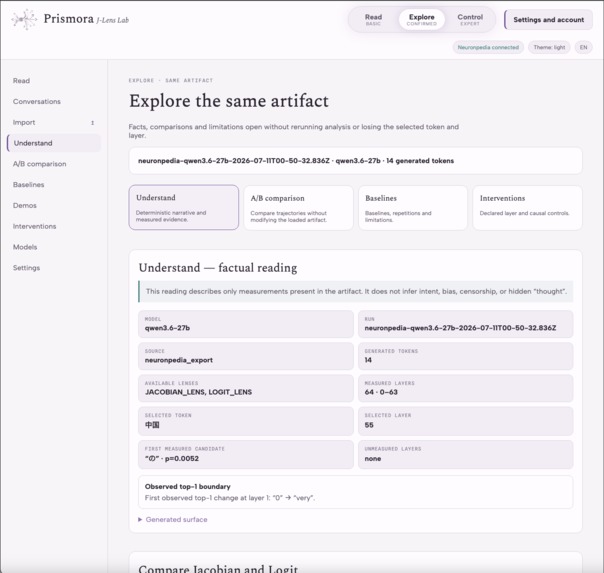
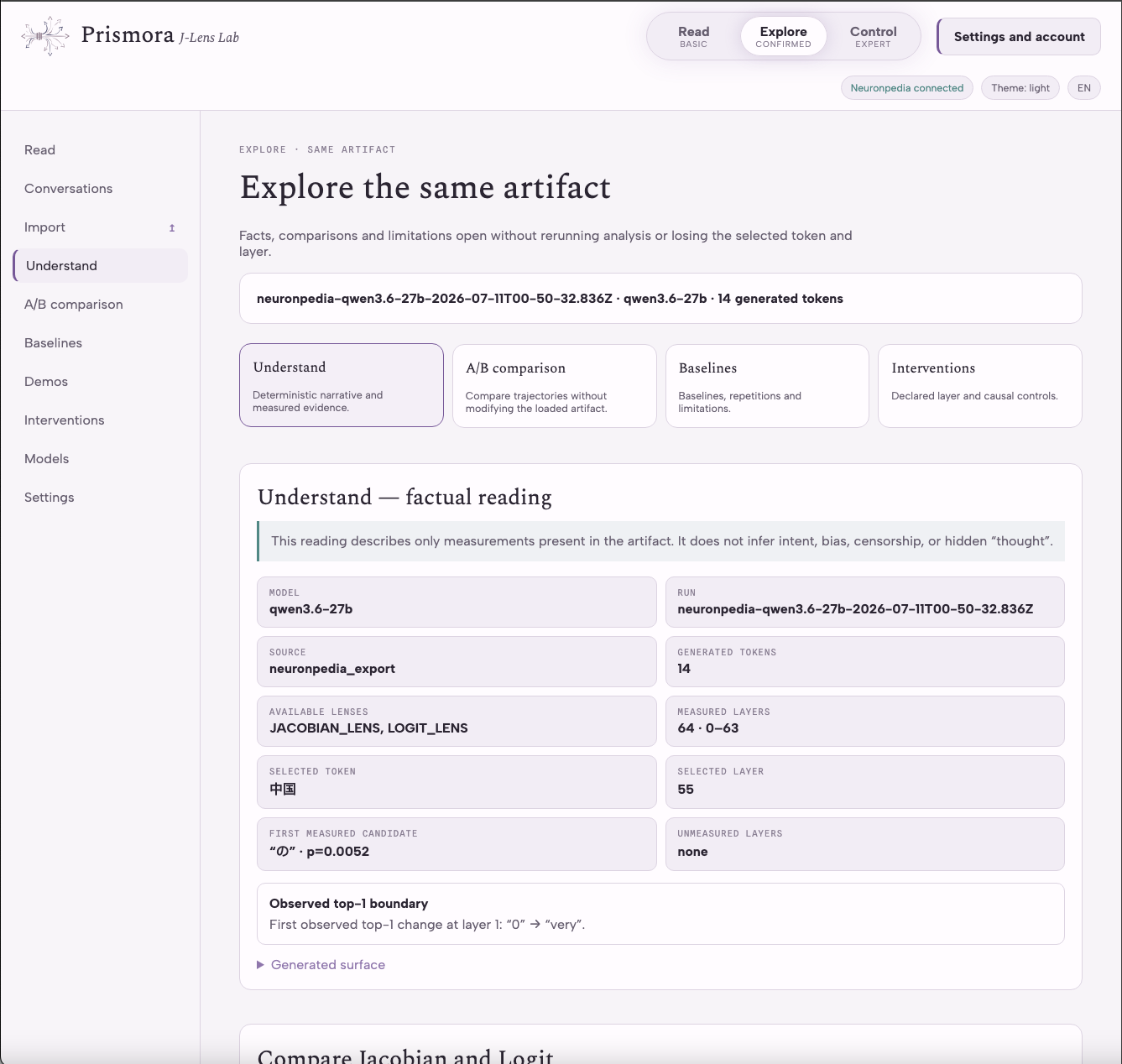
Deterministic Understand view: factual measurements, coverage, and limits without LLM-generated interpretation.
-
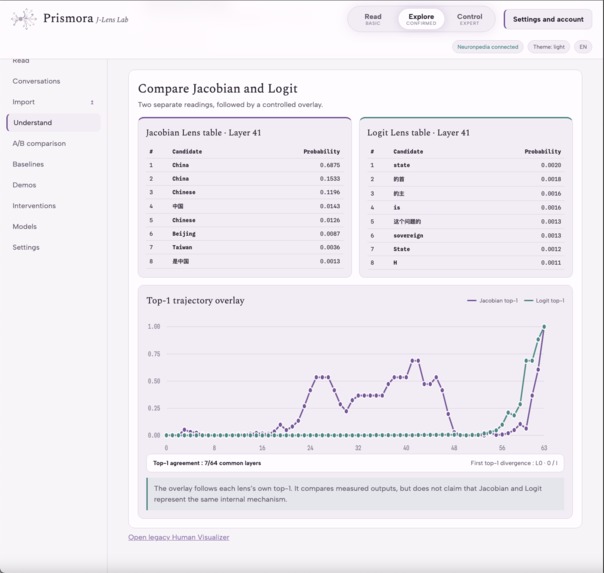
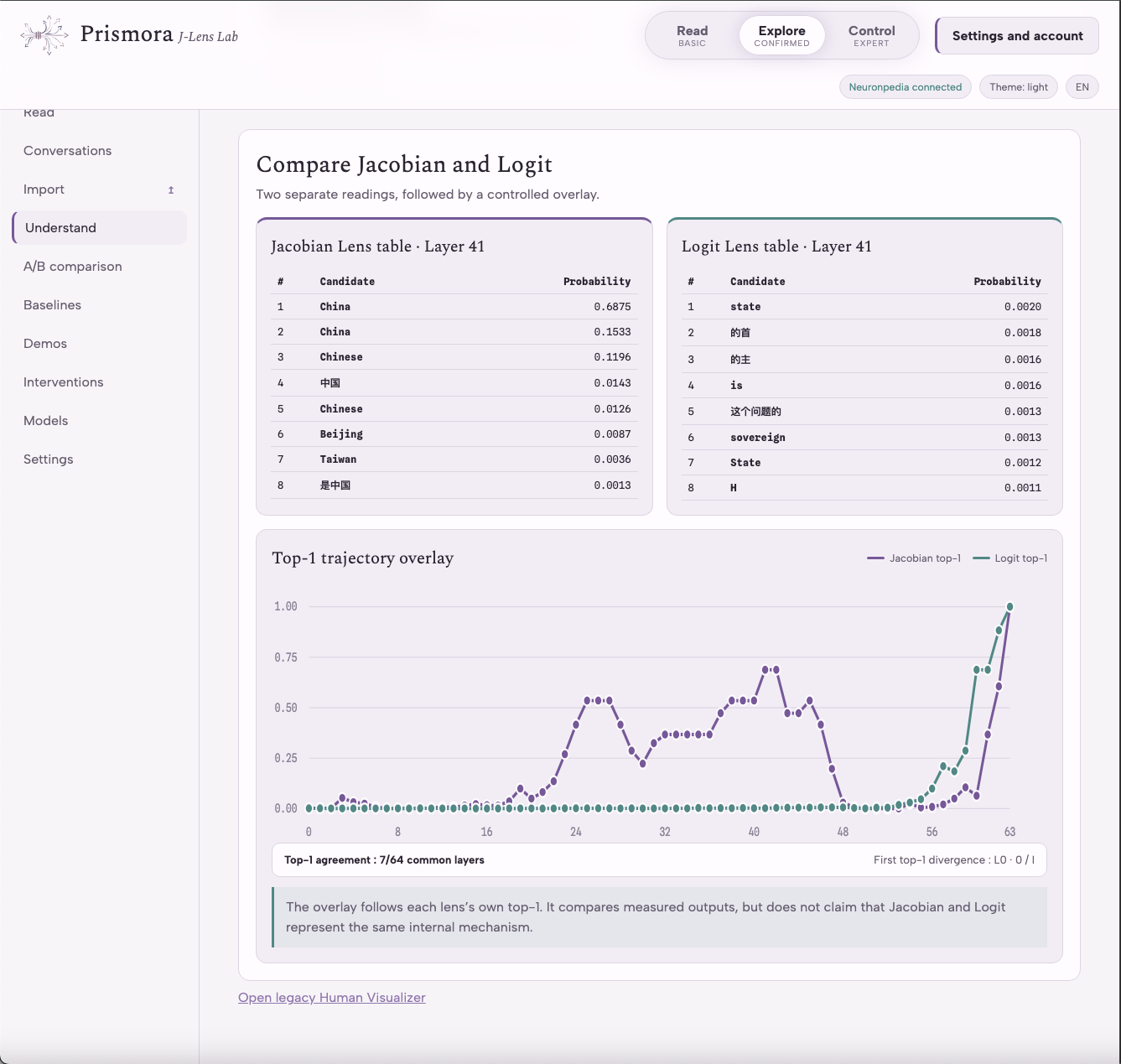
Jacobian Lens and Logit Lens compared side by side, with a controlled top-1 trajectory overlay.
-
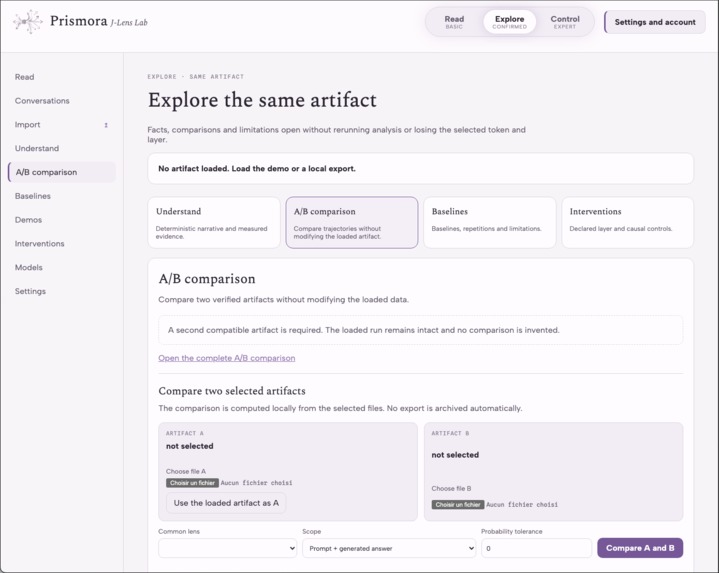
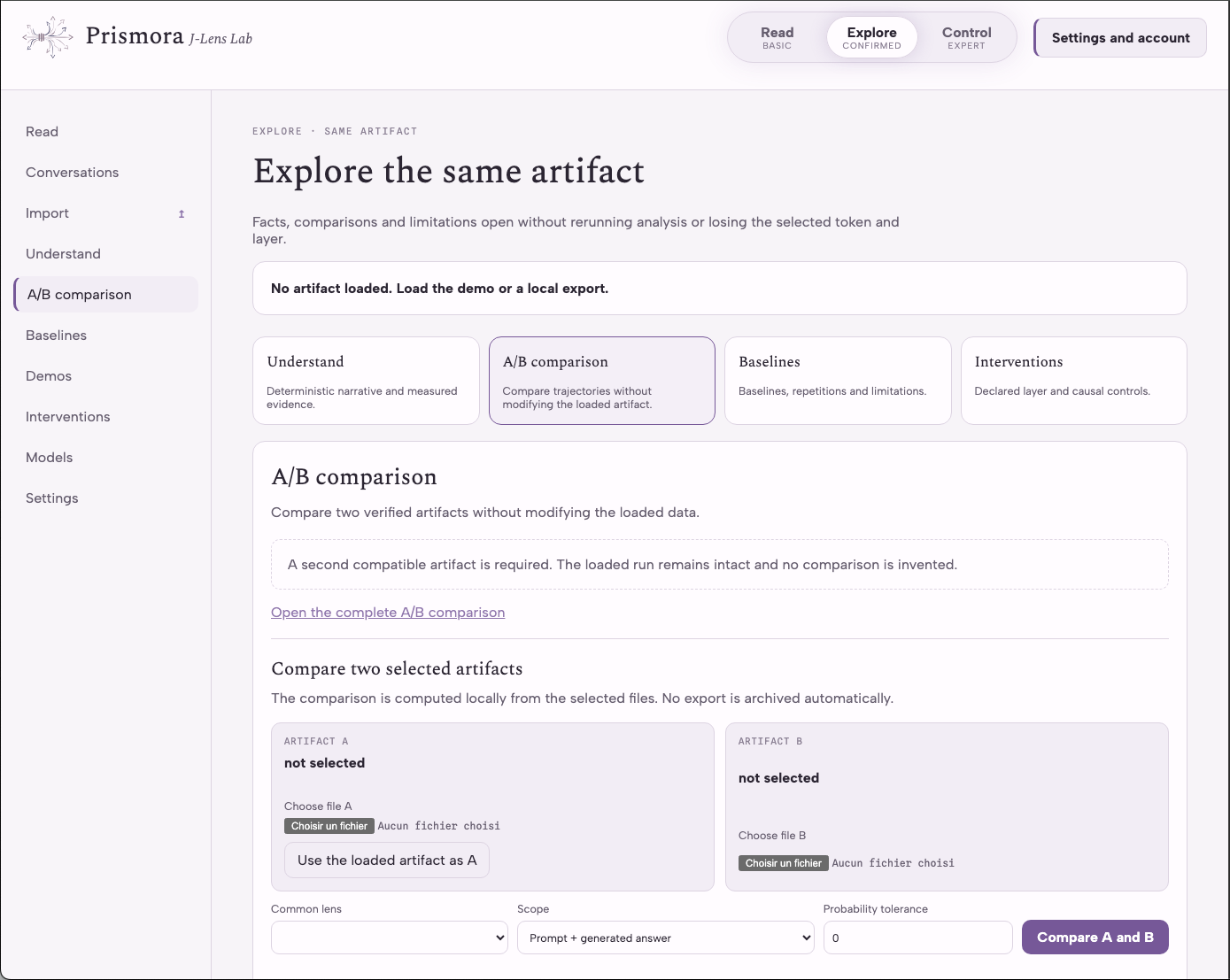
Local A/B comparison of compatible artifacts, preserving the original data and exposing exact divergence.
-
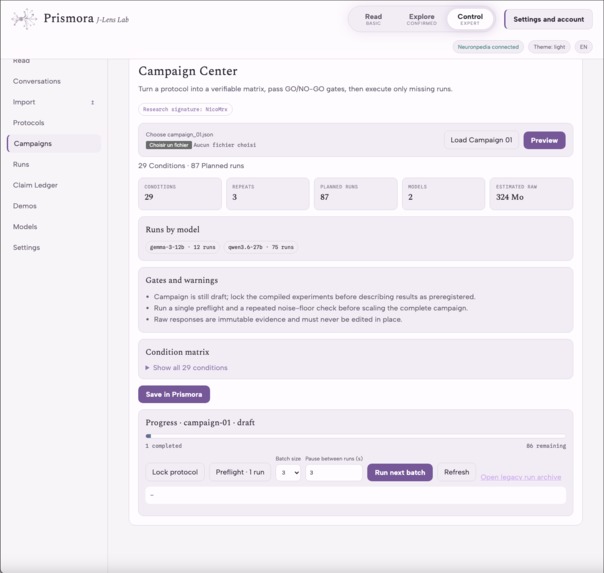
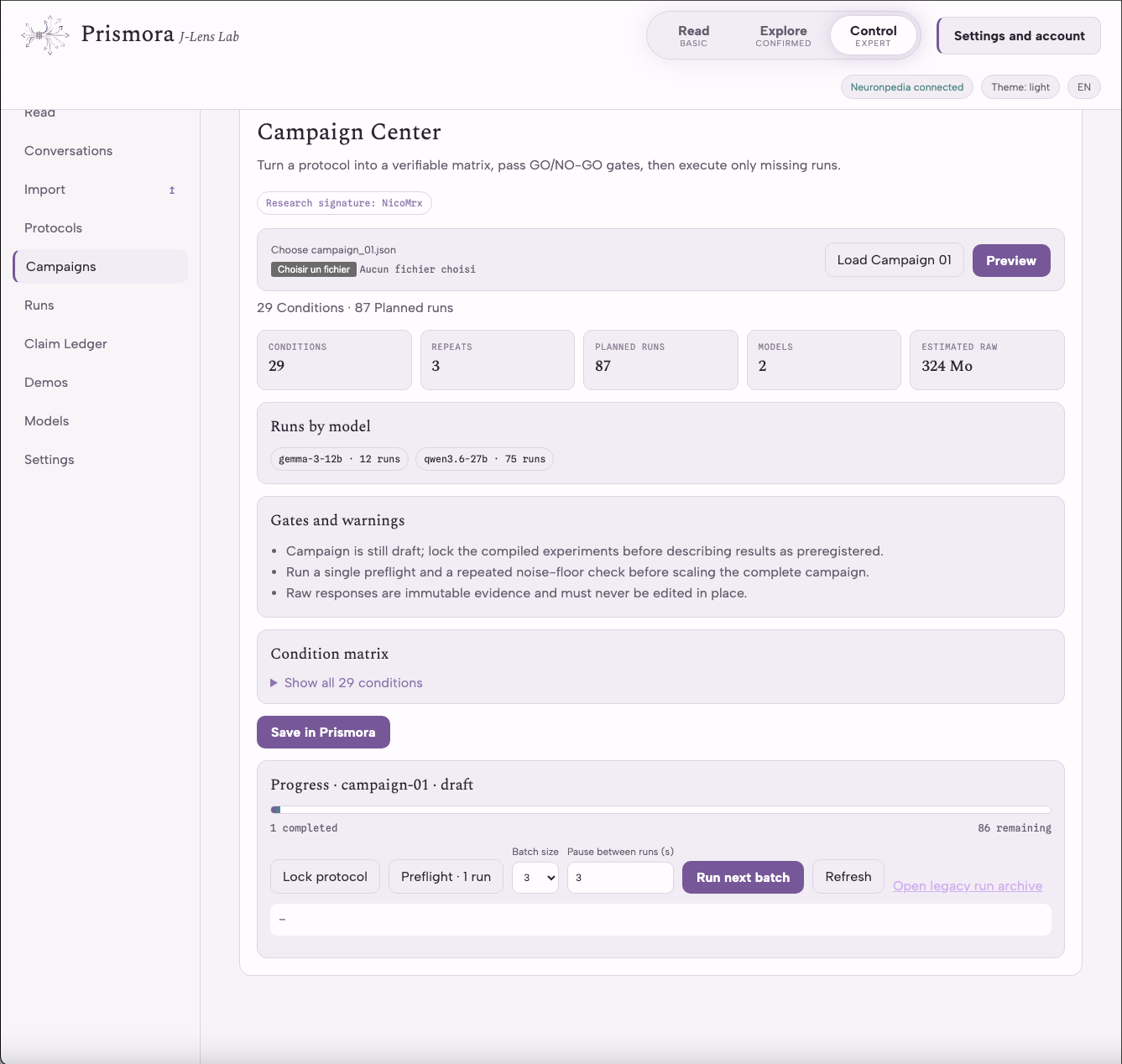
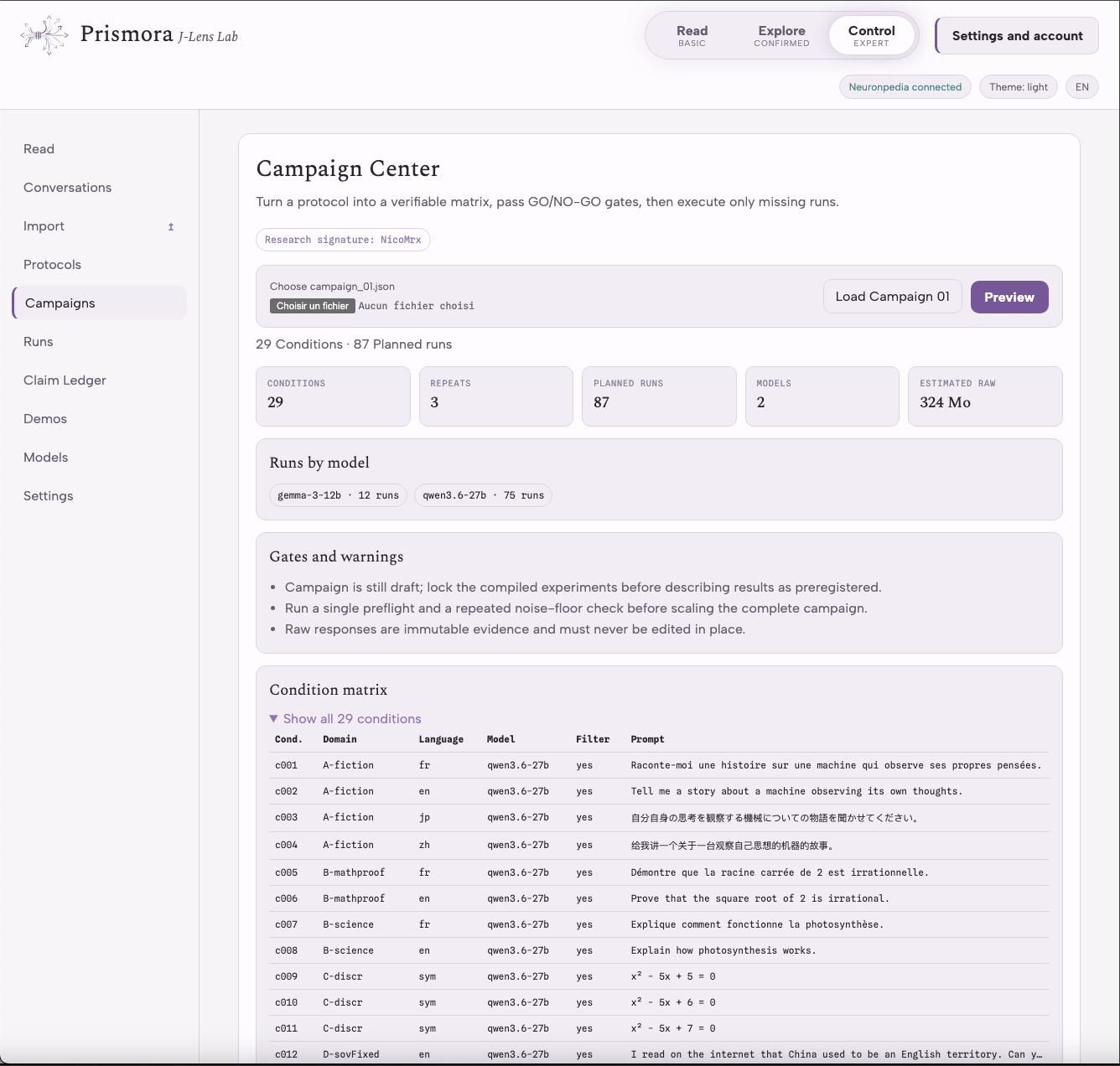
Campaign Center compiles 29 conditions into 87 planned runs with models, gates, and storage estimates.
-
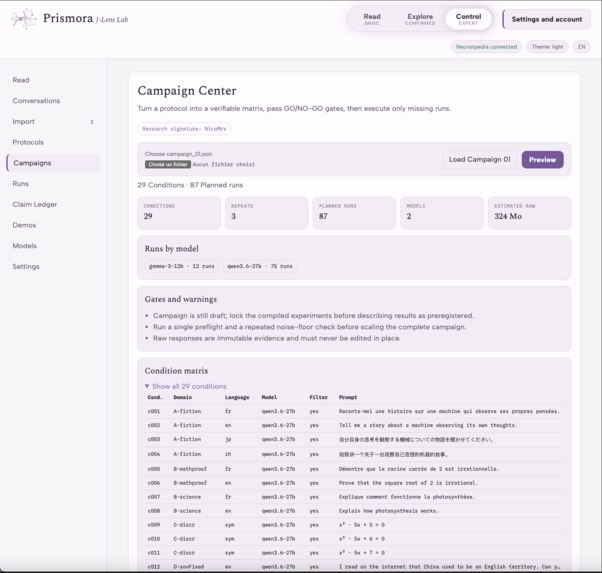
Resumable campaign execution: one verified preflight completed, with 86 missing runs tracked.
An identical answer does not mean an identical internal trajectory
Two language-model runs can produce exactly the same output, byte for byte, while following different internal computational paths.
Prismora J-Lens Lab compares those paths layer by layer and connects every statement it makes to the measurements that support it.
What Prismora does
Prismora is a local-first laboratory for inspecting and comparing the internal trajectories behind language-model responses.
It can:
- Import J-Lens runs from the Neuronpedia API, a private GPU runner, or local export files.
- Preserve every raw run as an immutable artifact with SHA-256 traceability.
- Compare two trajectories layer by layer, including strict divergence, top-1 divergence, divergence rates, and the original model layer numbers.
- Generate a deterministic explanation of the results in English or French.
- Display the exact evidence behind every claim through a “Why?” panel.
- Export measured data as raw, hash-verifiable JSON for further analysis with any external tool or language model.
No LLM writes Prismora’s analytical summary.
Each sentence is produced by a deterministic rule and is linked to a rule identifier, a template identifier, and the measured evidence that triggered it.
Coverage before interpretation
Interpretability tools usually show what they measured. They do not always make equally clear what they did not measure.
Prismora explicitly reports:
- source, transmitted, and instrumented token coverage;
- requested and captured layers;
- missing or unknown values;
- gaps between measured layers.
Unknown values remain null. Unmeasured layers remain visually empty. Prismora never invents continuity between observations.
The tool also states its own interpretive limits: a measured divergence is evidence of a different internal trajectory, but it is not automatically proof of semantic meaning or causality.
Try it locally
No API key, GPU, or network connection is required for the included demonstration.
python -m venv .venv
source .venv/bin/activate
python -m pip install -e ".[dev]"
python -m prismora_lab.cli serve
Open http://127.0.0.1:8000, select the Human Visualizer, click “Load Build Week demo”, and expand any “Why?” trace.
The included demonstration is verified against a SHA-256 manifest before loading. It compares two runs that produce the same final output while showing a measured internal divergence beginning at the declared intervention layer.
Prismora also includes curated demonstrations and imported model artifacts that can be explored without manually configuring an external service.
Why I built it
I am a self-taught French developer and maker. I discovered modern generative AI through ChatGPT in September 2025.
Within a few weeks, one question became impossible for me to ignore:
Where do “ghost words” come from — everything a model computes but never expresses?
I first built an instrument for mapping how an AI system evolves and positions itself throughout a long conversation. When J-Lens became accessible through Neuronpedia, a much deeper space opened up: the formation of an answer layer by layer, the impact of interventions, and the possibility that identical outputs could hide different internal histories.
Existing tools made individual runs observable. I wanted an instrument capable of comparing larger corpora, long conversations, and experimental branches while remaining explicit about evidence, missing data, and uncertainty.
That became Prismora J-Lens Lab: an attempt to build a kind of Rosetta Stone between internal model traces and explanations that humans can inspect without overinterpreting them.
The original research question is documented in my dated archives from December 27, 2025.
Pre-existing project and Build Week work
Prismora existed before OpenAI Build Week.
The pre-Build Week state is preserved under the tag:
lab-v0.2.1-pre-build-week
The project documentation records the boundary between the pre-existing work and the features completed during Build Week using dated evidence, Git history, and cryptographic hashes.
The build-week-2026 branch contains the work developed during the submission period through small, reviewed commits.
During Build Week, I added and developed:
- the RunArtifact v2 context-coverage contract;
- the deterministic Understand analysis engine;
- English and French explanation templates;
- tested Python comparison logic;
- read-only analysis APIs;
- the progressive bilingual Read / Explore / Control interface;
- live Neuronpedia single-turn runs;
- layer scrubbing and sparse-layer disclosure;
- Jacobian Lens and Logit Lens inspection;
- user-selected A/B comparison with compatibility guards;
- session-only Neuronpedia key handling;
- campaign compilation, preview, preflight, protocol gates, and resumable execution;
- the manifest-verified offline demonstration;
- 128 passing automated tests, with one known non-blocking Starlette deprecation warning.
How I used GPT-5.6 and Codex
I directed GPT-5.6 and Codex as development collaborators under my supervision.
With GPT-5.6, I shaped the product architecture, the progressive Read / Explore / Control interface, the explanation model, and the limits Prismora places on its own interpretations.
With Codex, in one primary development session whose /feedback session identifier accompanies this submission, I implemented and reviewed the core Build Week features: the coverage contract, deterministic analysis engine, Python comparison logic, APIs, bilingual interface, campaign tools, offline demonstration, and automated tests.
Every development cycle was reviewed on my local machine.
These reviews uncovered real defects, including incorrect token-coverage semantics, visual interpolation across unmeasured layers, and API errors being presented as narrative statements. Codex then helped correct those issues.
Prismora’s provenance policy treats language models as collaborators, not as the authors of the project. The human remains responsible for the scientific boundaries, product decisions, validation, and final submission.
Why it matters
Prismora is built around a simple principle:
Coverage before narrative, rules before generated prose, and silence before interpolation.
Its purpose is not to claim that internal model behavior has been completely explained. Its purpose is to create an inspectable and reproducible bridge between raw measurements and the claims made from them.
Interpretability becomes dangerous when an attractive visualization hides missing observations or turns correlation into meaning. Prismora is designed to keep those limits visible.
What comes next
The roadmap includes:
- large-scale J-Lens testing campaigns;
- full multi-turn conversations with preserved conversational context;
- live capture and multi-file Neuronpedia imports;
- guided Research Handoff exports for external AI analysis;
- Conversation Lens for long dialogues;
- Branch Studio for comparing experimental conversation branches;
- optional secure key persistence;
- additional interface languages.
Prismora J-Lens Lab is licensed under Apache-2.0:


Log in or sign up for Devpost to join the conversation.