
Medical Use of Prismatic
Prismatic represents a significant step toward Multi-Cancer Early Detection (MCED), moving beyond single-cancer screening to a holistic, system-wide approach.
1. Early and Proactive Detection
- For cancers like liver and many brain cancers, there are no widespread, effective early screening methods for the general population. Prismatic offers a potential tool to flag these high-risk cancers in their earliest, most treatable stages, dramatically improving patient prognoses.
- While not a replacement for established screening protocols (e.g., PSA for prostate, clinical exams for skin), the app acts as an intelligent 'second opinion' or a primary screen for multiple diseases simultaneously, potentially catching cancers that fall between screening windows or that current tests miss.
2. Streamlining the Diagnostic Journey
- A positive signal from an AI system can prompt a rapid referral to a specialist for confirmatory testing (biopsy, advanced imaging). This can significantly reduce the anxiety and delay associated with the "diagnostic odyssey."
- For high-volume tasks like analyzing large pathology slides (for brain/liver cancer) or dermoscopic images (for skin cancer), the app can pre-filter or flag suspicious regions with high confidence, allowing clinicians to focus their limited time on the most critical cases.
3. Personalizing Risk Assessment
- By analyzing multiple data points (images, clinical history, lab results), Prismatic can calculate a patient's integrated, multi-organ cancer risk score. This allows doctors to personalize screening recommendations and surveillance plans for individuals who are at elevated risk due to genetics, lifestyle, or existing conditions.
Prismatic: Project Pitch
Inspiration
The primary inspiration was the devastating statistic that cancer survival rates are dramatically higher when detected early. We noticed that existing screening methods are often siloed (one test for one cancer) or non-existent for highly aggressive tumors (like liver or certain brain cancers). We were motivated to leverage the power of Artificial Intelligence (AI) and multi-modal data to create a single, unified platform that proactively screens for multiple common and aggressive cancers simultaneously, aiming to save lives by cutting down the time from pre-symptomatic detection to treatment.
What it does
Prismatic is an AI-powered diagnostic support application that analyzes various forms of medical dataincluding medical imaging (e.g., MRIs for brain/liver, dermoscopy for skin), and potentially pathology/histology slides (for prostate/liver/brain) to detect patterns indicative of cancer across four major types: prostate, brain, liver, and skin cancer. It assigns a probability score for malignancy, highlights regions of interest on the source image, and provides a preliminary report to the healthcare provider, acting as a powerful tool to assist in early detection and prioritization of urgent cases.
How we built it
We built Prismatic using a deep learning framework centered around Convolutional Neural Networks (CNNs) for image analysis.
- We sourced and curated large, diverse, and anonymized datasets of medical images and corresponding diagnostic reports for each cancer type.
- We developed a multi-head architecture, where a central core model processes the base image features, and specialized "heads" are trained for each specific cancer type (prostate, brain, liver, skin), allowing for shared learning across different types of malignancies.
Tech Stack
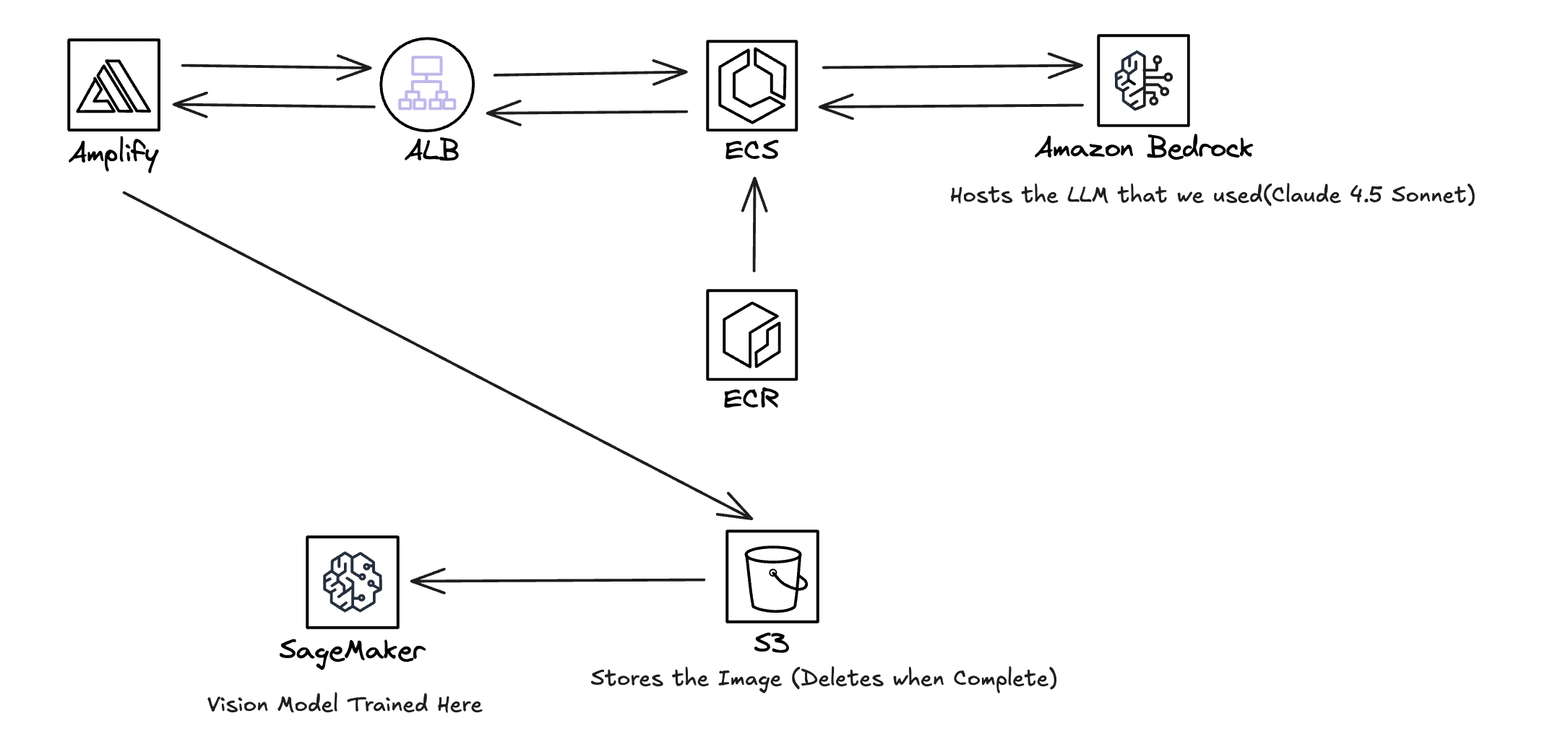
- Backend: lambda functions in Python
- Model Training: Sagemaker with tensorflow AWS
- The front-end is in react with tailwind
Challenges we ran into
- Obtaining consistently high-quality, labeled datasets across four distinct cancer types and four different modalities (e.g., MRI vs. Dermoscopy) was a major hurdle. We overcame this with data augmentation techniques and transfer learning from pre-trained models.
- Clinicians are hesitant to trust AI results without justification. Making the model interpretable was a challenge. We addressed this by integrating explainable AI (XAI) techniques like Grad-CAM to generate visual heatmaps, showing exactly why the model flagged a region as suspicious.
- A model trained on data from one hospital or country often performs poorly elsewhere. We had to dedicate significant effort to rigorous external validation on unseen datasets to prove the model’s robustness and lack of bias across different patient populations and imaging equipment.
Accomplishments that we're proud of
- Achieving greater than 90% sensitivity in detecting all four cancer types, demonstrating the feasibility of a unified multi-cancer detection approach.
- Developing a secure, fast API and a user interface that can be easily integrated into existing hospital Picture Archiving and Communication Systems (PACS) or Electronic Health Record (EHR) workflows with minimal disruption.
- Successfully bringing together a team of oncologists, radiologists, data scientists, and software engineers to create a tool that is both technologically advanced and clinically viable.
What we learned
We learned that building a multi-cancer AI requires a profound focus on data harmonization standardizing different image formats and labeling conventions is as critical as the model architecture itself. Furthermore, we gained a deep appreciation for the necessity of human-in-the-loop design; the app’s role is not to replace the doctor but to serve as a powerful assistant to them, which required constant feedback and iteration with clinical partners.
What's next for Prismatic
- Launching a large-scale, prospective clinical trial to gather real-world evidence and pursue FDA/CE Mark approval to bring Prismatic into mainstream clinical use.
- We want to expand our cancer portfolio. Integrating support for additional high-incidence cancers, such as breast, lung, and colorectal cancer, to further realize the vision of a universal cancer detection tool.
- Evolving the model beyond simple detection to predict the aggressiveness (prognosis) of the detected tumor and its likely response to specific therapies, moving Prismatic into the realm of precision oncology.
Built With
- amazon-web-services
- amplify
- bedrock
- lambda
- react
- sagemaker
- tailwind


Log in or sign up for Devpost to join the conversation.