Inspiration
Research papers contain valuable knowledge, but they can be difficult to approach, especially for students and people outside academia.
We wanted to make the first step easier by helping people understand the main ideas of a paper before they become overwhelmed by its length and technical language.
What it does
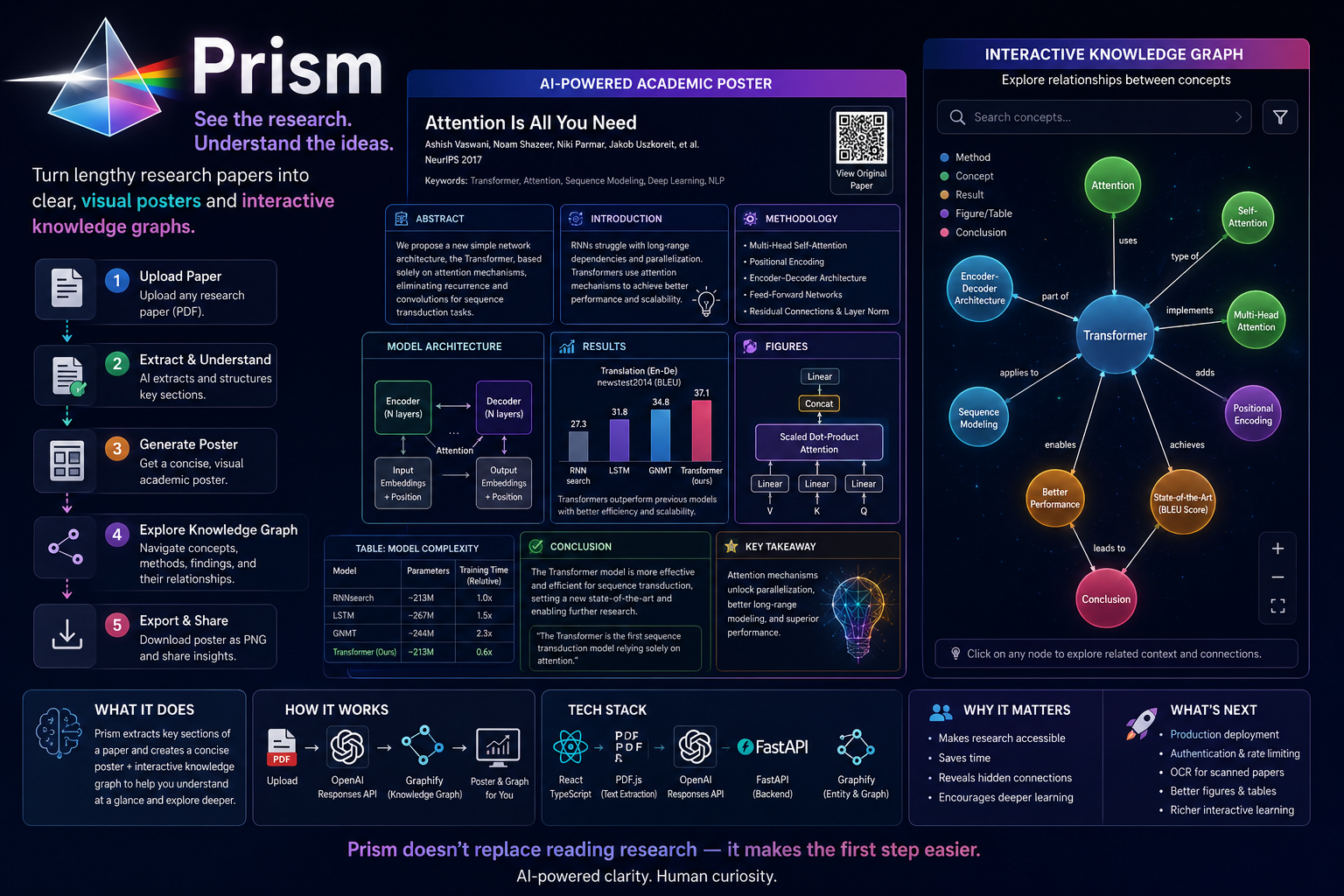
Prism transforms research papers into concise, interactive academic posters.
It extracts the key sections of a paper—including the abstract, introduction, methodology, results, figures, tables, keywords, and conclusion—and presents them in a clear, visual format.
Prism also generates an interactive knowledge graph that represents the paper as connected concepts. Users can explore methods, findings, figures, and conclusions by navigating the relationships between them.
How we built it
Prism is built with a React and TypeScript frontend that uses PDF.js to extract text from uploaded research papers.
The OpenAI Responses API converts the extracted content into structured poster sections and concise summaries.
Users can export the generated poster as a PNG.
A FastAPI backend uses Graphify to extract entities, build relationships, detect communities, and generate the knowledge graph.
The graph is rendered with an interactive node-based visualization that supports searching, filtering, selecting, and exploring connections.
Challenges we ran into
Our biggest challenge was keeping the generated content concise without losing the meaning of the original paper.
We spent significant time refining prompts, limiting overly long summaries, handling graph-generation failures, and ensuring the poster generation and knowledge graph worked together reliably.
Accomplishments that we're proud of
Prism transforms lengthy research papers into visual experiences that learners can understand at a glance.
The interactive knowledge graph adds another layer of exploration by helping users discover relationships that are easy to miss when reading a paper section by section.
We're also proud that Prism keeps the original paper as the source of truth while using AI to make research more accessible and engaging.
What we learned
We learned that effective AI isn't about generating more text—it's about selecting the right information, presenting it clearly, and helping users verify and explore it.
We also discovered that visual relationships often make complex research easier to understand than summaries alone.
What's next for Prism
Our next step is preparing Prism for production deployment.
We'll improve the API layer, authentication, rate limiting, file processing, and job handling to support multiple users reliably.
We also plan to add OCR support for scanned papers, improve the representation of original figures and tables, and expand the interactive learning experience with richer visualizations.
Built With
- api
- gpt
- graphify
- typescript


Log in or sign up for Devpost to join the conversation.