Inspiration
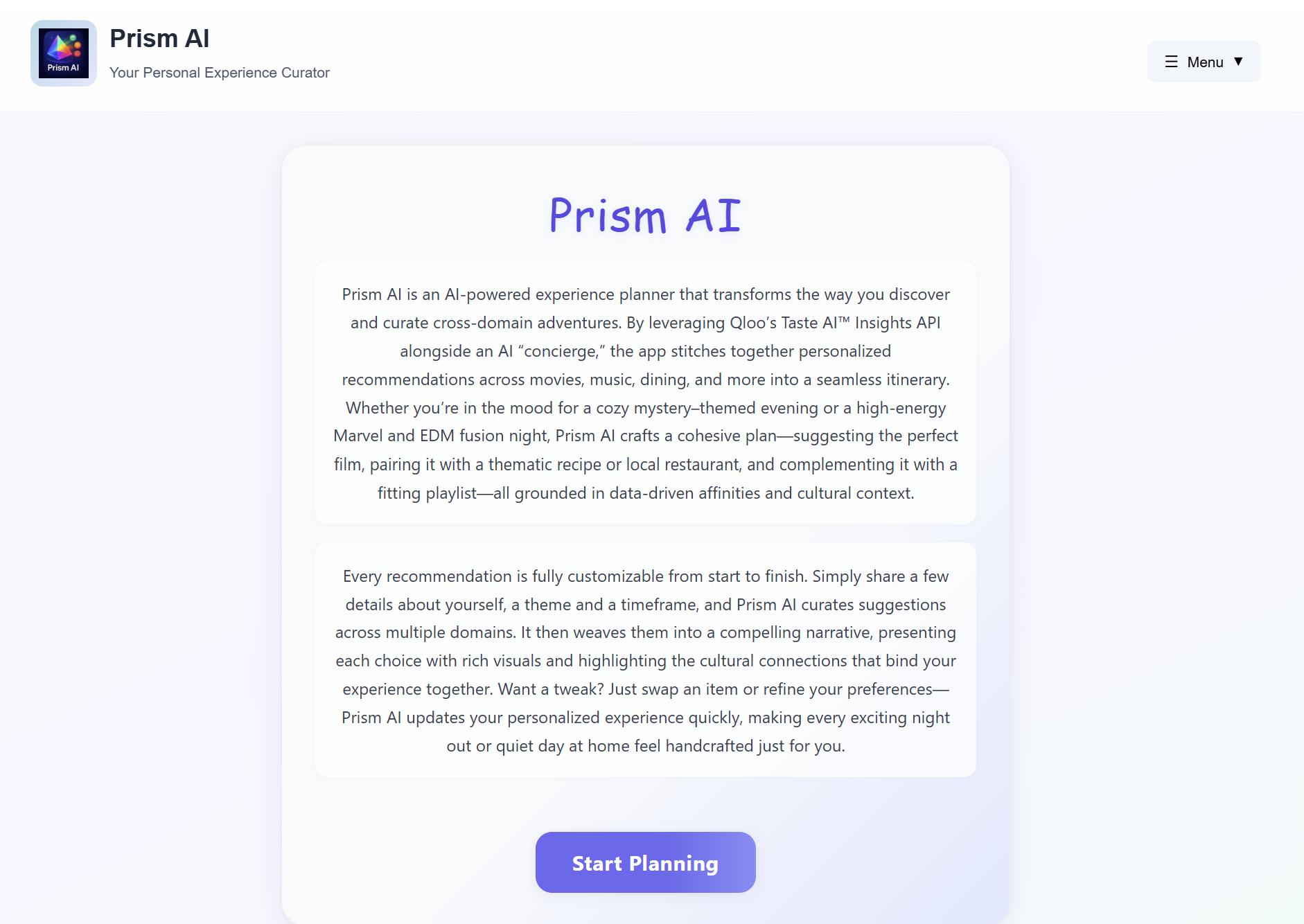
We love tools that make “What should we do tonight?” effortless. But most recommendation engines only solve one slice of life—pick a movie, find a restaurant, choose a playlist. When we discovered how Qloo’s Taste AI bridges domains (film → food → music → travel), we imagined a true cultural concierge that stitches everything together. Add an LLM’s knack for both creating structure from natural language and for creating narrative from structured inputs, and Prism AI was born: an app that translates any vibe into a ready-to-go experience.
What it does
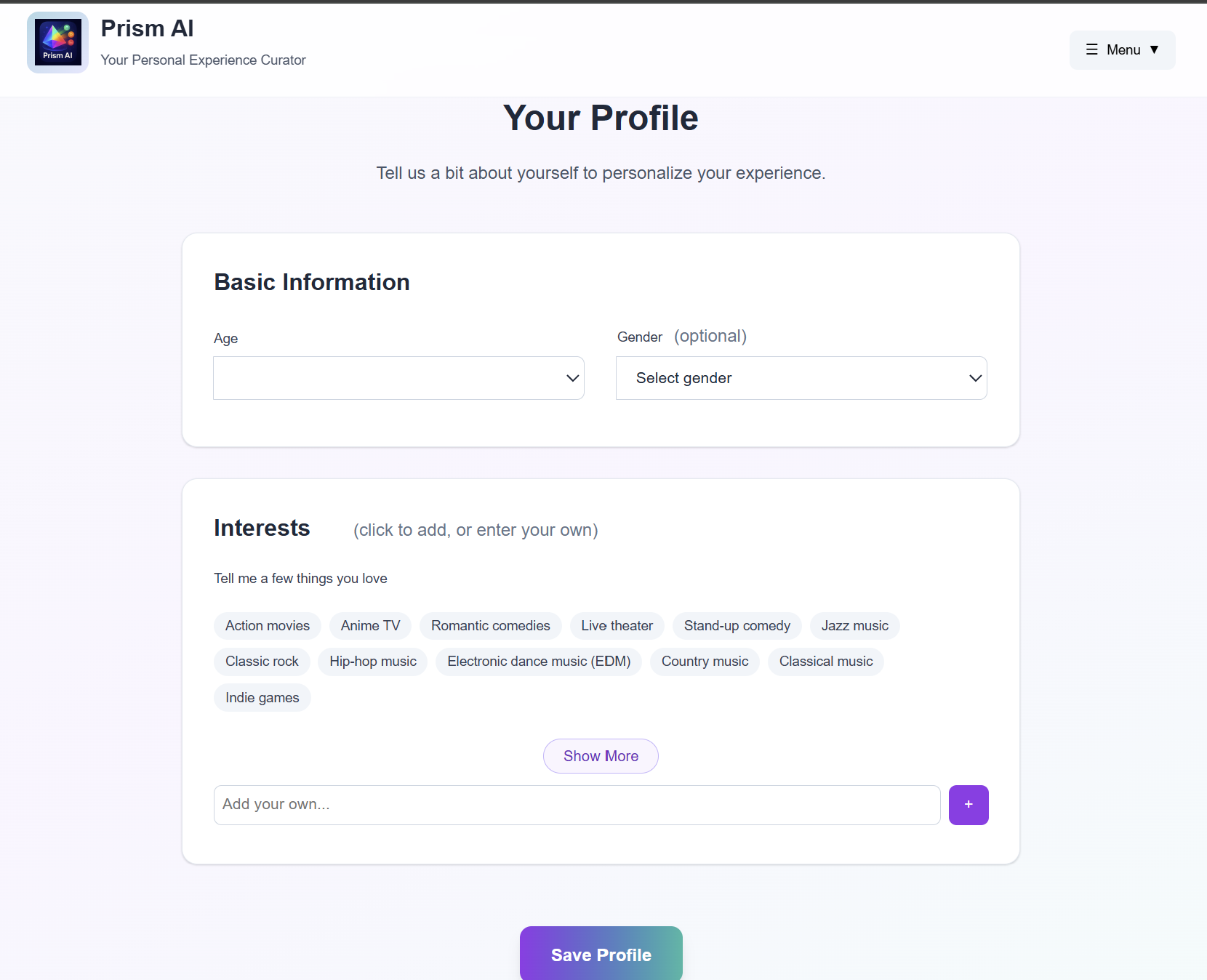
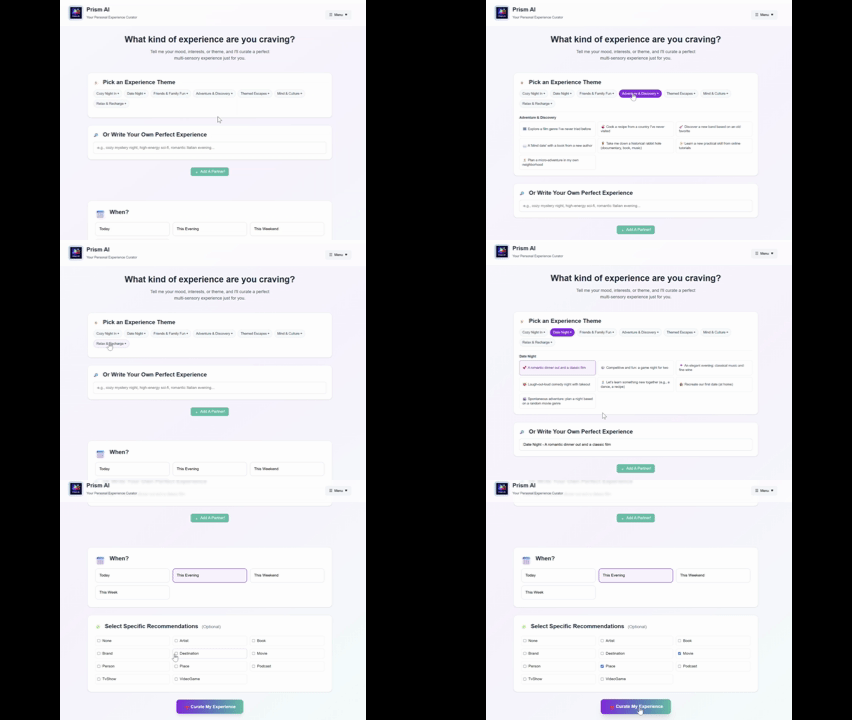
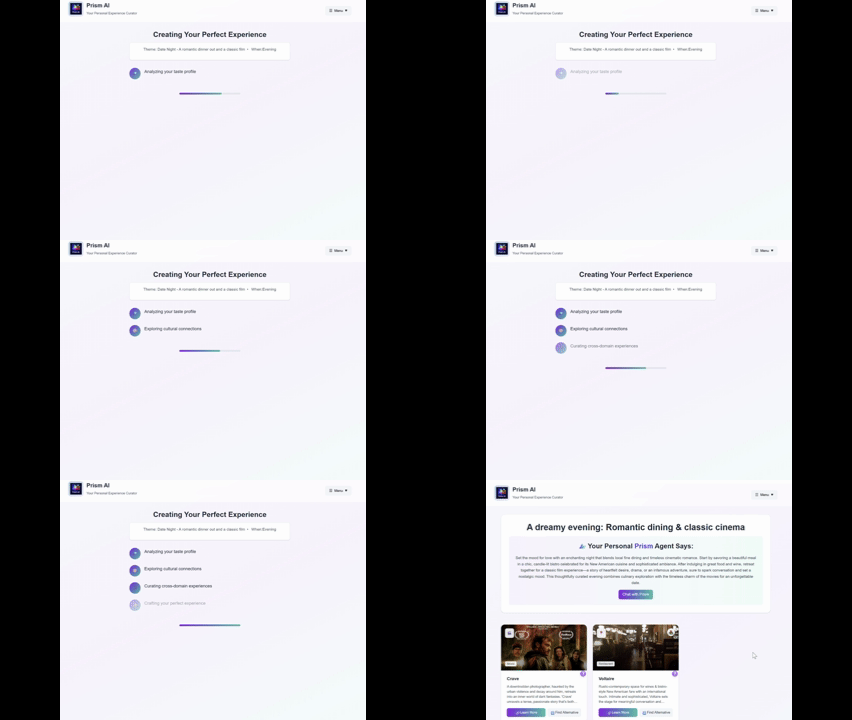
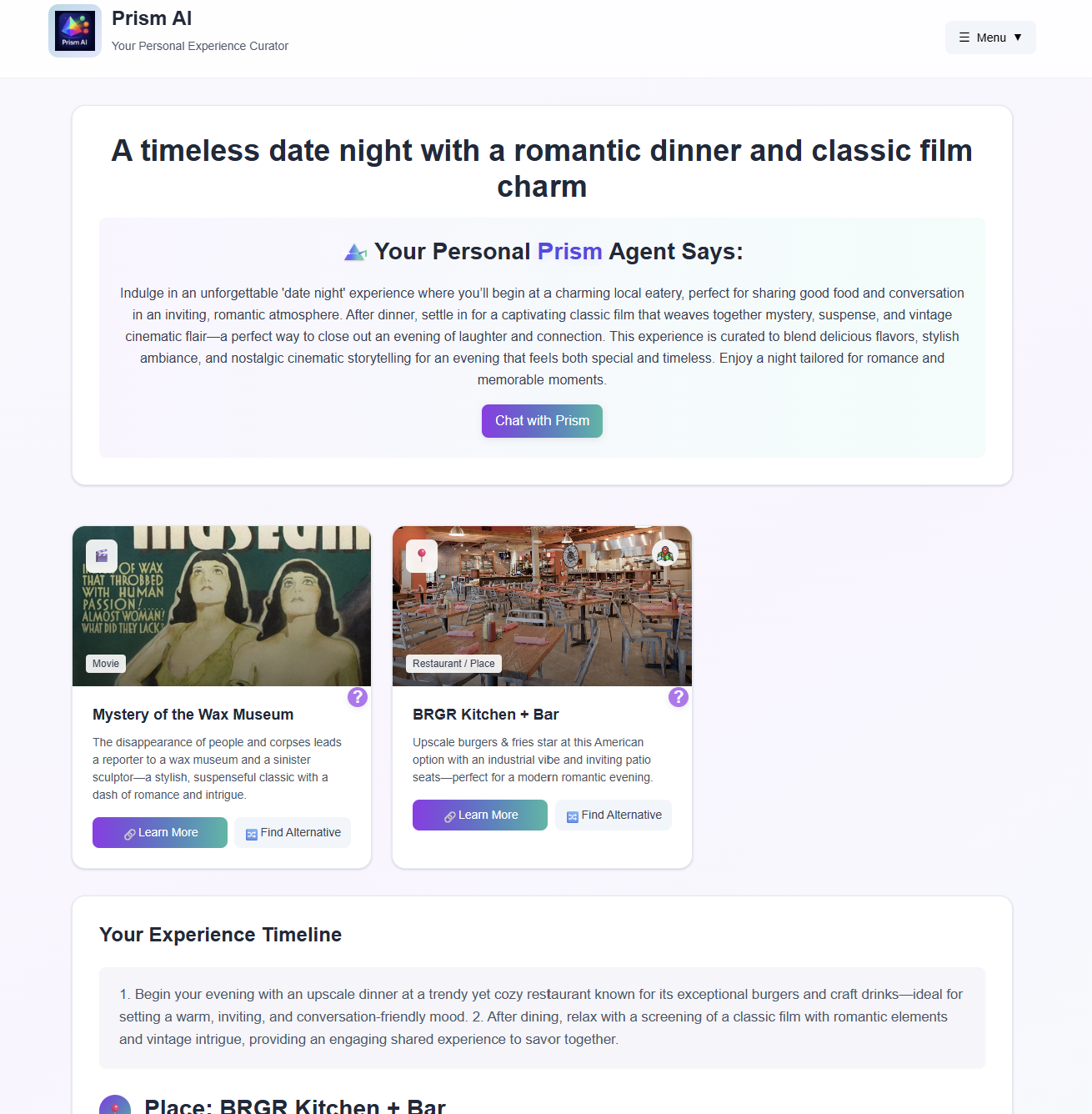
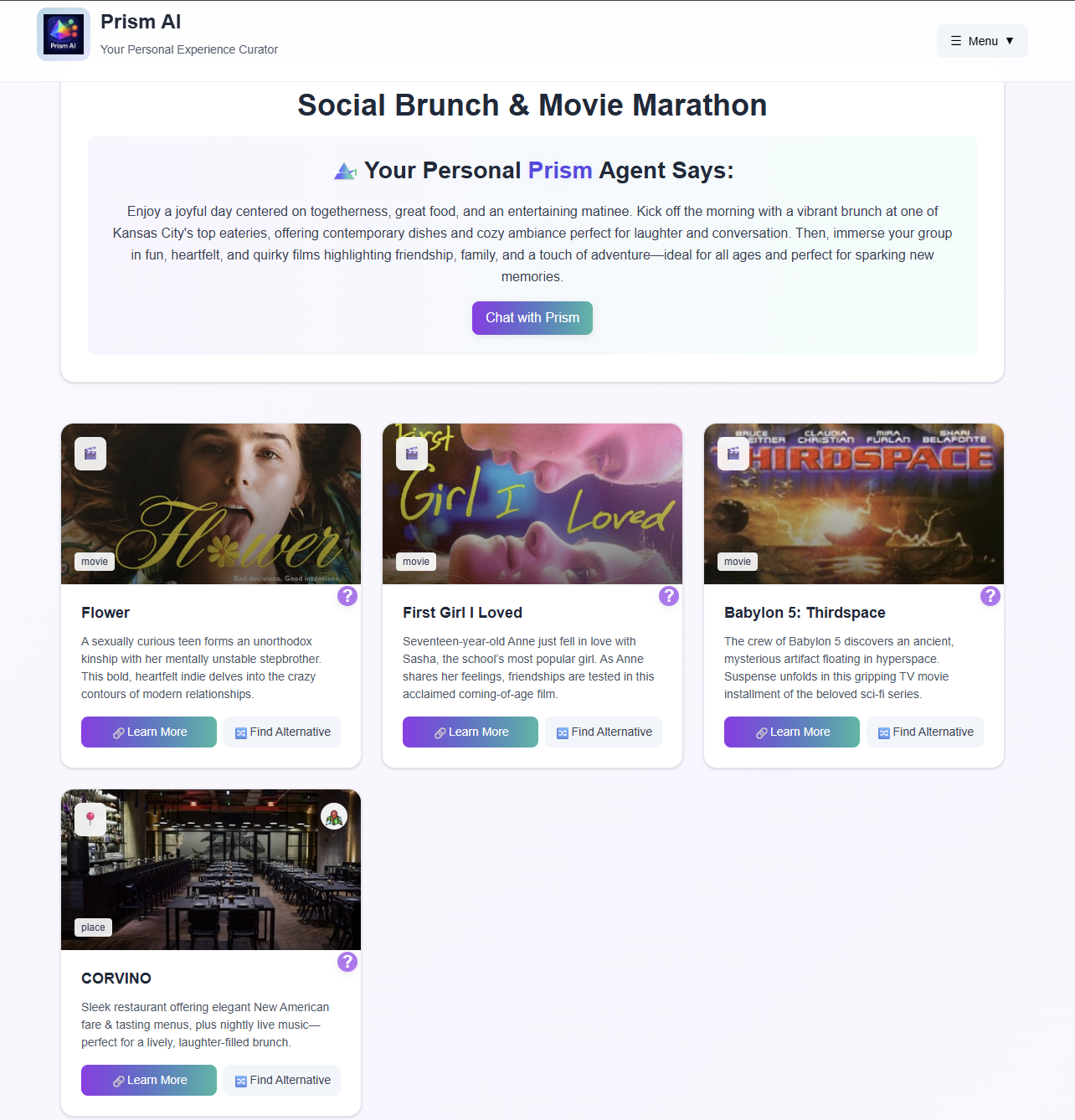
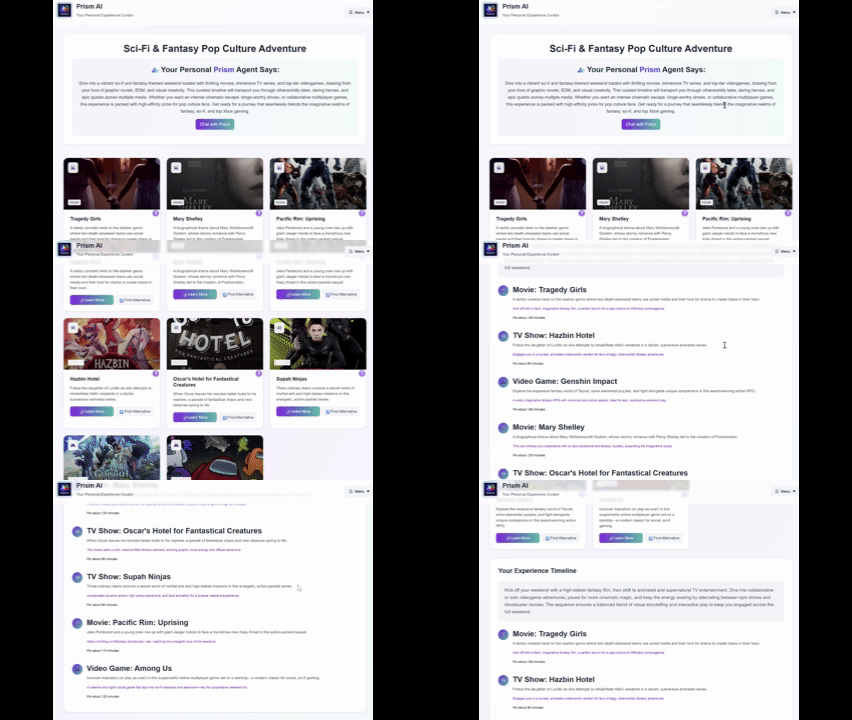
Prism AI turns any theme, mood, or “I-feel-like…” prompt into a fully-fledged, cross-domain experience in seconds. Powered by Qloo’s Taste AI and an LLM that is profile-aware, it aligns a user’s age, gender, and saved interests with the hidden affinities Qloo uncovers, then assembles a cohesive set of recommendations—movies, music, food, destinations, activities, and more—presented on an interactive dashboard. Whether someone wants an “Urban Family Exploration” weekend or an “Ultimate Science-Fiction Watchathon”, Prism AI hand-picks items that naturally belong together, explains why they fit, and lets the user swap any card for instant alternatives.
Key features & functionality
| Area | Highlights |
|---|---|
| LLM-Driven Qloo Orchestration | The LLM both generates the appropriate multi-endpoint Qloo requests (tailoring parameters to the user’s profile) and interprets the complex responses into friendly, theme-coherent cards—essential for wrangling Qloo’s flexible but intricate API at scale. |
| Cross-Domain Curation | Fetches high-affinity picks in multiple categories (movie, restaurant, playlist, activity, etc.) from Qloo in parallel, proving the API’s unique multi-domain reach. |
| Free-Form or Quick Themes | Users may type any theme (“cozy mystery-movie night”) or tap pre-made chips with popular options (divided by category) for speed. |
| Narrative Itinerary Assembly | The LLM stitches Qloo results into a contextual itinerary—complete with friendly explanations that cite taste links (“Jazz + diners are loved by mystery-film fans…”). |
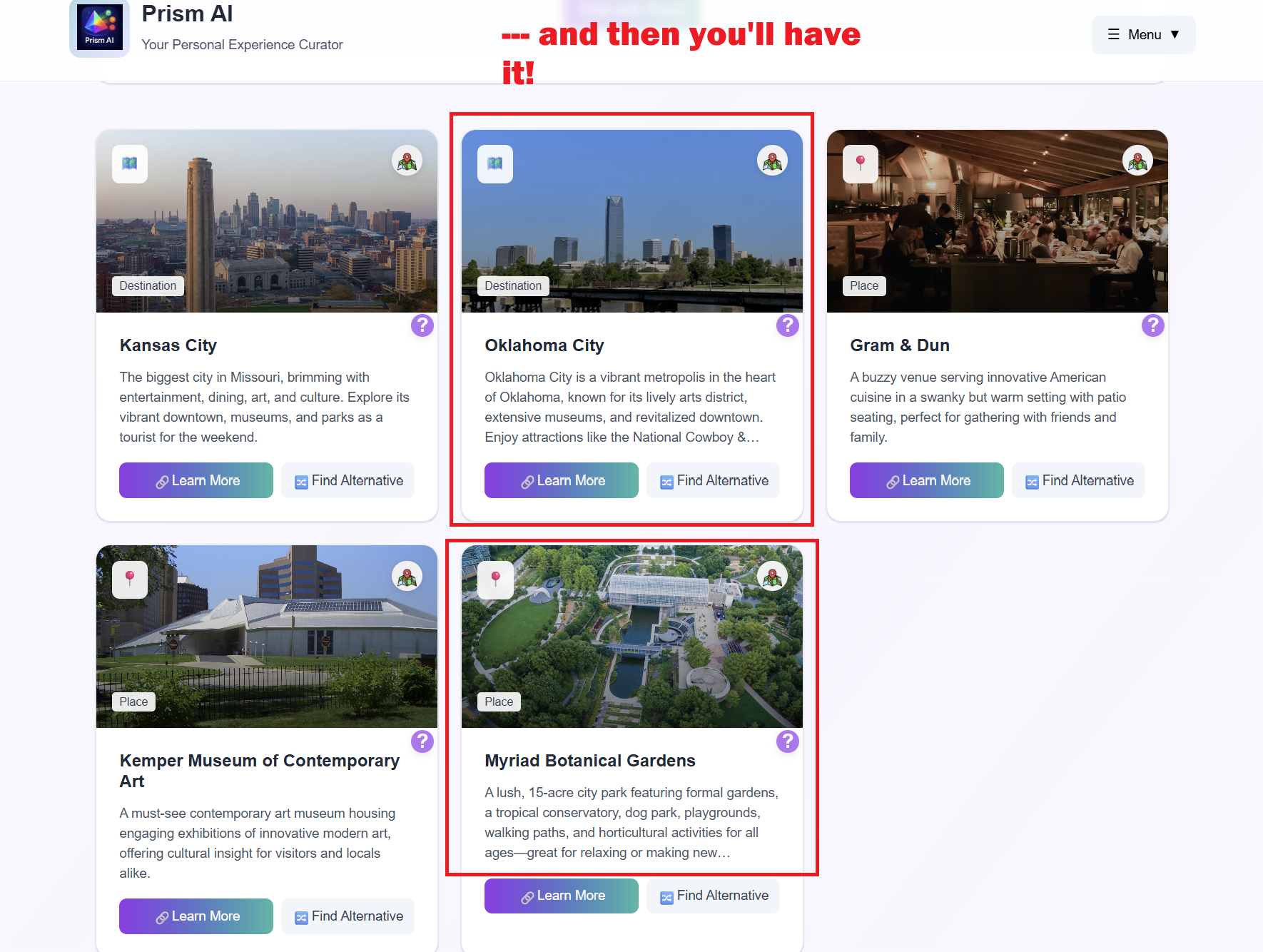
| Interactive Cards | Each recommendation appears as a card with an image, quick blurb, “Learn More,” and “Find Alternative” buttons so users can personalize on the fly. |
| Learn More Deep Dives | “Learn More” triggers LLM-guided web, YouTube, or Google Books searches (based on item type) and returns an annotated, citation-rich summary—so users can explore context without leaving Prism. |
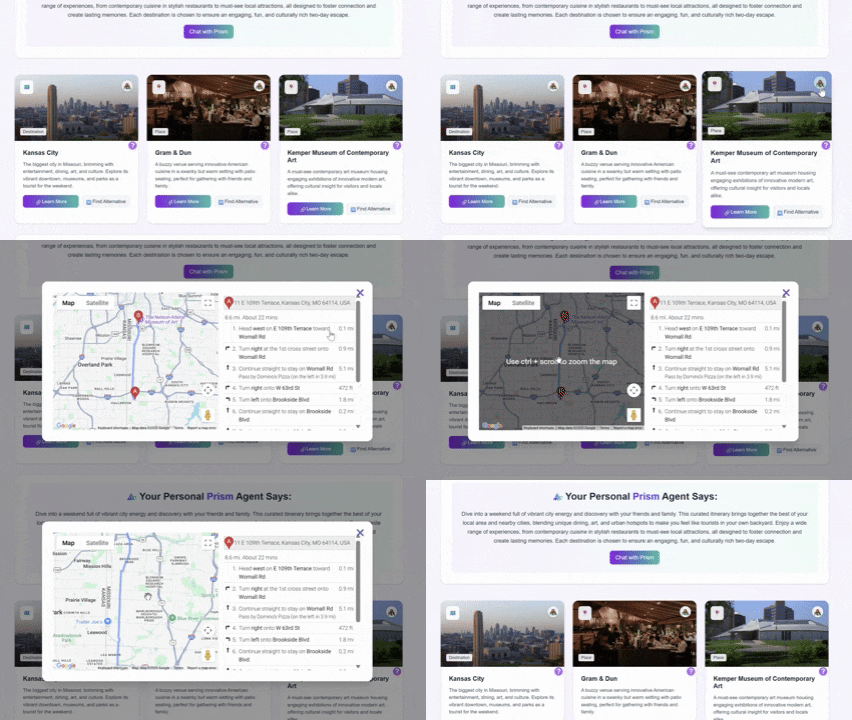
| Built-in Maps & Directions | For place and destination cards, a Google Maps overlay opens with one click, preloaded with live directions from the user’s current location. |
| Explain-Why Toggle | A subtle “?” icon expands a plain-language rationale grounded in Qloo affinity scores, boosting transparency and trust. |
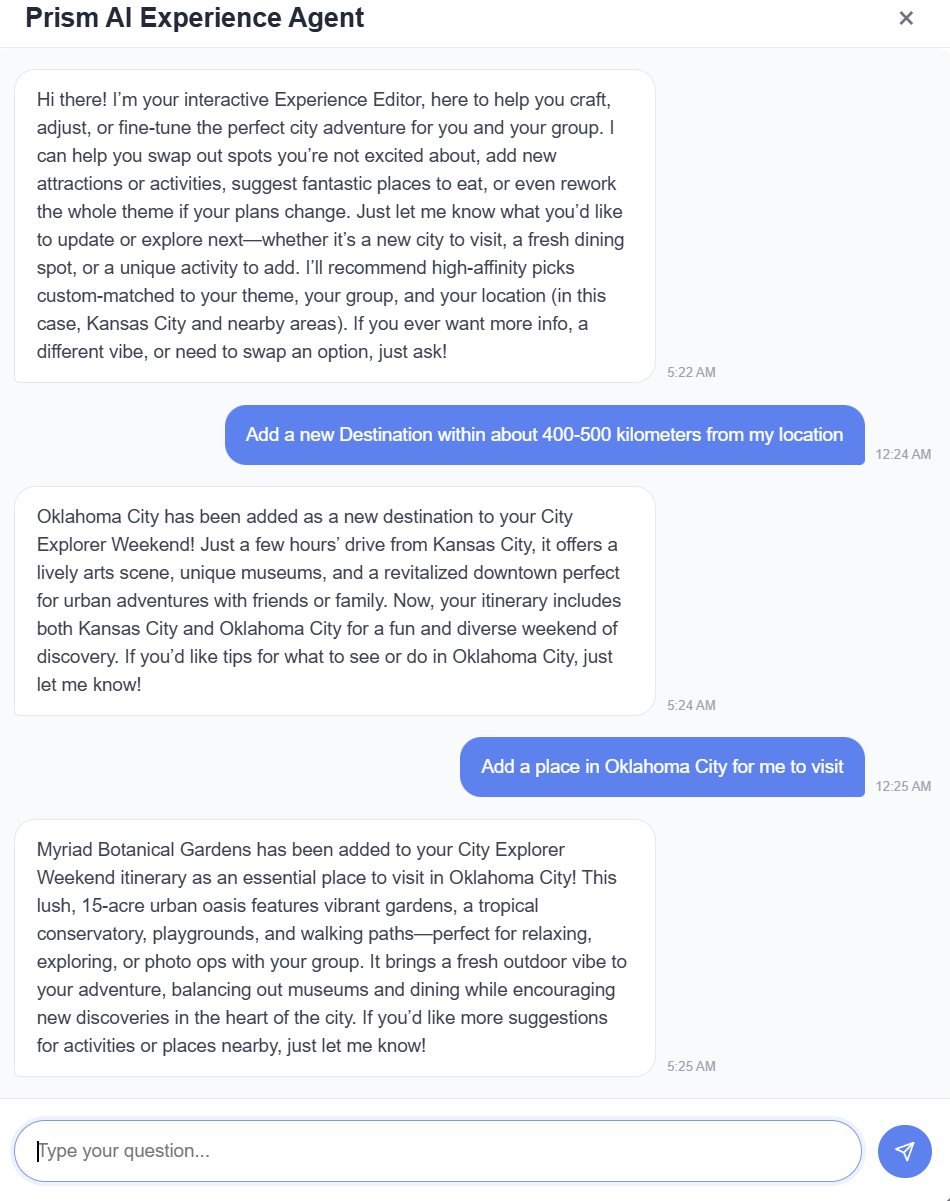
| Chat-with-Prism Agent | The same LLM powers a chat mode that can refine or extend the plan—e.g., “Make dinner vegetarian.” “Add something outdoorsy.” or “Extend the theme to the whole weekend.” |
| Privacy & Speed | Profile data stays local; anchor preferences and demographics are stored only in browser storage so returning visitors get faster suggestions without sharing personal info. |
Why it matters
Recommendation engines usually solve one domain. Prism AI demonstrates how an LLM-guided orchestration of Qloo’s cultural graph can elevate the experience from “choose a movie” to “design my whole evening,” making taste intelligence feel like a real-world concierge. By letting the LLM handle both sides—query crafting and response interpretation—it showcases a powerful pattern for harnessing complex, flexible APIs in user-centric products.
How we built it
- Stack: C# / Blazor Web App (Server + WASM) frontend, Semantic Kernel-driven LLM agents and OpenAI (primarily gpt-4.1) api.
- Profile-Aware Agent: The primary agent ingests age, gender, interests, theme, and timeframe, then generates multi-endpoint Qloo calls and assembles results into an itinerary.
- Created Qloo Taste AI Api Parameter Models: Modeled all parameters (Filters, Signals, Outputs) to create LLM friendly schemas for Tool Call parameters and Structured Outputs.
- Enrichment Agent: On “Learn More,” a second agent launches Web, YouTube, or Google Books searches and produces an annotated summary with inline citations.
- Maps Integration: For place/destination cards, we feed lat/lng into the Google Maps JavaScript API, auto-centering on the user’s geolocation with live directions.
- Local Storage & Return Visits: Anchor preferences and demographics live in browser storage, delivering instant recall with zero sign-up friction.
- UI Polish: A custom SVG icon set, a whole lot of custom css, dynamic chips for quick themes, and an explain-why toggle that reveals the Qloo affinity reasoning.
Challenges we ran into
- API Complexity: Qloo’s richness and flexibility meant dozens of optional parameters and near infinite parameter combinations. We iterated prompts so the LLM could decide when to add filters like
location,tagsoraudienceor signals liketagsordemographicsautomatically. - Latency vs. Quality: Calling multiple endpoints per domain risked slow responses. We parallelized requests and cached common anchors to keep the experience snappy.
Accomplishments that we're proud of
- End-to-End LLM Orchestration: A single prompt pipeline drives both Qloo query generation and response interpretation—very little manual glue code required.
- True Cross-Domain Experiences: Movies, meals, music, books, and destinations all pull from the same taste graph, proving the breadth of Qloo’s API.
- Actionability Over Lists: “Learn More” summaries with citations and one-click Google Maps directions transform recommendations into immediate next steps.
What we learned
- Taste graphs are powerful, but complex. Digging into Qloo’s flexible Insights endpoints taught us how affinities jump across seemingly unrelated domains.
- LLMs excel as “API whisperers.” Prompt engineering let the model both craft Qloo queries and unpack the JSON responses into human-friendly cards.
- Great UX matters. Users loved instant “Learn More” deep dives and one-tap Google Maps directions—features that turn static lists into actionable plans.
What's next for Prism AI - Your Personal Experience Curator
- Collaborative Planning: Enable shared boards so friends can co-edit an itinerary in real time.
- Calendar & Ticketing Hooks: One-tap export to Google Calendar, OpenTable, or ticketing sites to complete the booking loop.
- Taste Graph Learning: Fine-tune a lightweight on-device model to adapt suggestions based on past accept/reject actions.
- PWA & Mobile-First UI: Package as an installable Progressive Web App for offline access and push notifications.
- Open-Source Core: Release the agent orchestration layer so other devs can plug in their own APIs and front-ends.

Log in or sign up for Devpost to join the conversation.