-
-
PRISM logo
-
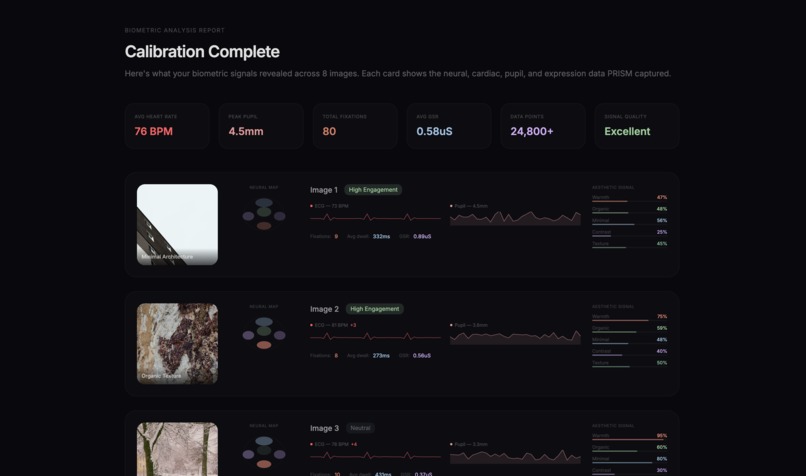
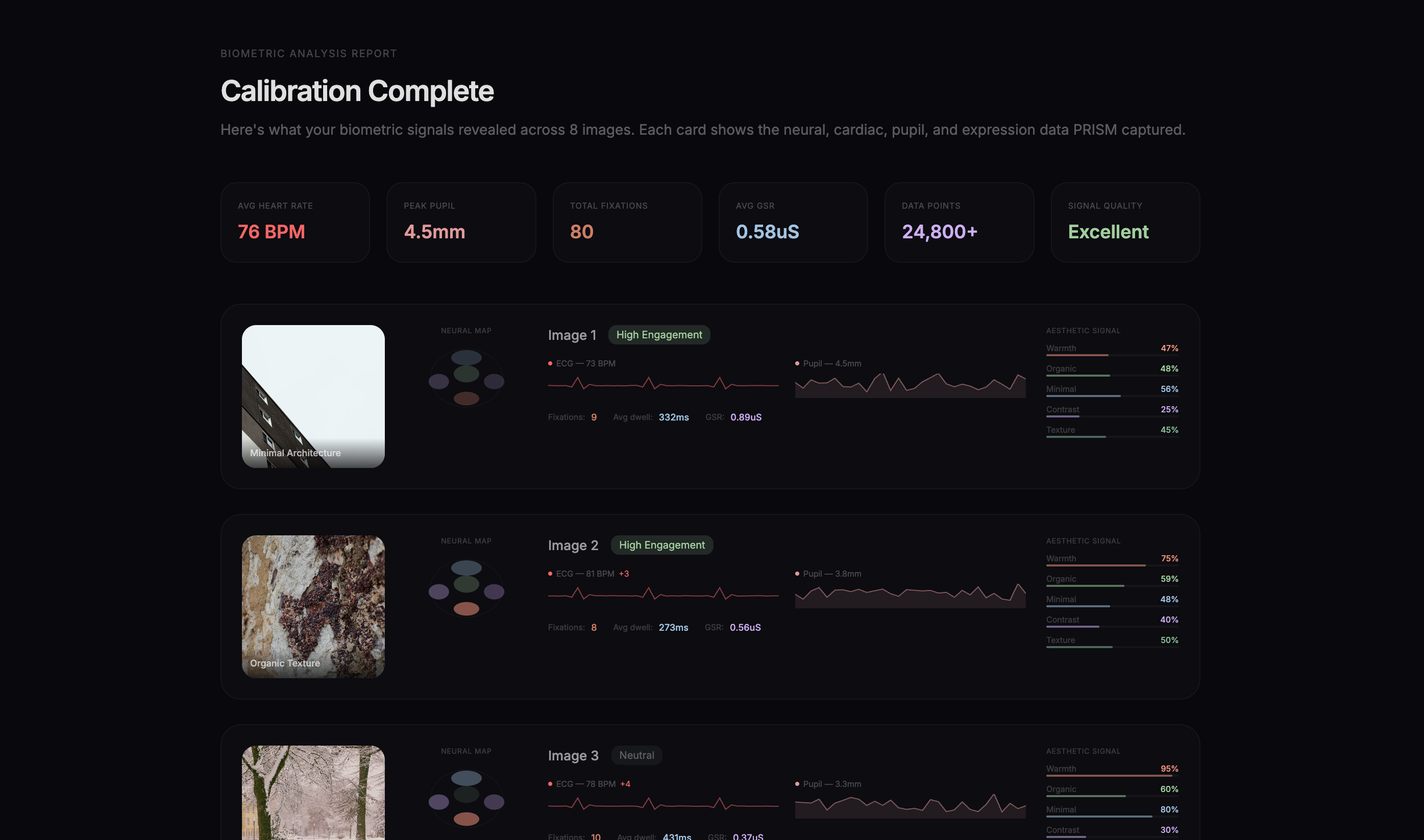
After Calibration
-
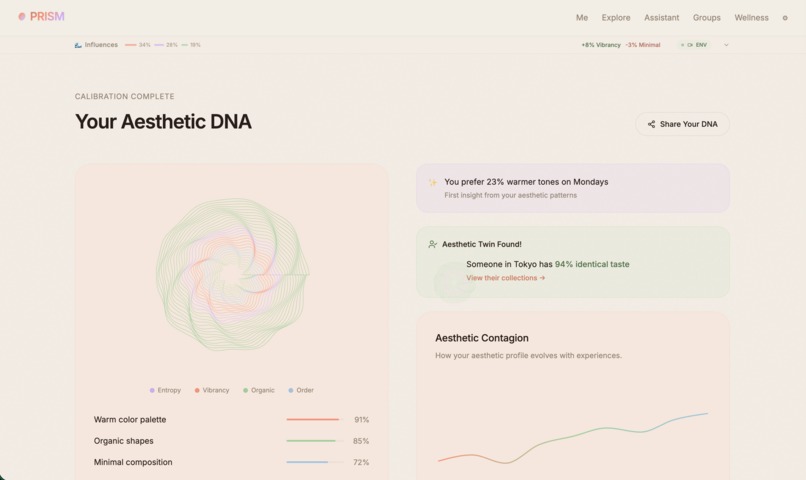
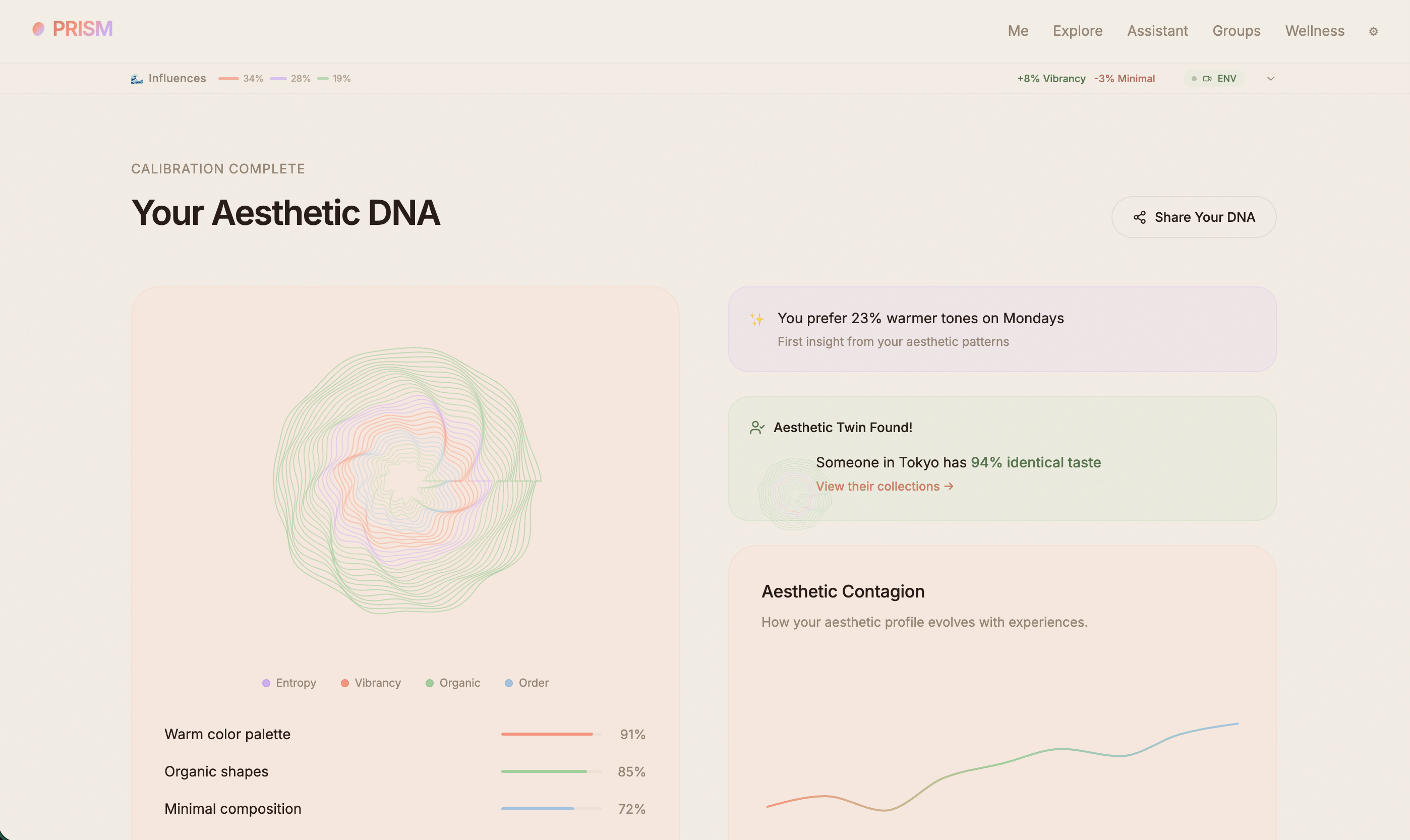
Me Page
-
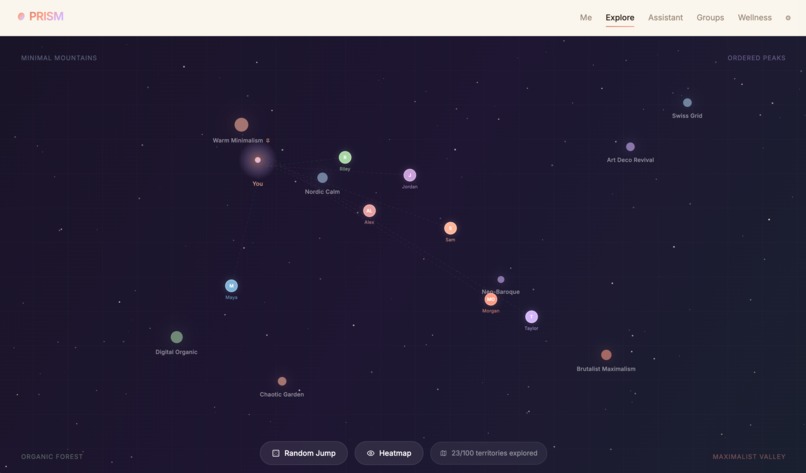
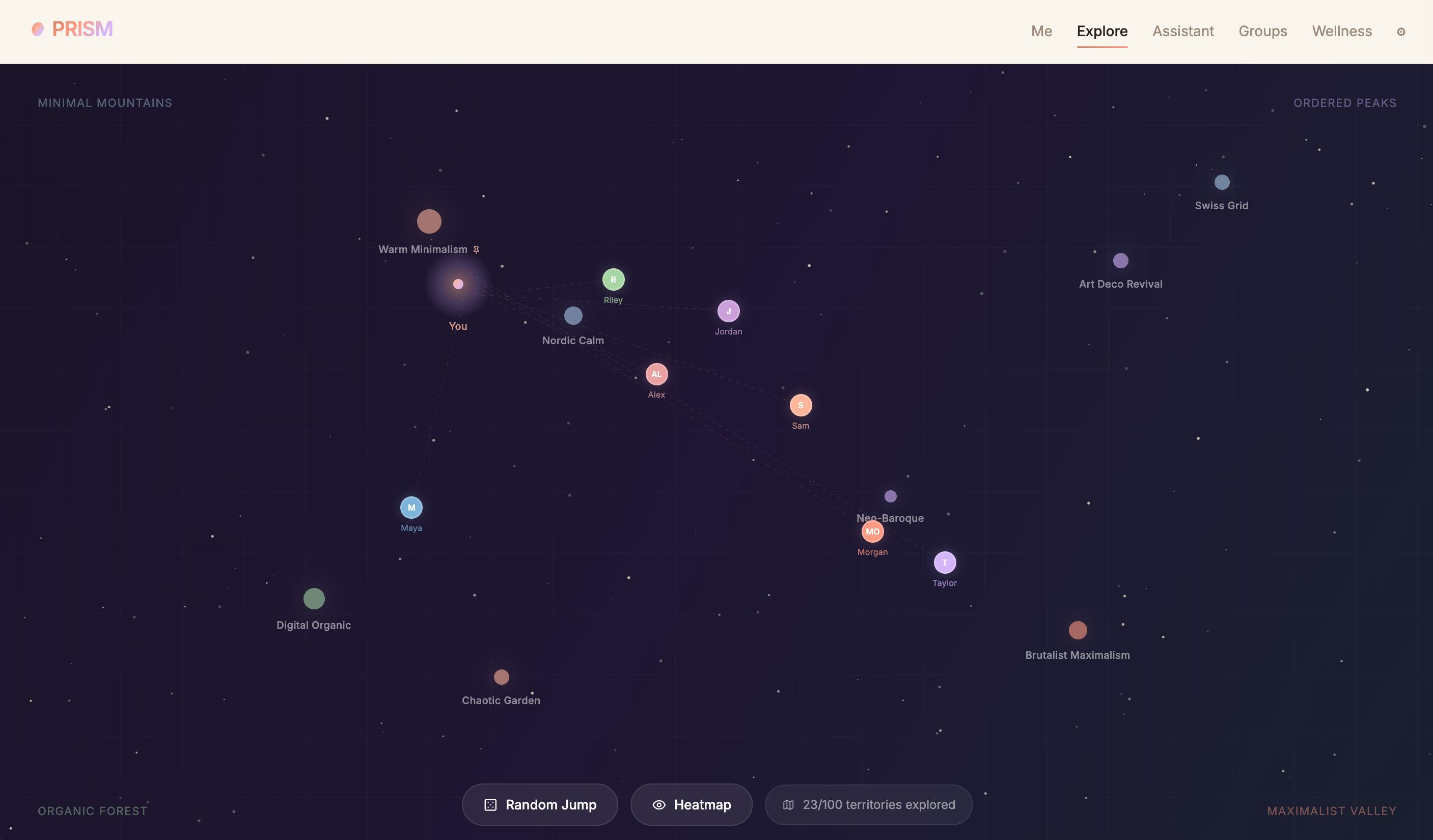
Explore Page
-
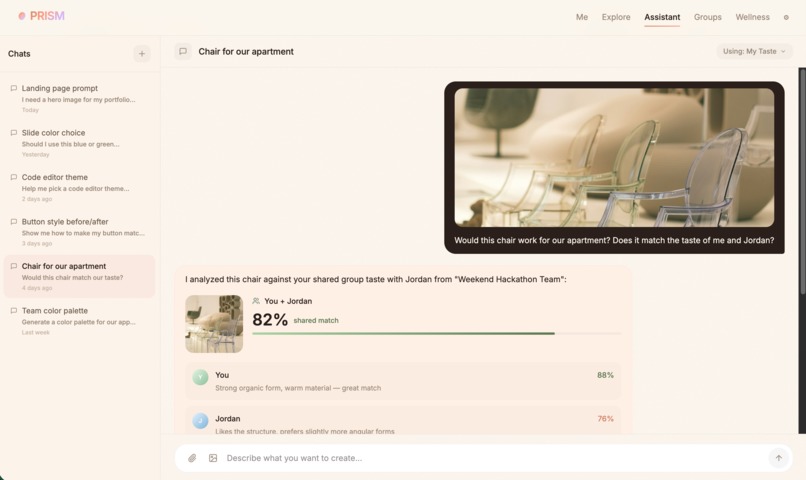
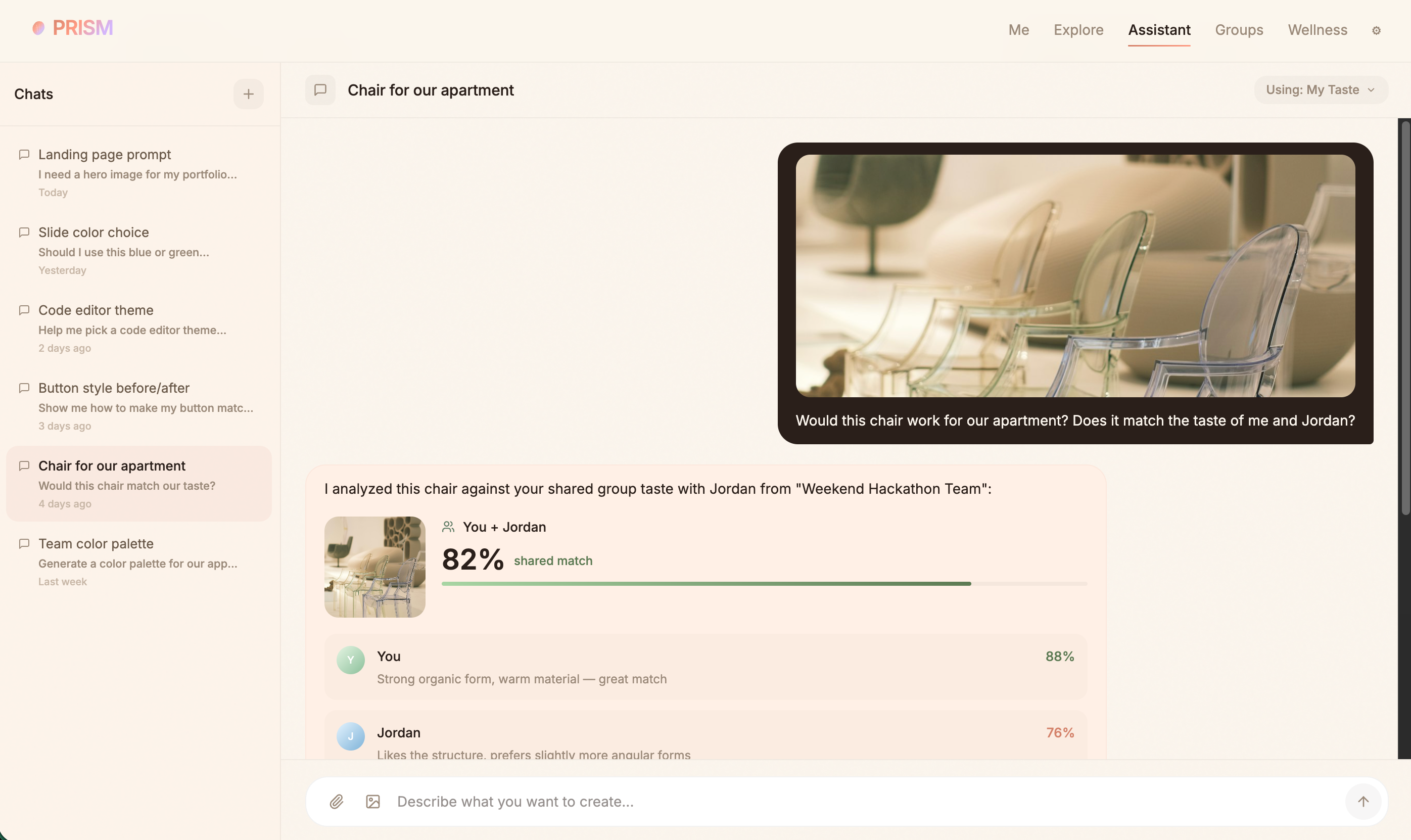
Chatbot Page
-
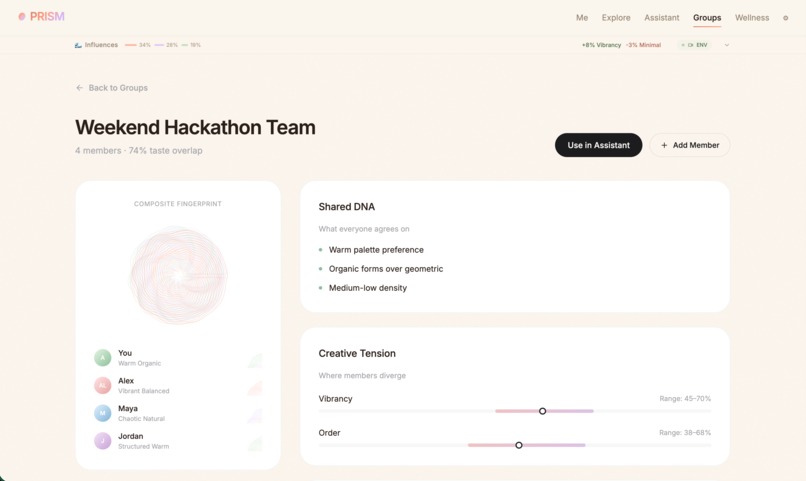
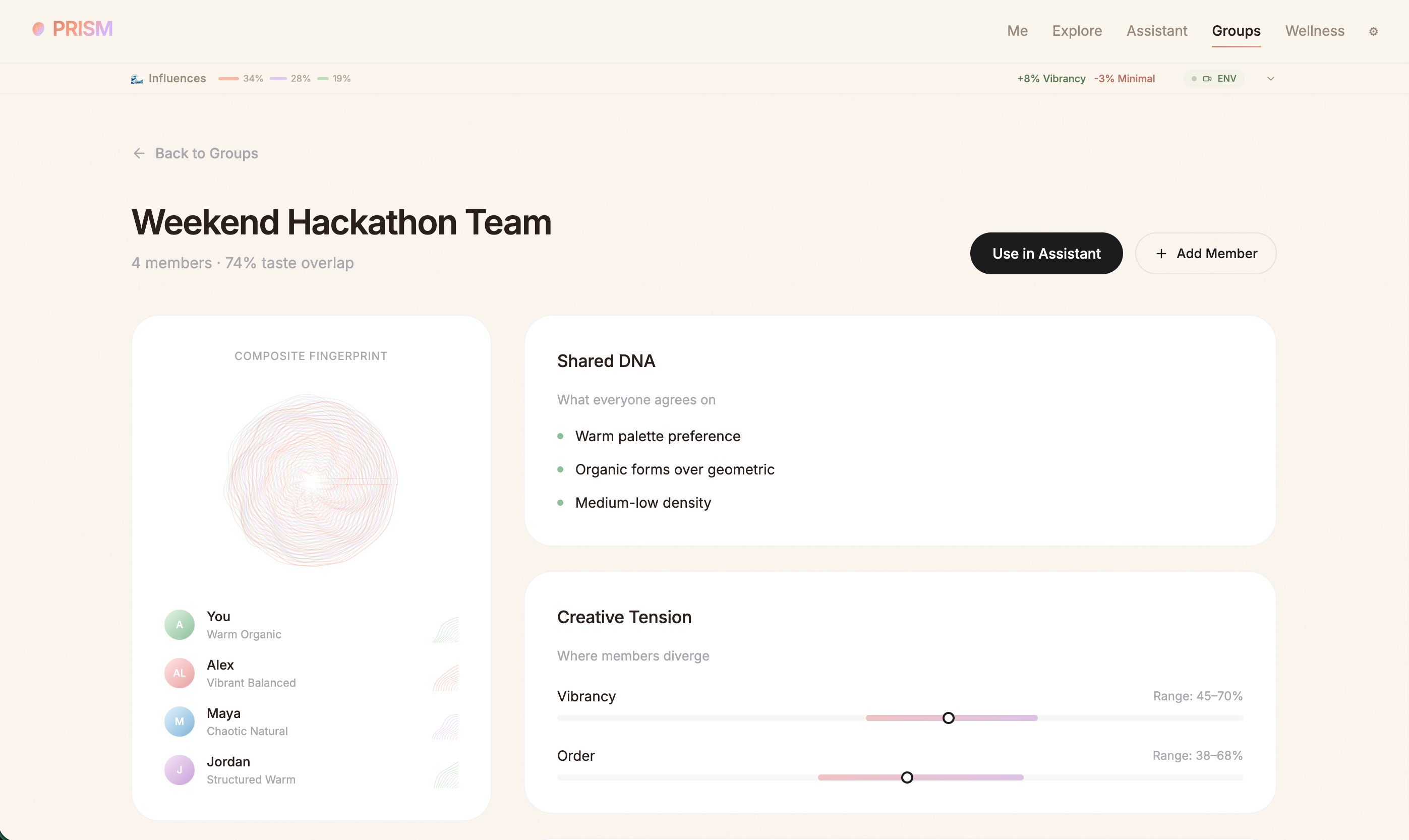
Group Calibration
-
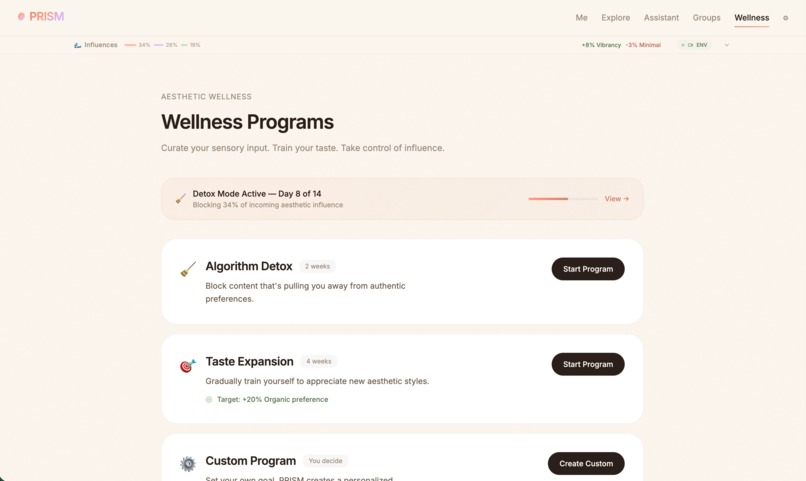
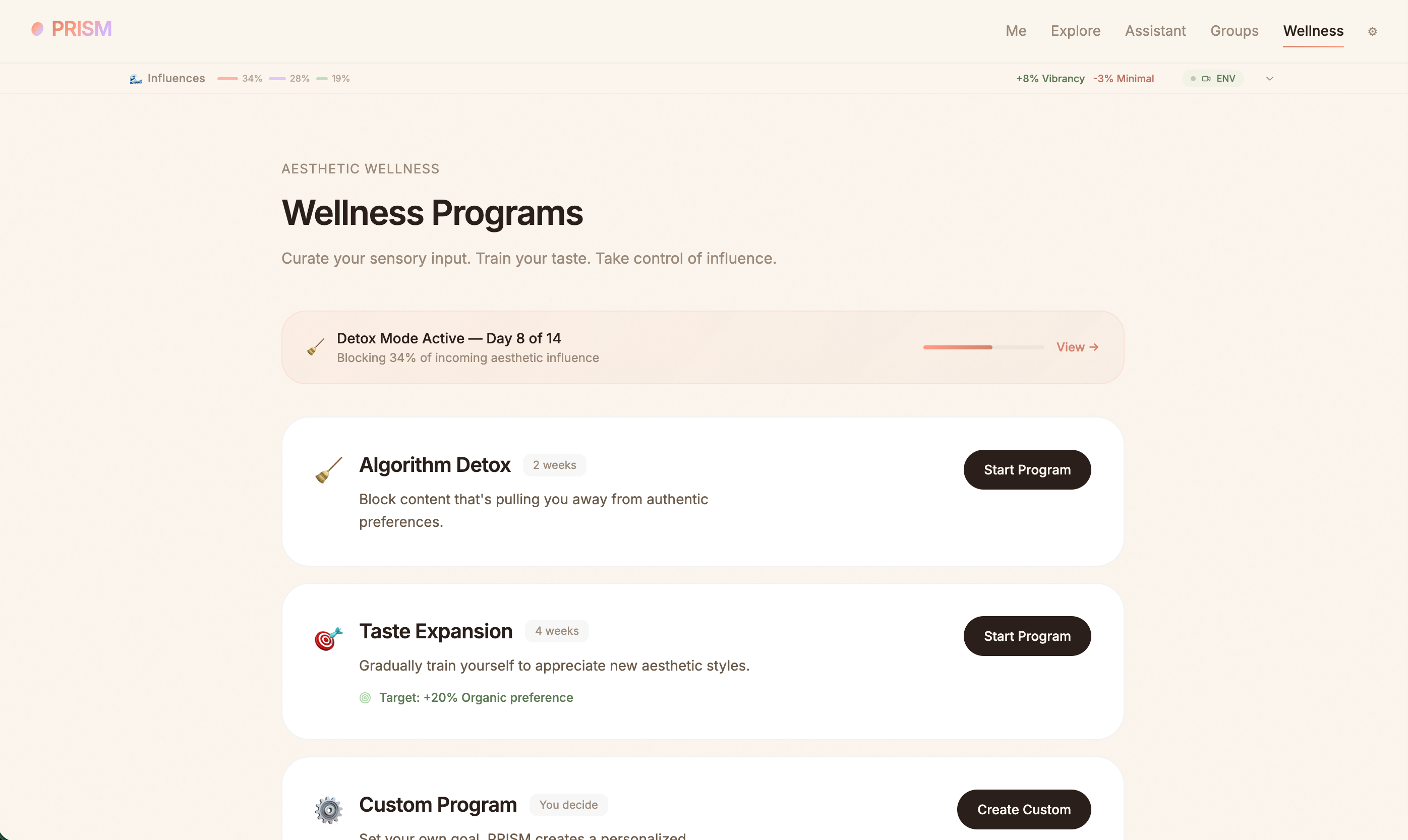
Wellness Program
-
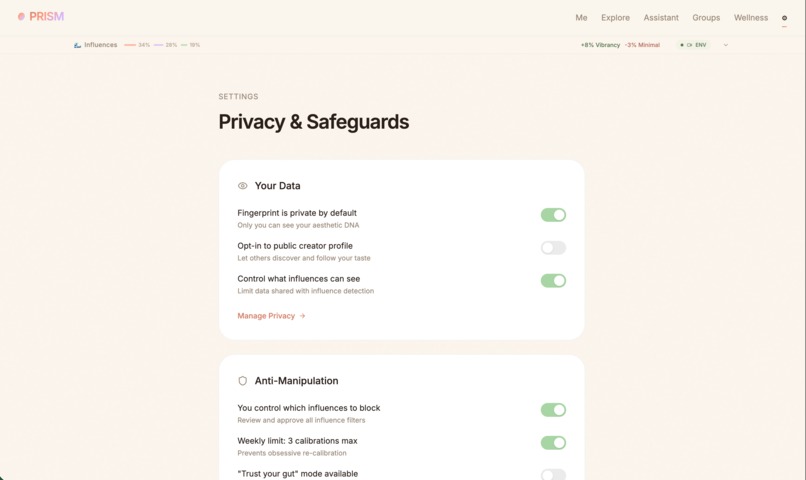
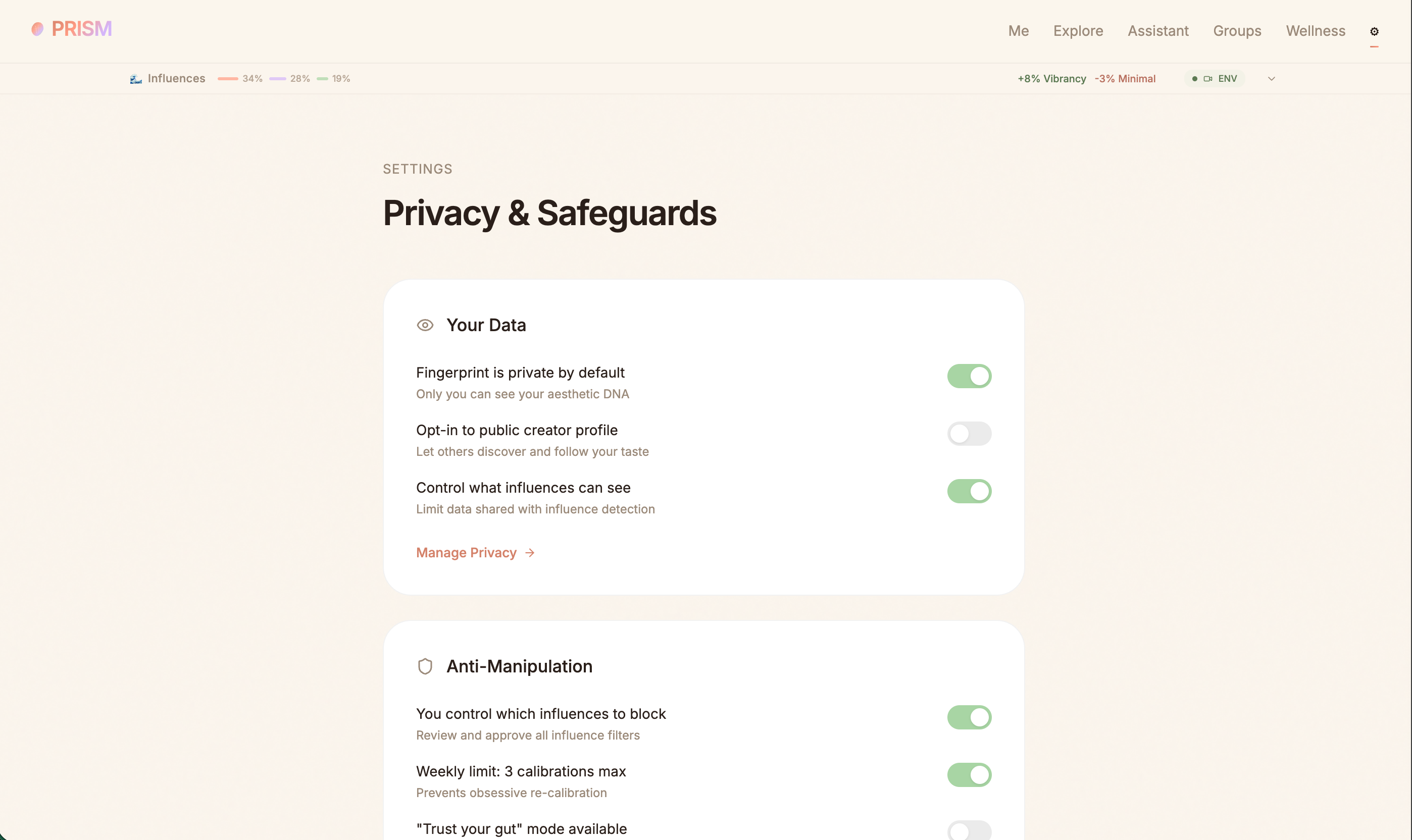
Privacy and Safeguard Settings
PRISM: Aesthetic Proprioception System
The Problem
As software developers, designers, and creative professionals, we find our workflow being increasingly automated by AI. This makes spinning up ideas into production much easier, but it also makes it increasingly difficult to retain your own voice, or sense of self. We were struggling to articulate what we wanted design-wise to AI, moving beyond just prompting it to "make it look better".
Software design is now all about this sense of "taste", and we wanted to see if we could capture the aesthetic part of it. We term this as a new sense, of "aesthetic proprioception", or put more simply, finding what resonates with you.
Primary Audience: Creative professionals utilizing AI in their workflow
- Software developers & designers (ages 22-45) building products with AI-assisted tools
- Creative professionals (writers, artists, UX designers) integrating AI into their creative process
- Design teams & brands seeking to maintain coherent aesthetic identity across AI-generated content
Context & Needs:
- Working in fast-paced environments where AI automates design decisions
- Struggling to communicate aesthetic preferences beyond "make it look better"
- Need to differentiate their work in an era where everyone has access to the same AI tools
- Want to maintain authentic creative voice while leveraging AI efficiency
- Require a shared aesthetic language for team collaboration
The New Sense: Aesthetic Proprioception
Just as proprioception allows you to sense where your limbs are in space without looking, aesthetic proprioception is the ability to sense and articulate your own aesthetic taste, what visually resonates with you at a subconscious, biological level.
What was invisible before PRISM:
- The why behind aesthetic preferences (you knew you liked something, but couldn't explain it)
- Subconscious visual patterns that trigger positive responses in your brain
- The gap between conscious design choices and authentic personal taste
- Evolution of aesthetic identity over time
- Collective aesthetic DNA within teams or brands
Why it matters: In an AI-automated world, personal taste becomes the only differentiator. PRISM makes the invisible visible, via capturing biological responses to visual stimuli that your conscious mind can't articulate. It translates gut feelings into actionable design language, enabling you to guide AI tools with precision instead of vague prompting.
The biological signals PRISM measures:
- Brain signals - Which visual elements activate specific neural regions?
- Saccadic eye-tracking - What do your eyes linger on versus skip?
- Pupillary dilation - What prompts subconscious arousal or interest?
- Micro-expressions - What subtle facial muscle movements reveal emotional responses?
- Heart rate variability - What prompts physiological engagement?
This streamlines aesthetic discovery, making it automatic rather than requiring conscious articulation.
Wellness Goal: Creative Autonomy & Authentic Self-Expression
Dimensions addressed:
- Mental wellness: Reduced decision fatigue and increased confidence in design choices
- Emotional wellness: Restored sense of creative identity and ownership in AI-assisted work
- Social wellness: Improved team collaboration through shared aesthetic vocabulary
- Professional wellness: Differentiation in saturated creative markets
Behavioral change:
- From: Vague AI prompting ("make it modern," "add some flair") and reliance on generic AI aesthetics
- To: Precise, intentional design decisions grounded in personal biological data and articulated preferences
Long-term impact: Users develop a robust aesthetic vocabulary and self-knowledge that persists beyond the tool itself. They become more aware of what resonates with them, making more intentional choices in all creative work.
Use Cases
Use Case 1: Daily AI Workflow Enhancement
Sarah, Product Designer
Sarah is designing a new landing page using an AI design tool. Instead of generic prompting, she opens PRISM and reviews her aesthetic DNA profile. The system shows her that she has strong positive biological responses to:
- Asymmetric layouts with organic flow (95% neural activation)
- Warm earth tones with high-contrast accents (increased heart rate + pupil dilation)
- Generous negative space (sustained eye gaze, relaxed micro-expressions)
She uses this insight to prompt her AI tool: "Create a landing page with asymmetric grid, warm terracotta and charcoal palette, abundant whitespace." The AI generates options that authentically match her taste rather than generic "modern" designs. PRISM continues learning as she works, noting which AI-generated options trigger positive biological responses.
Use Case 2: Periodic Aesthetic Calibration
Marcus, Brand Strategist
Every month, Marcus goes through a 15-minute calibration session. PRISM displays a curated set of images, some from his recent photography, saved inspiration, and controlled design samples. As he views them naturally:
- Eye-tracking sensors note which elements draw his gaze
- EEG headband captures neural responses to color, composition, texture
- Webcam analyzes micro-expressions revealing emotional reactions
- Smartwatch tracks heart rate patterns
PRISM generates an updated aesthetic DNA report showing how his taste has evolved. He notices his preference for brutalist architecture has intensified (+12% neural response), while his affinity for minimalism has softened. He shares this evolution with his personal AI assistant, which now better understands his design direction for the quarter.
Use Case 3: Team Collaboration & Brand Alignment
Design Team at Studio Flux
The team uses PRISM to create a collective brand aesthetic DNA. Each team member completes calibration sessions, then the system identifies:
- Shared aesthetic values: What visual elements create positive responses across all members?
- Individual signatures: What makes each designer's style unique?
- Complementary contrasts: Where do different tastes create productive tension?
During a rebrand project, they reference the team's collective DNA to guide AI asset generation. When presenting to clients, they can articulate choices not as personal preference but as biologically-grounded team identity. The AI assistant can now generate work that feels "on-brand" by referencing the aggregated aesthetic DNA rather than generic style guides.
Privacy & Consent
Data minimization:
- PRISM never stores raw user images, only the resulting design pattern analysis
- Biometric data is processed locally on-device when possible
- User retains complete ownership of their aesthetic DNA data
Granular control:
- Opt-in for each data source (photos, browsing, social media)
- Ability to exclude specific images or timeframes from analysis
- One-click deletion of entire aesthetic DNA profile
- Export your data in standard formats at any time
Transparency:
- Clear visualization of what data is collected and when
- Plain-language explanations of how biological signals translate to insights
- No black-box algorithms, users can see why the system made recommendations
Vision
We envision PRISM as a tool that helps people develop aesthetic self-knowledge in an era where AI can generate anything but can't know what you specifically want. By measuring biological responses to visual input, we make taste tangible and articulable.
As more creative tasks become automated, personal taste becomes the only differentiator. PRISM helps you understand, articulate, and evolve your aesthetic voice, ensuring that AI amplifies your creativity rather than replacing it.
We hope that looking at this, you become aware of your own aesthetic proprioception, and inspired to learn more about different aesthetics and build the necessary vocabulary to use it intentionally.
Built With
- figma
- figma-make


Log in or sign up for Devpost to join the conversation.