Inspiration
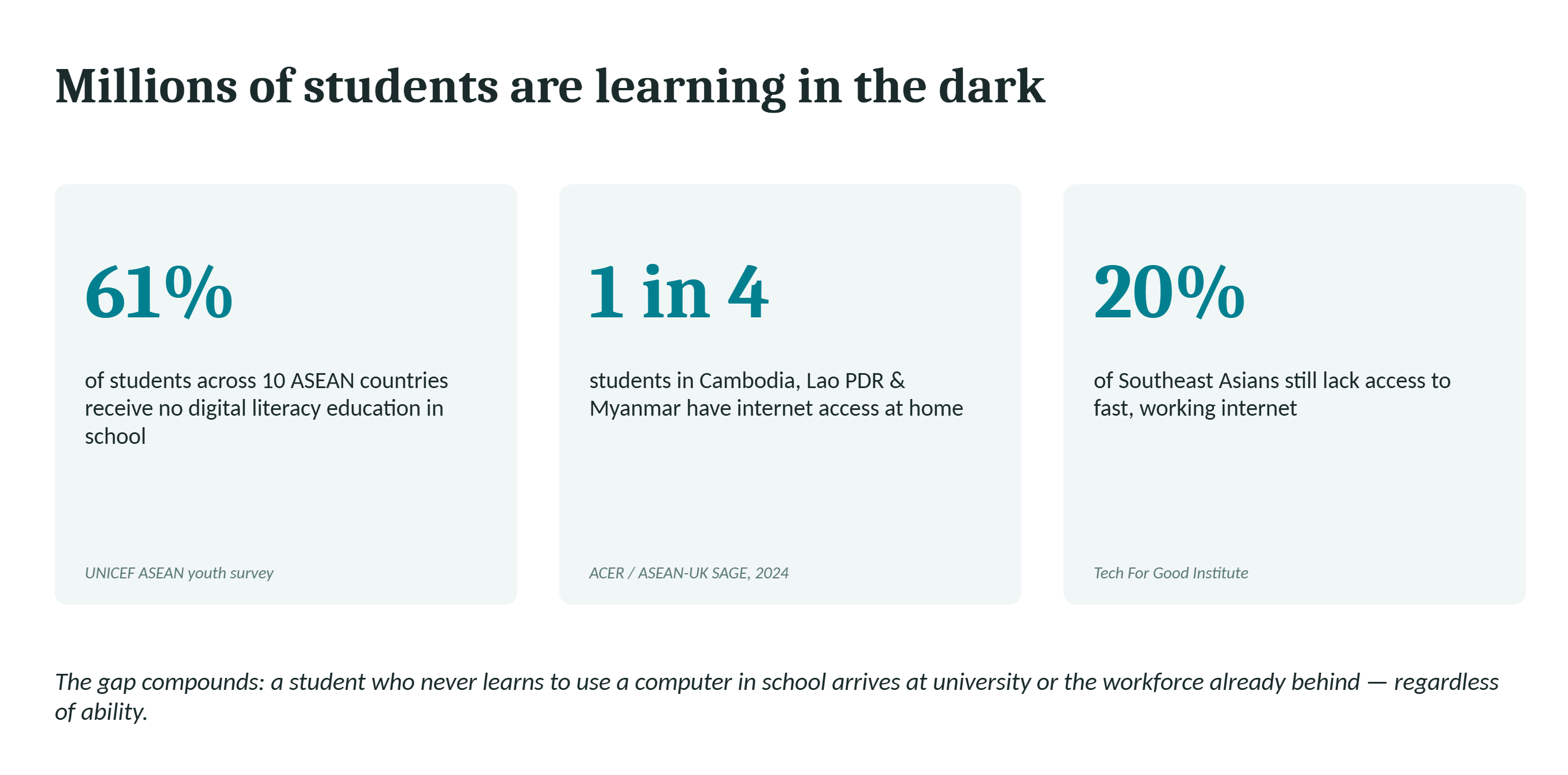
Millions of students across Southeast Asia are still missing opportunities to develop basic digital literacy. In the deck, we found that 61% of students across 10 ASEAN countries receive no digital literacy education in school, while only around 1 in 4 students in Cambodia, Lao PDR and Myanmar have internet access at home.
We realised that the problem is not simply a lack of computers. Schools may receive donated devices but have no offline curriculum, connectivity plan, or trained teachers to use them effectively. At the same time, many existing e-learning platforms assume reliable internet access and modern hardware.
This led us to a simple question:
What if digital literacy could be designed around the constraints these classrooms actually face, instead of expecting the classrooms to adapt to technology?
That became BridgeBox.
What it does
BridgeBox is an offline-first digital literacy solution for underconnected classrooms in Southeast Asia.
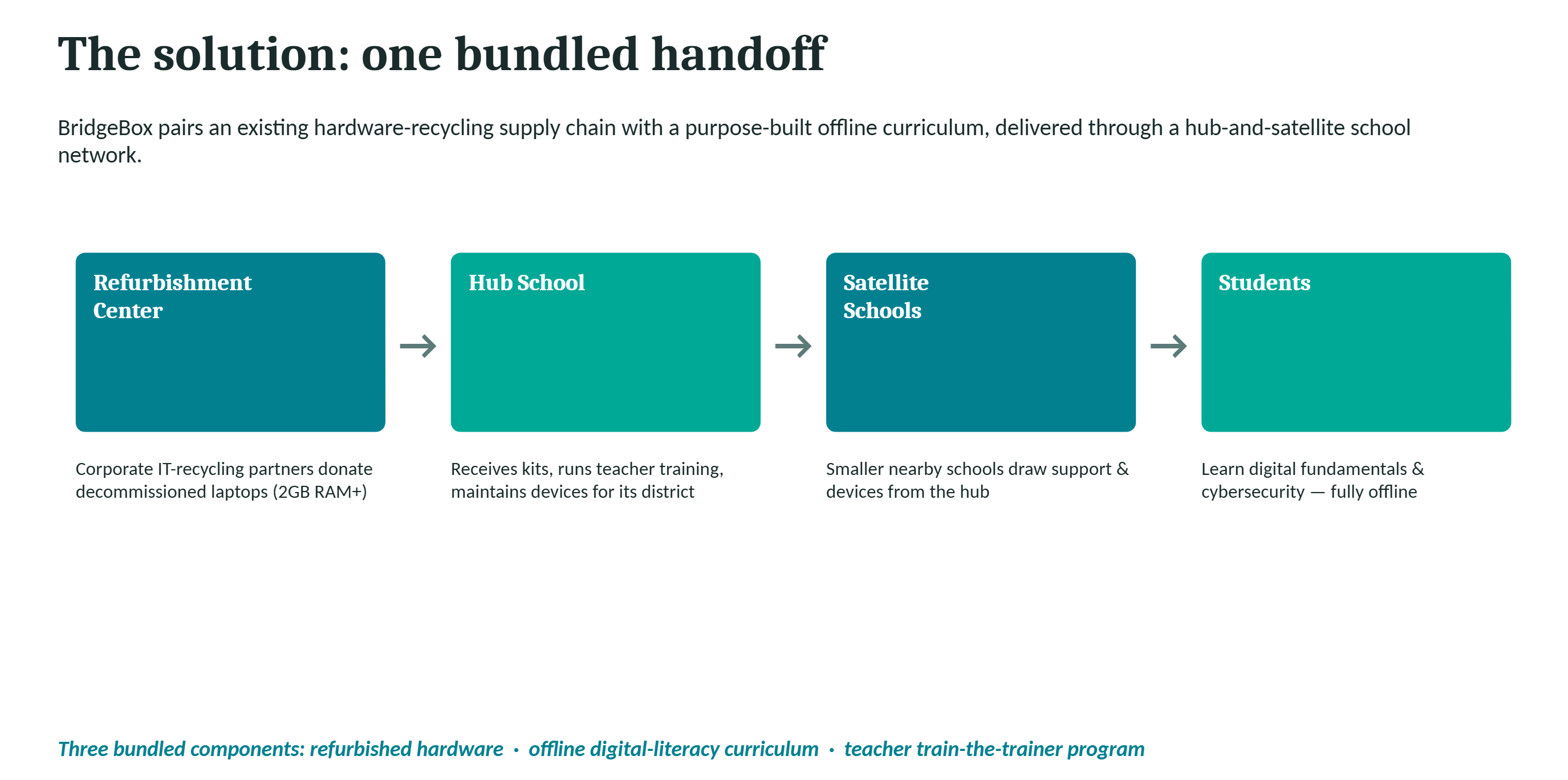
Instead of treating hardware, education and teacher training as separate problems, BridgeBox bundles three components into one handoff:
Refurbished laptops sourced through corporate IT-recycling partners A fully offline digital-literacy curriculum A teacher train-the-trainer programme
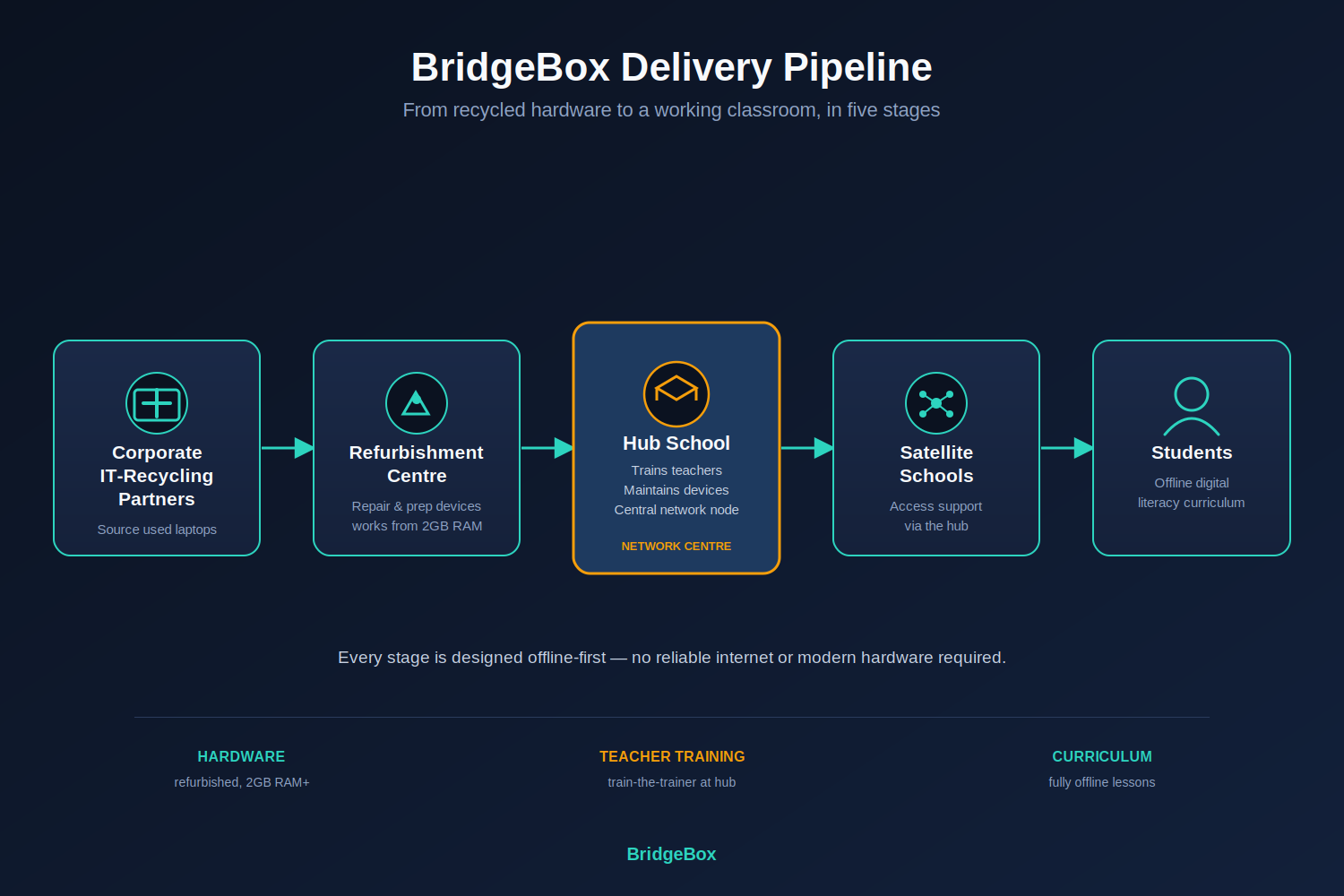
The solution uses a hub-and-satellite school network. A central hub school receives the equipment, trains teachers and maintains the devices, while smaller satellite schools in the surrounding area can access support and equipment through the hub.
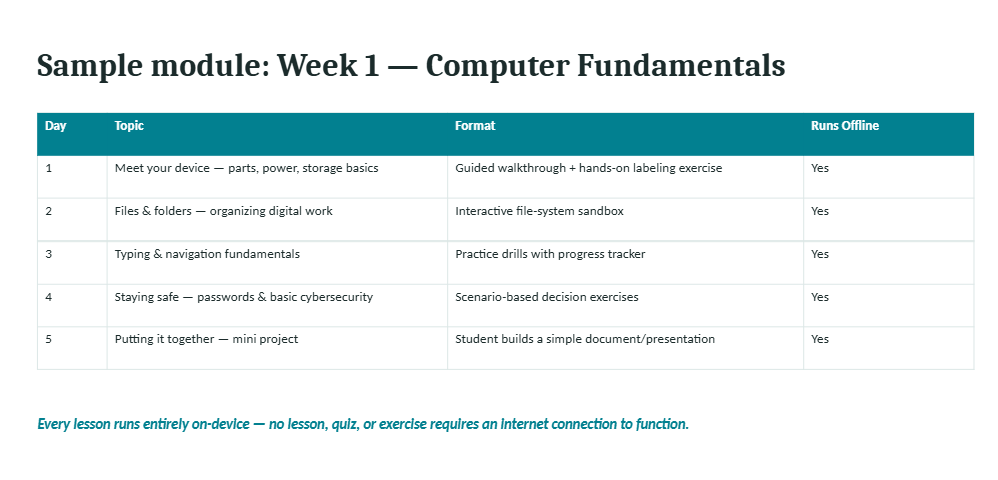
The curriculum itself requires no internet connection. For example, the first week teaches computer fundamentals, file management, typing, navigation, basic cybersecurity and a final mini-project, with every lesson designed to run directly on the device.
How we built it
We approached BridgeBox as a constraint-first service and business model, rather than simply designing another e-learning platform.
First, we identified the constraints: limited connectivity, older hardware, lack of digital-literacy instruction and limited teacher support.
We then designed the solution around those constraints:
Corporate IT-recycling partners → Refurbishment Centre → Hub School → Satellite Schools → Students
The refurbished devices are designed to work with hardware as low as 2GB RAM, while the curriculum is built to function entirely offline. Teachers are trained so that the programme can continue independently after the initial deployment.
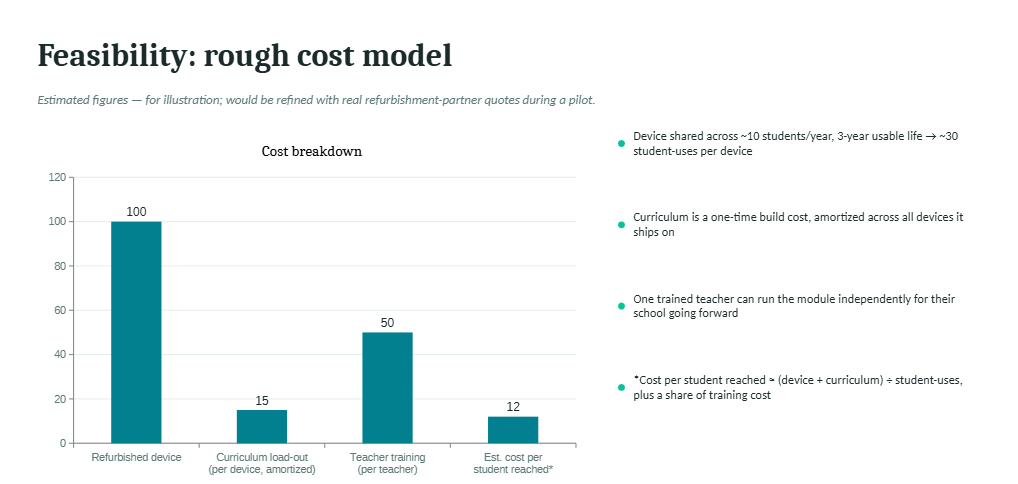
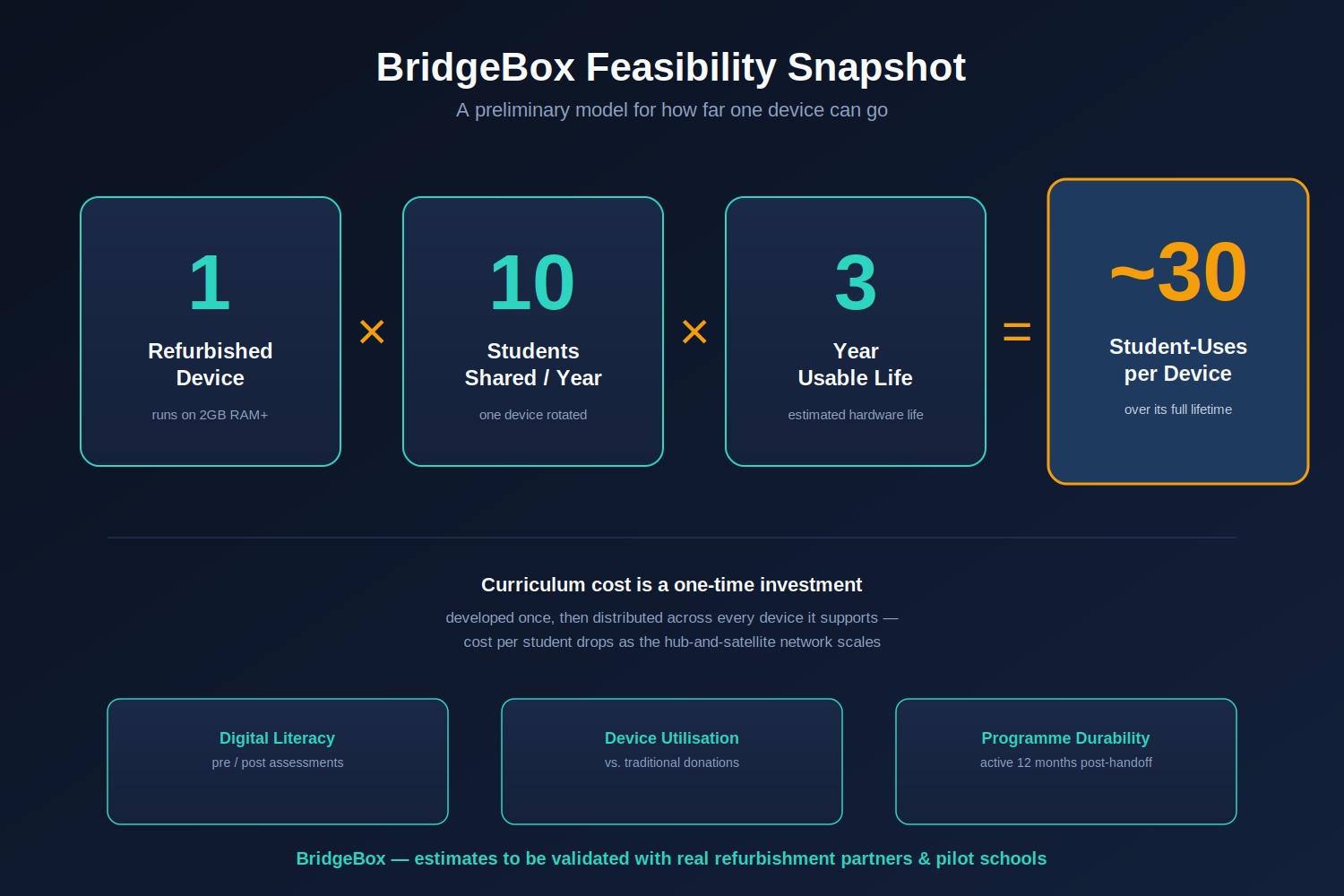
We also developed a preliminary feasibility model. A device shared across approximately 10 students per year with a three-year usable life could provide around 30 student-uses, while the curriculum is treated as a one-time development cost that can be distributed across the devices it supports.
Challenges we ran into
The biggest challenge was recognising that access to technology is not the same as access to digital education.
A hardware-only solution can leave donated laptops sitting unused if there is no curriculum or teacher support. On the other hand, conventional e-learning platforms are often unsuitable for classrooms with unreliable connectivity or low-specification devices.
We therefore had to think beyond the individual product and design the entire delivery model: how devices are sourced, how they reach schools, how teachers are trained, how smaller schools receive support, and how the programme can remain sustainable after the initial handoff.
Another challenge is feasibility at scale. Our current cost figures are intentionally estimates and would need to be validated with real refurbishment partners and pilot schools before implementation.
Accomplishments that we're proud of
We are proud that BridgeBox does not treat digital inequality as a single hardware problem.
Our biggest accomplishment is turning three disconnected interventions — hardware donation, digital education and teacher training — into one integrated model.
We also designed BridgeBox to be:
Offline-first, rather than an online platform adapted as an afterthought Sustainable, through refurbished hardware and local maintenance capacity Scalable, through the hub-and-satellite school structure Teacher-enabled, so schools are not permanently dependent on external facilitators Measurable, with proposed metrics covering digital-literacy gains, device utilisation and programme durability.
Most importantly, BridgeBox reframes the problem from “How do we get computers into schools?” to “How do we make sure those computers actually create learning?”
What we learned
We learned that meaningful innovation often comes from designing around constraints instead of designing around ideal conditions.
It is easy to assume that giving students access to technology automatically improves digital literacy. In reality, the surrounding ecosystem matters just as much: appropriate curriculum, teacher capability, maintenance and long-term ownership all determine whether technology actually gets used.
We also learned that sustainability needs to be considered from the beginning. BridgeBox's hub-and-satellite model is designed to build local maintenance and teaching capacity so that schools can continue running the programme without permanent outside facilitation.
The core lesson behind BridgeBox is simple:
A solution is only useful when it works within the reality of the people it is designed for.
What's next for BridgeBox
Our next step would be to validate BridgeBox through a small pilot.
We would first establish partnerships with 2–3 regional organisations already involved in corporate IT recycling, then launch a pilot involving one hub school and several satellite schools. Teachers would receive training while students participate in the initial curriculum. Feedback and usage data would then be used to refine the programme.
After the pilot, we would align the curriculum with local Ministry of Education digital-literacy standards before expanding district-by-district through NGO and government partnerships.
We would measure success through three key outcomes:
Digital literacy gains through pre- and post-programme assessments Device utilisation compared with traditional hardware donation programmes Programme durability by measuring how many schools continue using the curriculum 12 months after handoff without external facilitation
Ultimately, we want BridgeBox to make sure that a student's access to digital education is not determined by whether their classroom has reliable internet.
A device without a curriculum is just a box. A curriculum without a device goes nowhere. BridgeBox delivers both, together.
Built With
- powerpoint
- research

Log in or sign up for Devpost to join the conversation.