Inspiration
Prior authorization delays cost the US healthcare system $35 billion annually. Physicians wait 3–5 business days for imaging decisions that should take seconds, and patients wait with them. We built PriorAuth AI to collapse that window to under 10 seconds at the point of care.
What it does
PriorAuth AI exposes two MCP tools on the Prompt Opinion platform:
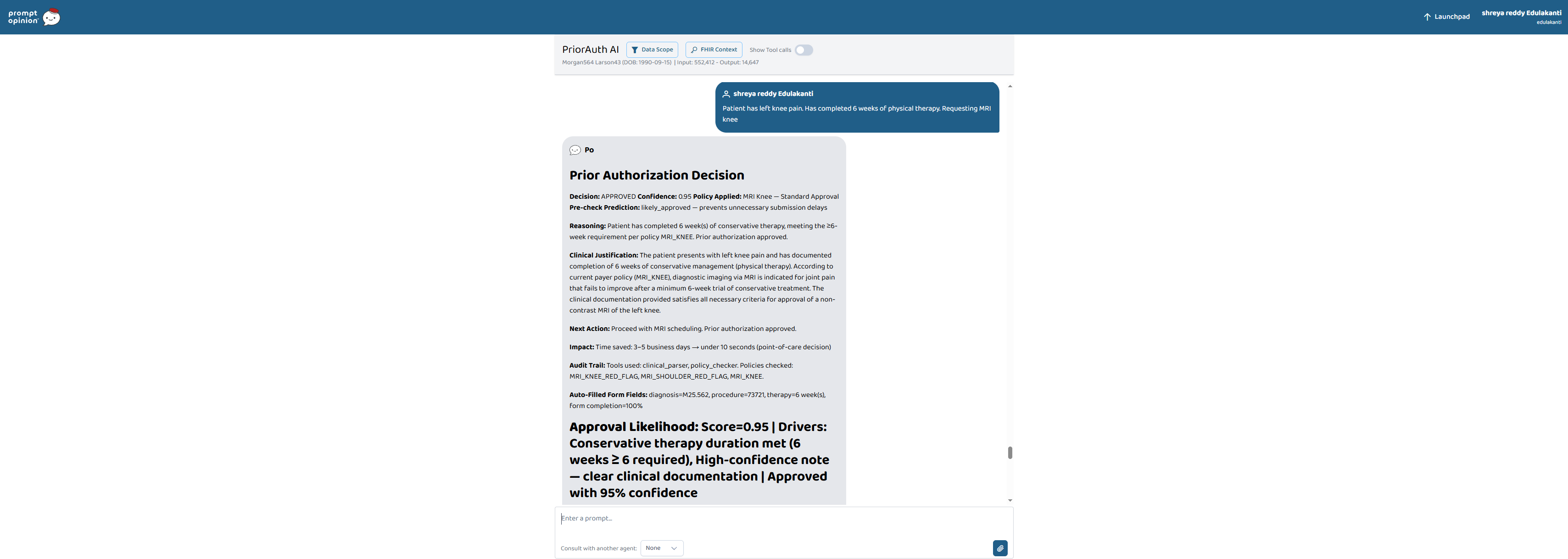
- clinical_parser - extracts procedure, body part, laterality, therapy duration, and red-flag symptoms from any free-text clinical note
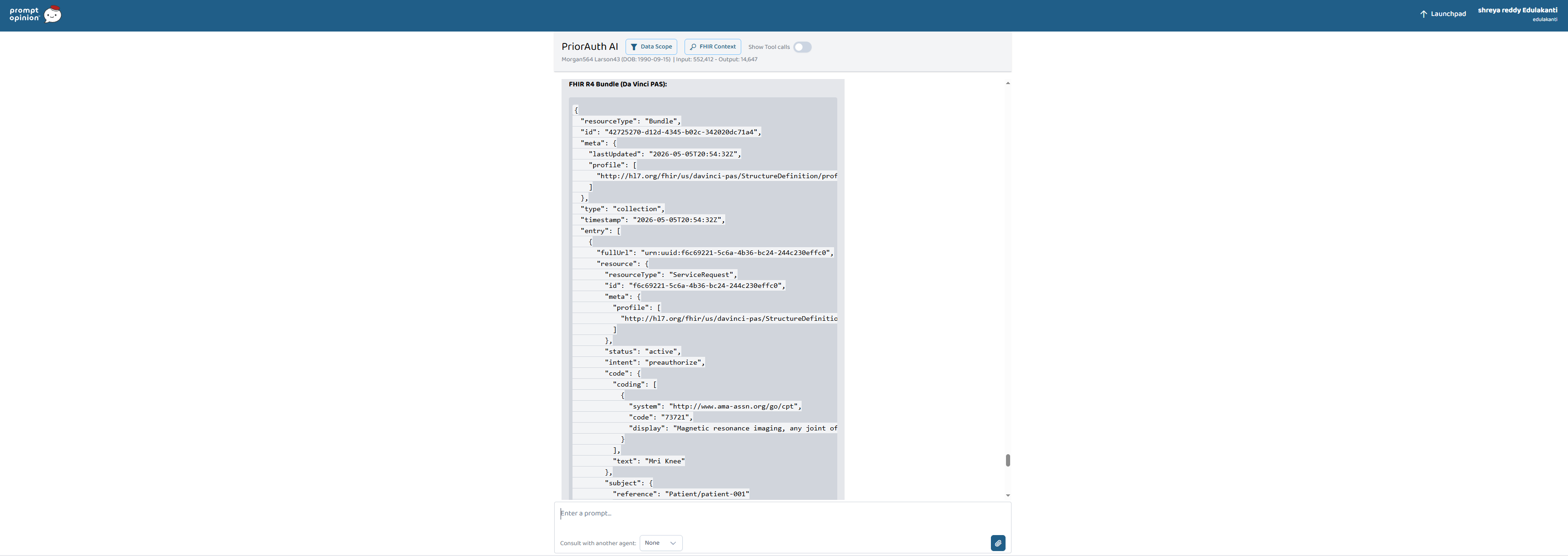
- policy_checker - evaluates the request against payer policies and returns a Da Vinci PAS-compliant FHIR R4 bundle with the authorization decision
Key capabilities:
- Red-flag override pathway, clinical urgency automatically waives therapy requirements
- Laterality-aware ICD-10 coding (left/right/unspecified knee and shoulder)
- Confidence scoring with automatic escalation for ambiguous cases
- Denial prevention, every denial names exactly what is missing and what would flip it to approval
- Sequential auth numbers with FHIR ServiceRequest and X12 PAS review codes (A1/A4)
How we built it
Python MCP server using FastMCP with Streamable HTTP transport, deployed via ngrok and connected to Prompt Opinion. Rule-based clinical parser for deterministic extraction of structured fields. Policy engine evaluates 6 payer policies across MRI knee and MRI shoulder. FHIR R4 bundle is built inside the tool, the LLM never constructs clinical codes.
Challenges we ran into
Balancing determinism with flexibility. In healthcare, hallucinated CPT codes are a patient safety issue, so the tools are rule-based by design while the LLM handles orchestration and clinical justification. Also navigating FastMCP transport security settings to work correctly behind ngrok tunneling.
Accomplishments that we're proud of
- A fully working prior auth system live on Prompt Opinion in under 3 minutes per request
- Da Vinci PAS-compliant FHIR R4 output with correct CPT, laterality-aware ICD-10, and X12 review codes
- Red-flag clinical pathway that approves urgent cases without therapy documentation
- Policy engine that is fully data-driven, adding a new payer policy is one dictionary entry, no code changes
What we learned
The right architecture for healthcare AI separates the reasoning layer (LLM) from the compliance layer (deterministic tools). The LLM orchestrates the workflow and generates clinical justification. The tools provide auditable, explainable compliance. That split is not a limitation — it is the correct design for a regulated environment.
What's next for PriorAuth AI
- SHARP FHIR context extension to receive real patient data directly from the platform
- Expanding to CT, X-ray, and ultrasound procedure types
- Real payer policy integration via CQL or structured policy files
- Human review queue UI for escalated low-confidence cases
Built With
- cpt
- da-vinci-pas
- fastmcp
- fhir-r4
- icd-10
- mcp
- ngrok
- prompt-opinion
- python
- x12

Log in or sign up for Devpost to join the conversation.