-
Landing Page
Inspiration
Doctors spend an average of 45 minutes on every prior authorization request. With 400 million requests filed annually in the US, that's billions of dollars and countless patient delays. We wanted to build an AI system that handles the most tedious, error-prone parts of the process — policy lookup, medical necessity justification, and form completion — so clinicians can focus on care instead of paperwork.
What it does
PriorAuth AI is a 3-stage clinical pipeline that takes a doctor's treatment plan and automates the prior authorization workflow. Stage 1 parses insurer policy criteria against the proposed treatment. Stage 2 generates a medical necessity justification letter grounded in clinical guidelines. Stage 3 packages the submission, tracks follow-ups, and generates appeal letters if denied. The doctor stays in the loop — reviewing, editing, and approving the package before anything gets submitted.
How we built it
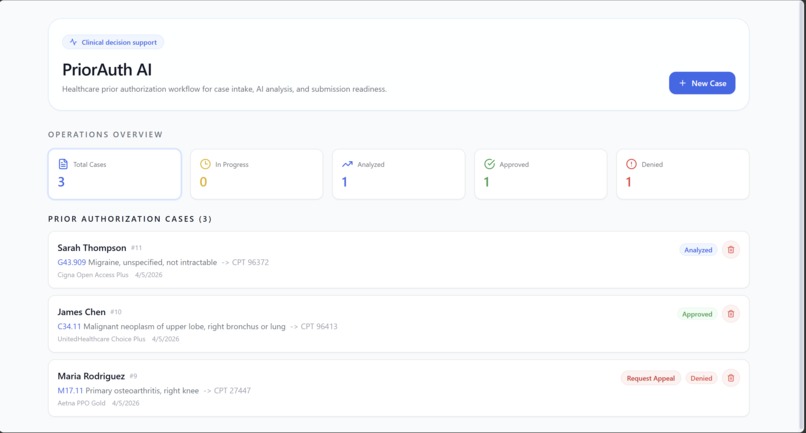
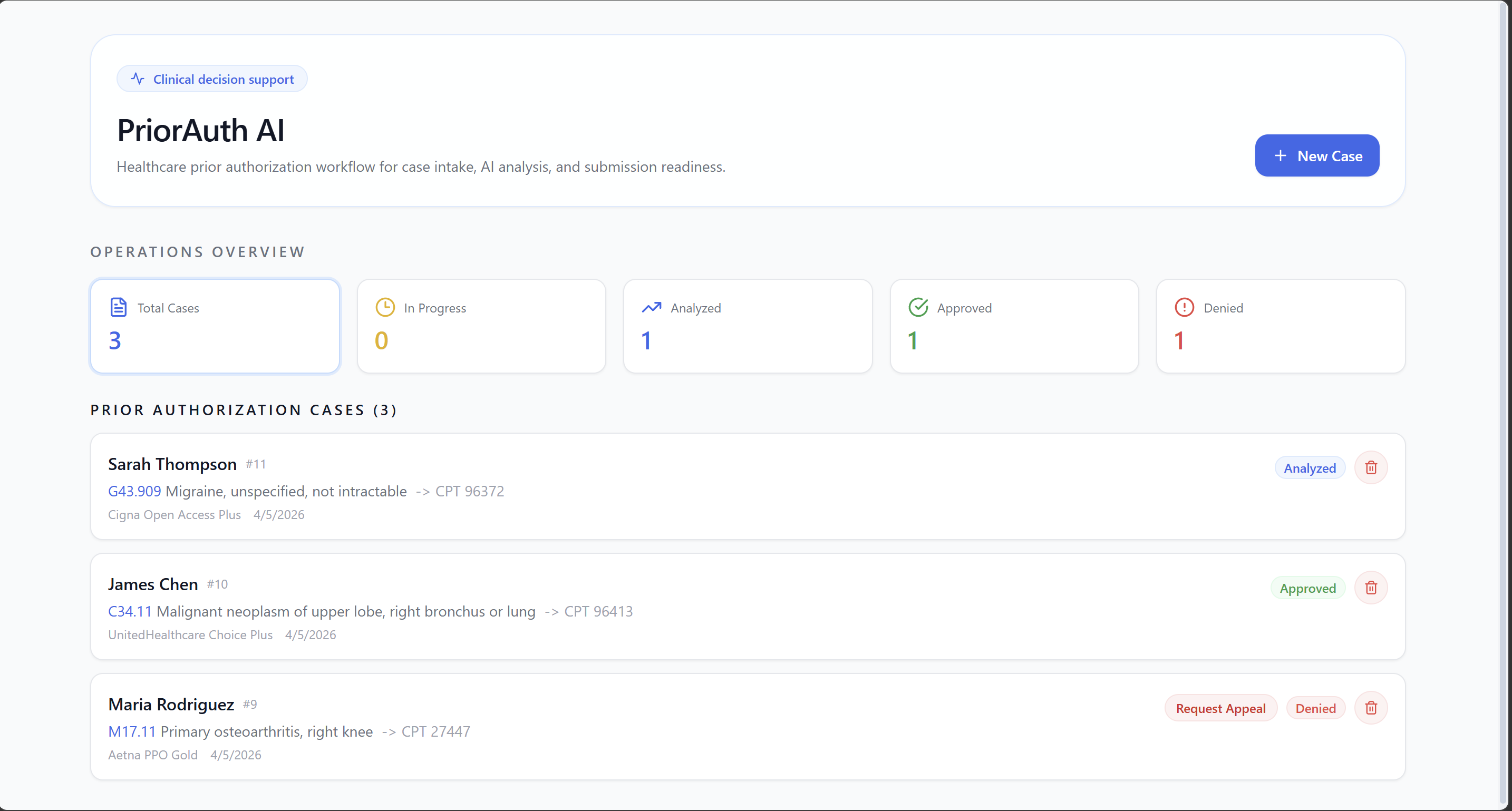
Python and FastAPI on the backend, React with Tailwind on the frontend, SQLite for case tracking. Each pipeline stage runs as a specialized LLM agent with access to a structured knowledge base built from real CMS coverage data, NIH clinical guidelines, and publicly available insurer prior auth requirements. We built deterministic fallback heuristics for every stage so the system works reliably even without an active API key. The frontend gives clinicians an editable submission draft, real-time case insights with approval probability scoring, and a follow-up simulation that models payer and physician communication over time.
Challenges we ran into
Getting the approval probability math to be internally consistent was harder than expected — early versions would show contradictory risk flags and scores. Scoping the policy knowledge base was a balancing act: too narrow and the demo feels thin, too broad and we couldn't build it in 24 hours. We also had to rethink the architecture mid-build after removing CrewAI in favor of a direct staged pipeline, which meant rewiring agent handoffs.
Accomplishments that we're proud of
The medical necessity letter generator produces output that reads like a real clinician wrote it — citing specific guidelines, referencing documented treatment failures, and structured the way insurance medical directors expect. The denial-to-appeal flow works end to end: the system identifies why a case was denied, suggests specific improvements, and auto-generates a stronger appeal letter. And the whole thing runs in under a minute versus the 45-minute industry benchmark.
What we learned
Healthcare data is surprisingly accessible if you know where to look — CMS publishes coverage determinations, procedure codes, and regulatory rules as open data. We also learned that in clinical software, explainability beats autonomy: a staged pipeline where the doctor can see and edit every output is more trustworthy than a fully autonomous agent, and that design choice resonated when we tested the workflow.
What's next for PriorAuth AI
Wire the tool modules into Claude's tool-use API so agents can autonomously query policy databases and clinical guidelines instead of relying on pre-loaded snapshots. Integrate with real clearinghouse APIs (EDI 278/270/271) for live submission and eligibility checks. Add payer-specific form templates so the system adapts to each insurer's requirements automatically. And build a provider-facing analytics dashboard that tracks approval rates, common denial reasons, and time-to-decision across cases.
Built With
- cms
- fastapi
- google-gemini-api
- javascript
- python
- react
- sqlite
- tailwind-css
- vite

Log in or sign up for Devpost to join the conversation.