-
-
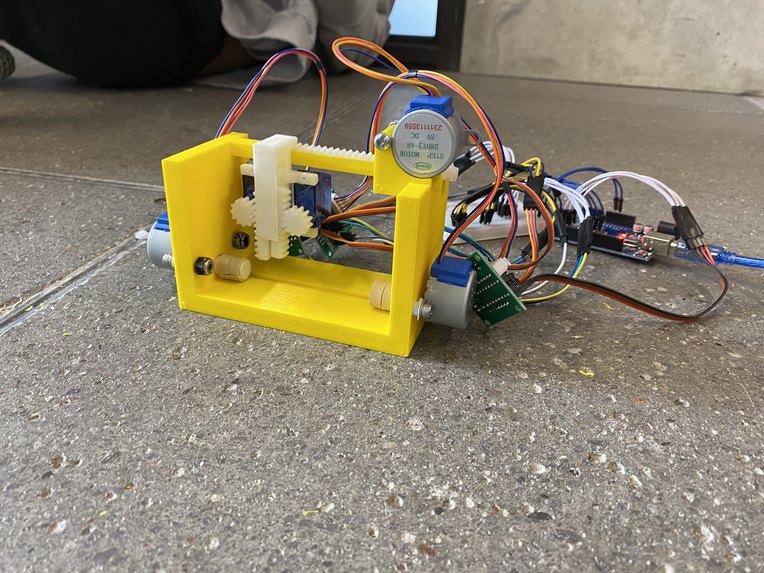
Photo of our project nearing its completion
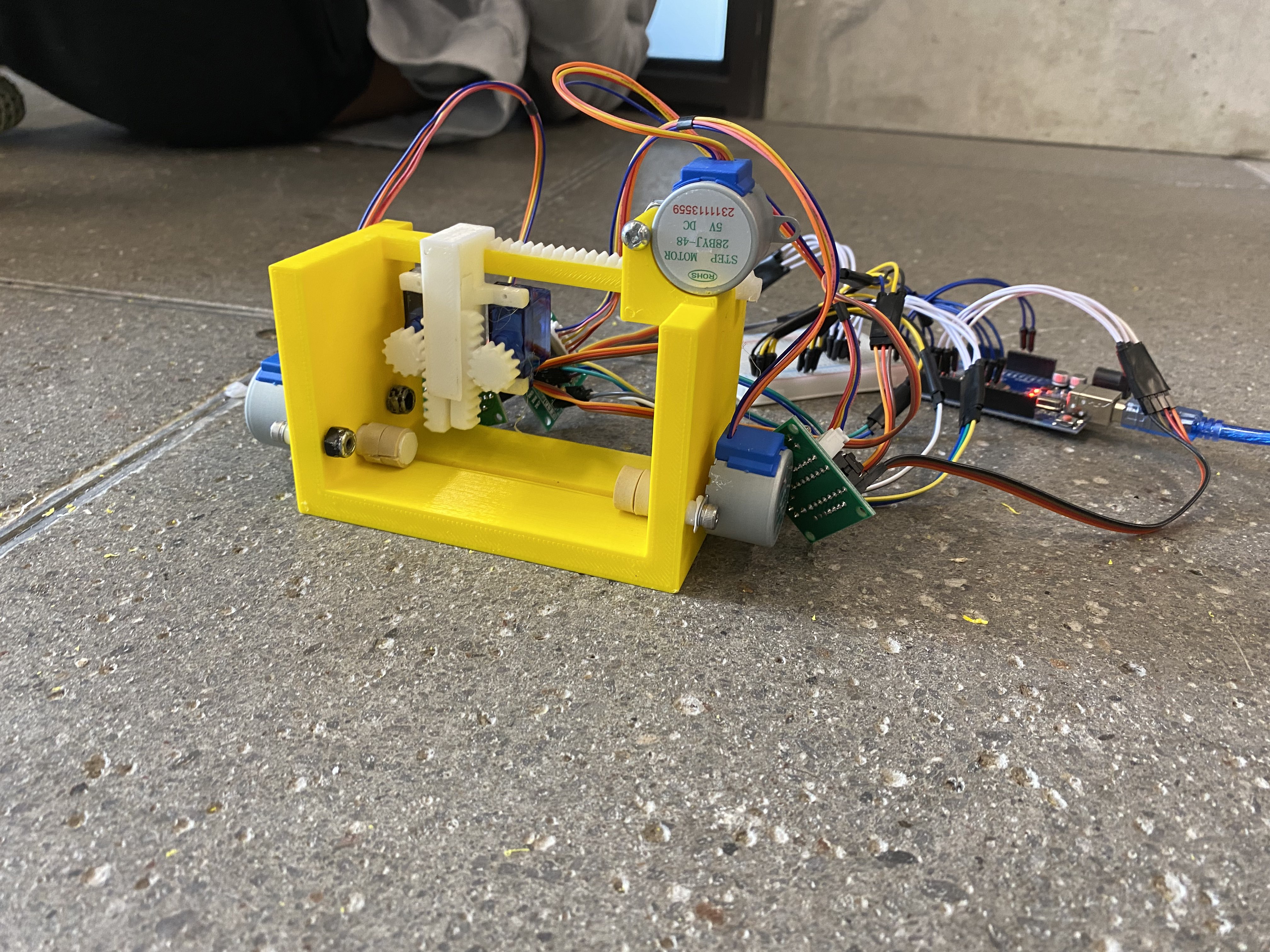
With blindness affecting over 43 million people worldwide and 295 million people having moderate to severe visual impairment, braille has become a necessity for them to lead convenient everyday lives. However, with so few infrastructures having braille displays due to the complexity of producing them, everyday tasks are difficult for people with visual impairment. That’s why we’ve developed Printabraille, a convenient and cost-effective solution to printing easy-to-use braille labels. Through user input, it punctures labels to be stuck on any surface, easily removable and interchangeable. Our labels can be used in households, grocery stores, and any other infrastructure where differentiating between similar products is difficult, making the world we live in more accessible.
Driven by an Arduino UNO, two servo motors, and three stepper motors, our 3D-printed braille printer receives text input through a computer and prints out each letter accordingly in braille. Composed of pinion and rack mechanisms, the thumb tacks used to puncture holes through labels are able to move vertically and horizontally. The rollers at the bottom serve as a way of moving the label paper forwards and backwards to write multiple rows of braille.
We struggled with incorporating the Arduino language into our build. Its syntax, though similar to C++, often worked against us when trying to incorporate different elements and features into one vision. Initially wanting to have both text and audio inputs, we were forced to scrap the voice recognition feature due to the code’s inability to compile with C++. As enthusiasm ran high, our ideas were sometimes unrealistic, which taught us to limit our ambitions to more realistic projects.
As Grade 11 and 12 high school students, we wanted to challenge ourselves by competing at Canada’s largest robotics hackathon. New to the hackathon community, we gained experience working as a team and designing a project. Learning CAD and 3D-printing allowed us to produce a customized product by quickly prototyping and modeling designs. Many of our members having no prior experience with Arduino and microelectronics, we also learned how to use and program them.
Although our braille printer has its flaws, we’re proud that we were able to learn so much and produce a working product in such little time. Moving forward, our next step is to incorporate voice recognition as a second input method and turn our printer into an all-in-one system, able to function without a computer.
Built With
- arduino
- autocad
- c++
- visual-studio

Log in or sign up for Devpost to join the conversation.