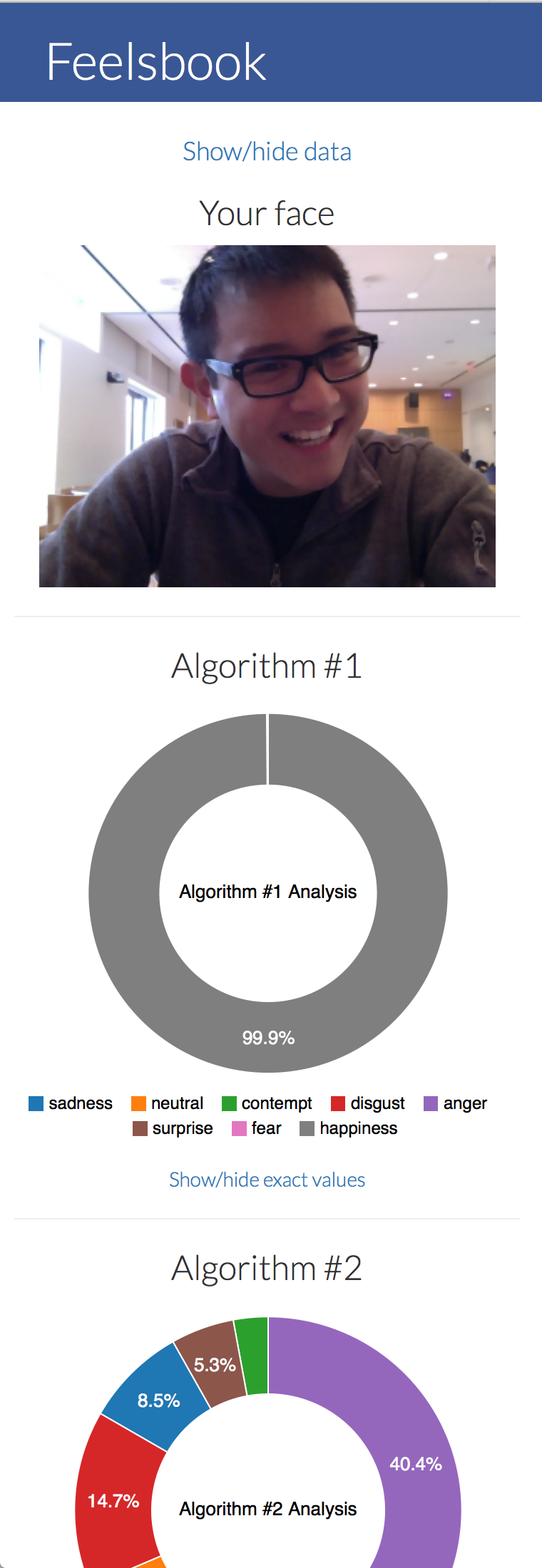
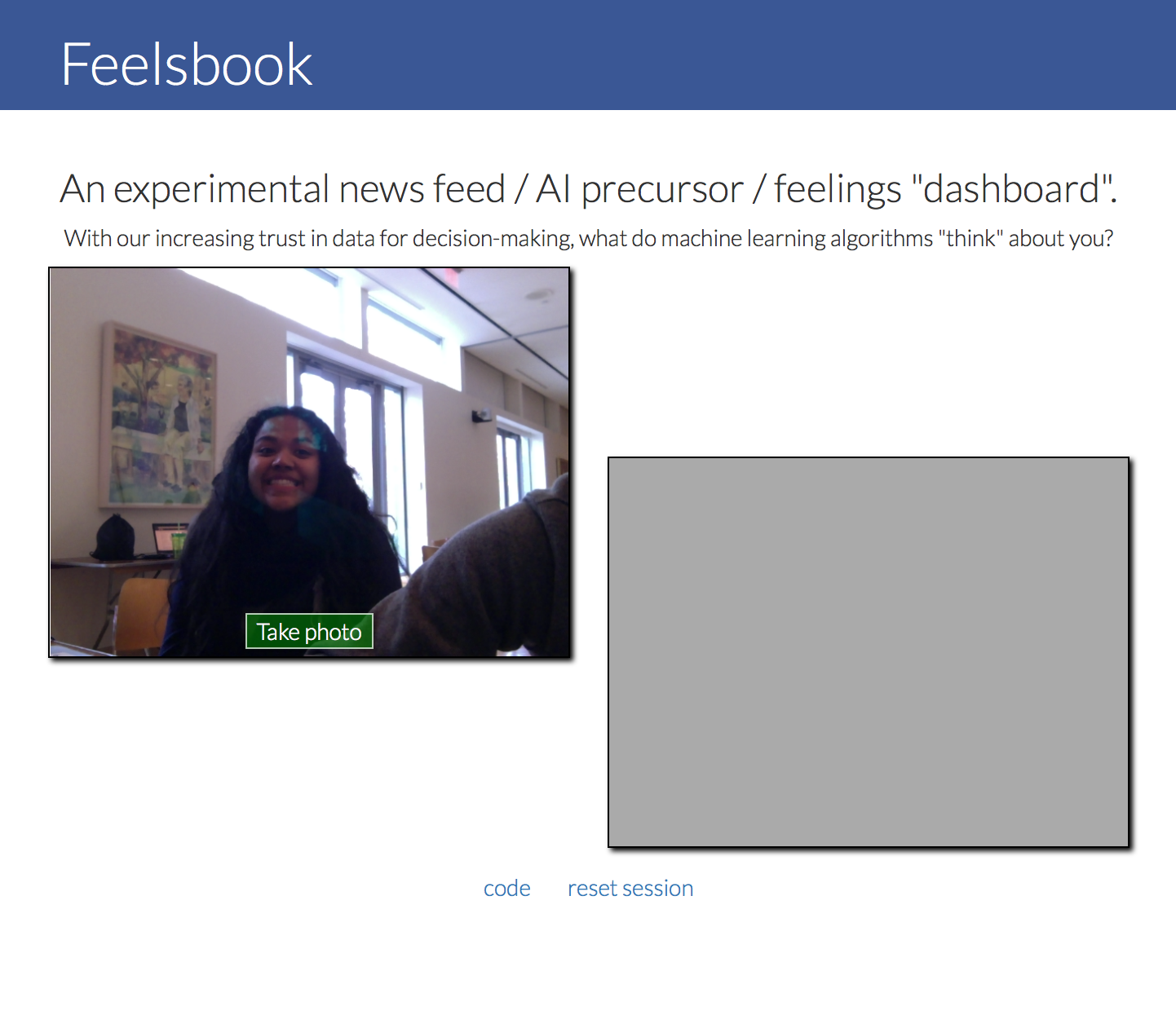
Feelsbook.com (live link)
A HackPrinceton 2015 hack
We take a still of your face, and pool emotional/topic predictions from the Microsoft, Indico, and Clarifai APIs to spark a conversation with an AI.
Credz
Rainier - Web development, APIs, ML, and deployment
Minah and Claryssa - This fun idea :), graphic design, creative direction, learned web development
APIs/services used
- Microsoft Project Oxford
- Indico
- Clarifai
- DigitalOcean
- Flask (Python)
- Bower for front-end dependencies (d3, bootstrap)
Technical challenges
Data encoding troubles with the still img_handler
- Grabs the binary data from the
WebRTCstill grab attached toPOST WebRTCwas somewhat intuitive to use--unicode or ASCII byte-encodings not-so-much. Manipulates the unicode that Python gets from thePOSTrequest form dict and turns it into the appropriate ASCII byte-encoding, which is then base-64-decoded, and then piped into a randomUUID-named.pngfile.- As a hack, I used
sshfsto mount thepublic_htmldirectory of my UT Austin CS account address into my working dir, and sent the new.pngfiles into that folder,chmoding per upload. - This renders the image into a resource that's easily accessible by APIs.
(Although this obviously won't scale, I only have 2 GB as an undergrad.)
- Finally, sends the
URLviaPOSTto the Microsoft Emotions API - tl;dr I changed an image
data-URIto a publicly availableURLso it'd play better with some ML libraries that didn't have native Python clients, but did have RESTful APIs. And this took longer than anticipated. - if you ask, changing to
application/octet-streamin the HTTP header did not work for me... but I learned a lot more from this anyway! :grin:
Ways to make this better
- Extraction of related tweets from status update
- Visualization of topic modeling tweets with network graphs
- Store the data-URIs to a database
- Integration with a chatterbot whose training state is on a database (or at least keep chat history
and bot training live for the session with something like Redis). Use long polling or websockets for
smooth UX


Log in or sign up for Devpost to join the conversation.