-
-
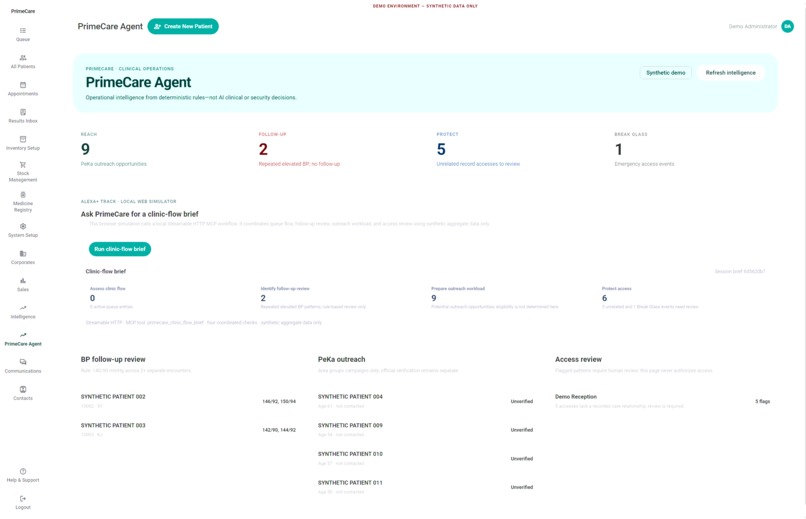
The analysis result from local Streamable HTTP MCP
Inspiration
I'm a doctor, working at primary care level in Malaysia. Primary care is just the first line defense, it serves to educate, to prevent to manage acute and chronic medical condition. In Malaysia, the prevalence of non-communicable disease is worrying, and people tend to know it late, making complications inevitable. 1 in 3 of adult Malaysian is having Hypertension, 1 in 2 is overweight, 1 in 5 is diabetic.
Current method seems to be outpaced by the ever increasing cases of non-communicable diseases. I believe Ai can enhance our approach to be more aggressive in spreading awareness, provide access to early detection, and hopefully achieve better primary care parameters which are reduction in overall burden of non-communicable diseases, both in clinical and economical aspect.
## What it does
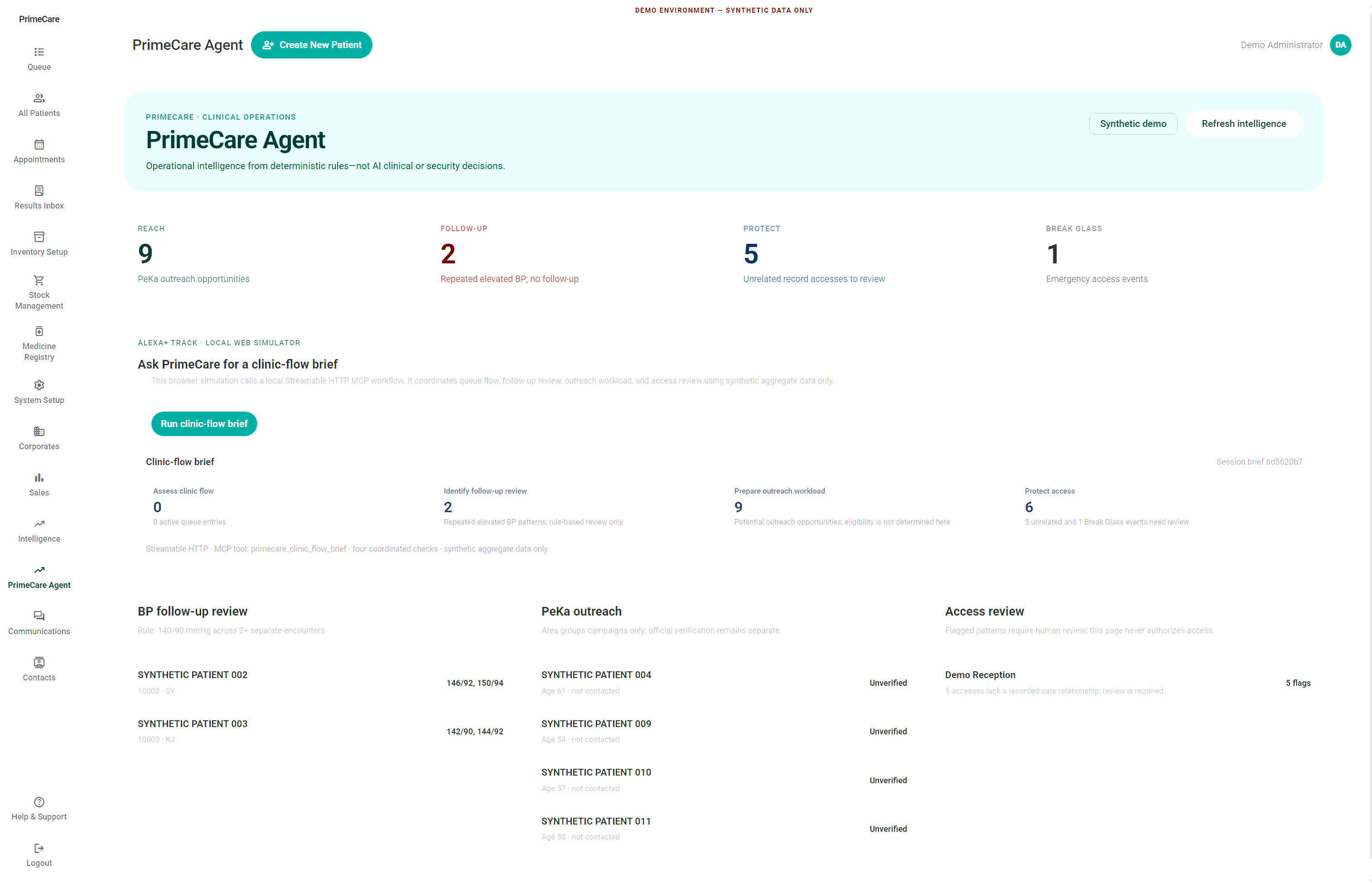
PrimeCare is a clinic-operations workspace designed to help primary-care teams stay ahead of important follow-up work. It brings together queue coordination, appointments, patient records, visits, prescriptions, dispensing, billing, stock management, and reporting in one connected workflow.
For the hackathon, we added the PrimeCare Agent experience: a local Alexa+ simulation powered by a self-hosted Streamable HTTP MCP server. The agent produces a clinic-flow brief by coordinating four read-only operational checks:
- Queue flow and active workload
- Repeated elevated blood-pressure patterns that require follow-up review
- Potential PeKa outreach opportunities
- Record-access patterns that need human review
The system uses synthetic aggregate data for the demo. It does not diagnose patients, determine eligibility, or make security decisions. It highlights work that needs a clinician or authorised staff member to review.
## How we built it
PrimeCare is built as a React and Vite frontend with a Node.js and Express backend. The demo uses a local SQLite-compatible database seeded with clearly labelled synthetic patients, clinic locations, visits, queue entries, and inventory data.
We created a dedicated local MCP server using Streamable HTTP. The
primecare_clinic_flow_brief tool calls separate service modules
for clinic operations, blood-pressure follow-up, outreach, and
access review. These services return aggregate, read-only results
that are combined into a single workflow brief.
To make the experience easy to understand, we built a browser-based Alexa+ simulator inside PrimeCare. It demonstrates how an agent can request the MCP workflow and present a clear, structured summary for a busy clinic team.
We also designed the demo with safety in mind: demo mode only permits a local database, external email and storage services are disabled, and the interface clearly identifies the environment as synthetic-only.
## Challenges we ran into
One challenge was balancing useful operational intelligence with safe clinical boundaries. It was important that the system did not present automated findings as diagnoses or treatment decisions. We addressed this by using transparent, deterministic rules and clear language that every flagged item requires human review.
Another challenge was demonstrating an MCP integration in a way that is understandable to non-technical clinic users. We solved this by creating the PrimeCare Agent page, which turns the MCP response into a simple four-step clinic-flow brief.
We also had to ensure the hackathon demo could never accidentally use real patient data or production services. This required isolating the local database, using synthetic fixtures, disabling external integrations, and documenting what must not be run in the demo environment.
## Accomplishments that we're proud of
We are proud that PrimeCare turns several disconnected clinic checks into one clear operational brief without exposing patient identities through the MCP workflow.
We are also proud of the safety-first design. The demo makes a clear distinction between operational support and clinical judgement: it can surface repeated BP patterns, outreach workload, and access-review signals, but it never replaces a clinician or authorised reviewer.
Finally, we are proud that the project combines a practical clinic- management interface with a working Streamable HTTP MCP server and a visible Alexa+ simulation. The result is not just a concept; it is a working local demo that can be explored end to end.
## What we learned
We learned that the value of an agent in healthcare operations is not in making more decisions automatically. It is in reducing the time required to find, organise, and review the work that already needs attention.
We also learned that MCP is a useful way to keep agent-facing workflows separate from the main application. By exposing a narrow, read-only tool with aggregate data, we can make operational context available without opening broad access to patient records or clinical notes.
Most importantly, we learned that trust depends on clarity. Users need to understand what the system knows, what it does not know, and when human judgement is required.
## What's next for PrimeCare
Next, we want to expand the deterministic operational rules with more configurable, clinician-approved workflows for follow-up, stock planning, outreach, and access review.
We also plan to improve the PrimeCare Agent experience with clearer workflow explanations, saved review queues, and role-appropriate summaries for administrators, clinicians, and front-desk staff.
Before any real-world use, we would continue strengthening privacy controls, auditability, consent handling, role-based access, and clinical governance. PrimeCare’s goal is to help primary-care teams act earlier and work more smoothly, while keeping people—not automation—responsible for care decisions.
Built With
- alexa
- express.js
- material3
- node.js
- react
- sqlite
- vite

Log in or sign up for Devpost to join the conversation.