Inspiration
We often rely on apps for recommendations for movies, music,but these suggestions usually depend on platform specific usage rather than our overall cultural taste. We wondered:
"What if an AI assistant could understand your taste holistically, like a friend who knows what you enjoy across music, movies, shows, and more?"
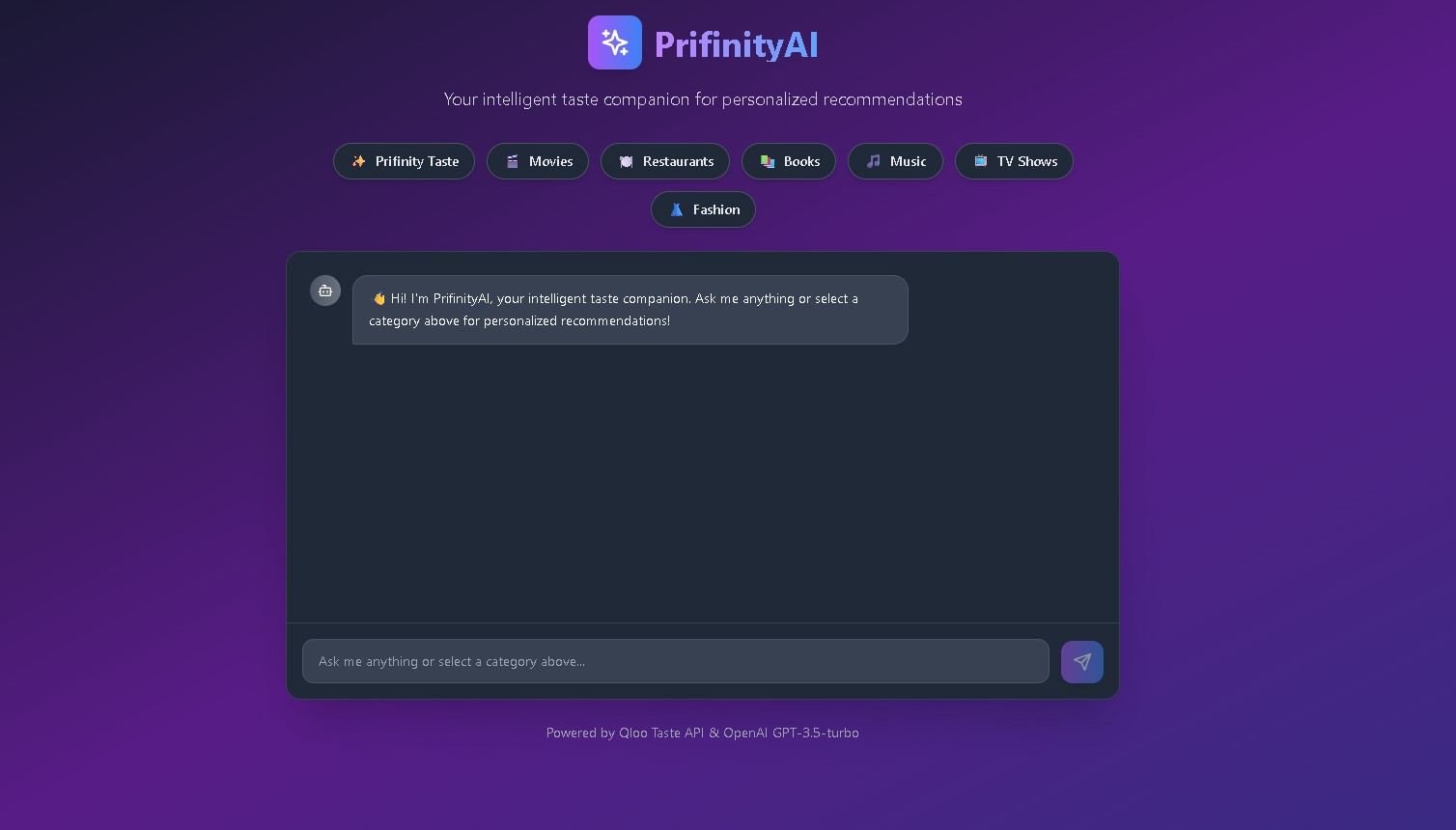
That’s where ✨PrifinityAI was born,a smart conversational app that uses Qloo’s Taste API to provide contextual recommendations along with GPT-3.5 Turbo. We were excited by the idea of fusing LLM language understanding with a data-backed taste engine to provide real, personalized, and explainable recommendations.
What it does
PrifinityAI is a smart recommendation platform that uses the power of OpenRouter’s GPT-3.5 Turbo and Qloo’s Taste API to offer tailored suggestions across categories like movies, TV shows, music, books, and more. It’s designed to feel like chatting with an intuitive friend who knows your taste.
Core Features
1 . Natural Language Chat Interface
Users can type natural queries like:
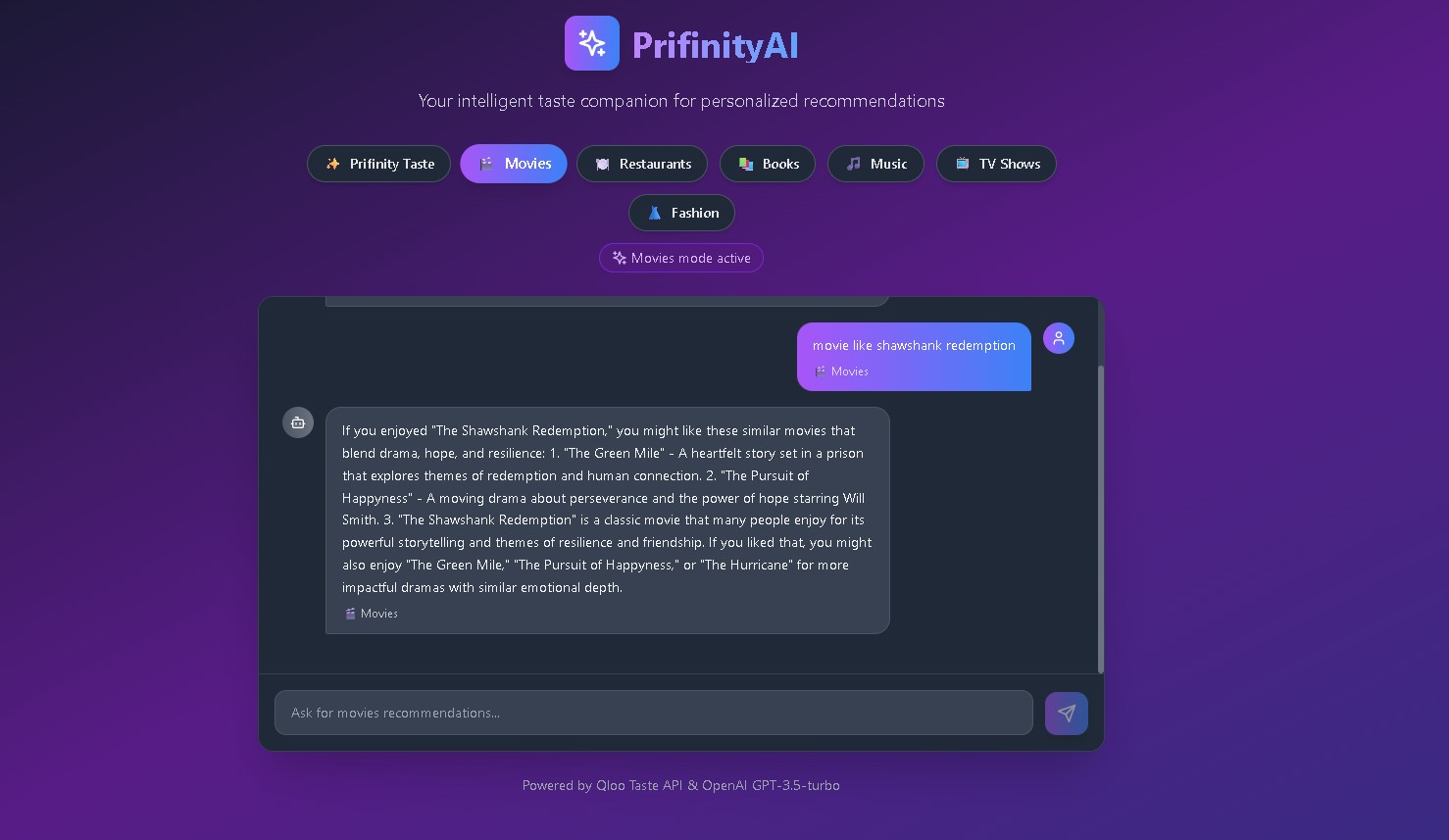
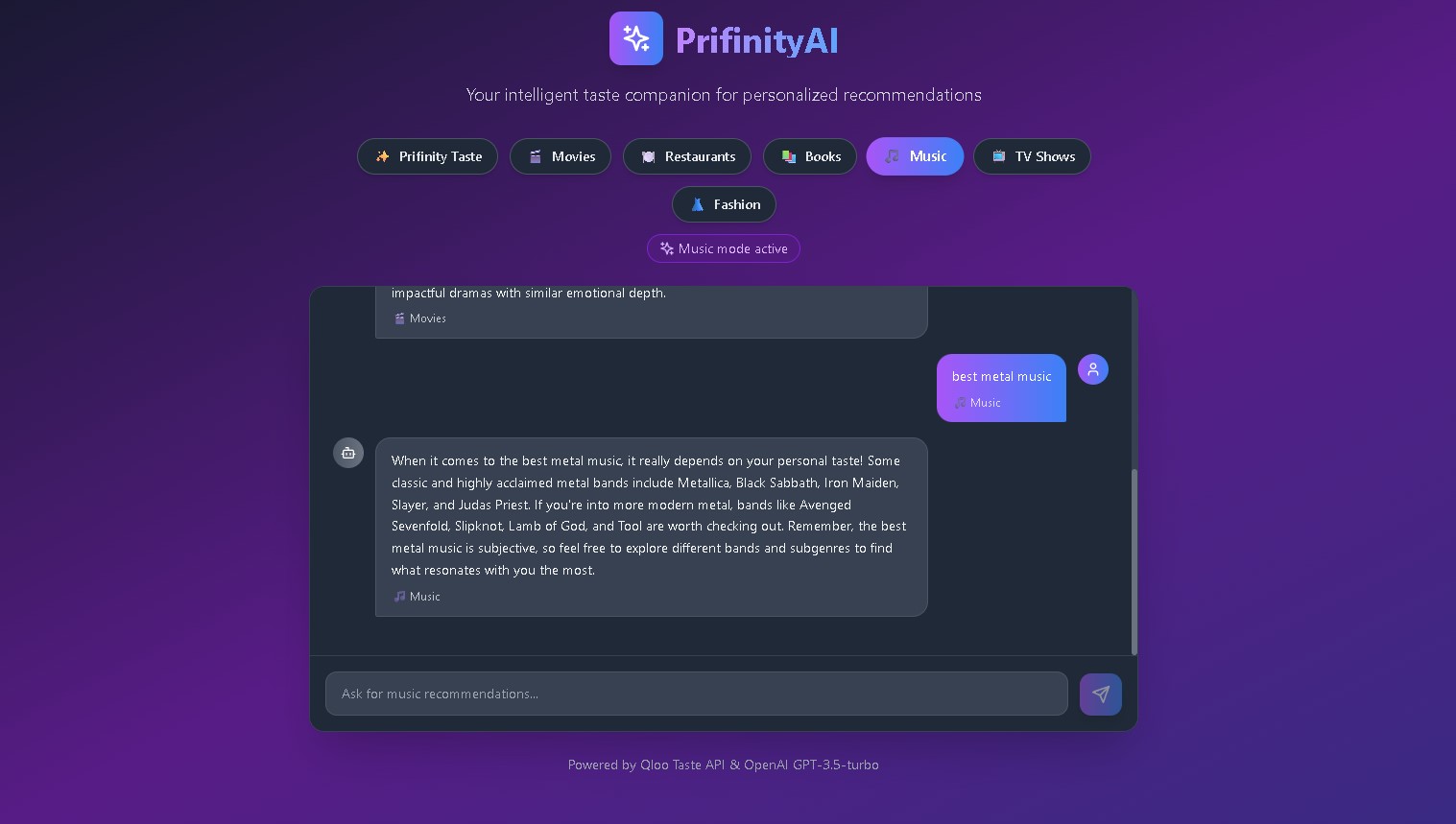
“Suggest movies like Ride Along” “Give me some calm music similar to Coldplay” “Recommend comedy shows I might enjoy” The interface feels like a smart assistant conversation, using GPT responses styled in a friendly, concise manner.
2 . Intelligent Category Detection
Even if the user doesn't specify a category, PrifinityAI detects the intent (e.g., “movies like XYZ” implies the category "movies") and builds a targeted query.
How we built it
Frontend (React + TypeScript):
We built chat UI using Vite,React and TypeScript, along with Tailwind CSS. The interface allows users to select categories such as Movies, Books, Music, and more. Each query is sent through a clean and responsive input field which are then further used to pass queries to the apis.
Backend (API):
Using Qloo Taste API to fetch cultural and taste based recommendations and GPT-3.5 Turbo through OpenRouter for language understanding .
Deployment:
The entire project is deployed on Vercel with environment configuration handled automatically. Environment variables (API keys for Qloo and OpenRouter ) are securely managed via Vercel’s dashboard.
Challenges we ran into
1 . Understanding Qloo’s Schema
The URN-based format was initially confusing. It took time to decode and construct these queries dynamically.
2 . Rate Limits & Cost
Even though GPT-3.5-Turbo was free till limit, each call still showed a cost on the dashboard, which we had to monitor.
Accomplishments that we're proud of
1 . Built a seamless, responsive chat interface using React and TypeScript, powered by Vite.
2 . Designed an architecture that sends user queries to Qloo, uses GPT, and returns human-like, personalized recommendation experience using GPT.
What we learned
1 . How to structure a React-based chatbot that routes and merges external data sources seamlessly without disrupting flow.
2 . Handling edge cases like empty results or ambiguous categories.
3 . Implemented environmental security best practices , and learned how to debug opaque API responses with minimal documentation.
What's next for PrifinityAI
1 . Add support for user profiles and taste memory, allowing the assistant to recall previous preferences and improve suggestions over time.
2 . Introduce rich content output, such as images, trailers, or previews fetched dynamically from third-party media APIs.
3 . Add authentication and usage analytics, so users can track their sessions, favorite suggestions, and create taste histories.
4 . Experiment with fine-tuned LLM prompts for even more natural, emotionally intelligent responses.
Built With
- react
- typescript
- vercel
- vite


Log in or sign up for Devpost to join the conversation.