-
-
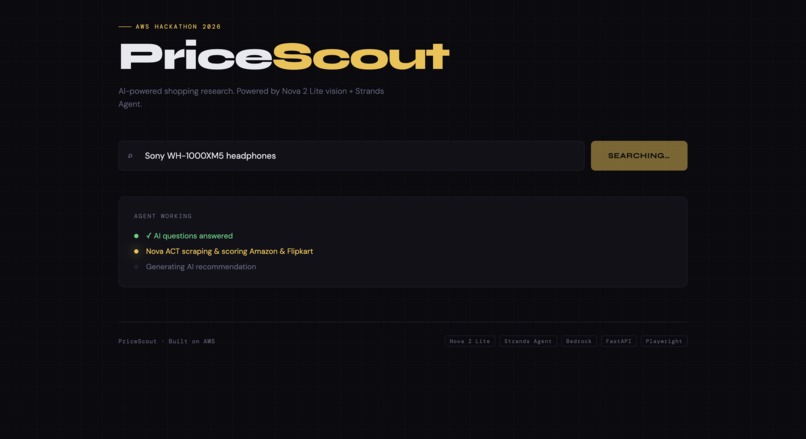
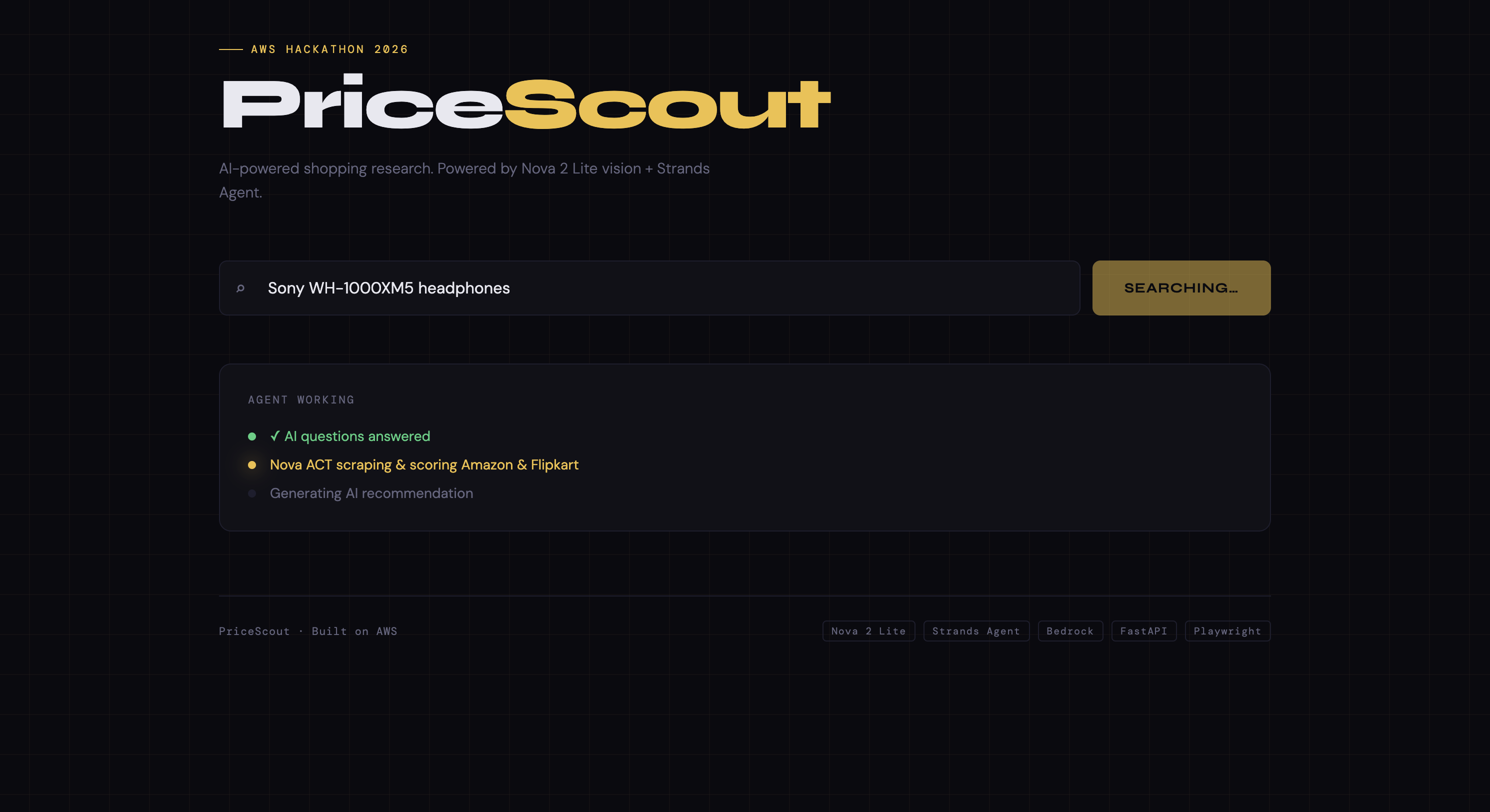
PriceScout AI agent autonomously researching products across e-commerce sites using Nova vision agents and generating shopping insights.
-
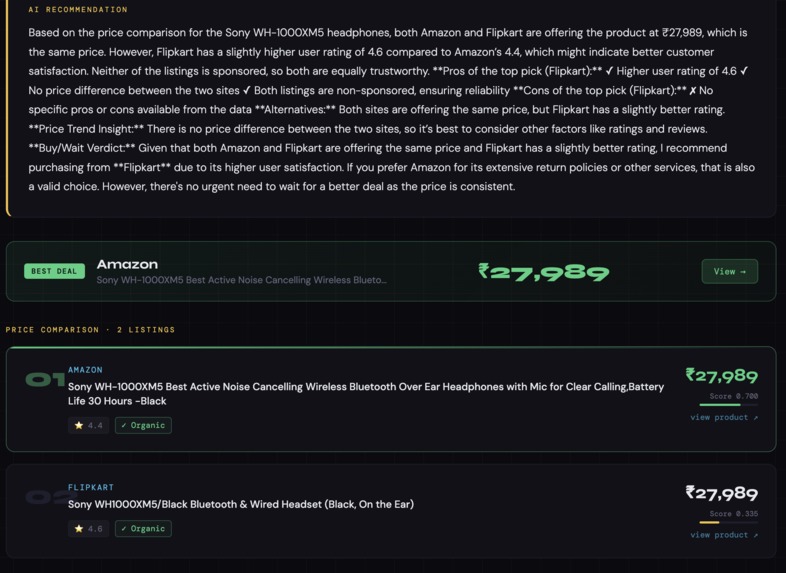
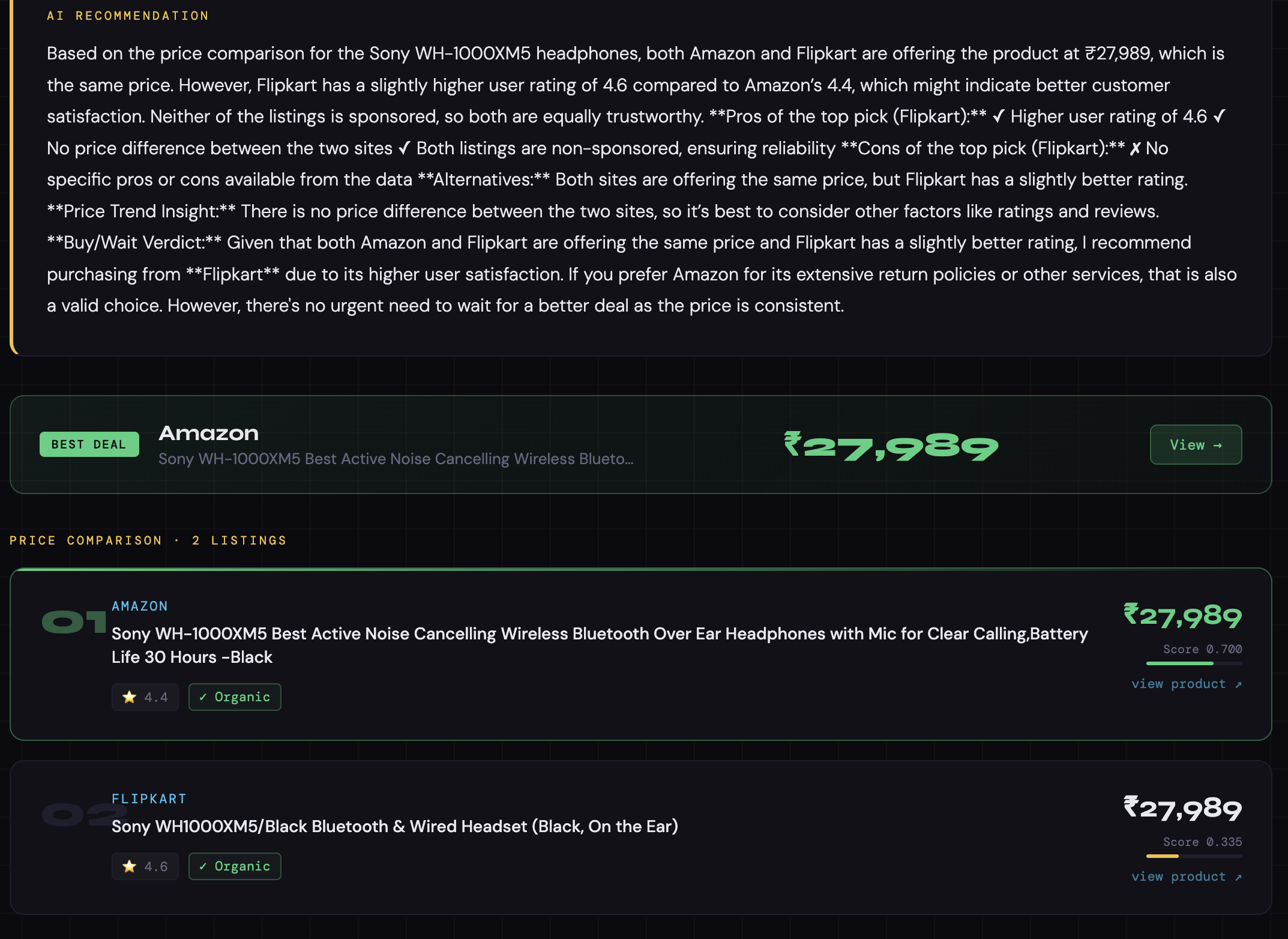
AI-generated product comparison with automated scraping, scoring, and a final purchase recommendation across multiple marketplaces.
Inspiration
We've all been there — opening ten browser tabs across Amazon, Flipkart, and Croma, trying to figure out which TV actually fits our needs and budget. The process is exhausting, and it still doesn't tell you if you're getting a good deal. We built PriceScout because smart shopping shouldn't require a research degree. We wanted a tool that understands what you need, fetches live prices, and gives you a clear answer — not more tabs.
What it does
PriceScout is an AI-powered price comparison engine for Indian e-commerce. You tell it what you're looking for in plain language, and it guides you through a short conversation to narrow down the right features — without letting you pick incompatible ones (no one needs an 8K panel on a 32" screen). Once your requirements are clear, it crawls top Ecommerce websites in real time, normalizes the results, and presents a side-by-side comparison with trade-off highlights — so you can make a decision in seconds, not hours.
Key capabilities:
- Conversational feature elicitation with compatibility guardrails
- Live web crawling via Nova Act across major Indian e-commerce platforms
- Apples-to-apples product comparison using a structured product schema
How we built it
- Amazon Nova Act for autonomous browser-based crawling — opens real browser sessions on E-commerce websites to extract product titles, prices, ratings, and sponsored flags
- Amazon Nova Lite (Bedrock) as the intelligence layer — powering query clarification, dynamic site classification, and natural-language report generation with pros/cons and buy/wait verdicts
- AWS Strands Agents SDK to orchestrate the multi-tool agent pipeline — chaining clarify → classify → crawl → score → report into a single autonomous flow
- Scoring engine that ranks products by value, not just price — 70% relevance (fuzzy match + keyword overlap) and 30% price, with sponsored listings flagged
- FastAPI backend with Server-Sent Events (SSE) streaming progress in real time to a React + Vite frontend
Challenges we ran into
- Website crawling restrictions — Many e-commerce platforms actively restrict or block automated crawling. Handling rate limits, anti-bot protections, and access restrictions while still retrieving reliable data became one of the biggest challenges during development.
- Limited initial product awareness — During the first stage of the search, the AI may not know all available product variants. For example, if a user searches for an iPhone, the system may not immediately know every available model or configuration, requiring additional steps to discover and expand the available options.
- Data normalization across platforms — Different e-commerce websites structure product information differently, making it difficult to compare products directly without additional processing and normalization.
- Balancing freshness and speed — Prices change frequently on e-commerce platforms, but crawling every site for every query is slow. Designing a system that balances cached results with fresh data was an important challenge.
Accomplishments that we're proud of
- Building an AI agent designed to think and interact like a human during the shopping process, helping users save time when purchasing products online.
- Designing a workflow where the agent first gathers user requirements conversationally, then fetches real-time prices and reviews from e-commerce platforms to recommend better options.
- Even though we couldn’t fully optimize the system within the hackathon timeframe, we successfully built the complete workflow and foundation for how the product should function.
- Establishing the groundwork for our long-term goal: an AI agent that can eventually complete the entire online shopping process end-to-end for the user.
- Effectively utilizing multiple tools, models, and technologies available to us during the hackathon, and exploring their capabilities to implement innovative ideas within the project.
What we learned
- Building AI agents that interact more like humans than traditional software significantly improves the shopping experience, especially when gathering requirements conversationally.
- Separating responsibilities in the system is important — the AI agent focuses on understanding user intent, while other components handle data retrieval like prices, reviews, and product details.
- Integrating with real-world e-commerce websites is complex, as different platforms structure their data differently, requiring thoughtful handling and normalization.
- Working with multiple tools and AI models taught us how to combine their strengths to build more capable systems rather than relying on a single technology.
- Even in a limited timeframe like a hackathon, building a clear workflow and foundation is crucial, because it makes future improvements and automation much easier.
What's next for PriceScout
- Expanded platform coverage — Integrating more e-commerce platforms like Croma, Vijay Sales, Reliance Digital, and Tata Cliq to provide broader and more competitive price comparisons.
- Price history tracking — Adding historical price analysis so users can see whether the current price is truly a good deal based on past trends.
- Deal alerts — Allowing users to set target prices and receive notifications when a product drops below their desired price.
- Mobile app — Building a mobile application with a scan-and-compare feature, enabling users to quickly compare online prices while shopping in physical stores.
- Category expansion — Extending beyond electronics into categories like home appliances, furniture, and personal care, making PriceScout useful for a wider range of shopping needs.
Built With
- amazon-bedrock
- amazon-nova-act
- amazon-nova-lite
- aws-strands-agents-sdk
- boto3
- cloudflare-tunnel
- fastapi
- javascript
- loguru
- postgresql
- python
- react
- uvicorn
- vite


Log in or sign up for Devpost to join the conversation.