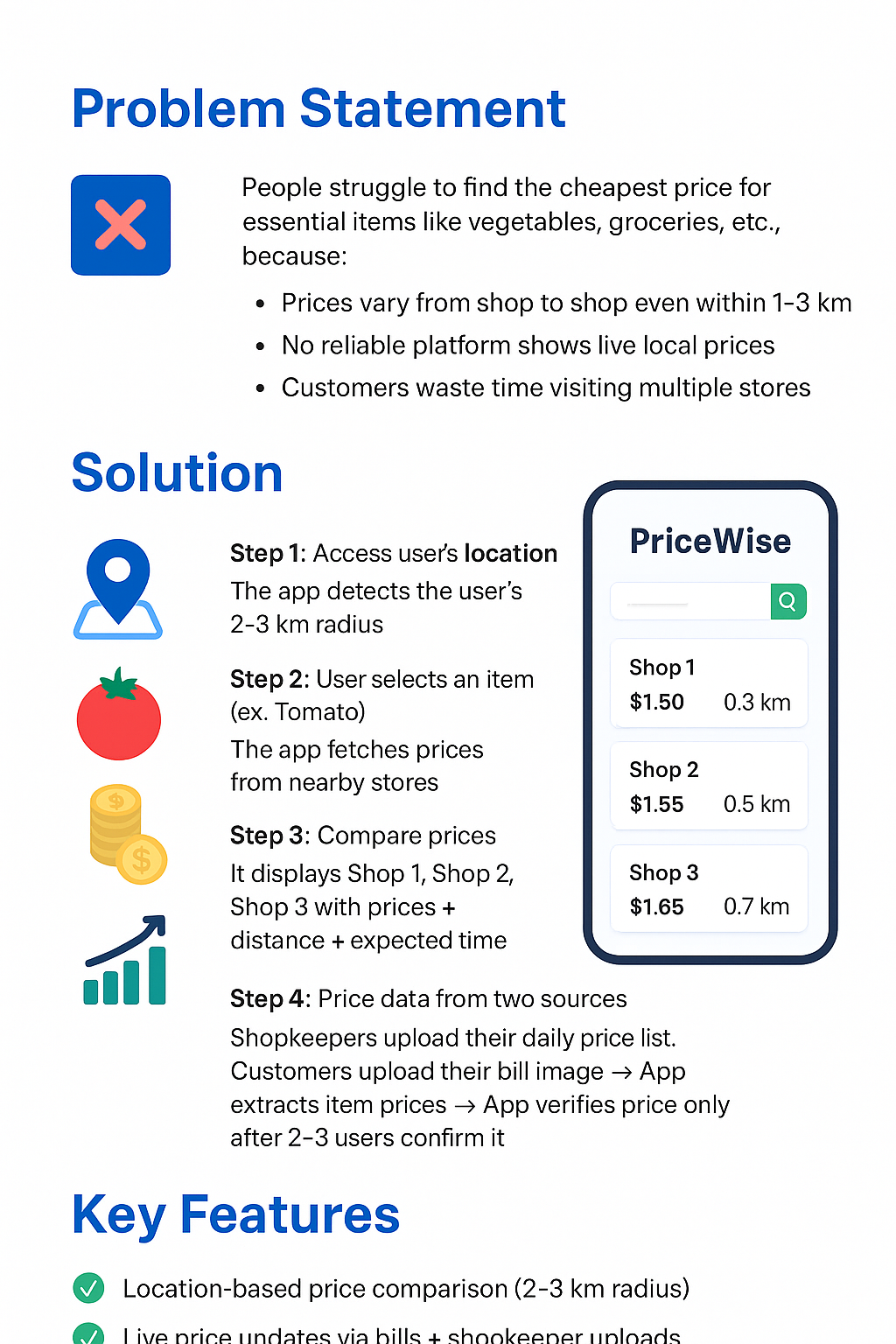
🌟 Inspiration In everyday life, people often visit multiple shops to find the cheapest price for groceries and essential items. Small price differences—₹2, ₹5, ₹10—may seem minor, but they accumulate into a big monthly expense. This problem inspired us to build a hyperlocal price comparison platform so users can instantly check which nearby shop offers the best price for any product. We wanted to reduce: • Wasted time in travelling to compare prices • Overpaying due to lack of transparency • Dependency on assumptions or guessing the “cheapest shop” Our goal was simple: Make local shopping smarter, transparent, and efficient for everyone.
🏗️ How We Built It We broke the project into four major components:
Data Collection Layer • Bill Scanner Uploads (from customers) • Manual Uploads (by shopkeepers) • Price Listings (entered by registered shops) All data is normalized and stored with: • Product name • Shop name • Price • Timestamp • Location coordinates
Backend + APIs We designed secure APIs to: • Fetch shops near the user • Compare prices across multiple stores • Rank the cheapest price • Show trending items • Identify price drops and spikes The backend also includes: • Authentication for shopkeepers • Validation for user-uploaded bills • Efficient database indexing for fast search
Frontend (User + Shop Views) User Features • Enter a product and instantly view the stores selling it • Sort by price, distance, or ratings • Save items to a wishlist • Upload bills to help others • View map + list results Shopkeeper Features • Add/edit product prices • Manage inventory • Upload daily/weekly updated rates • Gain insights on what users are searching for
Location + Distance Logic We used geolocation APIs to get accurate user and shop coordinates. Distance-based sorting helps users find the nearest and most affordable options simultaneously.
🧪 What We Learned Throughout the development, we gained practical knowledge in: • Structuring a real-world, data-heavy application • Working with location-based services and mapping • Handling multiple user roles (buyer + shop owner) • Designing scalable APIs • Filtering, sorting, and ranking large datasets efficiently • Improving UI/UX to simplify user decision-making • Creating price comparison logic for real-time updates
🚧 Challenges We Faced
Cleaning and Validating Data User-uploaded bills often had inconsistent designs or unclear text. We had to build rules to: • Extract product names • Correct spelling variations • Map similar items to a standard list
Handling Price Variations Two shops might list: • “Aashirvaad Atta 5kg” • “Aashirvaad Atta 5 kg Packet” • “Aashirvaad Atta 5KG” We created a normalization system to treat them as the same item.
Efficient Distance Sorting Sorting many shops by proximity was initially slow. We optimized queries and indexing to make this process fast even for large datasets.
UX Flow Issues Designing the interface for both shops and users without confusion was challenging. We iterated multiple times until the flow felt intuitive.
🎯 Conclusion This project taught us how to identify a real-world problem and create a scalable solution around it. By combining user-generated data, shopkeeper inputs, and location intelligence, our platform brings true price transparency to everyday shopping. It’s not just an app—it’s a step toward smarter hyperlocal commerce.
Built With
- html5
- jwt
- ocr


Log in or sign up for Devpost to join the conversation.