-
-
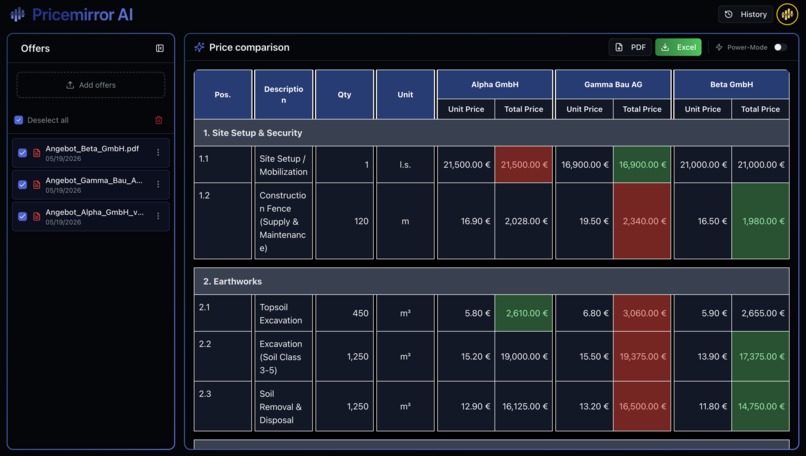
Pricemirror AI – editable price-comparison workspace
Inspiration
AI can already generate spreadsheet content. The harder problem is turning that content into a genuinely well-designed, professional spreadsheet with clear visual hierarchy, consistent formatting, reliable formulas, and structured layouts. Pricemirror AI solves this while keeping the output native and fully editable. Users can select, apply, and customize themes after generation—without regenerating or changing the underlying content, formulas, or structure. The result is a polished, adaptable spreadsheet rather than a static image or fixed export.
What it does
Pricemirror AI converts unstructured supplier quotes into polished, editable price-comparison workbooks.
Users can:
- upload PDF, XLSX, XLS, or CSV offers, including scanned documents;
- extract and reconcile differently named line items across vendors;
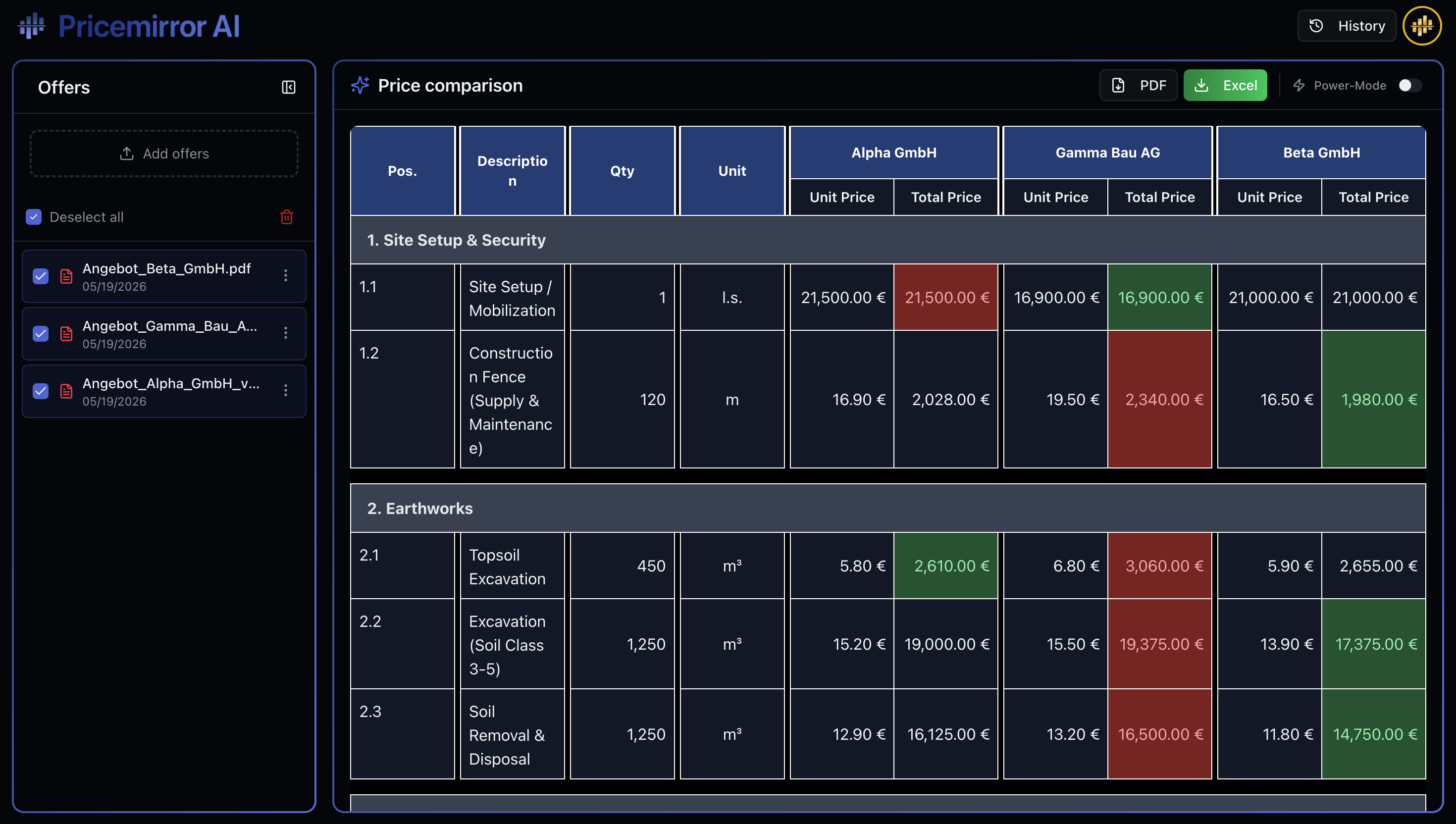
- generate a structured comparison with formulas, subtotals, totals, and visual hierarchy;
- edit the generated table directly;
- select or customize a theme after generation without changing the underlying data;
- export a native XLSX workbook or a carefully paginated PDF;
- highlight the lowest and highest prices automatically; and
- choose EU-only AI processing when data-residency requirements matter.
The result is not a screenshot of a spreadsheet. It is editable native output with real cells, formulas, number formats, layout, and styling.
How we built it
Pricemirror AI is a production web application built with Next.js 16, React 19, TypeScript, Tailwind CSS, Supabase, the Vercel AI SDK, Vercel AI Gateway, Google Vertex AI, ExcelJS, and jsPDF.
The system uses a staged pipeline:
- Secure upload to private storage.
- Text and spreadsheet extraction, with OCR fallback for scans.
- AI-based normalization and semantic matching of vendor line items.
- Generation of a structured intermediate table with explicit formula metadata.
- Sanitization and schema-boundary validation before rendering.
- Independent theme application in the browser.
- Native XLSX and PDF rendering with formulas, rich text, pagination, and formatting preserved.
Separating document understanding, table structure, formulas, and presentation is what makes post-generation editing and theme changes reliable.
How GPT-5.6 and Codex were used
GPT-5.6 through Codex served as an engineering agent across the repository. Codex accelerated codebase navigation, implementation, refactoring, debugging, and verification across the ingestion, AI orchestration, table-processing, and export layers. It helped centralize AI task adapters, trace cross-layer failures, strengthen schema boundaries, and expand deterministic benchmark and regression coverage.
Codex was especially valuable for rapidly following a spreadsheet value from an uploaded document through extraction, AI output, sanitization, browser editing, and final XLSX/PDF rendering. It also ran type checks, benchmark suites, and production builds to verify changes.
The key product decisions were human-directed: native workbooks over flattened output, formulas and themes as separate concerns, a validated intermediate representation, support for messy real-world inputs, and explicit EU routing.
Challenges
The hardest challenge is that supplier offers describe the same work in different words, units, document layouts, and levels of detail. A useful comparison must reconcile those differences without inventing facts or silently dropping unmatched rows.
The second challenge is fidelity. A table can look correct in HTML while formulas, merged cells, borders, rich text, or pagination break during export. Pricemirror therefore treats rendering and export as testable product layers rather than a final formatting step.
The third challenge is safe AI integration. Large documents, partial model output, provider routing, storage boundaries, and long-running jobs all need deterministic guardrails around a probabilistic model.
Accomplishments
- Professional, formula-aware native Excel output
- Editable generated tables with post-generation theme switching
- OCR and spreadsheet ingestion in one workflow
- Structured matching across multiple supplier documents
- High-fidelity PDF export with pagination and rich-text handling
- Deterministic benchmark fixtures and regression tests for core AI tasks
- EU-only routing and audit events for provider, model, and execution region
- A complete multilingual product experience in English, German, and French
What we learned
High-quality AI spreadsheets require more than a strong prompt. The dependable approach is to constrain the model with a clear schema, validate its output, keep calculation metadata explicit, and make the renderer responsible for deterministic visual quality.
What's next
Next steps include more industry-specific templates, stronger GAEB interoperability, collaborative review workflows, deeper accounting and procurement integrations, and additional automated checks for workbook accessibility and formula consistency.
Built With
- codex
- exceljs
- google-vertex-ai
- gpt-5.6
- jspdf
- next.js
- ocr
- react
- supabase
- tailwind-css
- typescript
- vercel
- vercel-ai-gateway
- vercel-ai-sdk

Log in or sign up for Devpost to join the conversation.