-
-
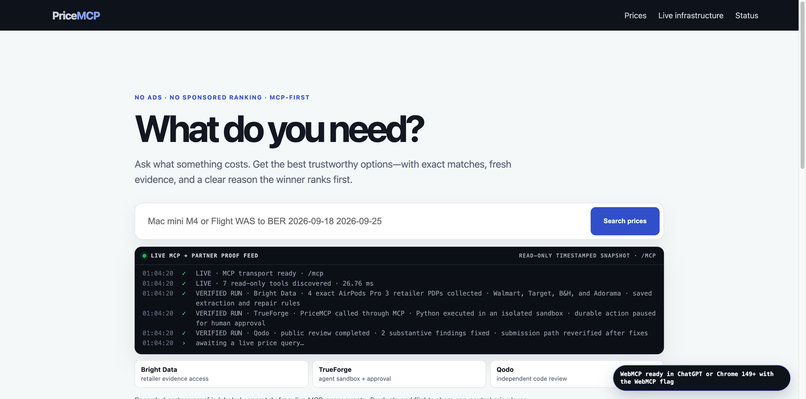
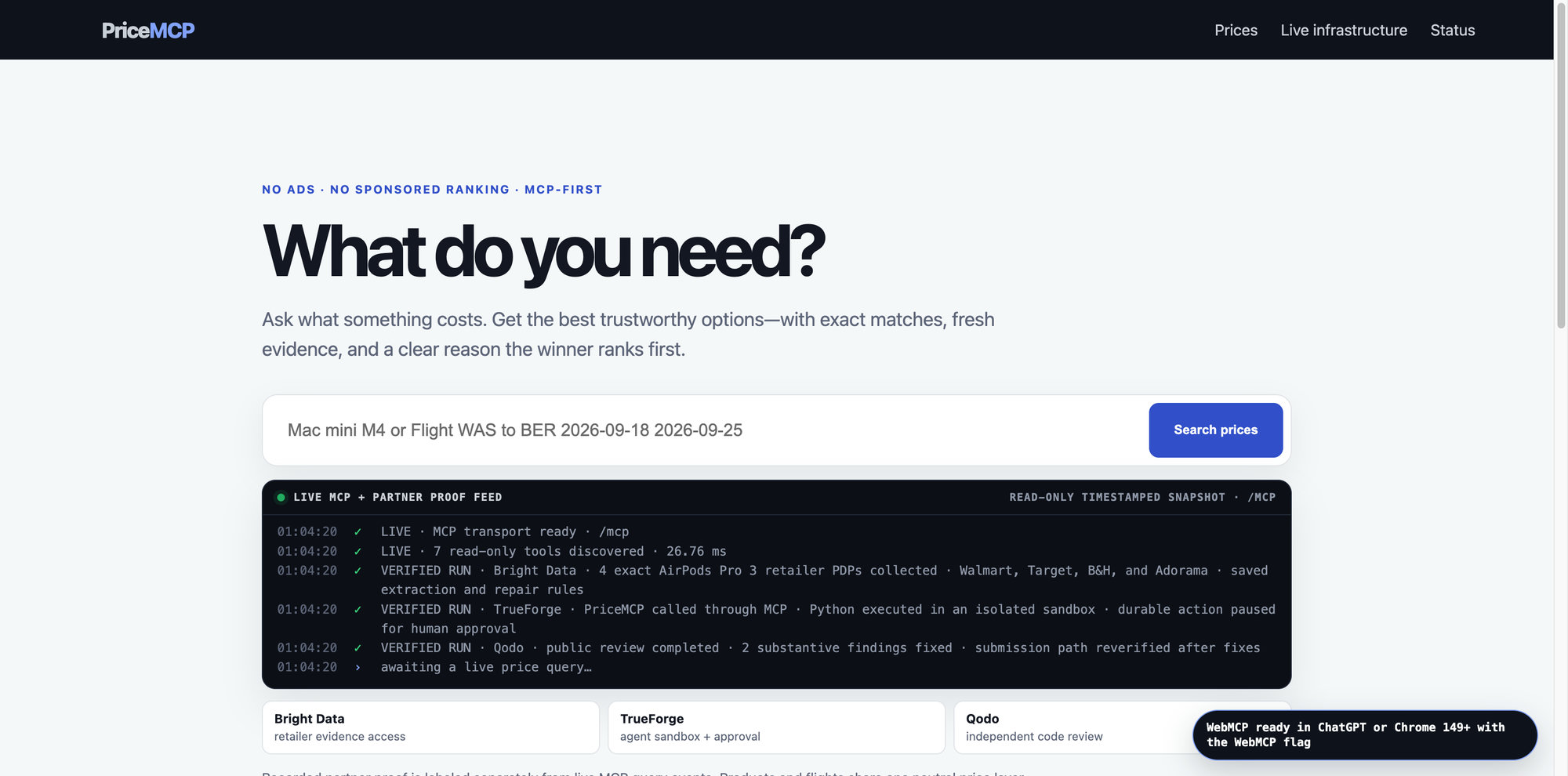
PriceMCP’s live search interface with the WebMCP-ready status visible.
PriceMCP — WebMCP Challenge
- Live application: https://pricemcp.vercel.app
- Public 1:30 YouTube demo: https://youtu.be/8UA3jLzF6_s
- Reproducible video backup: https://github.com/tobias-minibot/pricemcp/releases/download/webmcp-challenge-v2/pricemcp-webmcp-demo.mp4
- Implementation pull requests: #30, #31
What people and agents do together
A person opens PriceMCP and asks their browser agent to find an exact product
variant. The agent calls find_best_price instead of guessing through page
controls or scraping rendered text. PriceMCP resolves the canonical product,
excludes stale, unavailable, conditional, or untrusted offers from the winner,
and returns compact evidence with timestamps, conditions, and source URLs.
The result is also rendered into the open page. Person and agent can inspect the
same winning offer and ranking explanation, then use
inspect_price_evidence to audit the underlying seller records. This shared
page state is the collaboration boundary: the agent researches; the person sees
and judges the evidence. The WebMCP tools are read-only and never purchase,
reserve, subscribe, message a seller, or write a procurement decision.
Why WebMCP
Ordinary browser automation would have to infer PriceMCP's meaning from forms, cards, and text. The existing backend MCP endpoint is structured but is not automatically available to a browser agent. WebMCP bridges the actual web app: the page advertises purpose-built tools, validates structured arguments, calls the same read-only price pipeline as the human interface, and visibly shares the result back into the page.
Implementation
src/webmcp.ts registers three imperative WebMCP tools with
document.modelContext.registerTool(...):
find_best_price({ query })calls PriceMCP's read-only MCP diagnostic bridge at/v1/mcp/search. It returns the canonical subject, best qualifying offer, two alternatives, ranking reasons, observation time, and provenance.inspect_price_evidence({ product_id, max_age_hours })calls the canonical product offer endpoint and returns up to three seller observations with their trust, availability, membership, freshness, and source fields.run_flight_price_demo({})runs a permanent, explicitly synthetic and non-bookable WAS–BER fixture through the existing read-only MCP diagnostic bridge. It lets judges verify discovery, execution, shared page state, and normalized conditions even after the deployed product snapshot has aged.
Tool descriptions and outputs follow Chrome's recommended character budgets.
Both tools set readOnlyHint: true and untrustedContentHint: true. Fetches
receive the WebMCP execution AbortSignal. Returned data is capped before the
1,500-character recommendation, and DOM updates use textContent rather than
injecting retailer content as HTML.
The original PriceMCP repository was created on August 29, 2026, inside the challenge period that began August 25. Browser WebMCP support was added on September 3; its commits and pull request distinguish this challenge-specific implementation from the prior backend MCP work.
Reproduce
- Open https://pricemcp.vercel.app in ChatGPT's in-app browser, or Chrome
149+ with
chrome://flags/#enable-webmcp-testingenabled. - Ask the agent:
Find the best trustworthy price for AirPods Pro 3 and explain why it wins. - Confirm that it discovers and calls
find_best_price. The page should display a Shared agent result containing the same winner and explanation returned to the agent. - Ask:
Inspect the source evidence for the canonical product you found. - Confirm that it calls
inspect_price_evidenceand reports seller trust, availability, membership dependency, freshness, timestamp, and source URL. - For a permanent reproduction path, ask:
Run PriceMCP's disclosed WebMCP
flight demo.
Confirm that the response and page both label it synthetic and non-bookable.
In a browser without WebMCP, the fixed status pill explains how to enable it. All production tools remain read-only. Product data is a deployed timestamped snapshot; location-dependent tax is excluded and unknown shipping is disclosed rather than estimated.
Verified evidence
On September 3, 2026 UTC, Chrome 152 with WebMCPTesting enabled discovered all
three tools through document.modelContext.getTools() and executed
run_flight_price_demo through document.modelContext.executeTool(). The live
result reported dataset: pricemcp-demo-v1, synthetic: true, and the boundary
Synthetic demonstration; not live, purchasable, or bookable. The same
execution rendered the shared WAS–BER result into the page.
The YouTube upload is 1:30, public, contains OpenAI Cedar narration, and passed YouTube's checks
with no issues found. Its exact release backup has SHA-256 digest
c215d98c83b331ea1cfad8cce71e4de61fa03ef84232f6826a1e75d55bbe5ee0.
Built With
- context
- model
- next.js
- node.js
- react
- typescript
- vercel
- webmcp

Log in or sign up for Devpost to join the conversation.