-
-
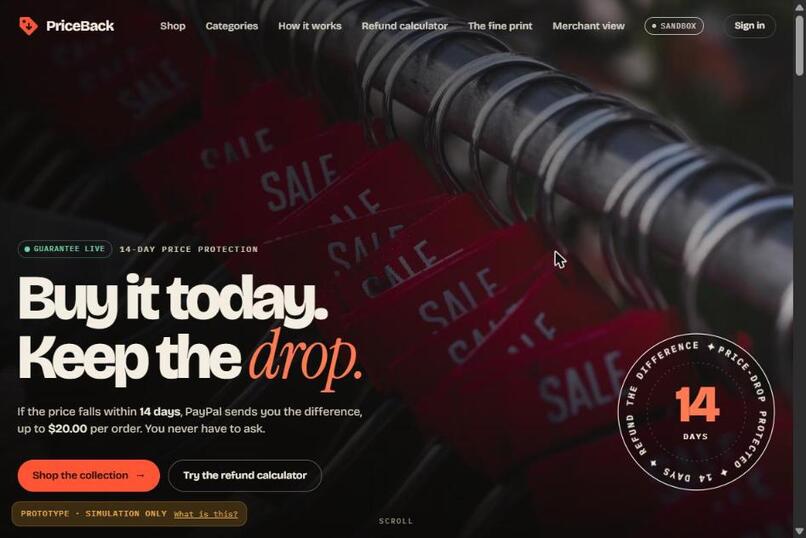
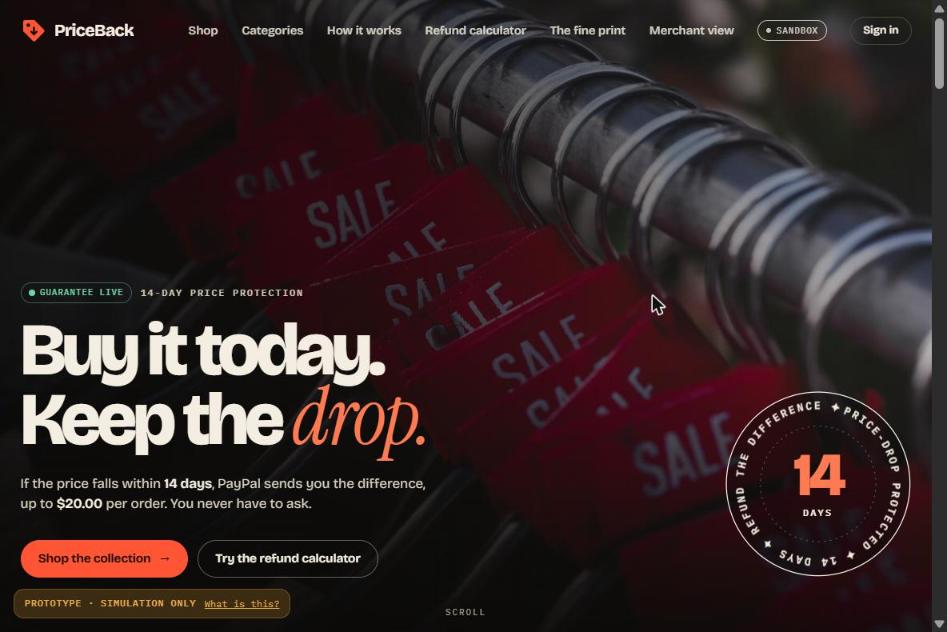
Landing Page (Intro Page)
-
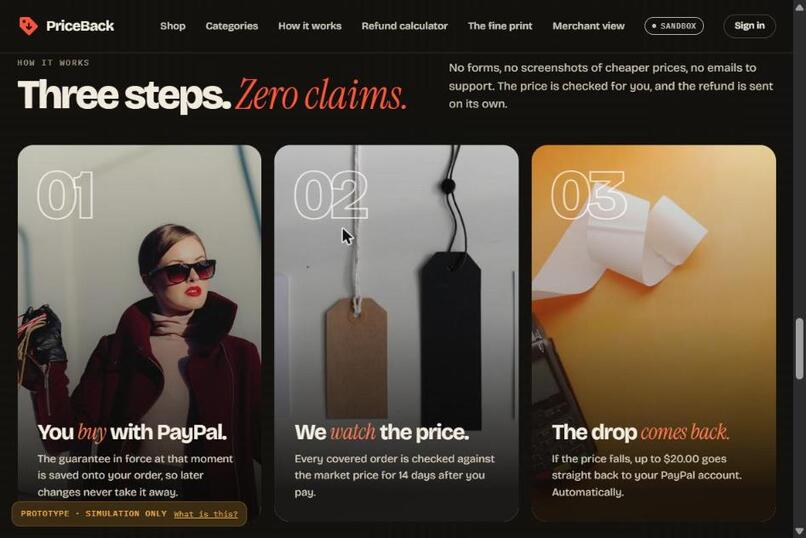
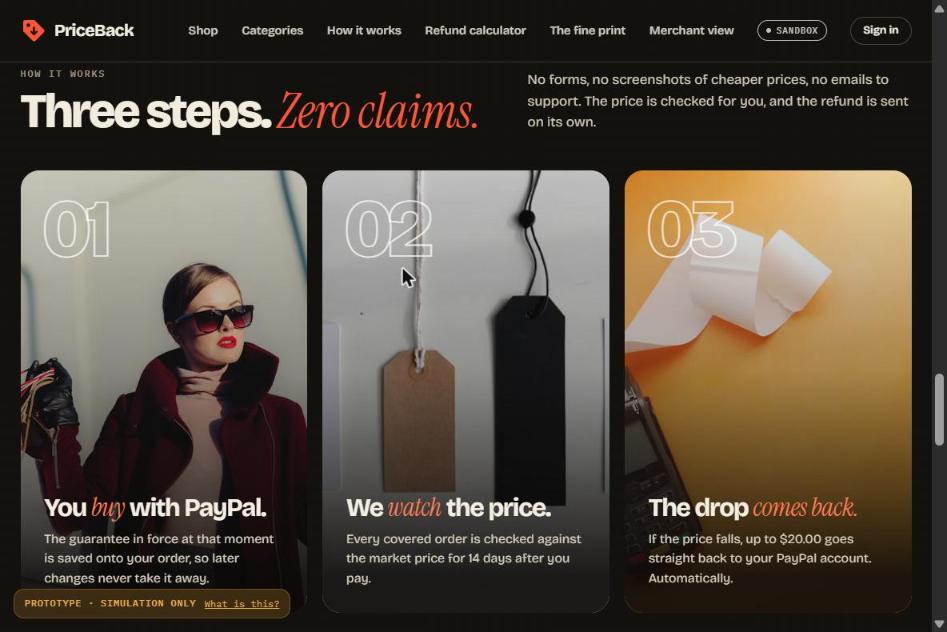
How page (explains how PriceBack works)
-
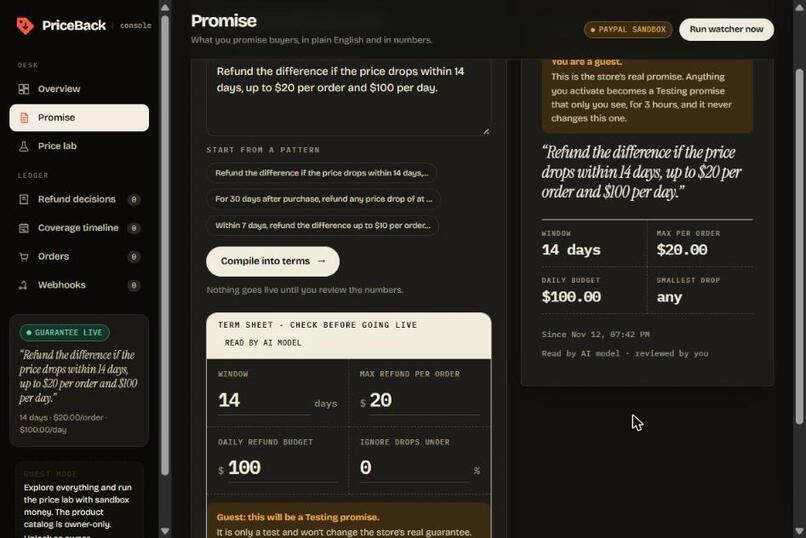
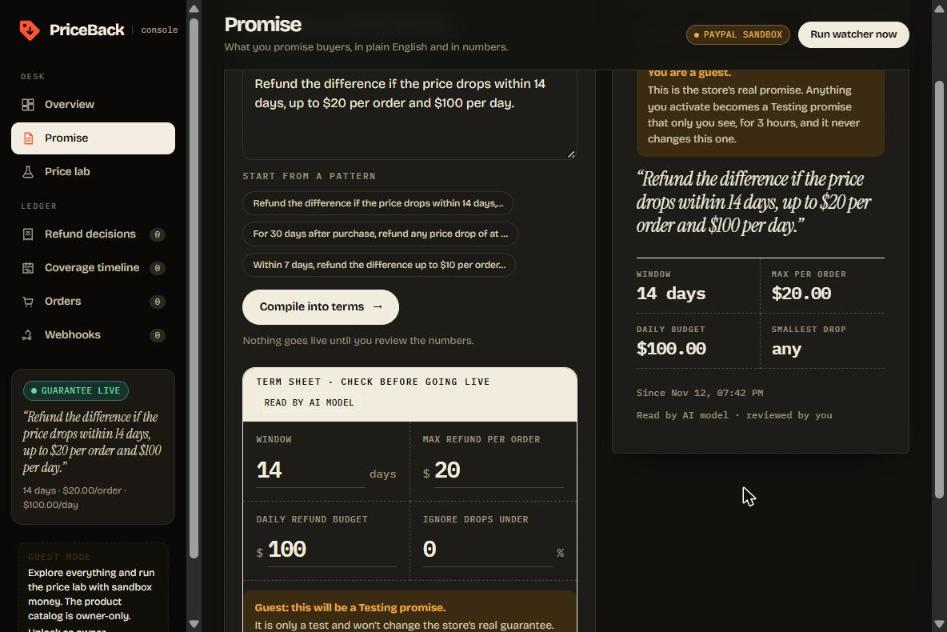
Merchant writes a Promise in plain English(Merchant Page)
-
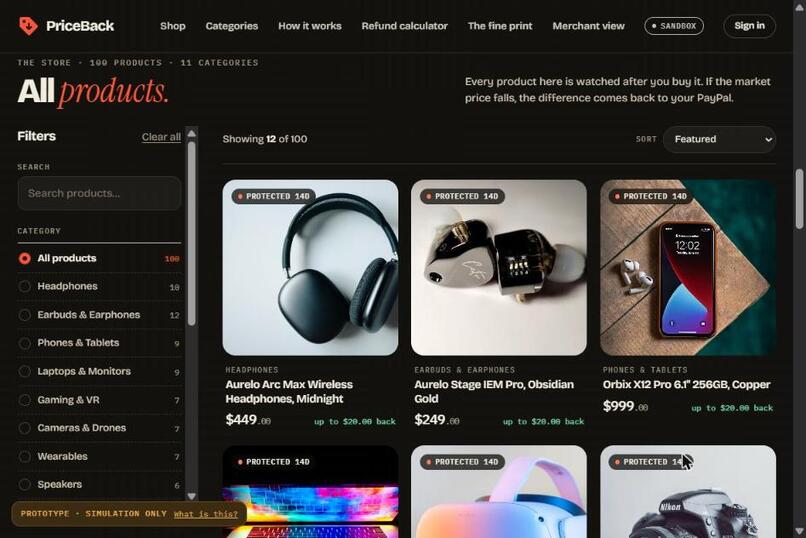
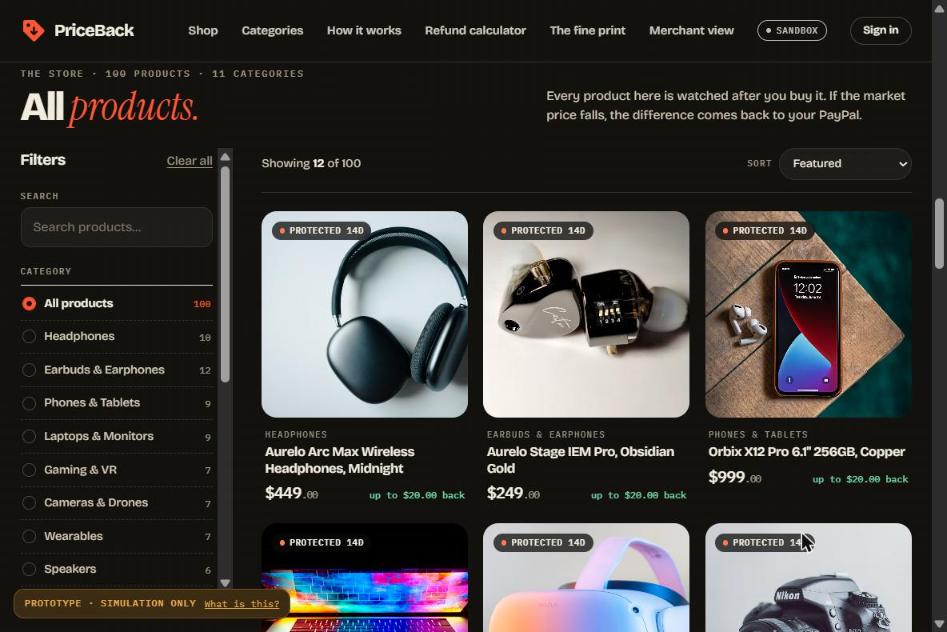
Store Products
-
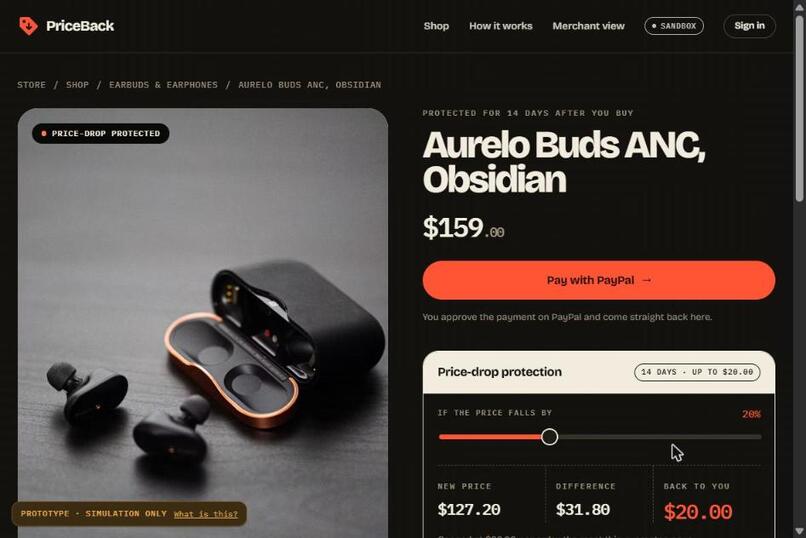
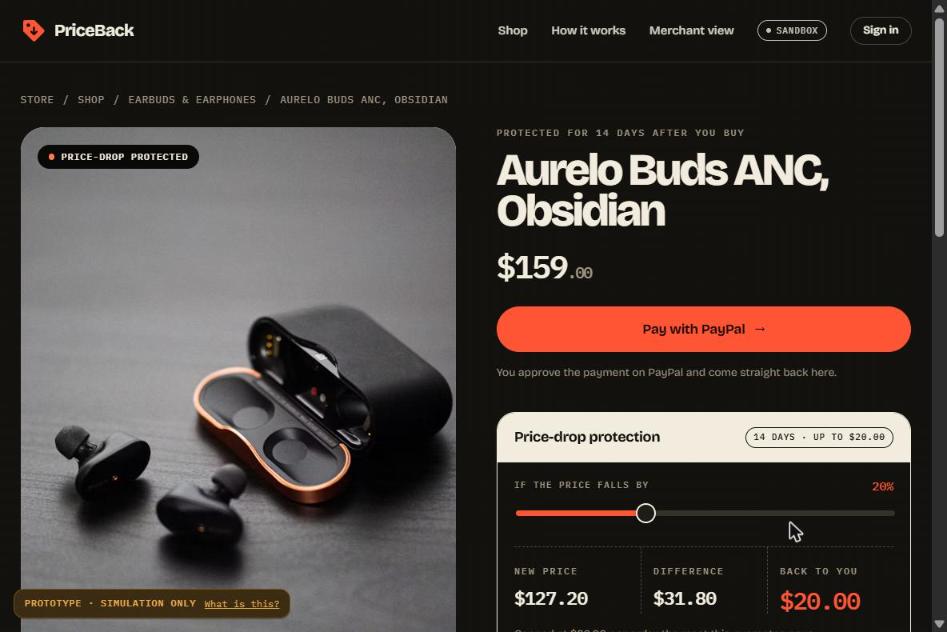
Particular Product Page (Pay with PayPal)
-
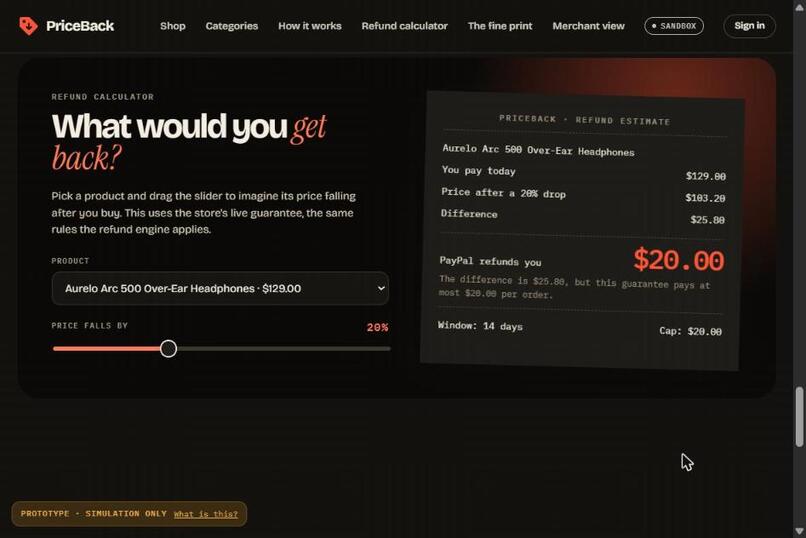
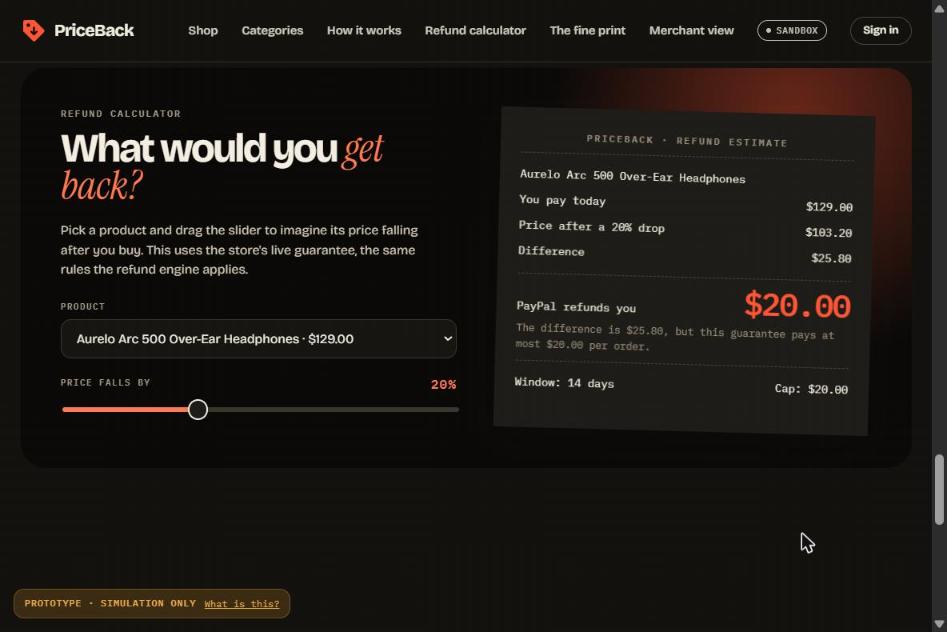
Refund Calculator (helps buyer analyze how much money will they get back if Price drops)
-
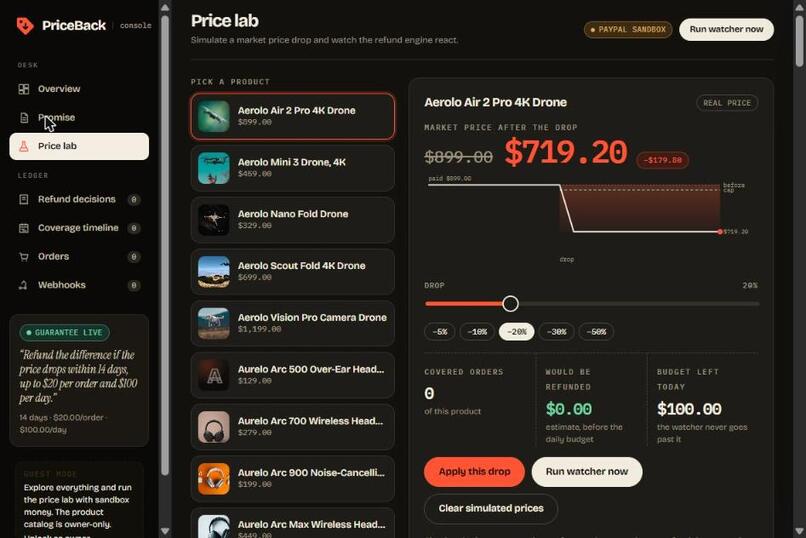
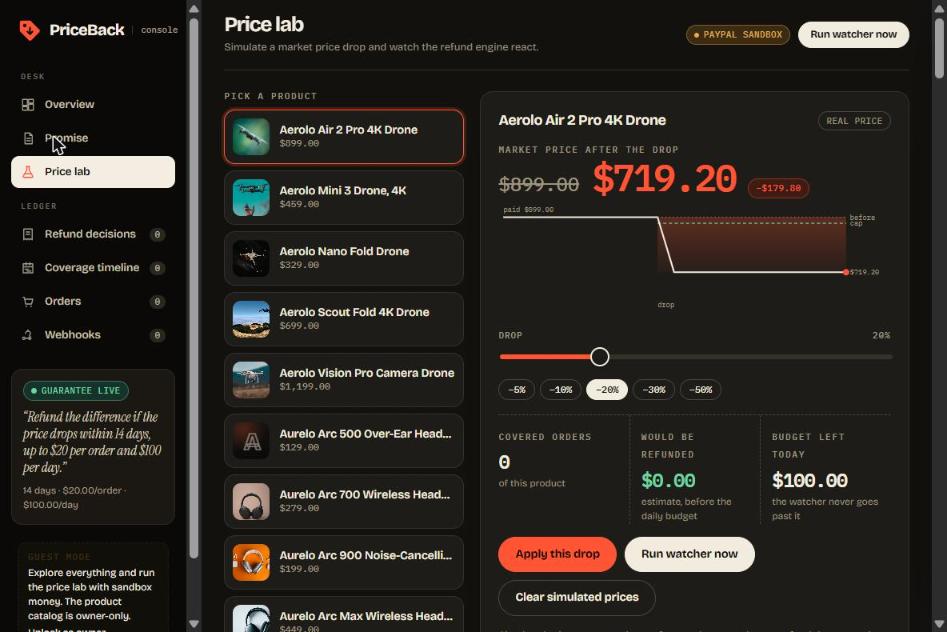
Product Live Simulation price drop (Merchant Page)
-
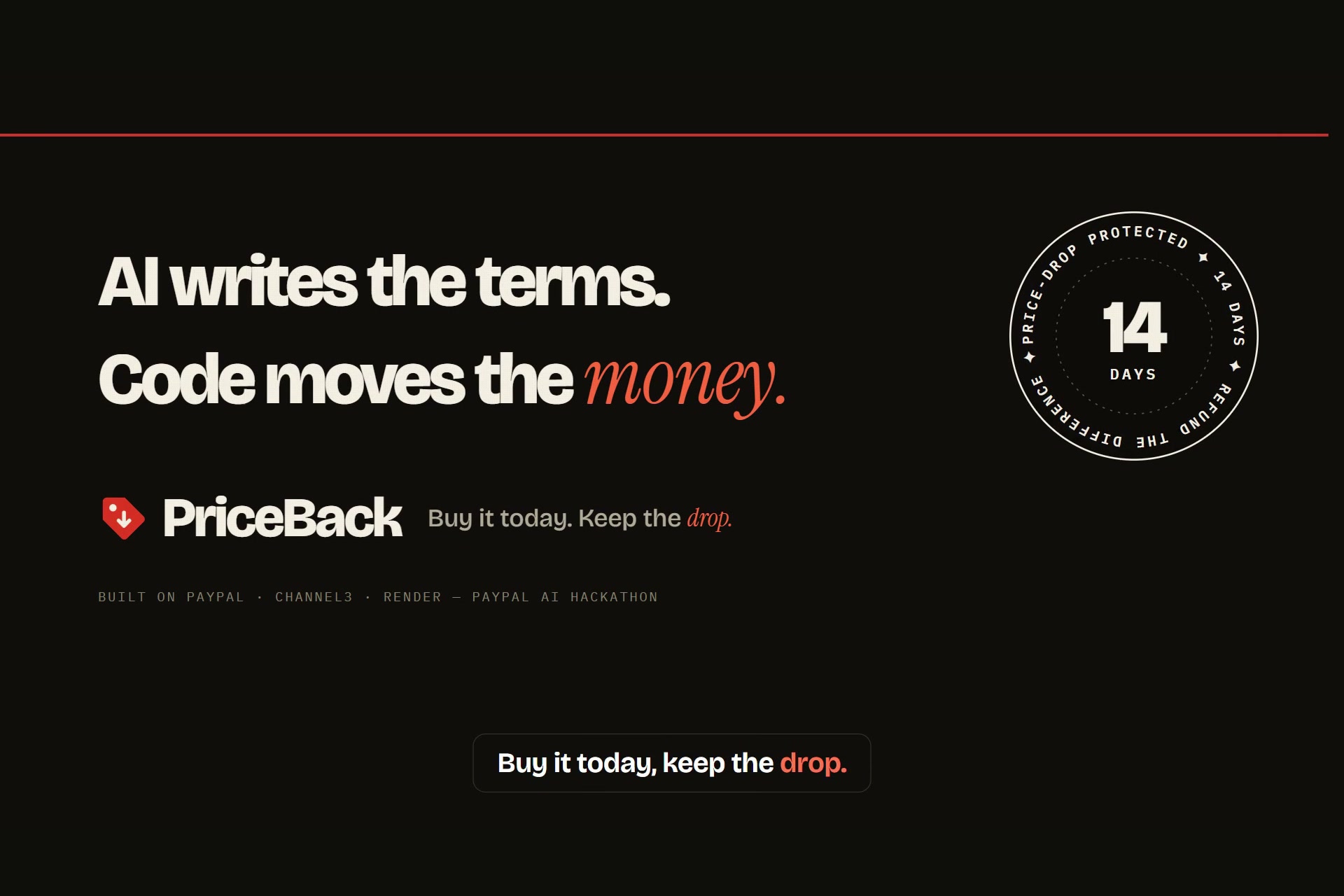
Outro Page. ("AI writes the terms, code moves the money")
-
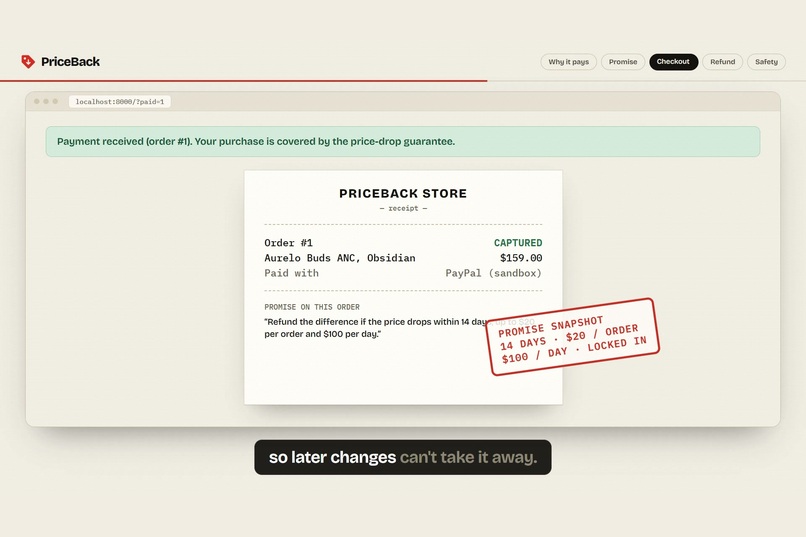
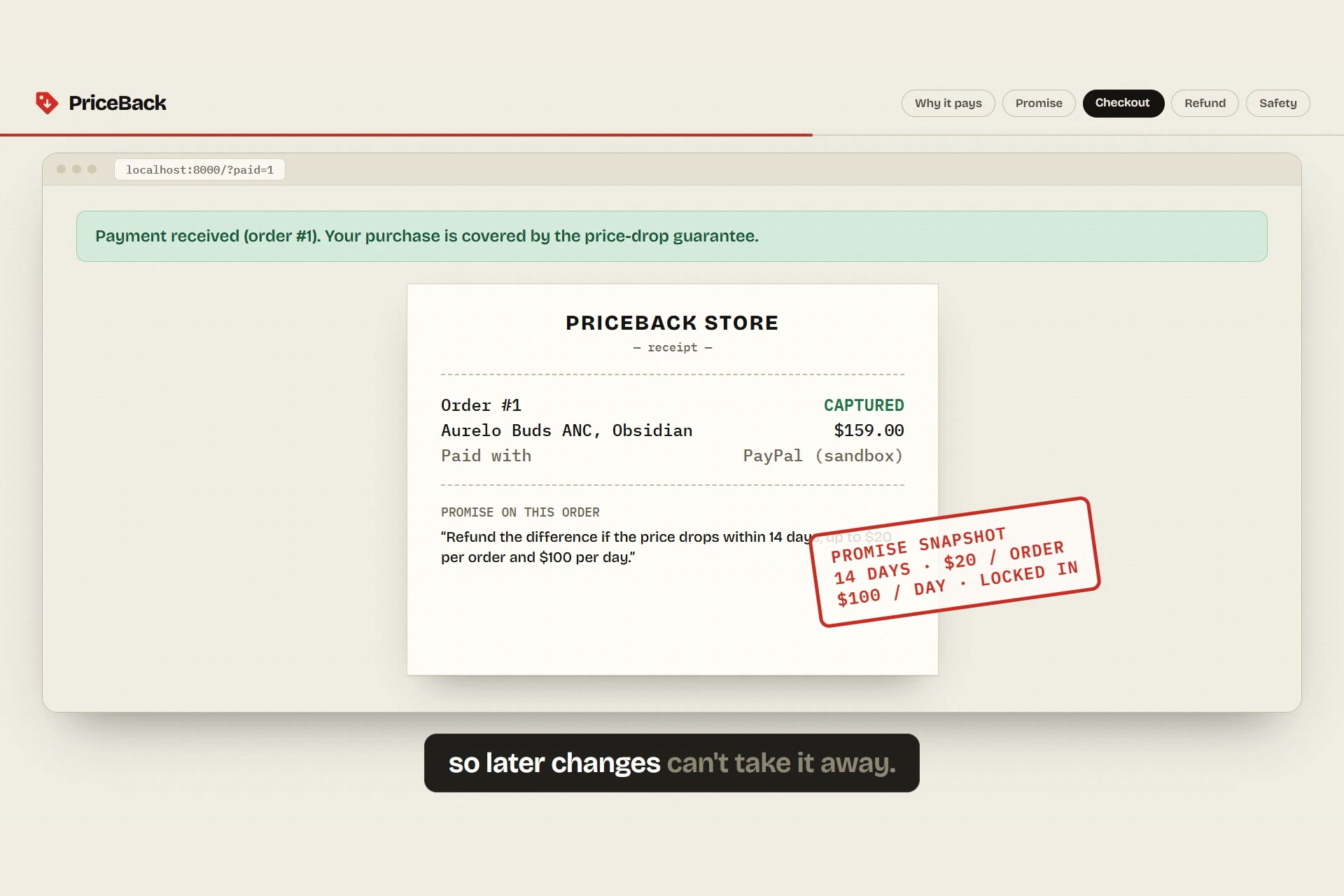
Order captured of Promise snapshot
-
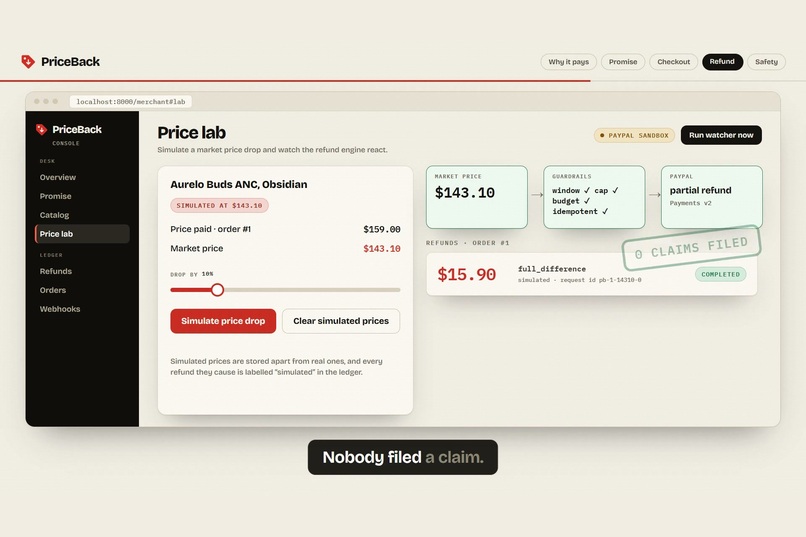
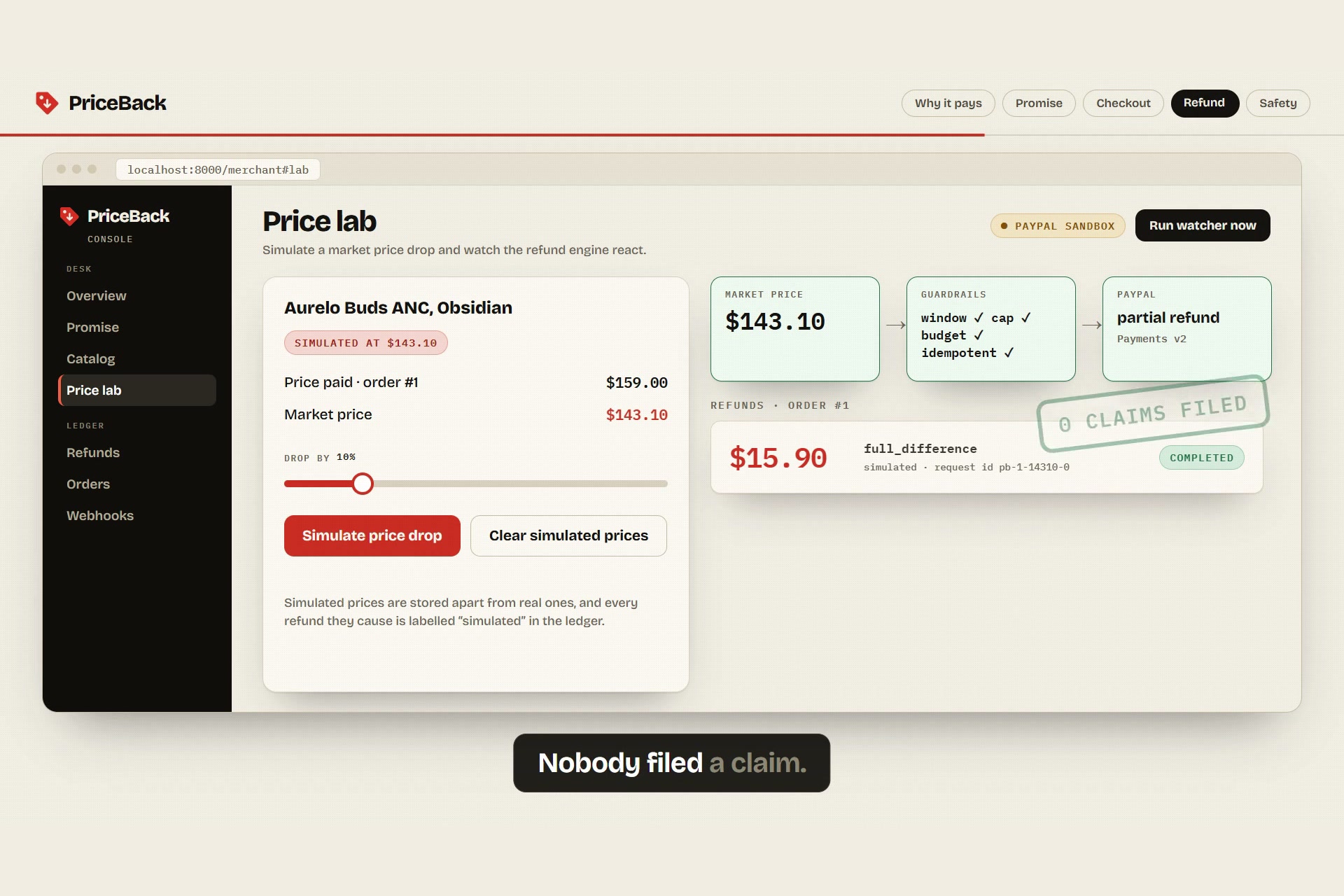
Price Lab (to experiment with the drop rates for merchants to analyze the promise they may build)
-
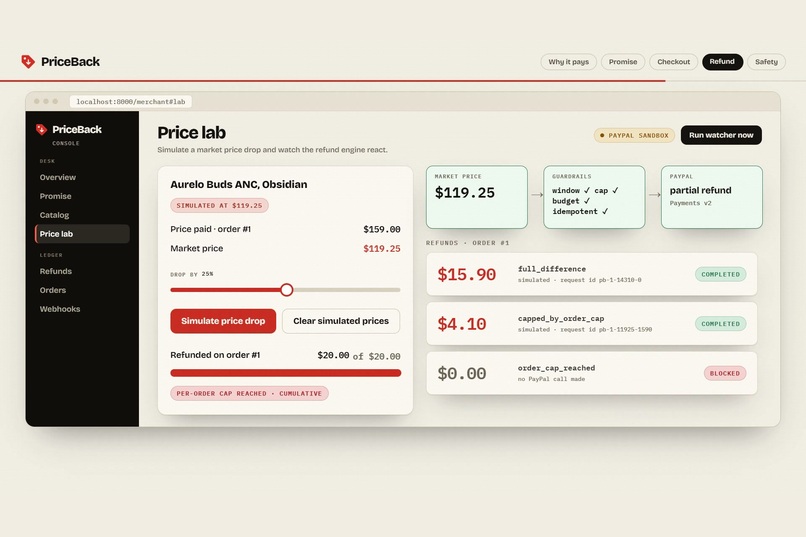
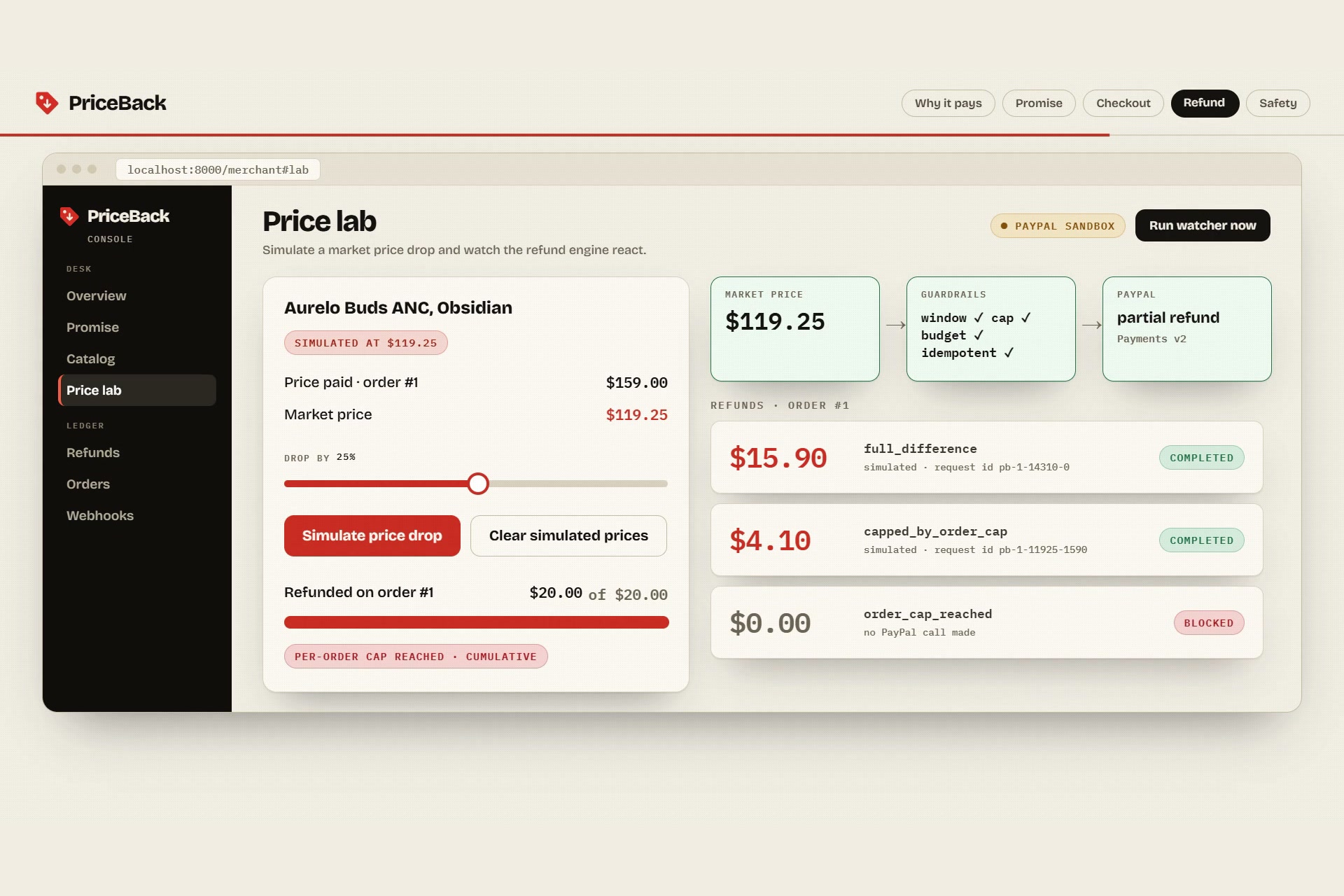
Order Cap reached (Guard-railing) (As price drops happens, price money is returned back only upto the promise limit)
-
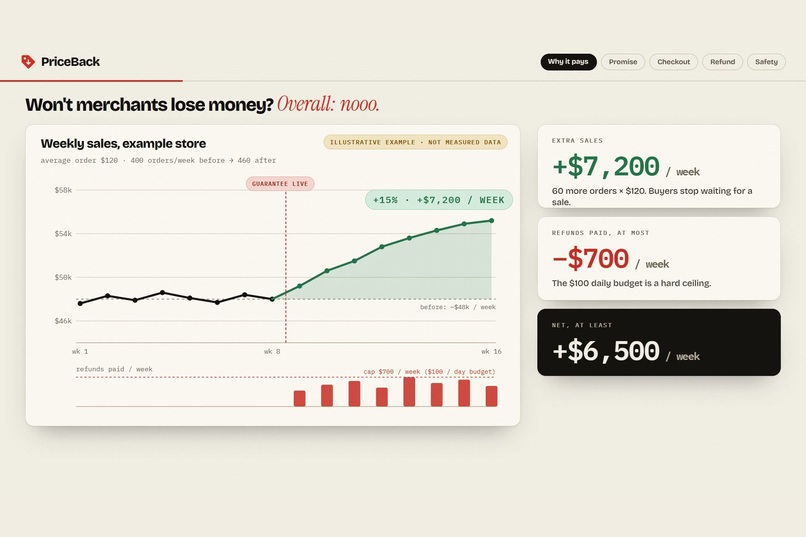
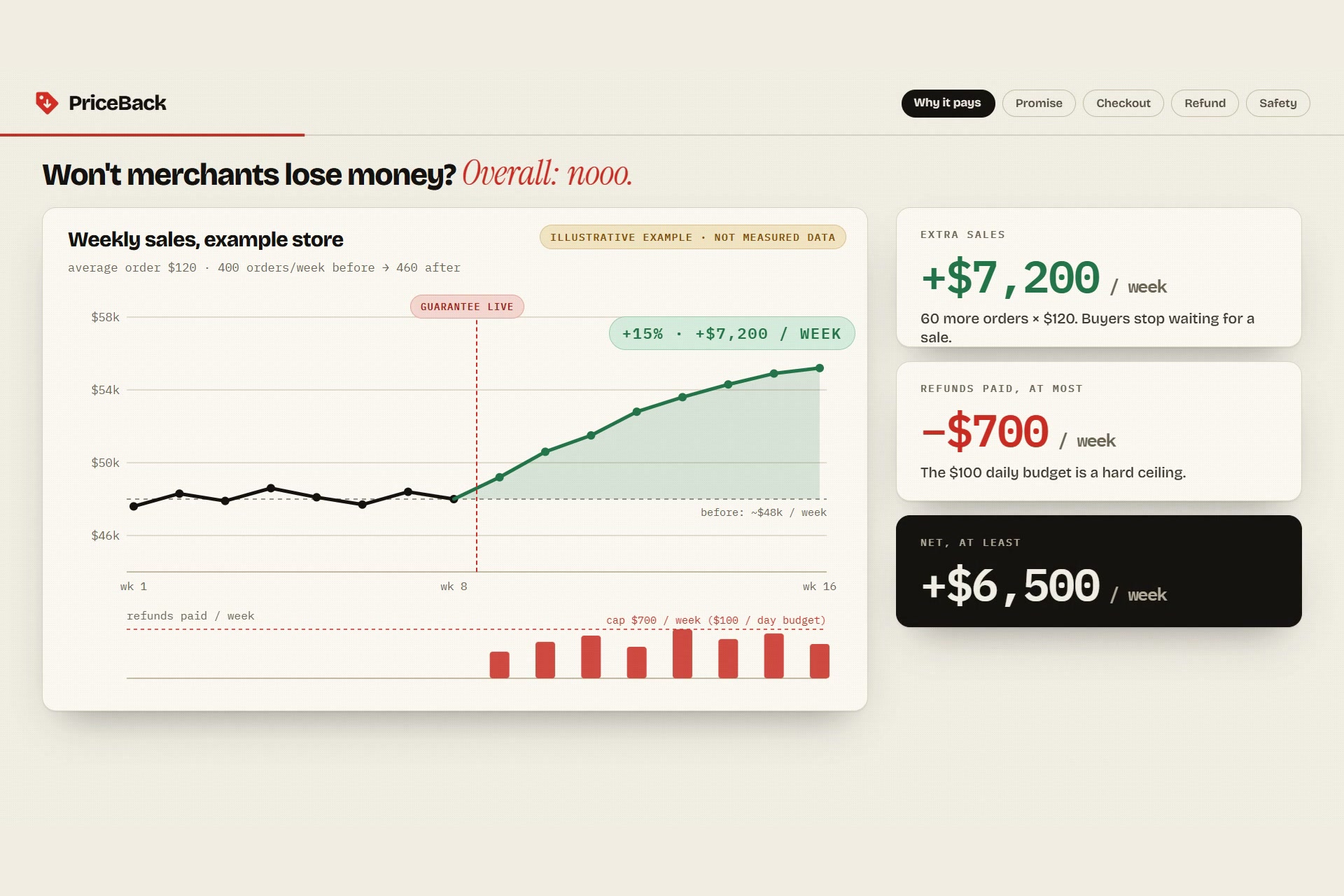
Why this is a Win-Win condition for Merchants
Inspiration
You buy headphones for 159 dollars, and the next day they cost 119 dollars. Getting that 40 dollars back usually means finding the receipt, opening a support ticket and arguing, so most people never bother. Shoppers love price protection, but merchants find it hard to offer: people have to file claims, staff check them by hand, and there is no limit on what it can cost. We wanted the refund to arrive on its own, with a cost limit the merchant sets in advance. PayPal already handles the payment, partial refunds and signed webhooks. PriceBack is the piece that connects them.
What it does
A merchant writes a promise in plain English, for example: "Refund the difference if the price drops within 14 days, up to 20 dollars per order and 100 dollars per day." PriceBack turns it into clear, checked terms. Shoppers pay with PayPal, and the promise that is live at that moment is saved with their order. A watcher then checks the market price of every covered order using Channel3. When the price drops, PriceBack sends a PayPal partial refund automatically, with no claim needed. Signed PayPal webhooks confirm every refund in an audit log, and the shopper gets an email.
How we built it
We built the backend with FastAPI and SQLite. It uses PayPal Orders v2 to take payments, Payments v2 for partial refunds, and verified Webhooks to confirm them. Google Gemini reads the merchant's promise, AG Grid and Bryntum Scheduler power the merchant dashboard, Brevo sends the emails, and the app runs on Render. Every refund is decided by one simple rule. The shopper gets back the smallest of three amounts: the price difference they have not been refunded yet, what is left of the per-order limit, and what is left of the store's daily budget. The per-order limit adds up over time. For headphones bought at 159 dollars, a 10 percent drop refunds 15.90 dollars, a 25 percent drop refunds only 4.10 dollars more, and any further drop is blocked. The AI never decides how much money is refunded. It only reads the merchant's promise and writes the friendly message to the customer. Its output is checked against strict rules, a simple backup parser takes over if the AI fails, and every refund amount is calculated by regular code. Each refund is saved as pending before PayPal is called, and it is sent with a unique key so that a retry can never pay the same refund twice. If PayPal does not answer in time, the refund is retried with the same key instead of being treated as failed. 65 automated tests cover this logic.
Challenges we ran into
- Real prices do not change during a hackathon, so we added simulated price drops. They are clearly labelled as simulated everywhere in the app.
- Judges needed to try the product without changing the real store. A guest's promise becomes a private testing promise: only that guest sees it, it expires after 3 hours, it has small demo limits and it uses its own budget.
- Hosting had its own limits. Render's free plan blocks normal email sending, so we switched to Brevo's web API. The PayPal sandbox also rejected buyer accounts from outside the US on a store priced in US dollars.
Accomplishments that we're proud of
- It works from start to finish using real PayPal sandbox payments. A merchant writes a promise, a shopper pays, the price drops and the refund shows up in the shopper's PayPal account without anyone filing a claim.
- The AI is useful but never in charge of money. It turns a plain English sentence into clear terms in seconds, while every refund amount comes from simple, tested code. If the AI is unavailable, the product still works.
- Refunds are safe even when things go wrong. Retries, timeouts and two runs happening at the same moment can never pay a customer twice or go over the merchant's limits, and 65 automated tests check this.
- Judges and testers can try everything themselves. They can sign in with their own email, buy a product, trigger a price drop on their own order and get the refund email within seconds, all without changing the real store's promise.
- It is honest about what is real. Simulated price drops are labelled everywhere, each refund records why it got that amount, and the known limits are written down in the README.
- It is live and easy to run. The app is deployed on Render, needs no build step, and keeps working even if the dashboard's chart and table libraries fail to load.
What we learned
When software moves money, most of the work is in handling what can go wrong: retries, answers that never arrive, and two processes running at the same time. AI is most useful where language is the problem, as long as strict checks and a reliable backup sit around it. A daily budget is what makes this kind of guarantee practical for a merchant, because it caps the total cost and turns it into a marketing expense they can plan for.
What's next for PriceBack
- Go live with real PayPal payments, and track real refund timing and fees for merchants.
- Watch each merchant's own competitors, not just the lowest market price from Channel3.
- Support many merchants on one platform, each with their own account, team logins and settings.
- Move from SQLite to Postgres with a proper job queue so the watcher can cover thousands of orders reliably.
- Build plugins for popular store platforms so any merchant can switch on the guarantee in a few clicks.
- Support more currencies and countries, so shoppers outside the US can be protected too.
- Give merchants a report showing what the guarantee cost them and how much extra it helped them sell.
