PreZero
Inspiration
Canada eliminated endemic measles in 1998. However, an outbreak linked to international travel began in October 2024, spreading through under-vaccinated communities. By November 2025, Canada had lost its elimination status after over 5,000 cases, 85% of which were unvaccinated.
Imported infections can trigger outbreaks in susceptible communities. Travellers visiting friends and relatives face up to 4.5 times the malaria risk of tourists, yet one Canadian study found that only 26% of children visiting relatives received pre-travel advice.
Imagine a family in Vancouver planning a trip to Brazil. They know where and when they're going, but what health risks should they prepare for? Would travelling a month earlier or later change those risks?
Public surveillance data could answer these questions, but it's scattered across sources designed for health professionals and difficult for everyday travellers to interpret.
We built PreZero to bridge that gap. By making health data accessible and specific to travel destinations and dates, we help families make informed decisions and reduce the risk of bringing preventable infections back to their communities.
What it does
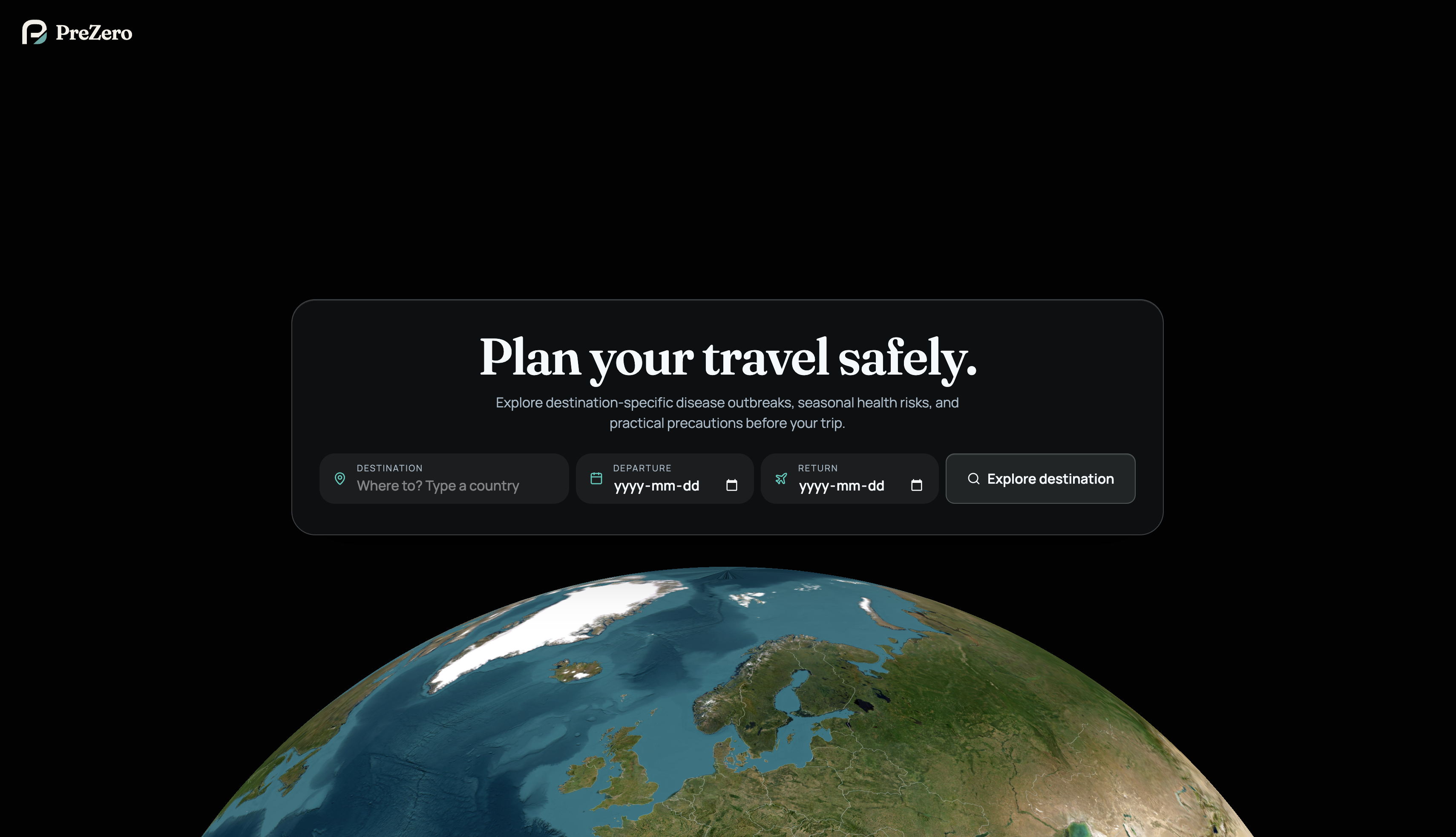
PreZero is an interactive travel health planning tool that helps users prepare for potential disease exposure.
Users enter their destination and travel dates to receive health outlooks for four diseases: measles, influenza, dengue, and malaria. Each has relevant preventive measures and publicly available country-level surveillance data.
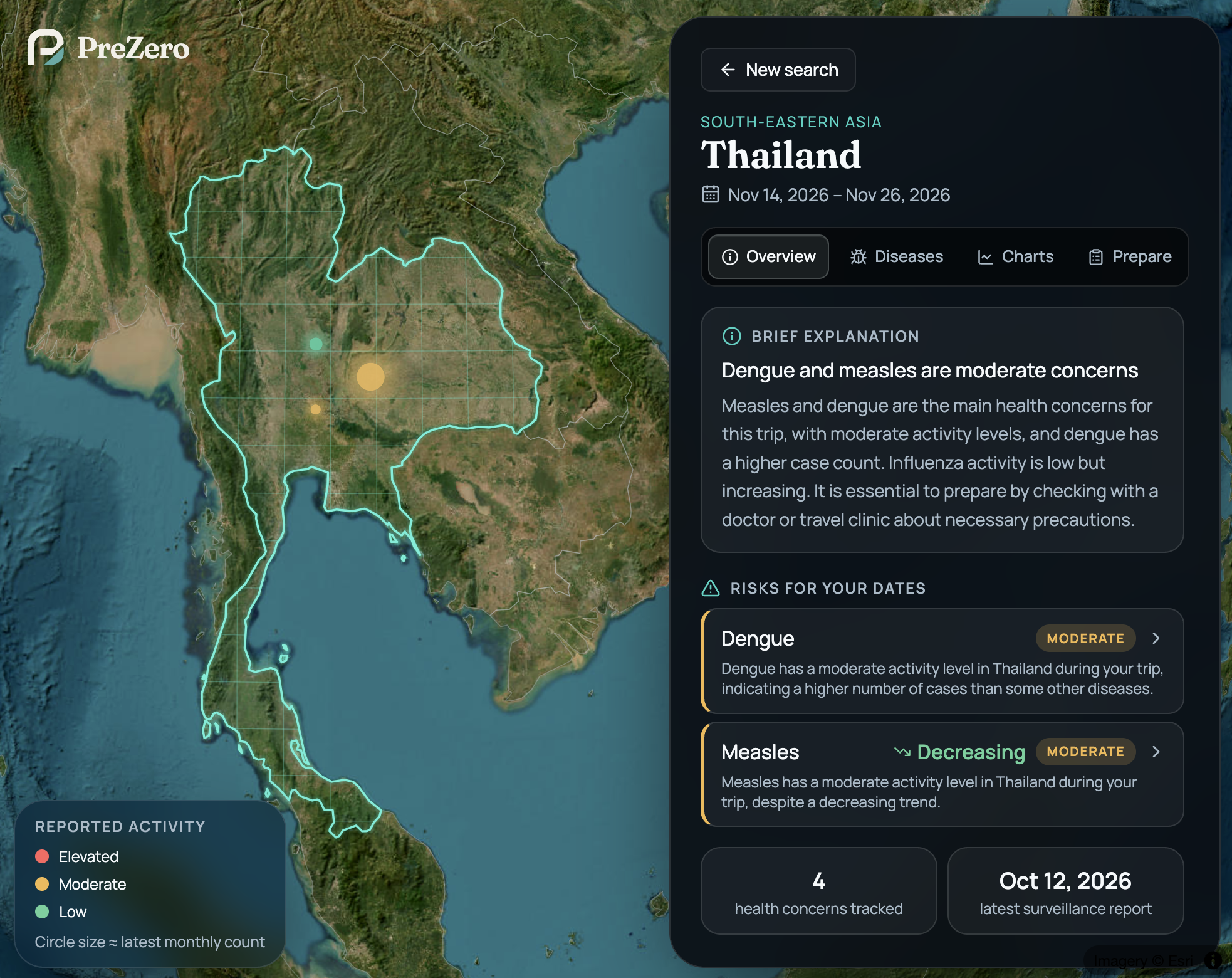
An interactive 3D globe lets users explore destinations, visualize health conditions, and compare travel periods without restarting their search.
Unlike generic year-round advice, PreZero accounts for both where and when users travel. Changing dates can reveal different disease outlooks based on seasonal patterns.
Results appear in four tabs:
- Overview: Plain-language briefing highlighting diseases needing attention.
- Diseases: Risk levels (low, moderate, elevated), sources, and latest reporting dates.
- Charts: Recent monthly cases showing disease trends.
- Prepare: Checklist of vaccines, packing essentials, and travel clinic questions.
All levels are computed from public data, not AI. AI only translates results into plain language, without adding statistics, altering levels, or diagnosing.
Our goal is to turn complex surveillance data into practical, actionable information.
Community impact
PreZero is designed for Canadian communities with close family ties abroad, many of whom travel home for occasions such as Lunar New Year, Diwali and Christmas. These travellers have a higher risk of travel-acquired infection and are less likely to receive pre-travel advice. When an infection is brought into a community with gaps in vaccination coverage, it can spread beyond the traveller, as in Canada's 2024 to 2025 measles outbreak.
PreZero makes surveillance data usable before the trip. It tells a family which diseases are active at their destination during their travel dates and which preventive steps apply, such as checking measles vaccination or asking a clinic about malaria prevention. Preventing an imported infection protects the traveller and the people they return to, including infants too young to be vaccinated and people who cannot receive live vaccines.
The app avoids stigmatizing language. Levels describe disease activity, not countries or travellers, and outbreak data is presented as a reason to prepare rather than to avoid travel. PreZero is free, needs no account and asks for no personal health information. We plan to pilot it with a travel clinic and a community organization, and to translate it into the languages these families speak at home.
How we built it
Data pipeline and analytics — Databricks
A Python pipeline collects data from WHO FluNet, WHO measles reports, WHO malaria estimates, OpenDengue, and the World Bank. It filters low-quality records and computes outlooks for 250 countries and territories.
Running daily as a Databricks Lakeflow Job, it stores bronze, silver, and gold Delta tables in Unity Catalog.
Disease levels combine incidence per population with seasonal patterns where supported by available data. Thresholds remain provisional and flagged for expert review.
Rather than relying on AI to estimate disease risk, Databricks powers reproducible, source-backed calculations that update as new data becomes available.
The app queries gold tables through Databricks SQL, while Llama 3.3 70B generates plain-language summaries from computed results.
Frontend and user experience — Lovable and Freebuff
We built the frontend with TanStack Start and React, using Lovable to rapidly prototype the search experience, dashboard, and initial interface.
We incorporated Freebuff throughout development to support frontend implementation and iterative refinement.
Our design centres on an interactive 3D globe that transitions from destination searches into health dashboards, making PreZero feel like an approachable travel planner rather than a complex health database.
Deployment and testing
We deployed PreZero on Vercel with our custom GoDaddy domain, p-rezero.health.
The domain playfully references the anime Re:Zero while reinforcing our mission: preparing travellers before they become patient zero.
The project includes 113 automated tests covering data processing and application logic.
Challenges we ran into
- Inconsistent data: Harmonizing sources ranging from weekly test positivity to annual incidence estimates.
- Missing data: Establishing minimum-data requirements and omitting levels rather than assuming missing data means low risk.
- Disease differences: Accounting for measles' limited seasonality and malaria's mostly annual estimates.
- Historical baselines: Excluding pandemic-era influenza seasons to avoid distorted comparisons.
- Reporting lag: OpenDengue extends to early 2025, so dengue is presented as a seasonal outlook rather than current activity.
- AI reliability: Preventing generated summaries from inventing statistics or changing computed classifications.
- User experience: Balancing an interactive globe with readable dashboards and practical recommendations.
Accomplishments that we're proud of
We built a daily pipeline producing sourced health outlooks for 250 countries and territories, including subnational dengue seasonality where available, without manually entered levels.
Every level is traceable to its source file by hash, supported by 113 automated tests.
We transformed this data into an interactive experience where users can explore destinations, compare dates, inspect trends, and generate preparation checklists.
Using Lovable and Freebuff, we rapidly developed and refined the frontend while integrating our data-intensive backend.
We also launched our working application at p-rezero.health, giving PreZero its own identity beyond the hackathon.
What we learned
Missing surveillance data should never be mistaken for low risk.
Disease burden and seasonality must be evaluated separately: a seasonal peak in a low-incidence country doesn't necessarily mean high risk.
Our medallion architecture allowed us to revise data cleaning without downloading sources again. We also found that AI works best when explaining precomputed results rather than estimating risk independently.
Lovable and Freebuff showed us how rapid prototyping tools can accelerate frontend development while keeping backend analytics separate and testable.
Most importantly, making data useful is just as important as making it accurate. Even comprehensive datasets have limited impact if people cannot understand or access them.
What's next for PreZero
- Pilot first: Partner with a travel clinic and community organization before Lunar New Year, with expert review of our thresholds.
- More diseases: Add chikungunya and Zika using PAHO data, plus hepatitis A and typhoid reminders.
- Regional detail: Extend existing province-level dengue seasonality to regional disease burden.
- Expanded outbreak alerts: Extend official alert integration beyond measles.
- Community languages: Support Vietnamese, Chinese, Punjabi, Tagalog, and more.
- Clinic handoff and follow-up: Share preparation checklists with clinics and send post-trip reminders.
We envision PreZero making travel health information accessible to everyone, especially families and communities facing barriers to pre-travel advice.
Because the best time to think about an outbreak is before it begins.
PreZero describes disease activity at a destination, not personal medical risk. It is not medical advice; consult a doctor or travel clinic before travelling.


