-
-
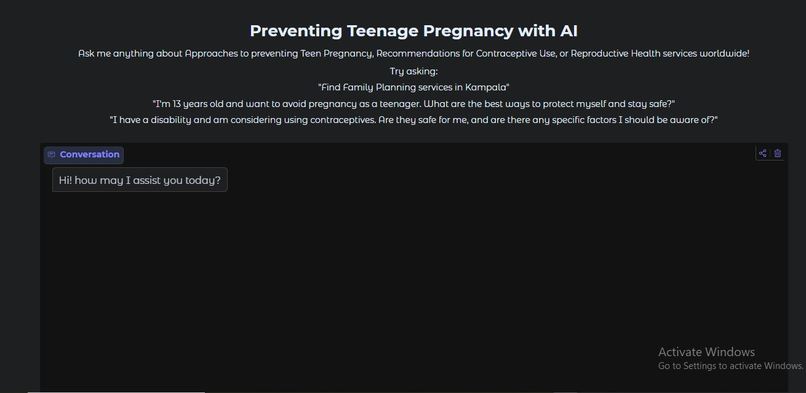
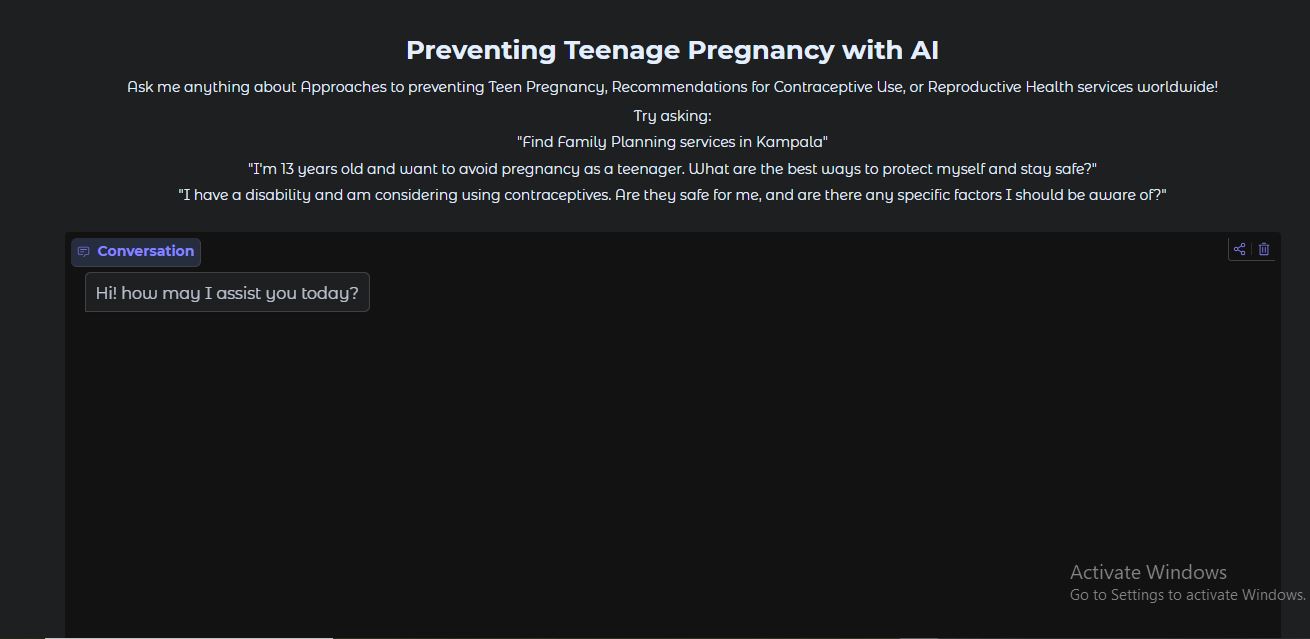
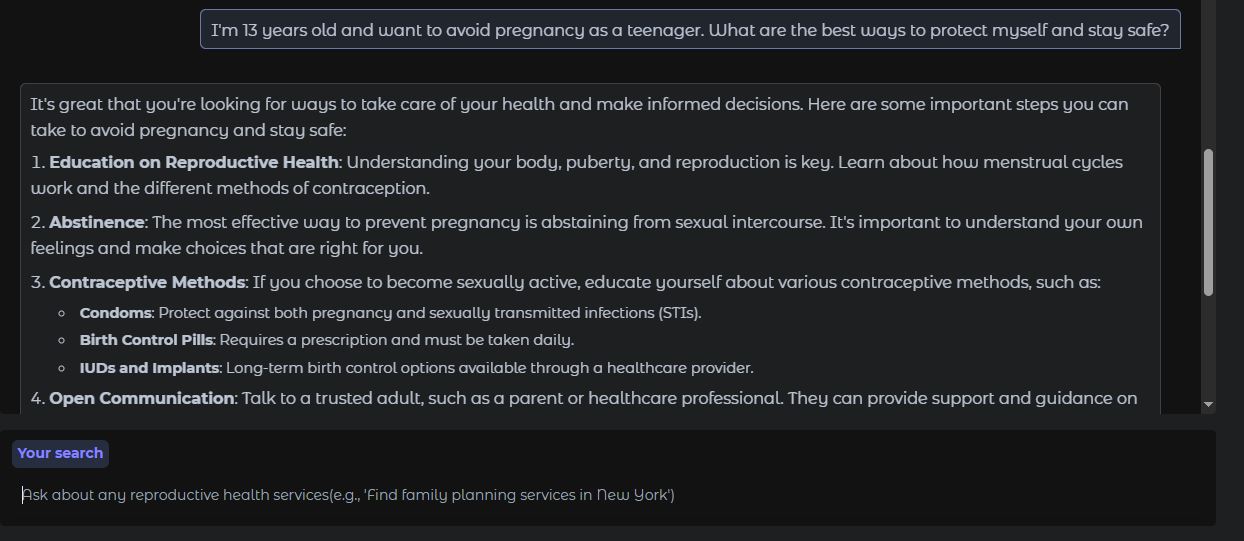
UI for the AI assistant
-
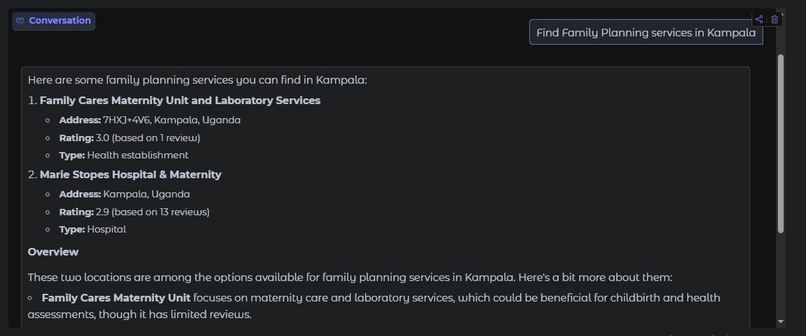
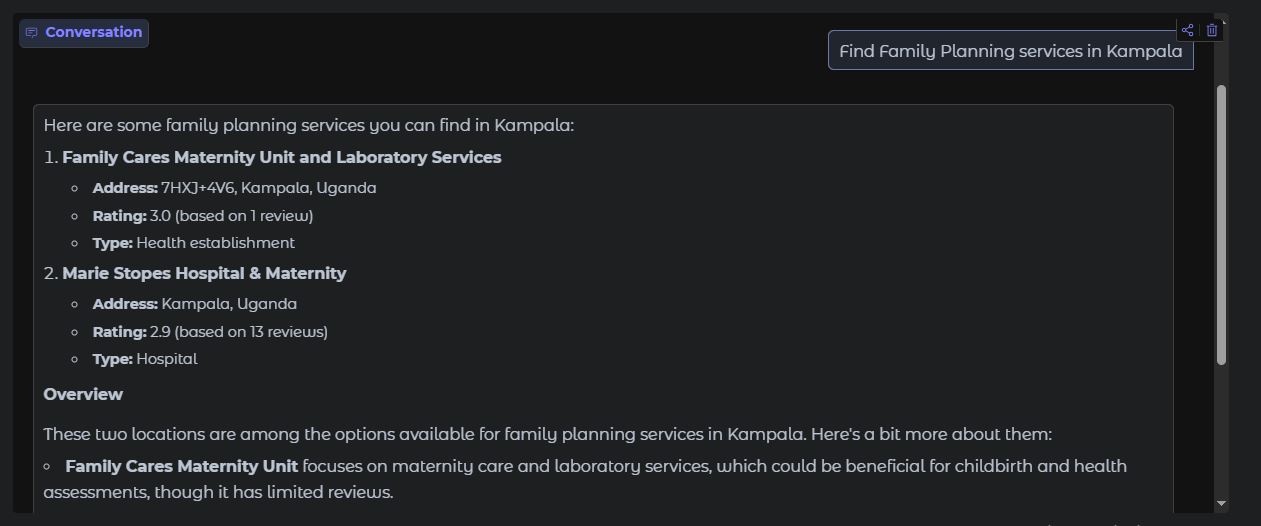
Testing google places api functionality
-
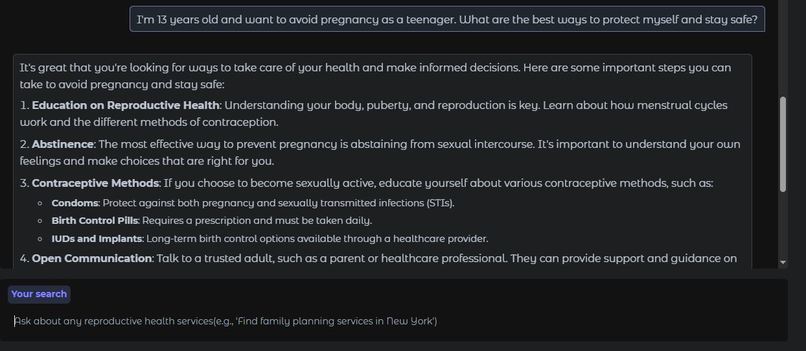
Test RAG functionality which query related data from multiple pdfs
Inspiration
Growing up, my schools occasionally held sex education sessions, and as a result, teenage pregnancy was rare among my peers. However, at my friend’s school, where such sessions were absent, teenage pregnancies were much more common.
This stark contrast made me realize the power of education in preventing teenage pregnancy. When I came across WHO data from 2023, revealing that approximately 23.86 million girls aged 10–19 were affected by teenage pregnancy globally, I felt compelled to act.
I decided to develop an AI-powered chatbot to empower young girls with essential knowledge on teenage pregnancy prevention, contraceptive recommendations, and access to reproductive health services worldwide. My goal is to ensure that every girl, regardless of her circumstances, has access to the information she needs to make informed choices about her future.
What It Does
Our AI-powered tool leverages insights from the Promising Approaches to Preventing Teen Pregnancy report by HHS and the WHO’s Selected Practice Recommendations for Contraceptive Use.
By analyzing these resources, the AI assistant can answer questions about effective strategies for preventing teen pregnancy and contraceptive recommendations. Additionally, using the Google Places API, it can locate reproductive health services for users anywhere in the world, ensuring young girls have access to the support they need.
How I Built It
I leveraged the LangGraph framework to develop a Retrieval-Augmented Generation (RAG) application that enhances the OpenAI model with custom data.
The AI is trained on key resources, including the Promising Approaches to Preventing Teen Pregnancy report by HHS and WHO’s Selected Practice Recommendations for Contraceptive Use. Additionally, it integrates the Google Places API to provide real-time recommendations for reproductive health services worldwide.
With these capabilities, the AI assistant can effectively answer questions on teen pregnancy prevention, contraceptive options, and access to reproductive health services, empowering young girls with essential knowledge and support.
Challenges I Ran Into
Building this AI assistant came with several challenges:
- API Costs: Both the OpenAI API and Google Places API require payment, making it challenging to maintain affordability.
- LLM Hallucinations: The model occasionally generated inaccurate or misleading information, requiring use of advanced RAG techniques.
- Finding Reliable Sources: Identifying credible, research-backed resources on teen pregnancy prevention was difficult, as many sources lacked scientific rigor or accessibility.
Accomplishments That I'm Proud Of
Despite the challenges, I successfully refined my approach to ensure the AI delivers accurate, trustworthy, and impactful guidance.
I'm especially proud of developing a powerful and accessible tool that has the potential to help millions of young girls make informed decisions about their reproductive health, empowering them with knowledge and support.
What I Learned
Through this project, I gained valuable insights into advanced Retrieval-Augmented Generation (RAG) techniques.
One key takeaway was that to ensure the model retrieves accurate information from multiple PDF files, implementing a multi-query retriever is essential. This approach significantly improves the precision and relevance of responses, enhancing the AI's ability to provide reliable guidance.
What's Next for Preventing Teenage Pregnancy with AI
Looking ahead, I plan to enhance the AI assistant by integrating healthcare experts into the loop.
For queries that require medical expertise, a qualified healthcare professional will take over, ensuring users receive accurate, personalized, and professional guidance beyond what the AI can provide. This will further improve the reliability and impact of our solution.
Built With
- google-places
- gradio
- huggingface
- langgraph
- openai-api
- python


Log in or sign up for Devpost to join the conversation.