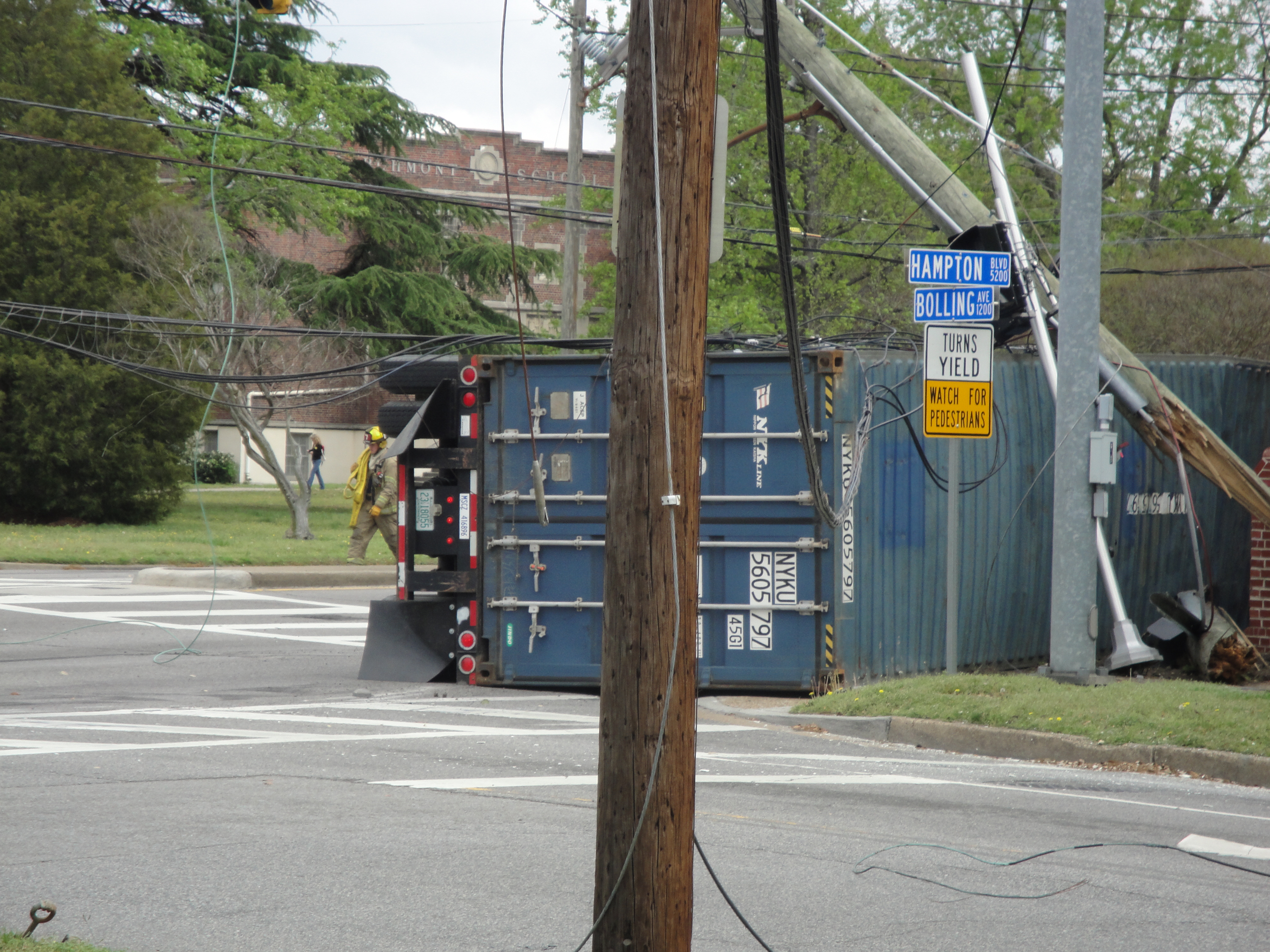
(image: A rollover accident caused by excessive speed through a tight turn) In October 2010, a study was published looking at the frequency of certain types of crashes using IntelliDrive Safety Systems. The study compared Vehicle to Vehicle (V2V) communications, Vehicle to Infrastructure (V2I) communications and Autonomous Vehicle responses. Focusing on the types of communications, the overlap between V2V and V2I is minimal. Unfortunately to avoid such crashes all vehicles involved would need to be equipped with a Direct Short Range Communications device (DSRC); even if this were to be standard on all new vehicles, those with older vehicles may not choose to adapt.
Instead of relying on drivers to upgrade, let’s look at how we can improve V2I communications to cover a wider range of crashes.
Using imaging technology such as video and infrared, vehicles can be detected and tracked as to their position on the road. If one were to drift outside the boundary of the road, an alert could be sent to the vehicle. If the driver is making an emergency stop, a response could then be sent back and relayed to the nearby emergency personnel. A possible application for heavy trucks is to add an alert for upcoming height restrictions. This can also be applied to detecting if two vehicles were approaching each other on a course of collision, such as drifting or changing lanes into another vehicle, turning across the path of another vehicle, and others. In such cases, if one driver involved were made aware of what was happening, action could be taken to avoid the collision if possible. The driver could choose to maneuver away from the potential collision, or adjust speed depending on what the situation calls for. Making at least one driver aware of an impending situation can still reduce the chance for a collision. Neither system addresses crashes involving cyclists, but with the infrared sensors, cyclists could be detected and then vehicle drivers could be made aware of them. This can work for both bicycles and motorcycles. According to the study crosswalk crashes are already addressed through V2I, but outside of the crosswalk these sensors could detect a pedestrian (or an animal) moving into traffic and alert the oncoming vehicles. Combined with speed sensors, the system could alert drivers if other vehicles are decreasing at a faster rate than their vehicle is and possibly prevent rear end crashes. These speed sensors can also be used to alert drivers of a potential rollover if their speed overly exceeds what the road was designed for. These devices can also be applied in parking lots to warn drivers of vehicles leaving a spot, or oncoming cars that may not notice the vehicle pulling out. It could work alone, or with sensors that could detect the occupancy of the parking space and also work with those who are seeking a place to park to reduce the amount of circling during the search. This can also improve upon current systems in place in some areas that allow you to check parking availability via you computer or smartphone. While the idea is intended to check parking availability before making your trip, there would still be those trying to find a space using their smartphones while circling around the area; the real-time availability of this information with DSRC would prevent such a distraction from taking place. As technology improves, the devices could be updated to detect the condition of the pavement of the road as well as track traffic volumes and determine the priority of repairs. Knowing the road condition could also be useful for the drivers as well. If a road is noted to be particularly bad, drivers may then choose to slow down to reduce damage to their vehicles, or at least be aware that others may be adjusting their speed and possibly taking evasive maneuvers to avoid potholes. Potholes may not be the only road hazard to be detected, but even the presence and location of black ice could be passed onto the drivers so that they can adjust speed and route as needed. On continual improvement and combining technology, if deteriorated conditions are detected, or if a vehicle is too large to go through an underpass ahead, the system could alert the vehicle’s Global Positioning System (or Global Navigation Satellite System) device to reroute the driver to a safer route. This would also require the navigation system to be more flexible at finding alternate routes, but already this is showing signs of improvement. In conclusion, Vehicle to Infrastructure communications could be made more effective in preventing crashes with the addition of roadside imaging sensors such as video and infrared. This will reduce the need for every vehicle on the road to be equipped with DSRC equipment. These sensors can be used to collect data for future traffic study. As technology improves, detection to improve driving conditions can also improve allowing for a more enjoyable and safer driving experience.

Log in or sign up for Devpost to join the conversation.