Inspiration
Have you ever felt frustrated when trying to pick a Valentine’s gift for your partner? Or, when thinking of a perfect present for one’s birthday, you couldn’t think of a worthy choice? We, at PresentLy, certainly have. Our team recognized the need for an effective way to browse internet items and find the perfect fit. As a result, we developed a tool that uses AI-powered algorithms to find the best-fitting gift on the web with just a few clicks.
What it does
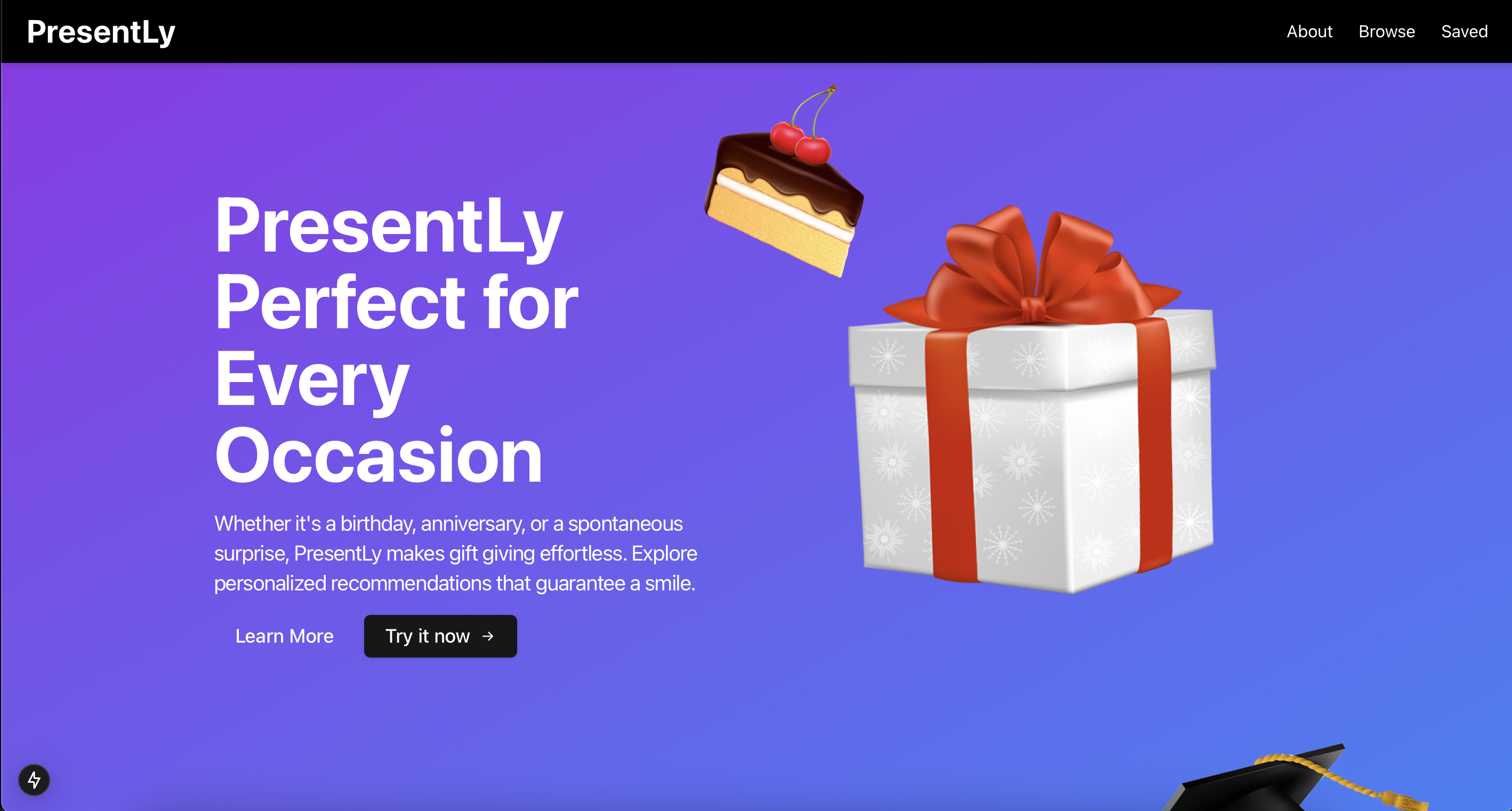
PresentLy allows users to effortlessly find and purchase gifts that match the recipient's interests. After completing a short survey, our application provides the user with a list of presents specific to their occasion.
How we built it
We built PresentLy with a network of tools that combines quality and efficiency and wraps it into an eye-pleasing design that prioritizes user’s needs. To process and store the dataset, we used data-wrangling tools, such as pandas, as well as Superbase. We then deployed it using AWS lambda function and API gateways. The outstanding user-interface was created thanks to Next.js, Shadcn, and Tailwind css, animated using Framer motion.
Challenges we ran into
The biggest challenge was deriving an effective algorithm to pick products based on the user’s query requests. We had to balance the line between accurate product suggestions and the potential long runtimes. In the end, we elected the method that combined the best of both worlds, creating high-quality suggestions while minimizing loading screens.
Accomplishments that we're proud of
We are proud of creating an eye-catching, engaging, yet simplistic and stylish user-interface. We are also proud of our gift-choosing algorithm, which provides well-fitting gift suggestions, while using minimal runtime. The algorithm owes its efficiency to the well-engineered LLM queries and the clever way of deriving most important product features from the Amazon product descriptions.
What we learned
Throughout the development of PresentLy, we learned the value of efficient data-analytic and user-centered design. We learned about the applications of word-vectors in Neural-Language Processing (NLP), and it’s used in LLM models to provide accurate text interpretation.
What's next for PresentLy MadData25
To improve product suggestions, the PresentLy team is planning to include a larger dataset (the dataset currently used is only ~26000 items), as well as include product options from multiple online shopping platforms, as the current dataset only includes Amazon items. In addition, the accuracy of suggestions can be increased significantly if the option to provide more specifications for the gift-receiver is added. Additionally, the AI-model can be further fine-tuned to improve its reasoning when it comes to picking best-fit gits.
Built With
- amazon-web-services
- framer
- lambda
- next
- openai
- pandas
- python
- react
- tailwind


Log in or sign up for Devpost to join the conversation.