Inspiration
In most domains, expertise does not come from knowing theory, but from developing the ability to anticipate what will happen next. Architects, engineers, and designers can understand complex systems on paper, yet real intuition only emerges after repeated exposure to outcomes in the real world.
We asked a simple question:
What if we could train that predictive layer of understanding directly, before years of experience are required?
PreSense explores a spatial learning methodology where understanding is built through prediction. Instead of presenting information first, the system asks learners to commit to an expectation, then reveals reality, and uses that gap as the core learning signal.
Spatial computing makes this possible by embedding prediction directly into physical space, turning invisible systems into interactive learning environments.
What it does
PreSense is a Spatial AI learning system built for Snap Spectacles that trains users to develop intuitive understanding of complex systems through prediction.
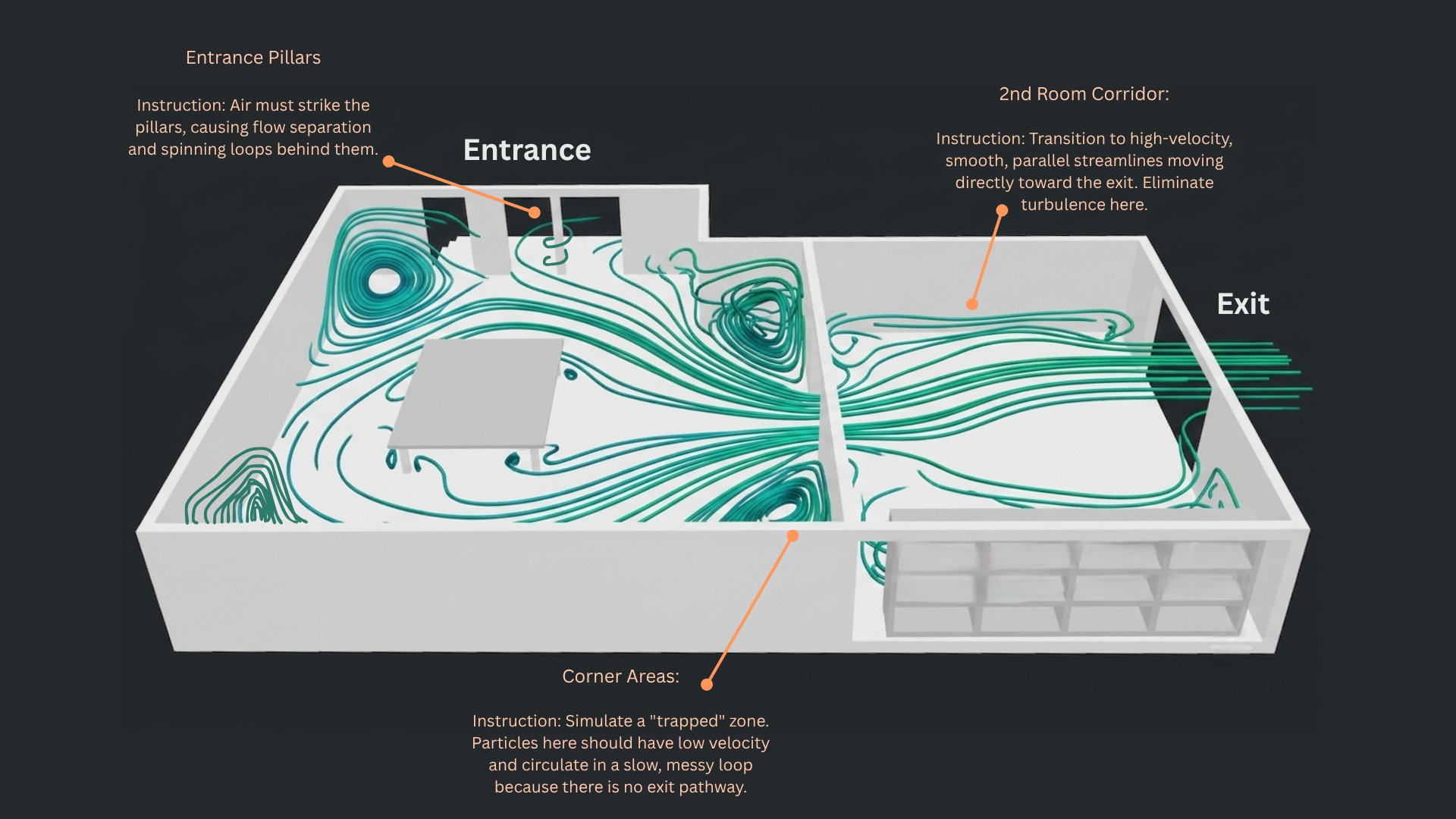
Users are placed in a spatial environment representing a system (such as airflow, acoustics, heat, or other physical dynamics). Before seeing the outcome, they are asked to draw or define a prediction of how the system will behave in space.
Once committed, the system reveals the actual simulated behavior.
An AI layer then:
• compares prediction and outcome
• identifies mismatches in reasoning
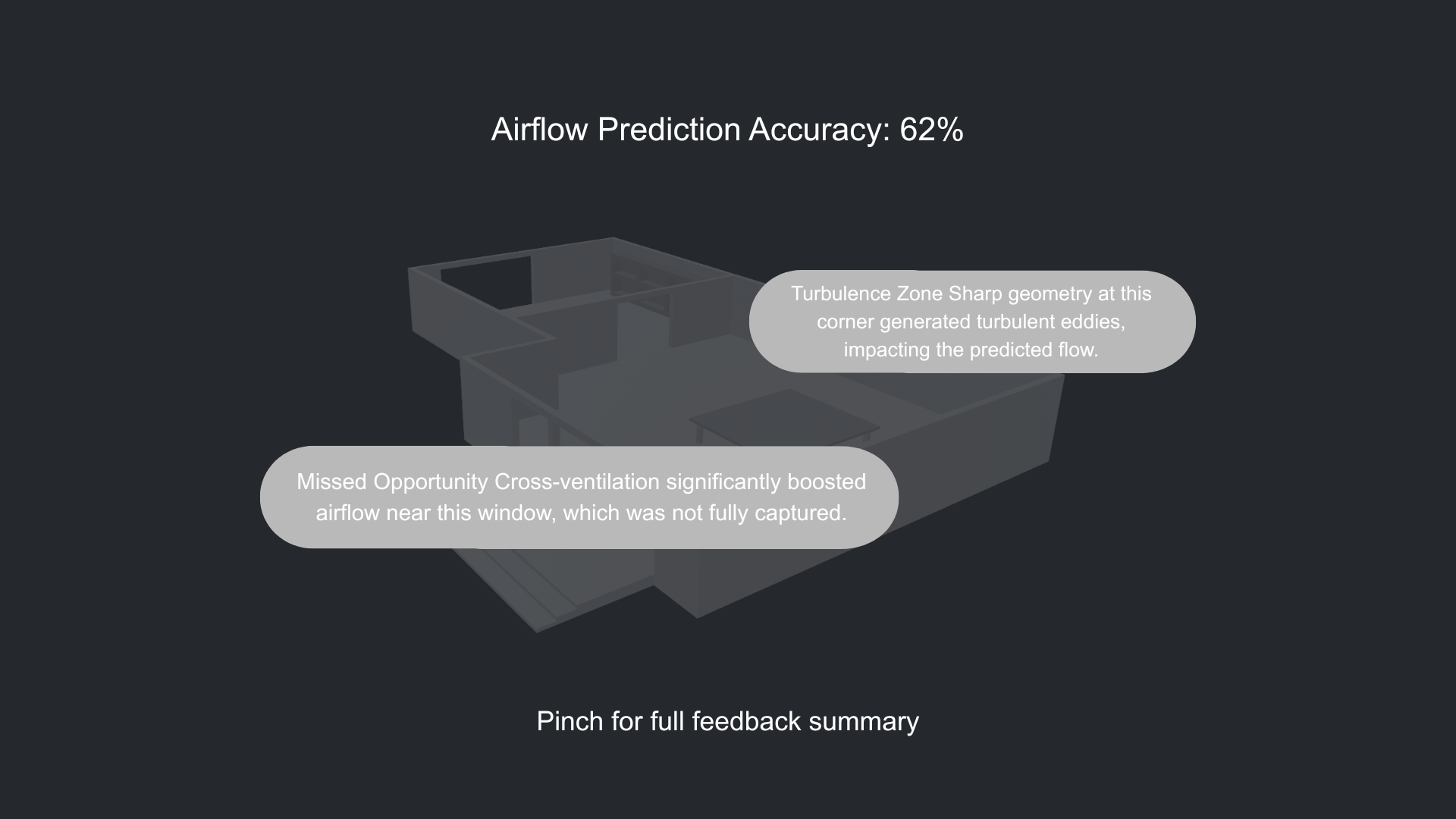
• generates feedback explaining the gap
• supports reflection on why intuition diverged from reality
Through repeated cycles of: Prediction → Outcome → Reflection → Adjustment, users gradually build stronger intuitive reasoning skills.
For this prototype, airflow is used as a demonstration case because it is an invisible system that is difficult to reason about without experience.
How we built it
PreSense is built in Snap Lens Studio using TypeScript and Spectacles spatial computing capabilities.
We use:
• Hand tracking for spatial prediction input
• Spatial anchoring for persistent prediction geometry
• World understanding for aligning simulations with real space
User predictions are stored as spatial trajectories and processed as structured representations of intent. These are compared against a real-time simulation model of the system. Both prediction and outcome are rendered in the same spatial coordinate system to allow direct visual comparison.
An AI reasoning layer analyzes divergence between expected and actual behavior, producing feedback focused on spatial reasoning rather than correctness alone.
The system is designed as a closed learning loop where the output of each cycle becomes the input for the next.
Challenges we ran into
One of the main challenges was designing feedback that supports learning rather than simply showing differences.
Spatial prediction errors are easy to visualize but harder to interpret in a way that improves intuition rather than confusion.
Another challenge was maintaining clarity in AR, where overlapping spatial information can quickly become cognitively overloaded.
We also optimized for wearable constraints to ensure stable tracking and consistent real-time simulation feedback.
Accomplishments we're proud of
We successfully implemented a full prediction-based learning loop in spatial computing:
Instead of passively consuming explanations, users actively generate hypotheses, test them in space, and refine their intuition through AI-assisted reflection.
Most importantly, the system demonstrates a generalizable learning mechanism rather than a single-domain tool.
What we learned
The most effective learning happens before the answer is revealed, when a user commits to an expectation.
We also found that AI is most valuable not as an information source, but as a reflection layer that helps translate differences between expectation and reality into understanding.
What's next for PreSense
While this prototype uses airflow as a case study, the underlying framework is designed to extend across domains such as:
• acoustics
• heat transfer
• fluid dynamics
• environmental and physical systems
• any domain where intuition develops through exposure to outcomes
Future work includes:
• personalized feedback models based on user reasoning patterns
• multi-user prediction environments
• integration with real-world sensor data
• learning analytics for tracking intuition development over time
Our long-term goal is to define a new category of Spatial AI learning systems where intelligence is developed through prediction in the physical world.
Built With
- gemini
- lens-studio
- snap-spectacles
- typescript


Log in or sign up for Devpost to join the conversation.