
💡 Inspiration
Our inspiration came from real life. Whether it was helping grandparents manage multiple medicines, caring for sick children without knowing which medications were safe, or even trying to understand what we ourselves were prescribed, we’ve all faced the same problem. Medical leaflets are full of jargon, and doctors don’t always have time to explain. We wanted to build something that bridges that gap with simple, personalized, and trustable answers.
💊 What it does
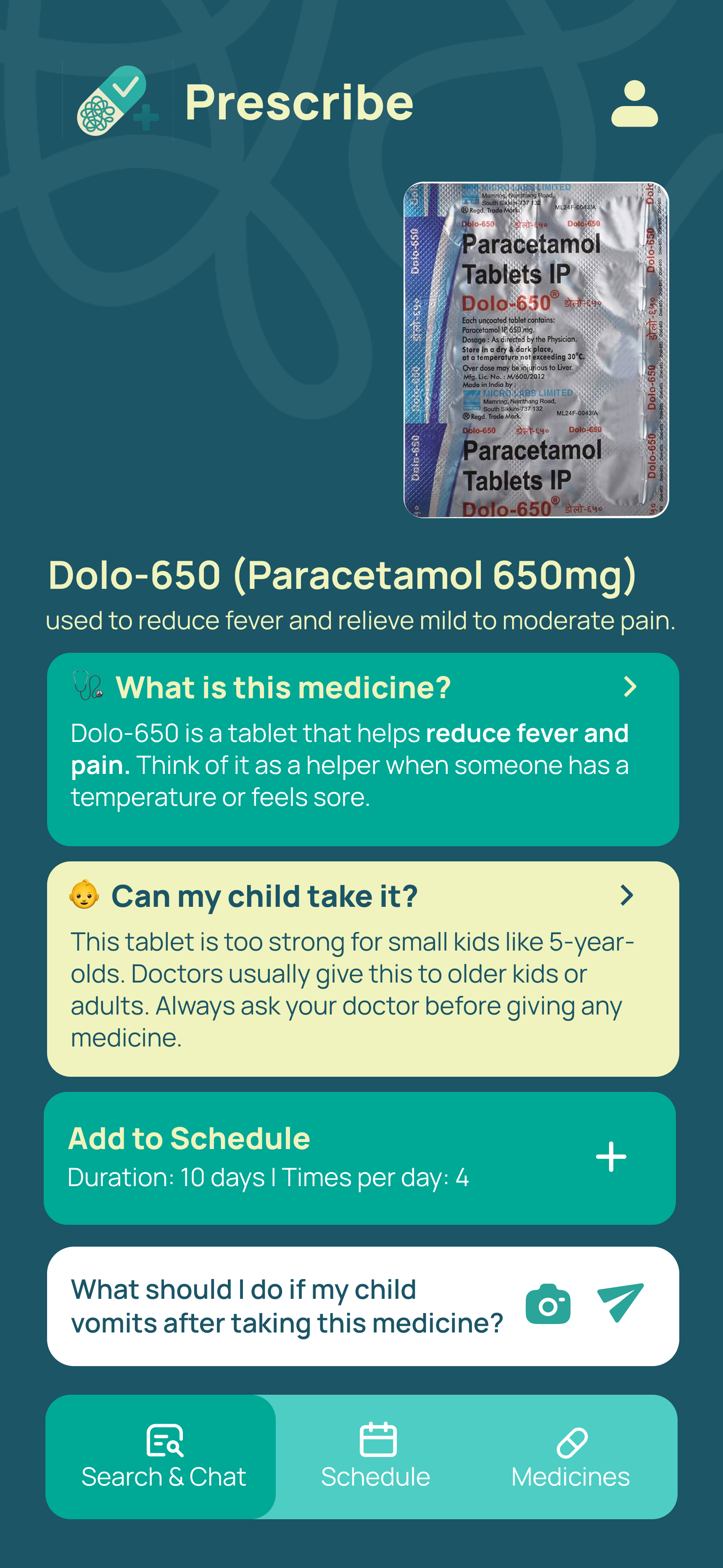
Prescribe lets users click a photo or type a question about any medicine and get a clear, customized explanation in seconds. It tailors responses based on user type (like parent, senior, general public, or medical professional), age, gender, and allergies. It also supports follow-up questions in natural language, so users can continue the conversation naturally. On top of that, it auto-generates a dosage and schedule based on the medicine and user context. No jargon, just clarity.
🛠️ How we built it
We built Prescribe using React and Tailwind CSS for the frontend and FastAPI for the backend. At the core, we used Perplexity’s Sonar API to power intelligent, context-aware medical explanations. We spent significant time crafting prompts to ensure consistent, structured JSON outputs that the frontend could easily parse into dynamic info cards.
⚠️ Challenges we ran into
One of the biggest challenges was maintaining consistent structure in responses, especially across follow-up queries. Ensuring that the language model returned predictable outputs. Regardless of input variation it took multiple iterations of prompt design and testing.
🏆 Accomplishments we're proud of
We’re proud of building a full working app in under a 4 days. In that time, we designed a clean, empathetic interface that works for a wide range of user types. We successfully integrated structured prompt outputs with a responsive frontend and ensured reliable backend communication for real-time results.
📚 What we learned
We learned that structuring language model outputs is critical for bridging AI with real-world UX. Personalization adds significant value and trust, especially when dealing with sensitive topics like healthcare. We also saw how careful design and prompt engineering can simplify a complex problem for everyday users.
🔮 What’s next for Prescribe – Pharma made simple
Our next steps include adding voice input/output to improve accessibility, especially for seniors and visually impaired users. We also plan to add multi-language support to make Prescribe useful in rural and regional areas. Beyond that, we aim to introduce features like side effect warnings, medicine interaction checks, and support for over-the-counter alternatives.
Built With
- fastapi
- mongodb
- perplexity
- react-native
- sonar


Log in or sign up for Devpost to join the conversation.