-
-
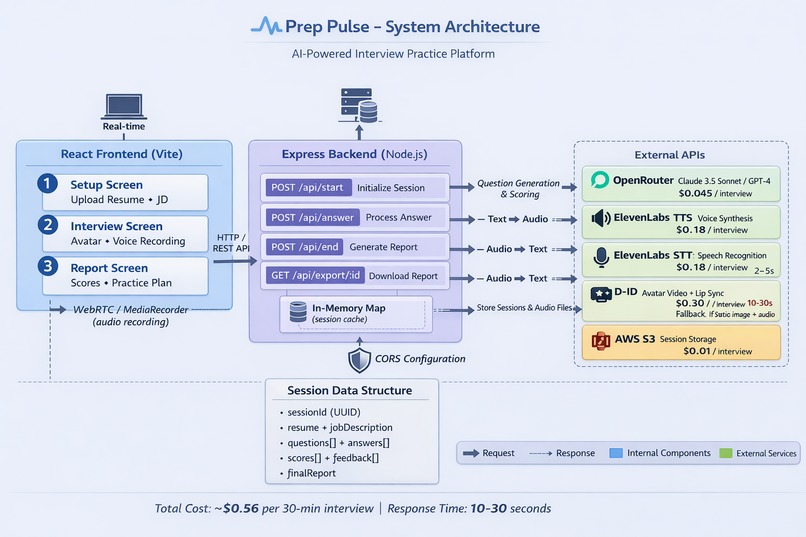
Architechture
Inspiration
High-quality interview preparation is often inaccessible — it’s expensive, time-bound, and dependent on strong professional networks. Many candidates never get the chance to practice speaking their answers out loud in a realistic setting. At the same time, most existing tools rely on text and generic questions that don’t reflect real interviews.
PrepPulse was inspired by the idea that interview practice should be accessible to everyone, anytime. By using voice instead of text and personalising questions based on a user’s resume and role, we aim to make realistic, high-quality interview coaching available to all job seekers.
What it does
PrepPulse is an AI-powered, voice-based interview coach that simulates a realistic interview experience.
Users upload their resume and a target job description. The system analyzes both and conducts a voice-based interview using a talking AI avatar. Questions are personalized to the user’s background, and users respond by speaking naturally.
After each answer, PrepPulse evaluates clarity, depth, relevance, and structure, provides actionable feedback, and adapts the interview flow by asking follow-up questions when needed. At the end, users receive a detailed performance report and a personalized practice plan.
How we built it
PrepPulse is built as a full-stack application designed around a single interview pipeline.
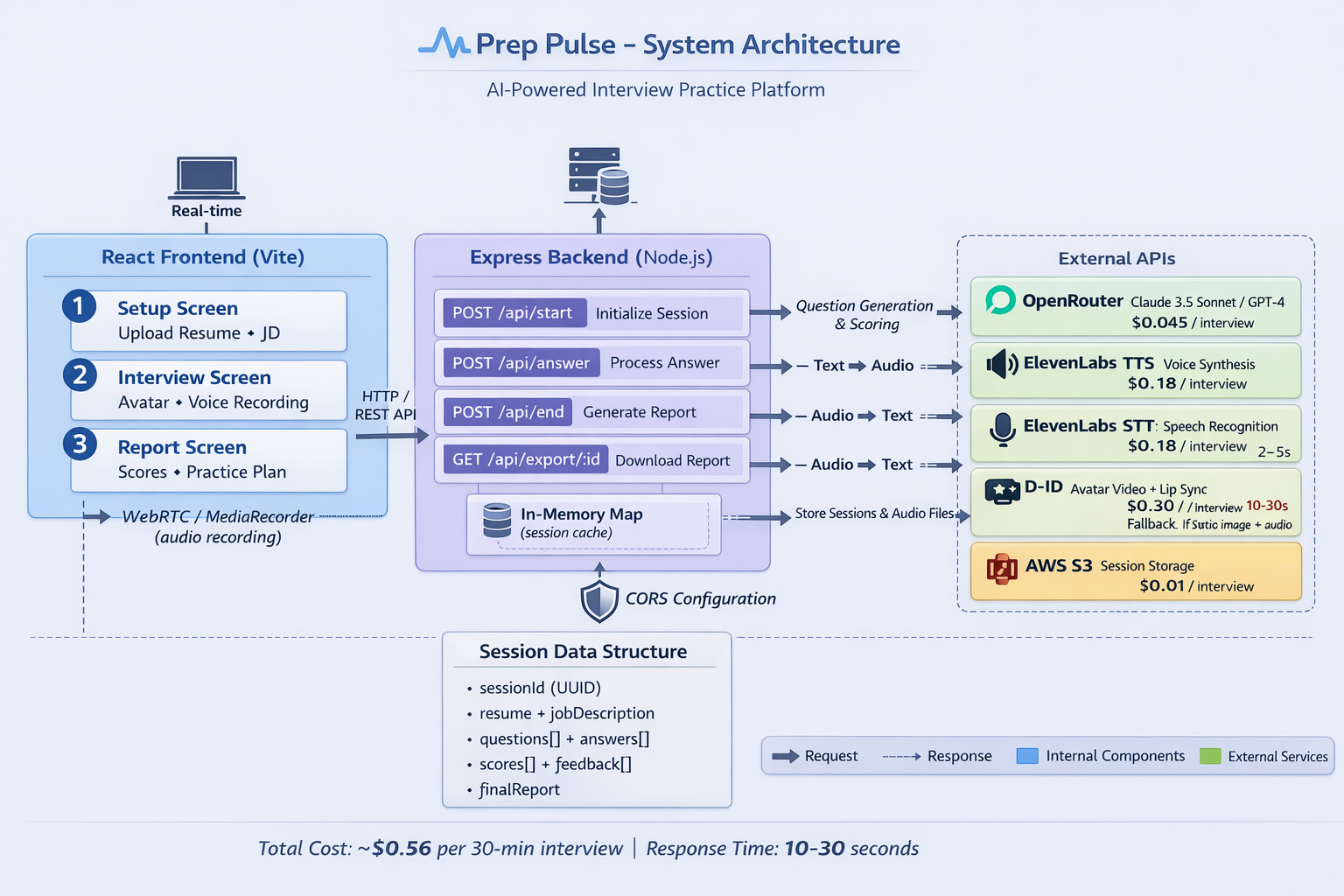
The frontend is built with React and Vite, using browser audio APIs for real-time voice capture and playback. The backend is built with Node.js and Express, coordinating interview state, AI calls, and session flow through a unified pipeline.
Multiple AI services are orchestrated together: a large language model for question generation, scoring, and reports; speech-to-text and text-to-speech for voice interaction; and an avatar service for visual realism. Session data and artifacts are stored using AWS S3.
A key architectural focus was making all components work as part of one continuous, conversational pipeline rather than a set of disconnected steps.
Challenges we ran into
Our biggest challenge was integrating multiple AI services into a single, reliable pipeline. Each step — transcription, reasoning, voice synthesis, and avatar generation — had different response times and failure modes. Early versions felt fragmented and brittle.
Latency was a major issue, especially with avatar generation and chained AI calls. While latency still exists, we significantly reduced it by restructuring the pipeline, parallelising certain operations, pre-generating content where possible, and introducing graceful fallbacks. The experience is now smooth enough to feel conversational rather than broken.
Another major limitation early on was that the model lacked sufficient external and real-world context. This affected question quality and follow-up relevance. We addressed this by switching models, which improved contextual awareness and allowed the system to reason more effectively using broader knowledge from the internet and the job domain.
Solving these challenges required multiple iterations of pipeline design, model selection, and prompt restructuring.
Accomplishments that we're proud of
We successfully integrated multiple AI components into a single end-to-end interview pipeline that works reliably in real time. Despite inherent latency constraints, we reduced delays enough to deliver a usable and realistic interview experience.
We built a system that adapts dynamically to user responses, personalises questions based on real resume content, and continues functioning even when certain services are slow or unavailable. The result is a production-ready MVP that demonstrates both technical depth and practical usability.
What we learned
We learned that the hardest part of building AI applications is not any individual model, but orchestrating multiple systems into one coherent pipeline. Latency management, sequencing, and fallbacks are just as important as model intelligence.
We also learned that model choice matters deeply — switching to a model with better contextual awareness dramatically improved the quality of the interview experience without changing the overall product design.
Finally, we learned that an MVP can still be robust. Even under hackathon constraints, careful architecture decisions can make complex AI systems feel simple to the user.
What's next for PrepPulse
Next, we plan to further reduce latency, especially in avatar generation, and explore streaming or partial-response techniques. We also want to deepen contextual awareness by combining resume data with richer external knowledge sources.
Future improvements include user accounts, session history, industry-specific interviews, mobile optimisations, and real-time feedback during answers. Long term, our goal is to make PrepPulse a widely accessible, reliable standard for interview practice — helping more people prepare confidently, regardless of background.


Log in or sign up for Devpost to join the conversation.